






Fearless, loyal, and built for adventure — an ancient hunting companion with a strong spirit and devoted heart.
🧠 QUICK SNAPSHOT
- Temperament: Loyal, confident, intelligent
- Energy Level: High
- Size: Medium
- Good With Families: Yes
- Trainability: Moderate
- Grooming: Moderate
- Best For: Active families, outdoor enthusiasts, experienced owners
📚 OVERVIEW
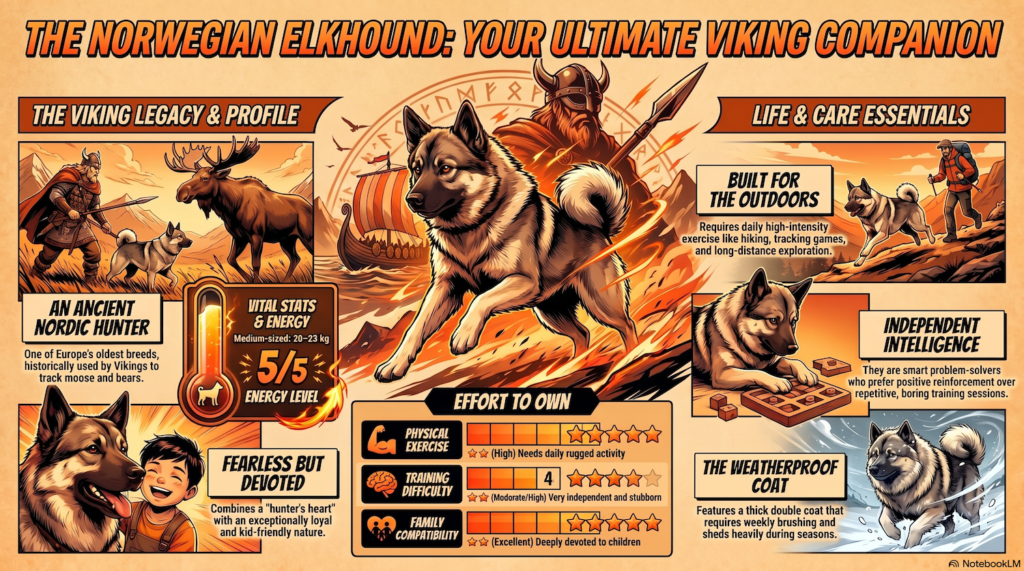
The Norwegian Elkhound is one of the oldest dog breeds in Europe, originally bred by the Vikings to hunt elk, moose, bears, and other large game. With its thick silver-grey coat, curled tail, and fearless nature, this Spitz breed is both a capable working dog and a loyal family companion.
Known for its courage and endurance, the Norwegian Elkhound loves being active and thrives in homes where it can enjoy regular exercise, mental challenges, and close companionship with its family.
✅ PROS & CONS
Pros
- Extremely loyal and devoted
- Brave and confident personality
- Great companion for active families
- Adaptable to cold climates
Cons
- Heavy seasonal shedding
- Can be independent and stubborn
- Needs plenty of daily exercise
- May bark frequently when alerting owners
Is a Norwegian Elkhound a Good Family Dog?
Yes. The Norwegian Elkhound can be a loyal, affectionate, confident and energetic family dog.
Elkhounds typically form strong bonds with their households and enjoy being involved in family life. They’re sturdy, playful and often excellent companions for active families.
However, prospective owners should be prepared for an independent personality, substantial shedding, strong hunting instincts and plenty of barking.
Are Norwegian Elkhounds Good With Children?
Generally, yes.
Their sturdy build and playful temperament can make them good companions for respectful children.
As with every breed, interactions with young children should be supervised, and both dog and child should learn appropriate boundaries.
How Much Exercise Does a Norwegian Elkhound Need?
Most Norwegian Elkhounds need around 60–90 minutes of exercise each day, with active individuals happily doing considerably more.
Walking, hiking, scent work and interactive games are excellent choices.
Mental stimulation is particularly important for a breed developed to think independently while hunting.
Is a Norwegian Elkhound a High-Energy Dog?
Yes.
They’re energetic working dogs with considerable stamina.
An Elkhound doesn’t necessarily need to sprint constantly, but it was developed to travel through difficult Scandinavian terrain for long periods while hunting.
Is a Norwegian Elkhound Easy to Train?
They’re intelligent and capable learners, but aren’t among the most automatically obedient breeds.
Elkhounds were expected to work at considerable distances from hunters and make independent decisions.
Training therefore requires patience, consistency and worthwhile rewards.
Are Norwegian Elkhounds Intelligent?
Very.
Their traditional hunting method required them to locate enormous wild animals, follow them through forests and communicate their position to hunters.
That requires intelligence, persistence and independent problem-solving rather than simply following commands.
Are Norwegian Elkhounds Stubborn?
They can certainly appear stubborn.
Usually, this is better understood as independence.
An Elkhound may understand exactly what you’re asking while simultaneously deciding that the smell disappearing into the forest deserves higher priority.
Are Norwegian Elkhounds Difficult to Toilet Train?
Usually not.
They’re intelligent and generally respond well to consistent routines.
Frequent outdoor opportunities and immediate rewards for correct behaviour are effective with puppies.
Does a Norwegian Elkhound Shed?
Yes — heavily.
The breed has a thick double coat with a dense insulating undercoat.
Seasonal shedding can be spectacular, with large quantities of loose undercoat coming away over a relatively short period.
Is a Norwegian Elkhound Hypoallergenic?
No.
Norwegian Elkhounds shed heavily and produce normal canine allergens.
They’re not a good choice for someone specifically seeking a low-shedding dog.
How Often Should You Groom a Norwegian Elkhound?
Usually at least once or twice each week, increasing considerably during seasonal shedding.
A thorough brushing helps remove loose undercoat before it spreads throughout the house.
Bathing is only required as necessary.
Does a Norwegian Elkhound Need Haircuts?
No.
The natural double coat doesn’t require routine clipping.
Regular brushing is far more important than haircuts.
Should You Shave a Norwegian Elkhound?
Generally, no.
Its double coat provides insulation and protects the skin.
Shaving doesn’t transform a cold-climate breed into a heat-adapted dog and can interfere with normal coat growth.
What Health Problems Are Common in Norwegian Elkhounds?
Potential health concerns include hip dysplasia, eye disorders, renal disease and some inherited neurological or skeletal conditions.
The breed has also historically been associated with renal problems such as familial renal disease in particular lines.
Responsible breeders should use appropriate health screening and maintain detailed family health records.
Are Norwegian Elkhounds Prone to Hip Dysplasia?
Yes, hip dysplasia can occur.
Responsible breeders should evaluate breeding dogs for hip health.
Keeping the dog lean and avoiding inappropriate high-impact exercise during puppy development can also reduce unnecessary stress on the joints.
Are Norwegian Elkhounds Prone to Kidney Problems?
Certain inherited kidney disorders have occurred within Norwegian Elkhound populations.
This is one reason prospective owners should ask breeders about longevity and kidney health within their lines rather than considering only the immediate parents.
Changes in thirst or urination warrant veterinary attention.
Are Norwegian Elkhounds Prone to Eye Problems?
Inherited eye disorders can occur.
Responsible breeding programmes use appropriate ophthalmic screening.
Any deterioration in vision, persistent eye irritation or unusual appearance should be assessed by a veterinarian.
How Long Does a Norwegian Elkhound Live?
Norwegian Elkhounds commonly live around 12–15 years.
That’s a relatively good lifespan for a sturdy medium-sized working dog.
Healthy weight, appropriate exercise and preventive veterinary care can help support longevity.
How Big Does a Norwegian Elkhound Get?
Adult Norwegian Elkhounds generally stand around 49–52 cm at the shoulder and weigh approximately 20–25 kg.
They’re compact and powerfully built rather than particularly tall.
Their dense coat makes them appear substantially larger.
Is There a Miniature Norwegian Elkhound?
No.
There is no recognised Miniature Norwegian Elkhound.
Dogs marketed under that name should be investigated carefully because miniature size isn’t part of the established breed standard.
Is There a Teacup Norwegian Elkhound?
No.
“Teacup Norwegian Elkhound” isn’t a recognised breed or variety.
The breed was developed as a substantial working hunting dog, not for extreme miniaturisation.
Can a Norwegian Elkhound Live in an Apartment?
Potentially, but it’s not the easiest arrangement.
Their physical size is manageable, but exercise requirements and barking can create difficulties.
A highly active owner prepared to provide substantial daily activity may succeed, but more space is generally easier.
Does a Norwegian Elkhound Need a Backyard?
A yard is useful but isn’t a substitute for proper exercise.
If one is available, it should be securely fenced.
A hunting dog following an interesting scent can become remarkably motivated to explore beyond property boundaries.
Are Norwegian Elkhounds Escape Artists?
They can be.
Strong hunting instincts, curiosity and independence can encourage roaming.
Secure fencing is extremely important, and gates should never be treated casually.
Can a Norwegian Elkhound Be Left Alone?
Adult Elkhounds can learn to tolerate reasonable periods alone.
However, they’re social dogs that generally prefer being part of household life.
Long periods without exercise, companionship or stimulation can result in barking and destructive behaviour.
Are Norwegian Elkhounds Prone to Separation Anxiety?
Some can be.
They’re strongly attached to their families, although many retain considerable independence.
Gradual alone-time training from puppyhood is beneficial.
Are Norwegian Elkhounds Velcro Dogs?
Some are extremely devoted without behaving like conventional lap dogs.
An Elkhound may want to know where its owner is while still maintaining a degree of independence.
They’re often best described as loyal companions rather than permanently dependent shadows.
Are Norwegian Elkhounds Cuddly?
Many are affectionate and enjoy physical contact.
However, individuals vary, and their thick coats can make prolonged cuddling rather warm.
Some prefer lying nearby where they can monitor the household.
Are Norwegian Elkhounds Good With Other Dogs?
Generally, with appropriate socialisation.
Some can be confident or assertive around unfamiliar dogs.
Early positive experiences and responsible management are important.
Are Norwegian Elkhounds Good With Cats?
They can live successfully with cats, particularly when raised together.
However, their hunting instincts are significant.
A familiar household cat may be treated very differently from an unfamiliar running animal outdoors.
Can Norwegian Elkhounds Live With Rabbits or Guinea Pigs?
Considerable caution is required.
Elkhounds are hunting dogs with strong instincts toward wildlife.
Small pets should be securely separated rather than assuming that familiarity will eliminate prey drive.
Do Norwegian Elkhounds Have a Strong Prey Drive?
Yes.
This is an important breed characteristic.
Elkhounds were developed to locate and pursue game across difficult terrain, so movement, scent and wildlife can trigger powerful hunting behaviour.
Are Norwegian Elkhounds Good Off Leash?
They can be challenging.
A well-trained Elkhound may develop good recall until an exciting wildlife scent appears.
Secure fenced areas are generally the safest places for unrestricted running.
Do Norwegian Elkhounds Bark a Lot?
Yes.
The Norwegian Elkhound is naturally very vocal.
Barking wasn’t merely tolerated historically — it was an essential part of how the dog communicated with hunters.
Why Is My Norwegian Elkhound So Vocal?
Because barking is built into its traditional hunting method.
After locating game, an Elkhound could use repeated barking to keep the animal’s attention and tell the distant hunter exactly where the action was occurring.
Humans deliberately valued dogs that communicated effectively with their voices.
Can You Train a Norwegian Elkhound Not to Bark?
You can reduce unnecessary barking, but expecting complete silence is unrealistic.
Teaching a reliable quiet cue, rewarding calm behaviour and providing sufficient exercise can help.
The breed’s natural tendency toward vocal communication remains strong.
Are Norwegian Elkhounds Good Watchdogs?
Excellent.
They’re naturally alert and quick to announce unfamiliar activity.
Their distinctive bark makes them effective alarm dogs.
Are Norwegian Elkhounds Good Guard Dogs?
They’re courageous and protective but aren’t primarily specialist protection dogs.
Their traditional role relied heavily on alerting and hunting rather than controlled human-directed aggression.
Their confidence and substantial bark can nevertheless make them an effective deterrent.
Are Norwegian Elkhounds Aggressive?
Aggression toward people shouldn’t be characteristic of a well-bred Elkhound.
They should be confident, courageous and steady.
Poor breeding, fear, inadequate socialisation or inappropriate handling can still create behavioural problems.
Are Norwegian Elkhounds Friendly With Strangers?
Many are initially reserved or alert rather than immediately enthusiastic.
Once someone is accepted, they can become friendly.
Early socialisation helps ensure natural watchfulness doesn’t develop into unnecessary suspicion.
When Does a Norwegian Elkhound Calm Down?
Many become noticeably more settled between two and three years old.
However, they remain energetic working dogs throughout much of adulthood.
Even older Elkhounds often retain considerable enthusiasm for outdoor exploration.
Do Norwegian Elkhounds Get the Zoomies?
Yes.
A compact 20-plus-kilogram Nordic hunting dog moving through the house at maximum speed can be surprisingly impressive.
Fortunately, adequate outdoor exercise usually reduces the frequency of unscheduled indoor expeditions.
Are Norwegian Elkhounds Fast?
They’re quick, agile and extremely persistent.
Raw sprinting speed wasn’t as important as the ability to travel efficiently across rough terrain while tracking game.
Their greatest athletic asset is often endurance rather than maximum speed.
Are Norwegian Elkhounds Good Walking Dogs?
Yes.
They’re excellent companions for active walkers.
Regular walks should include opportunities to sniff and explore rather than requiring the dog to march continuously at heel.
Are Norwegian Elkhounds Good Hiking Dogs?
Excellent.
Their endurance, strong feet and Scandinavian working heritage make hiking one of the most natural activities for the breed.
Wildlife and recall need careful management.
Are Norwegian Elkhounds Good Running Dogs?
Healthy, mature Elkhounds can enjoy running with properly conditioned owners.
Cool conditions suit them best.
Long runs during warm weather should be avoided because of their dense coat.
Can Norwegian Elkhounds Swim?
Many can swim competently.
They’re not specialised water retrievers, so enthusiasm varies between individuals.
Supervision remains sensible around deep or moving water.
Do Norwegian Elkhounds Like Snow?
Usually.
Their thick double coat and Nordic heritage make them exceptionally well adapted to cold conditions.
Many appear thoroughly comfortable exercising and playing in snow.
Do Norwegian Elkhounds Get Cold Easily?
Generally, no.
Their dense undercoat provides excellent insulation.
They’re much more naturally suited to Norwegian winters than hot climates.
Can Norwegian Elkhounds Handle Hot Weather?
Heat requires careful management.
Exercise should occur during cooler periods, particularly during Australian summers.
Shade, constant fresh water and cool indoor environments are important, and strenuous activity should be avoided in extreme heat.
What Does a Norwegian Elkhound Look Like?
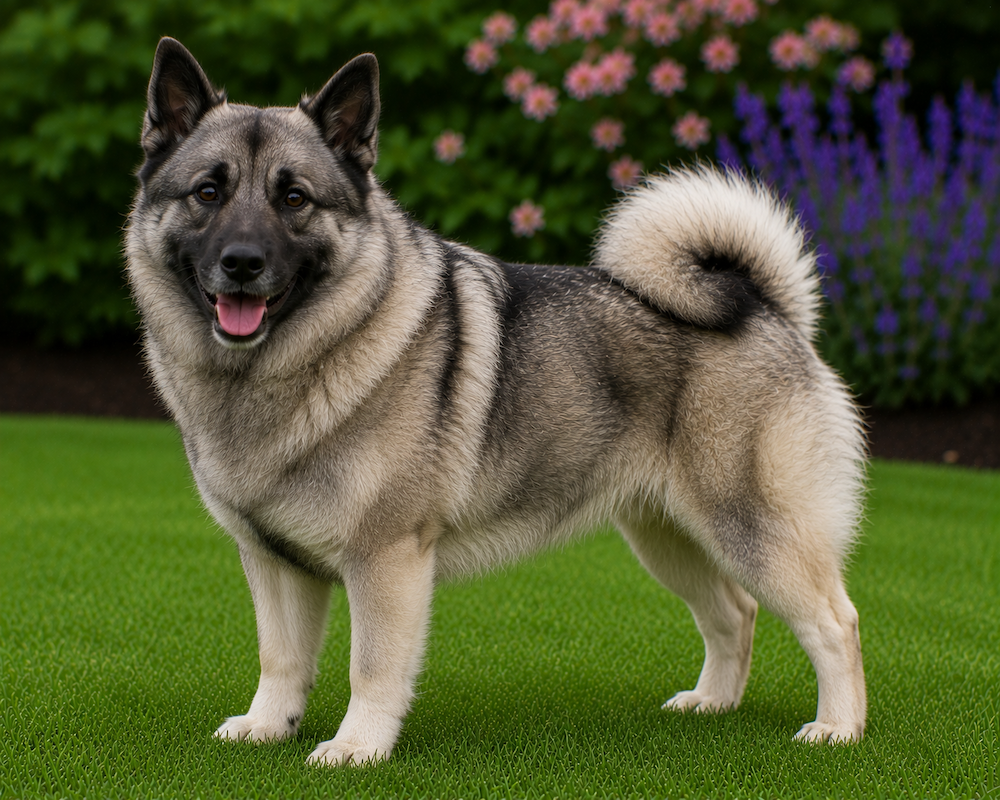
The Norwegian Elkhound is a compact, squarely built Nordic Spitz with erect ears, a broad wedge-shaped head, dense grey double coat and tightly curled tail carried over the back.
Its appearance is powerful without being heavy.
The overall impression is of a hardy dog designed for difficult terrain and cold weather.
Why Does a Norwegian Elkhound Have a Curled Tail?
A tightly curled tail carried over the back is characteristic of the breed and many other Nordic Spitz dogs.
It contributes to the Elkhound’s classic northern appearance.
Tail carriage also helped preserve the compact, functional Spitz silhouette selected over generations.
Why Does a Norwegian Elkhound Have Pointed Ears?
Its erect ears provide excellent sound localisation and contribute to the breed’s alert expression.
For a hunting dog working through forest and wilderness, detecting distant movement and sound was extremely useful.
What Colour Is a Norwegian Elkhound?
The classic Norwegian Elkhound is grey with black-tipped hairs and darker shading, particularly around the muzzle and ears.
The undercoat is lighter.
The combination produces the breed’s distinctive wolf-grey appearance.
Can a Norwegian Elkhound Be Black?
This is where breed names can become confusing.
The familiar Norwegian Elkhound is grey, but there is also a distinct Scandinavian breed commonly known as the Black Norwegian Elkhound.
It isn’t simply a black colour variation of the standard grey Norwegian Elkhound.
What Is a Black Norwegian Elkhound?
The Black Norwegian Elkhound, or Norsk Elghund Sort, is a distinct Norwegian hunting breed.
It’s generally smaller and lighter than the Grey Norwegian Elkhound and has a solid black coat.
Both were developed for Scandinavian hunting, but they are separate breeds rather than colour varieties.
Can a Norwegian Elkhound Be White?
White isn’t a standard colour for the Grey Norwegian Elkhound.
The characteristic coat is grey with darker markings and lighter areas.
A predominantly white dog wouldn’t represent the traditional breed standard.
Can a Norwegian Elkhound Be Merle?
No.
Merle isn’t a traditional Norwegian Elkhound colour.
A merle dog marketed as a purebred Norwegian Elkhound should raise questions about ancestry.
Is a Norwegian Elkhound a Spitz?
Yes.
The Norwegian Elkhound belongs to the Nordic Spitz family.
Its erect ears, dense double coat, curled tail, cold-weather adaptation and independent working temperament are classic Spitz characteristics.
Is a Norwegian Elkhound a Husky?
No.
Both are northern Spitz-type dogs, but they were developed for very different jobs.
Siberian Huskies specialised in pulling sleds, while Norwegian Elkhounds were primarily hunting dogs.
Is a Norwegian Elkhound Related to the Norwegian Buhund?
Yes, broadly through their Nordic Spitz heritage, but they’re distinct breeds.
The Buhund developed primarily as a farm and herding dog, whereas the Elkhound became a specialist big-game hunting dog.
Their histories explain many of their behavioural differences.
Is a Norwegian Elkhound Related to the Swedish Elkhound?
They’re related Nordic hunting breeds but aren’t the same dog.
The Swedish Elkhound, or Jämthund, is generally larger and has its own recognised breed history.
Both were developed for demanding Scandinavian big-game hunting.
Is a Norwegian Elkhound Related to the Finnish Spitz?
They’re part of the wider Nordic Spitz family.
However, the Finnish Spitz became particularly associated with hunting birds and smaller game using a distinctive barking hunting style, while the Norwegian Elkhound became famous for pursuing much larger quarry.
What Does “Elkhound” Mean?
The English name can be misleading.
The Norwegian name Norsk Elghund essentially means Norwegian moose dog.
In Norwegian, elg refers to the animal English speakers generally call a moose.
Does a Norwegian Elkhound Hunt Elk or Moose?
Historically, primarily moose in the North American sense of that word.
The naming confusion comes from differences between European and North American English.
The enormous deer called elg in Norwegian is moose in North American English and traditionally elk in British usage.
Why Is It Called an Elkhound Instead of a Moosehound?
Because the English breed name reflects older British usage of elk for the large animal known in North America as a moose.
So “Norwegian Elkhound” sounds slightly misleading to many modern readers, but historically the translation makes sense.
Where Does the Norwegian Elkhound Come From?
The Norwegian Elkhound comes from Norway, where dogs of its general Nordic Spitz type were used for hunting in challenging Scandinavian environments.
The modern breed was later standardised from these longstanding Norwegian hunting-dog traditions.
It remains one of Norway’s most internationally recognisable native breeds.
What Was the Norwegian Elkhound Originally Bred For?
Its most famous historical role was hunting moose and other large game.
Elkhounds were also used in connection with animals such as bear and could perform broader hunting and watchdog functions.
Their courage is remarkable considering the size of the animals they were expected to confront.
How Does a Norwegian Elkhound Hunt Moose?
One traditional method involves locating a moose and keeping it occupied through movement and persistent barking.
The dog avoids dangerous attacks while staying close enough to hold the animal’s attention.
Its barking allows the hunter to approach through the forest.
Does a Norwegian Elkhound Actually Attack Moose?
Its primary job isn’t simply to charge and fight the animal.
That would be extraordinarily dangerous.
A skilled loose-working Elkhound uses agility, positioning and barking to keep the moose engaged while avoiding its hooves and antlers.
Why Does a Norwegian Elkhound Bark at Moose?
The barking serves two important purposes.
It helps keep the moose’s attention focused on the dog while also telling the hunter where the animal has been located.
In dense forest, the hunter may hear the dog long before seeing either dog or moose.
What Is Loose-Dog Moose Hunting?
In one traditional method, the Elkhound searches independently for moose.
Once it finds one, it works around the animal while barking continuously, allowing the hunter to approach by following the sound.
This requires enormous independence and judgement from the dog.
What Is Leashed Elkhound Hunting?
Another Scandinavian method involves working a dog on a long lead or tracking leash.
The dog uses scent to quietly locate game while leading the hunter toward it.
This places different demands on the dog than the classic barking loose-dog method.
Were Norwegian Elkhounds Used to Hunt Bears?
Yes.
Elkhound-type dogs have historically been associated with hunting bear as well as moose and other game.
Their courage and persistence allowed them to work around animals many times their own size.
Were Norwegian Elkhounds Used to Hunt Wolves?
Nordic hunting dogs have historically encountered and sometimes been used in hunting contexts involving wolves.
However, the Norwegian Elkhound’s defining traditional role is much more strongly associated with moose hunting.
Were Norwegian Elkhounds Used to Hunt Reindeer?
Dogs of the broader Scandinavian hunting tradition could be used around various game species.
However, the Elkhound’s international reputation is overwhelmingly connected with moose and other large forest game rather than specialised reindeer hunting.
Is the Norwegian Elkhound an Ancient Breed?
The Nordic hunting-dog tradition behind the breed is extremely old, but the modern registered Norwegian Elkhound was standardised much later.
Archaeological finds demonstrate that Spitz-like dogs lived with people in ancient Scandinavia.
It would be an overstatement to claim that today’s pedigree Elkhound has remained unchanged for thousands of years.
Did Vikings Have Norwegian Elkhounds?
Viking Age Scandinavians certainly kept hunting and working dogs, including northern Spitz-type dogs resembling the broader ancestry of modern Nordic breeds.
Dogs accompanied people in daily life, hunting and travel.
However, it isn’t possible to identify every Viking-era Spitz as a modern purebred Norwegian Elkhound.
Have Elkhound-Like Dogs Been Found in Ancient Graves?
Dog remains have been discovered at ancient Scandinavian archaeological sites and burials.
Some show characteristics broadly associated with northern Spitz-type dogs.
These finds demonstrate deep historical continuity of Nordic dog types, although they don’t provide a direct modern pedigree.
Is the Norwegian Elkhound Really 6,000 Years Old?
Claims that the breed itself is exactly 5,000 or 6,000 years old should be treated cautiously.
Ancient dog remains and prehistoric Nordic dog populations certainly existed.
But a modern standardised breed isn’t genetically identical to every ancient dog that happens to resemble it.
It’s more accurate to say the Elkhound descends from an ancient Scandinavian working-dog tradition.
Were Dogs Important in Norse Culture?
Yes.
Dogs served as hunters, guardians, farm workers and companions.
Archaeological burials and Norse literature show that dogs could also have symbolic significance.
The ancestors of Nordic breeds developed within a society where useful dogs were highly valuable animals.
Did Norwegian Elkhounds Travel With Vikings?
Spitz-type dogs certainly travelled with Scandinavian people, and dogs accompanied Norse settlement and exploration.
However, saying that modern registered Norwegian Elkhounds sailed on Viking longships would project a modern breed identity backwards into an era before it formally existed.
How Was the Modern Norwegian Elkhound Standardised?
During the 19th century, dog exhibitions and organised breeding began transforming Norway’s traditional hunting dogs into formally documented breeds.
Breeders selected dogs that represented the desired hunting ability, appearance and temperament.
This eventually produced the modern pedigree Norwegian Elkhound.
When Did Norwegian Elkhounds First Appear at Dog Shows?
Norwegian hunting dogs of this type appeared at Scandinavian dog exhibitions during the late 19th century.
These early shows helped breeders establish a more consistent standard and distinguish related Nordic hunting populations.
When Was the Norwegian Elkhound Recognised in Britain?
The breed became established in Britain during the early 20th century as Scandinavian dogs attracted increasing international interest.
British enthusiasts helped promote the breed beyond Norway.
Its unusual combination of wolf-like appearance and friendly temperament attracted considerable attention.
When Did the AKC Recognise the Norwegian Elkhound?
The American Kennel Club recognised the Norwegian Elkhound in 1913.
The breed is placed in the Hound Group in the United States.
Its hunting technique is quite different from that of many familiar scent and sight hounds.
Is the Norwegian Elkhound Norway’s National Dog?
The Norwegian Elkhound is commonly described as the national dog of Norway and is one of the country’s most recognisable native breeds.
Its strong association with Norwegian hunting culture and history makes that description understandable.
Why Is the Norwegian Elkhound So Closely Associated With Norway?
Few breeds reflect their native environment so clearly.
Its dense coat suits the Scandinavian climate, its stamina suits difficult forest terrain, and its hunting technique evolved around Norway’s large game.
Even its original name essentially describes it as Norway’s moose dog.
Are Norwegian Elkhounds Still Used to Hunt Moose?
Yes.
Elkhound-type dogs continue to be used in Scandinavian moose hunting.
Modern hunting tests also help preserve the behavioural characteristics that originally defined the breed.
How Can Such a Small Dog Hunt a Moose?
Because the Elkhound isn’t expected to overpower the moose.
A mature moose can weigh many hundreds of kilograms and would be extraordinarily dangerous in direct combat.
The dog’s weapons are agility, courage, persistence, judgement and its voice.
How Close Does a Norwegian Elkhound Get to a Moose?
A skilled hunting dog must remain close enough to hold the animal’s attention while avoiding kicks and charges.
The precise distance constantly changes as dog and moose move.
Successful work requires remarkable judgement because one mistake around an animal of that size can be fatal.
Why Doesn’t a Moose Simply Chase the Elkhound Away?
Sometimes it tries.
The dog’s agility allows it to evade charges while repeatedly returning and barking.
The goal is to keep the animal occupied and relatively localised long enough for the hunter to approach.
Are Norwegian Elkhounds Fearless?
They’re renowned for courage, but “fearless” shouldn’t mean reckless.
A good hunting dog survives by understanding danger and responding intelligently.
The impressive part isn’t simply approaching a moose — it’s approaching one repeatedly without getting stepped on.
Do Norwegian Elkhounds Have a Good Sense of Smell?
Excellent.
Locating game in enormous forested areas requires powerful scenting ability.
Scent work can therefore be an excellent modern activity for pet Elkhounds.
How Far Can a Norwegian Elkhound Travel While Hunting?
Traditional hunting can require dogs to cover substantial distances over rough terrain.
Exact distances vary enormously according to landscape and hunting method.
The important characteristic is endurance: these dogs were selected to keep working long after a casual walk would have ended.
Why Does My Norwegian Elkhound Pull on the Lead?
Moving ahead and following scent is extremely natural for a hunting breed developed to work independently.
Loose-lead walking therefore needs deliberate training.
A front-clip harness or other appropriate equipment can help during the training process, but it doesn’t replace teaching the behaviour.
Why Does My Norwegian Elkhound Ignore Me When It Smells Something?
Scent can activate generations of hunting instinct.
The dog isn’t necessarily being deliberately disobedient; its attention has shifted to something its genetics consider extremely important.
This is why recall training needs exceptionally strong reinforcement.
Why Does My Norwegian Elkhound Chase Wildlife?
Pursuing game is fundamental to its history.
Birds, deer, rabbits and other animals can activate those instincts even when the dog has never hunted professionally.
Secure management remains important throughout the dog’s life.
Why Does My Norwegian Elkhound Patrol the Yard?
Elkhounds combine hunting awareness with natural watchdog behaviour.
Monitoring movement, smells and sounds around the property can be deeply rewarding.
A backyard can therefore become a surprisingly serious surveillance assignment.
Why Does My Norwegian Elkhound Follow Me Everywhere?
They’re strongly attached to their families despite their independent working style.
Historically, the dog needed to work independently while maintaining a partnership with the hunter.
Modern Elkhounds often preserve exactly that balance: independent enough to have their own plans, loyal enough to want their person nearby.
Why Does My Norwegian Elkhound Curl Its Tail Over Its Back?
The tightly curled tail is part of its Nordic Spitz anatomy.
It isn’t usually a sign of excitement or tension by itself.
The characteristic carriage is simply how the breed’s tail naturally sits.
Why Does My Norwegian Elkhound Make So Many Different Noises?
Vocal communication has been deliberately useful to this breed for generations.
Beyond barking, some individuals develop an impressive collection of whines, grumbles and other sounds.
Living with an Elkhound can occasionally feel less like owning a dog and more like subscribing to a Nordic commentary service.
Are Norwegian Elkhounds Good at Agility?
Yes.
They’re athletic, intelligent and capable of performing very well in agility.
Their independent nature means motivation and training style matter.
Are Norwegian Elkhounds Good at Scent Work?
Excellent.
Scent work is particularly appropriate because it uses abilities closely related to their historical purpose.
Searching games can also provide valuable mental exercise when outdoor activity is limited.
Are Norwegian Elkhounds Good at Obedience?
They can perform very well.
However, they’re not generally bred for the intense handler focus seen in some modern obedience breeds.
Success comes from making cooperation rewarding rather than trying to eliminate their independent nature.
Are Norwegian Elkhounds Good Therapy Dogs?
Calm, well-socialised individuals can potentially succeed in therapy work.
Their affectionate temperament can be an advantage.
Heavy shedding and vocal behaviour may make some individuals less suited to particular environments.
Is a Norwegian Elkhound a Good Dog for Older People?
Potentially, for active older owners.
Their medium size is manageable compared with giant breeds, but their exercise requirements, strength and prey drive shouldn’t be underestimated.
They’re not ideal for someone wanting a quiet, low-energy companion.
Is a Norwegian Elkhound a Good First Dog?
It can be, provided the owner understands what they’re getting.
The breed is intelligent, affectionate and robust, but first-time owners need to manage heavy shedding, barking, strong prey drive, substantial exercise and independent decision-making.
What Makes the Norwegian Elkhound Unique?
The Norwegian Elkhound looks like a medium-sized grey Spitz.
That description gives absolutely no indication of what this dog was actually expected to do.
Its traditional opponent was a moose.
A large bull moose can weigh several hundred kilograms and carries antlers capable of causing devastating injuries. The Elkhound, meanwhile, weighs roughly 20–25 kilograms.
Yet the dog wasn’t expected to overpower its quarry.
It had a much cleverer job.
The Elkhound searched enormous areas of Scandinavian forest, located the animal, then used agility, persistence and repeated barking to keep it occupied while simultaneously broadcasting its location to a hunter who might still be far away.
The dog had to get close enough to maintain the moose’s attention but remain agile enough to avoid being kicked or charged.
That helps explain almost everything about the modern Norwegian Elkhound.
Why does it follow scents?
Because finding game was its job.
Why is it independent?
Because the hunter couldn’t constantly tell it what to do.
Why does it have extraordinary stamina?
Because Scandinavian forests are enormous.
Why does it bark?
Because for generations, the bark was effectively the hunter’s GPS.
And why does a 22-kilogram dog sometimes behave as though very little in the world could possibly intimidate it?
Because somewhere in its history, humans looked at a dog roughly the size of a Border Collie, pointed toward an animal weighing half a tonne and said:
“Go find that — and keep it there until I arrive.”