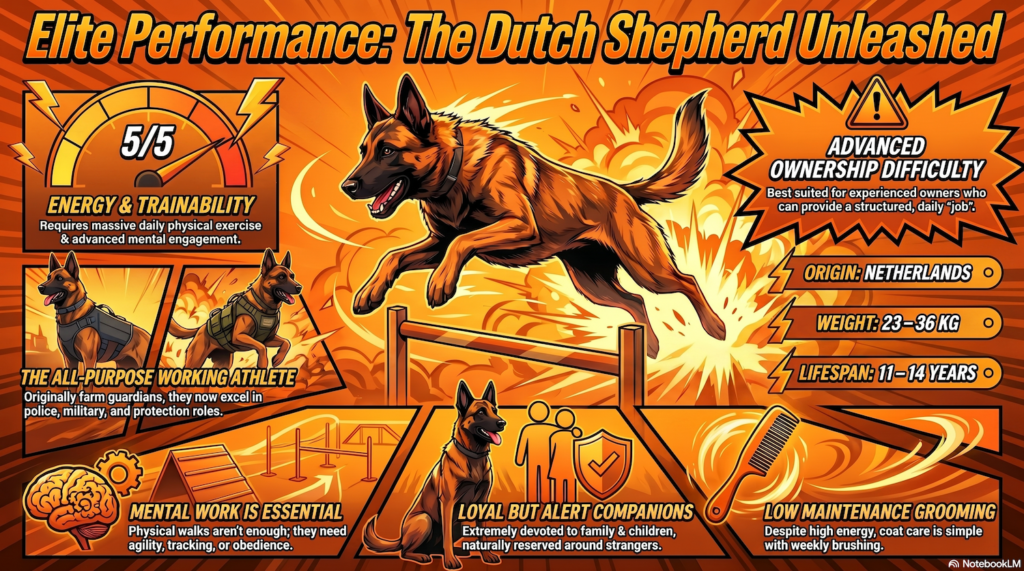







Intelligent, athletic, and incredibly loyal — a versatile working dog that excels with active families and experienced owners.
🧠 QUICK SNAPSHOT
- Temperament: Intelligent, loyal, alert
- Energy Level: Very high
- Size: Large
- Good With Families: Yes
- Trainability: Very high
- Grooming: Low to moderate
- Best For: Active families, working homes, experienced owners
📚 OVERVIEW
The Dutch Shepherd is a highly versatile working breed developed in the Netherlands to herd livestock and assist farmers with a wide range of tasks. Today, the breed is highly regarded for police work, military service, search and rescue, and canine sports thanks to its intelligence, athleticism, and exceptional work ethic.
Despite its impressive working ability, the Dutch Shepherd is a loyal and affectionate family companion that thrives when given plenty of exercise, training, and a meaningful job to do.
✅ PROS & CONS
Pros
- Exceptionally intelligent and trainable
- Loyal and devoted to family
- Highly athletic and versatile
- Excellent working and sporting dog
Cons
- Very high exercise requirements
- Needs constant mental stimulation
- Can become destructive if bored
- Best suited to experienced owners
Is a Dutch Shepherd a Good Family Dog?
Yes. A well-bred, properly socialised Dutch Shepherd can be an excellent family dog, particularly for active and experienced households.
Dutch Shepherds are intelligent, loyal and strongly bonded to their people. However, they’re genuine working dogs with substantial physical and mental needs.
Families wanting a relaxed dog requiring only casual walks may find the breed overwhelming. A Dutch Shepherd generally thrives when given training, exercise and meaningful activities.
How Much Exercise Does a Dutch Shepherd Need?
Most adult Dutch Shepherds need around 90 minutes to two hours of substantial daily exercise, often combined with significant mental work.
Running, hiking, obedience, tracking, scent work, agility and structured games are excellent outlets.
Simply exhausting the dog physically isn’t enough. Dutch Shepherds were bred to think and work independently, so they also need tasks that engage their brains.
Is a Dutch Shepherd Easy to Train?
Yes. Dutch Shepherds are exceptionally intelligent and highly trainable, particularly in experienced hands.
They learn quickly and can excel in advanced obedience, protection sports, detection work and numerous dog sports.
Positive reinforcement combined with clear, consistent boundaries generally works well.
Their intelligence and drive mean they also notice inconsistencies remarkably quickly.
Does a Dutch Shepherd Shed?
Yes. Dutch Shepherds shed, although the amount depends partly on coat variety.
Shorthaired Dutch Shepherds have dense undercoats and can shed heavily seasonally.
Longhaired dogs also shed substantially.
Roughhaired Dutch Shepherds have different grooming requirements and are usually hand-stripped periodically rather than simply brushed like the other varieties.
Is a Dutch Shepherd Hypoallergenic?
No. The Dutch Shepherd isn’t considered hypoallergenic.
All three coat varieties produce allergens through skin, saliva and dander.
Short hair doesn’t mean low shedding either.
Anyone with significant dog allergies should spend time around the breed before considering ownership.
What Health Problems Are Common in Dutch Shepherds?
Dutch Shepherds are generally considered relatively robust working dogs, but potential concerns include hip dysplasia, elbow dysplasia and certain eye conditions.
Some inherited disorders are associated particularly with specific coat varieties or breeding lines.
Responsible breeders should perform appropriate health screening rather than relying on the breed’s reputation for toughness.
How Long Do Dutch Shepherds Live?
Dutch Shepherds commonly live around 11–14 years, with some living longer.
Genetics, breeding line, body condition, exercise and veterinary care all influence longevity.
Maintaining a lean, well-muscled working dog is preferable to allowing excessive weight gain.
How Big Does a Dutch Shepherd Get?
Dutch Shepherds are medium-to-large athletic dogs.
Adults generally stand around 55–62 cm at the shoulder, with males typically somewhat larger than females.
Weight commonly falls somewhere around 23–32 kg, although working lines and individual dogs vary.
They should appear strong and muscular without becoming excessively heavy.
Can a Dutch Shepherd Live in an Apartment?
Technically yes, but the Dutch Shepherd’s energy and working drive can make apartment living challenging.
A well-exercised Dutch Shepherd may settle calmly indoors.
An under-stimulated one can become restless, vocal or destructive regardless of how large the home is.
For this breed, lifestyle matters considerably more than floor space.
Can a Dutch Shepherd Be Left Alone?
Adult Dutch Shepherds can learn to spend reasonable periods alone, but they’re generally strongly bonded working dogs.
They shouldn’t routinely be isolated for long days with nothing to do.
Boredom can result in destructive behaviour, barking or attempts to create their own entertainment.
Gradual independence training from puppyhood is valuable.
Do Dutch Shepherds Bark a Lot?
Dutch Shepherds can be alert and vocal, particularly when something unusual occurs around their territory.
Their historical farm work included guarding and monitoring livestock and property.
Excessive barking isn’t inevitable.
Training, exercise and adequate mental stimulation can make a substantial difference.
Are Dutch Shepherds Protective?
Yes. Dutch Shepherds often possess natural protective and territorial instincts.
They were historically expected to guard farms and livestock as part of their versatile working role.
Modern working lines are also used in police, military and protection work.
For family dogs, training should emphasise stability, socialisation and control rather than deliberately increasing suspicion or aggression.
Is a Dutch Shepherd a Good Guard Dog?
Yes. Dutch Shepherds can be excellent watchdogs and capable guardians.
They’re alert, intelligent, athletic and strongly attached to their handlers.
However, most families don’t need specialised protection training.
A confident, well-trained Dutch Shepherd already provides a substantial deterrent without being taught to treat ordinary visitors as threats.
Are Dutch Shepherds Aggressive?
Dutch Shepherds aren’t inherently indiscriminately aggressive.
A well-bred dog should be confident, responsive and controllable.
However, strong working drive, guarding instincts and physical ability mean poor breeding, inadequate socialisation or inappropriate training can create serious problems.
Temperament should be a major consideration when choosing a breeder.
Are Dutch Shepherds Good With Children?
Dutch Shepherds can be excellent with children in their family when properly raised and socialised.
However, they’re energetic, fast and physically powerful.
Herding behaviour may also produce chasing or attempts to control running children.
Supervision and early training are particularly important with young children.
Are Dutch Shepherds Good With Other Dogs?
Many Dutch Shepherds live successfully with other dogs, particularly when well socialised.
However, dog selectivity can occur, especially in high-drive working lines.
Compatibility depends on sex, temperament, socialisation and individual history.
Early social exposure should teach calm behaviour rather than simply encouraging uncontrolled play with every dog encountered.
Are Dutch Shepherds Good With Cats?
Dutch Shepherds can live with cats, especially when raised alongside them, but prey and chase drive can be substantial.
A familiar household cat may be accepted while unfamiliar cats or wildlife still trigger pursuit.
Introductions should be carefully controlled.
High-drive individuals may require ongoing management around small animals.
Do Dutch Shepherds Have a Strong Prey Drive?
Many do.
Prey and chase drive have been useful in modern police, military and dog-sport breeding, while historical farm dogs also needed quick reactions to moving livestock.
Intensity varies considerably between lines.
A working-line Dutch Shepherd may show dramatically more drive than a dog bred primarily for companionship or conformation.
Do Dutch Shepherds Have a Strong Herding Instinct?
Yes. Herding was one of the breed’s original major jobs.
Dutch Shepherds moved and controlled sheep, prevented livestock from entering crops and accompanied flocks between grazing areas.
Some modern dogs retain strong tendencies to chase, circle or control movement.
Structured herding or dog sports can provide useful outlets.
Why Does My Dutch Shepherd Nip at Heels?
Heel nipping can reflect herding behaviour, particularly in young or highly stimulated dogs.
Historically, controlling livestock sometimes involved using movement and physical pressure.
However, nipping people shouldn’t simply be accepted as “what shepherds do.”
Training can redirect these instincts into appropriate activities.
Are Dutch Shepherds Good Off Leash?
They can be excellent off-leash dogs when thoroughly trained.
Their handler focus and intelligence can produce outstanding recall.
However, high prey drive can override training if recall hasn’t been carefully proofed.
Long lines and secure areas are useful while building reliability around wildlife and distractions.
Are Dutch Shepherds Good Running Dogs?
Yes. Healthy adult Dutch Shepherds can make exceptional running companions.
They’re athletic, agile and capable of substantial endurance.
Structured distance running should wait until the dog’s joints and skeleton are sufficiently mature.
Training should then increase gradually.
Can Dutch Shepherds Swim?
Many Dutch Shepherds are capable swimmers, although enthusiasm varies between individuals.
They’re athletic dogs and often enjoy water-based exercise.
They aren’t specialised water retrievers, so swimming shouldn’t be assumed to come naturally to every dog.
Gradual introductions and supervision remain sensible.
Do Dutch Shepherds Ever Calm Down?
Yes, but a mature Dutch Shepherd generally remains an active working breed.
Puppies and adolescents can be particularly intense.
Training, structured exercise and teaching an “off switch” are crucial.
Waiting for the dog simply to become lazy with age is unlikely to be a successful strategy.
What Does “High Drive” Mean in a Dutch Shepherd?
Drive describes a dog’s motivation to perform particular behaviours, such as chasing, retrieving, searching, biting or working for a reward.
High-drive Dutch Shepherds can remain intensely focused on a task despite distractions.
This makes them valuable working dogs.
It can also make them extremely demanding household companions when those drives aren’t given appropriate outlets.
What Is the Difference Between Drive and Energy?
Energy refers broadly to how much physical activity a dog needs.
Drive describes the dog’s motivation to pursue a particular goal or behaviour.
A Dutch Shepherd can be physically tired yet still intensely motivated to search for a toy, chase movement or continue training.
Understanding this distinction is important because simply running a high-drive dog for longer doesn’t necessarily satisfy it.
Do Dutch Shepherds Need a Job?
Not literally, but they usually benefit enormously from having structured activities that feel like work.
Obedience, tracking, scent detection, agility, herding, retrieving and dog sports can all fulfil this need.
A Dutch Shepherd doesn’t need to join the police.
It does, however, generally need more purpose than patrolling the sofa between two short walks.
Are Dutch Shepherds Used as Police Dogs?
Yes. Dutch Shepherds are used internationally in police, security, detection and military work.
Their intelligence, athleticism, trainability and strong working drives make them well suited to demanding operational roles.
They’re considerably less common than German Shepherds and Belgian Malinois overall, but highly respected within specialist working-dog circles.
Are Dutch Shepherds Used in the Military?
Yes. Dutch Shepherds can be found in military and specialised security roles.
Suitable individuals can perform detection, patrol, tracking and other operational tasks.
However, not every Dutch Shepherd possesses the temperament required for military work.
Selection for these roles is extremely demanding.
Are Dutch Shepherds Good Detection Dogs?
Yes. Their strong work ethic, trainability and scenting ability can make Dutch Shepherds excellent detection dogs.
They can be trained to locate explosives, narcotics and other target odours.
Scent detection also makes an excellent recreational activity for pet Dutch Shepherds.
It exercises the dog’s brain without requiring specialised police training.
Are Dutch Shepherds Used in Search and Rescue?
Yes. Individual Dutch Shepherds can excel in search-and-rescue and tracking work.
Their athleticism allows them to negotiate difficult terrain, while intelligence and scenting ability support complex searches.
As with other working disciplines, suitability depends more on the individual dog’s temperament and drives than simply its breed label.
Are Dutch Shepherds Good at Dog Sports?
Yes. Dutch Shepherds can excel in obedience, agility, tracking, herding, protection sports, scent work and numerous other disciplines.
Their combination of speed, intelligence and trainability makes them remarkably versatile.
For owners who genuinely enjoy training dogs, this versatility is one of the breed’s greatest attractions.
What Is KNPV and Why Is It Associated With Dutch Shepherds?
KNPV refers to the Royal Dutch Police Dog Association (Koninklijke Nederlandse Politiehond Vereniging).
Its demanding working-dog programmes have historically produced dogs for police and security applications.
Dutch Shepherds and Belgian Malinois have both been strongly associated with KNPV breeding and training.
KNPV dogs are selected primarily for working ability rather than simply conforming to a show-ring appearance.
Are KNPV Dutch Shepherds Different From Show Dutch Shepherds?
They can be significantly different.
KNPV breeding traditionally emphasises working performance, nerves, drive and physical ability, while conformation breeding places greater emphasis on meeting a written breed standard.
Some working pedigrees can also contain ancestry that doesn’t fit neatly into closed show-registry classifications.
Consequently, “KNPV Dutch Shepherd” shouldn’t automatically be interpreted as simply a more energetic version of a show dog.
What Is the Difference Between a Dutch Shepherd and a Belgian Malinois?
Dutch Shepherds and Belgian Malinois are closely similar European shepherd breeds, but they’re distinct breeds with different national histories and standards.
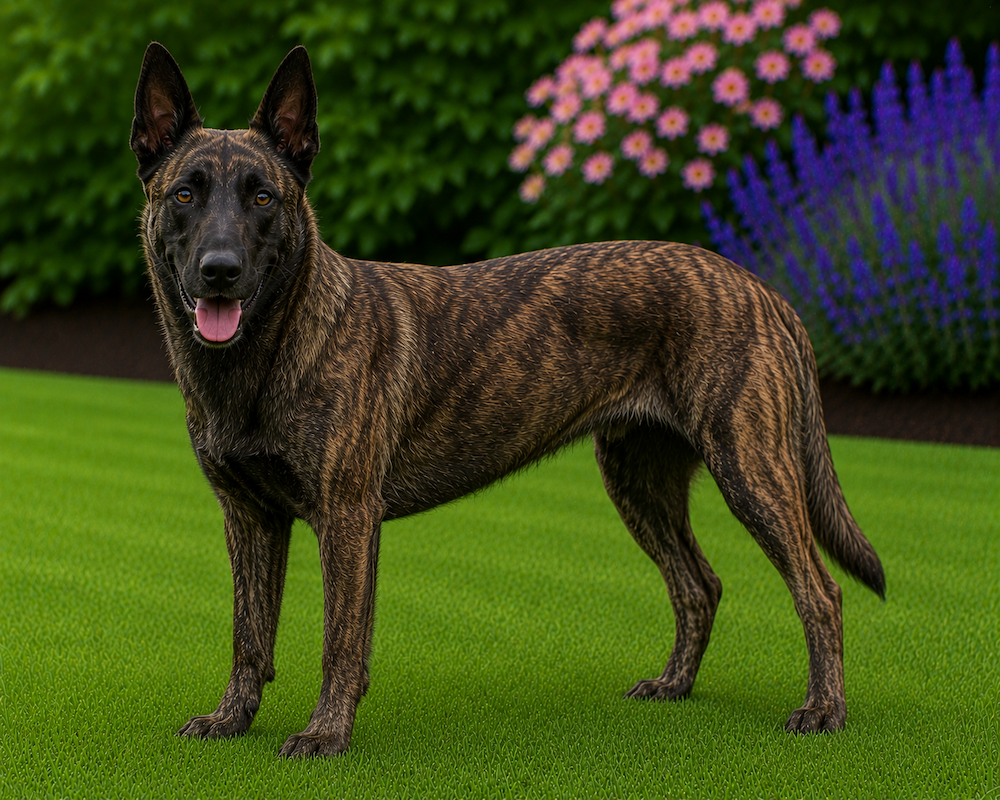
The most obvious visual distinction is colour: Dutch Shepherds are characteristically brindle, while Malinois are typically fawn with black overlay and mask.
Both can be exceptionally intense working dogs.
Individual working lines can sometimes resemble each other more than casual observers expect.
Is a Dutch Shepherd Calmer Than a Belgian Malinois?
Not necessarily.
Some Dutch Shepherd lines may be more moderate, but high-performance working Dutch Shepherds can be every bit as intense as Belgian Malinois.
Breed labels alone aren’t enough to predict drive.
The breeding line, parents and intended working purpose are often more informative.
Anyone looking for “a Malinois but calmer” shouldn’t automatically assume a Dutch Shepherd solves the problem.
What Is the Difference Between a Dutch Shepherd and a German Shepherd?
Dutch Shepherds are generally lighter, more compact and characteristically brindle, while German Shepherds occur in a wider range of colours and are more numerous worldwide.
Both originated as versatile European herding and working dogs.
German Shepherds developed in Germany, while Dutch Shepherds developed in the Netherlands.
Both now work in police, military, assistance and sporting roles.
Is a Dutch Shepherd Related to the Belgian Shepherd?
Dutch and Belgian Shepherds developed from closely related regional populations of European shepherd dogs.
Modern national borders and organised breed standards eventually separated them into distinct breeds.
Historically, working farm dogs didn’t necessarily recognise the political boundaries that later kennel clubs used to classify them.
Their similarities therefore aren’t accidental.
Why Are Dutch Shepherds Brindle?
Brindle became the signature colour of the Dutch Shepherd as the modern breed standard developed.
Early Dutch shepherd dogs appeared in more colours than today’s breed.
As neighbouring Belgian and German shepherd breeds became standardised, Dutch breeders increasingly used brindle as a defining characteristic.
Today brindle is one of the quickest ways to recognise the breed.
Are All Dutch Shepherds Brindle?
Under the modern recognised breed standard, the Dutch Shepherd is fundamentally a brindle breed.
The brindling can appear on a gold or silver base.
Some working dogs marketed as Dutch Shepherds may display non-standard colours because working populations and registry breeding haven’t always followed exactly the same rules.
For pedigree show lines, brindle is characteristic.
What Is a Gold Brindle Dutch Shepherd?
Gold brindle refers to a coat with dark stripes over a warmer golden, reddish or brownish base.
The amount of brindling can vary considerably.
Some dogs appear relatively light, while heavily brindled individuals can look almost black until viewed closely.
What Is a Silver Brindle Dutch Shepherd?
Silver brindle describes dark brindle striping over a cooler grey or silvery base colour.
It produces a striking appearance quite different from warmer gold brindle.
Both gold and silver brindle occur within recognised Dutch Shepherd standards.
Can a Dutch Shepherd Be Completely Black?
A completely black coat isn’t the characteristic recognised colour of the pedigree Dutch Shepherd.
Extremely heavy brindling can make some dogs appear almost black, particularly from a distance.
Solid black dogs marketed as Dutch Shepherds may come from non-standard working lines or have other ancestry.
Pedigree information is useful when colour doesn’t match the recognised standard.
Why Does My Dutch Shepherd Look Black Until It Is in the Sun?
Heavy brindling can place so many dark stripes across the coat that the lighter base becomes difficult to see.
Bright light can reveal the gold or silver hairs between the dark stripes.
This can make a dog that appears almost solid black indoors suddenly look unmistakably brindle outside.
Are There Three Types of Dutch Shepherd Coat?
Yes. The Dutch Shepherd has three recognised coat varieties: Shorthaired, Longhaired and Roughhaired.
All are the same breed.
However, each coat variety has its own appearance and grooming requirements.
The Shorthaired variety is by far the one most people recognise from modern working-dog imagery.
What Is a Shorthaired Dutch Shepherd?
The Shorthaired Dutch Shepherd has a close, firm outer coat with a woolly undercoat.
This is the variety most commonly encountered in police, military and protection-sport contexts.
Seasonal shedding can be substantial.
The short coat also makes the brindle pattern particularly obvious.
What Is a Longhaired Dutch Shepherd?
The Longhaired Dutch Shepherd has longer, straight, close-lying hair with a dense undercoat.
It retains the same fundamental working-dog structure beneath the extra coat.
Regular brushing is necessary, particularly during seasonal shedding.
Longhaired Dutch Shepherds are considerably less commonly seen than Shorthaired dogs.
What Is a Roughhaired Dutch Shepherd?
The Roughhaired Dutch Shepherd has a harsh, dense, tousled coat that gives it a very different appearance from the other varieties.
Facial furnishings can create pronounced eyebrows, beard and moustache.
The coat generally requires periodic hand stripping to remove dead hair properly.
To someone unfamiliar with the breed, a Roughhaired Dutch Shepherd may barely look related to a Shorthaired one.
Which Dutch Shepherd Coat Type Is the Rarest?
The Roughhaired and Longhaired varieties are much less commonly encountered than the Shorthaired Dutch Shepherd, although relative numbers vary by country and registry.
Shorthaired dogs dominate much of the international working-dog population.
This can create the misleading impression that Dutch Shepherds only come with short coats.
Can Different Dutch Shepherd Coat Types Be Born in the Same Litter?
Coat genetics and breeding regulations make this more complicated than simply mixing all three varieties freely.
Different registries have rules governing inter-variety breeding, and coat length/type follows inherited genetics.
Unexpected coat traits can occasionally appear depending on ancestry.
Responsible breeders should understand the genetics and registry rules relevant to their breeding programme.
Does a Dutch Shepherd Have a Double Coat?
Yes. Dutch Shepherds generally have weather-resistant coats with undercoat, reflecting their history working outdoors in the Netherlands.
The exact structure differs between Shorthaired, Longhaired and Roughhaired dogs.
That weather protection was valuable for a farm dog expected to work through changing European conditions.
Where Does the Dutch Shepherd Come From?
The Dutch Shepherd originated in the Netherlands, where it developed as a versatile farm and shepherd dog.
Rather than performing only one specialised task, these dogs were expected to handle whatever the farmer required.
They herded sheep, guarded property, kept animals away from crops, accompanied livestock and performed numerous general farm duties.
Versatility became one of the breed’s defining characteristics.
What Were Dutch Shepherds Originally Bred For?
Dutch Shepherds were primarily all-purpose farm dogs.
They herded sheep, watched livestock, guarded the farm, controlled poultry and helped prevent animals from wandering into cultivated fields.
A farmer couldn’t necessarily afford a different specialist dog for every task.
The Dutch Shepherd therefore needed intelligence, endurance, independence and the ability to switch between jobs.
Did Dutch Shepherds Herd Sheep?
Yes. Sheep herding was a major historical role.
Dutch Shepherds could move flocks between grazing areas and keep sheep away from crops.
They often worked along boundaries rather than merely driving animals in one direction.
This required stamina, awareness and independent decision-making.
Did Dutch Shepherds Guard Farms?
Yes. In addition to herding, Dutch Shepherds were expected to watch farms, livestock and property.
This helped preserve alertness and territorial awareness within the breed.
The modern Dutch Shepherd’s reputation as a capable watchdog therefore has genuine historical roots.
Did Dutch Shepherds Work With Poultry?
Historical descriptions of the Dutch Shepherd’s farm duties include keeping hens away from kitchen gardens and managing various farm animals.
This illustrates just how broad the breed’s original job description was.
The Dutch Shepherd wasn’t simply a sheep specialist.
It was effectively a four-legged farm employee expected to help wherever needed.
When Was the Dutch Shepherd Breed Standard Created?
The Dutch Shepherd began becoming formally organised during the late 19th century, with the Nederlandse Herdershonden Club founded in 1898.
Early breed standards allowed considerably more colour variation than modern standards.
As formal breeding developed, the appearance became more tightly defined.
Did Dutch Shepherds Originally Come in More Colours?
Yes. Early Dutch Shepherd populations occurred in more colours than the modern breed standard permits.
As Dutch, Belgian and German shepherd breeds became separately standardised, colour became one way to create clearer distinctions between them.
Brindle eventually became the defining colour of the Dutch Shepherd.
Why Did Brindle Become the Standard Dutch Shepherd Colour?
As organised dog breeding developed around the turn of the 20th century, neighbouring shepherd breeds needed clearer identities.
Restricting the Dutch Shepherd largely to brindle colouring helped distinguish it from German and Belgian shepherd populations.
What began partly as breed standardisation eventually produced one of the Dutch Shepherd’s most recognisable characteristics.
Did Modern Farming Nearly Make the Dutch Shepherd Obsolete?
Yes. Changes in agriculture dramatically reduced the need for traditional shepherd dogs.
As industrialisation, land-use changes and modern farming practices reduced sheep-herding work, the Dutch Shepherd lost much of its original occupation.
The breed survived by adapting to new roles including police work, tracking, obedience and other working disciplines.
Did the Dutch Shepherd Nearly Become Extinct?
The breed became seriously vulnerable during the 20th century, particularly as traditional farm work disappeared and the World Wars disrupted European dog breeding.
World War II was especially damaging.
Food shortages, military requisition and disruption of breeding populations affected many European breeds.
Dedicated breeders subsequently worked to preserve the Dutch Shepherd.
Did World War II Affect the Dutch Shepherd?
Yes. World War II had a major impact on Dutch dog populations and organised breeding.
The Netherlands experienced occupation, food shortages and widespread disruption.
Maintaining non-essential dogs became extremely difficult.
The Dutch Shepherd’s already reduced population suffered further, making post-war preservation particularly important.
Were Dutch Shepherds Used During World War II?
Dogs of shepherd type were used for various military, messenger, guard and support functions during wartime Europe.
However, dramatic claims about specific large-scale Dutch Shepherd operations should be treated carefully unless supported by documentation.
The war’s clearest effect on the breed was the severe disruption it caused to the Dutch population and breeding programmes.
Is the Dutch Shepherd a Rare Dog Breed?
Yes. Compared with German Shepherds and Belgian Malinois, Dutch Shepherds remain relatively uncommon internationally.
Some coat varieties are particularly rare.
Their growing popularity in working-dog sports and operational roles has increased awareness, but they’re still far from being a mainstream family breed.
Why Isn’t the Dutch Shepherd as Popular as the German Shepherd?
The German Shepherd developed a much larger international breeding population and extraordinary worldwide recognition through police, military, film and companion roles.
Dutch Shepherd numbers remained smaller and were heavily affected by changes in farming and wartime disruption.
Their intense working characteristics also limit their suitability for many ordinary pet homes.
Is the Dutch Shepherd an Ancient Breed?
The Dutch Shepherd’s ancestors belong to an old tradition of European farm and shepherd dogs, but the modern pedigree breed was formalised mainly during the late 19th and early 20th centuries.
Calling it “ancient” can therefore be misleading.
The working population is old; the formal breed standard is comparatively modern.
Is the Dutch Shepherd Related to Wolves?
No more recently than other domestic dogs.
Dutch Shepherds are domestic dogs, not wolf hybrids.
Their erect ears, athletic build and intense expression may appear wolf-like to some people, but they don’t contain recent wolf ancestry as part of normal breed development.
Is the Dutch Shepherd a Good First Dog?
Usually not.
The Dutch Shepherd’s combination of intelligence, energy, working drive, strength and protective instincts can be challenging for inexperienced owners.
A committed first-time owner with excellent professional guidance could succeed, but there are much easier breeds for learning dog ownership.
This is particularly true for high-drive working lines.
Why Are Dutch Shepherds Becoming More Popular?
Interest has grown because people have become increasingly aware of their abilities in police work, protection sports, scent detection, obedience and other working disciplines.
Their brindle appearance also makes them visually distinctive.
However, greater popularity has a downside if people choose them because they look impressive without understanding how much work they require.
Where Does the Dutch Shepherd Come From?
The Dutch Shepherd comes from the Netherlands, where it developed as a remarkably versatile farm dog rather than a narrowly specialised breed.
It could herd sheep, patrol field boundaries, guard property, manage livestock and even keep poultry away from the vegetable garden.
When traditional shepherding declined, the breed reinvented itself through police work, detection, sport and other demanding jobs.
That versatility still defines the Dutch Shepherd today: a brindle farm worker that lost its original job but proved intelligent and adaptable enough to find an impressive collection of new ones.