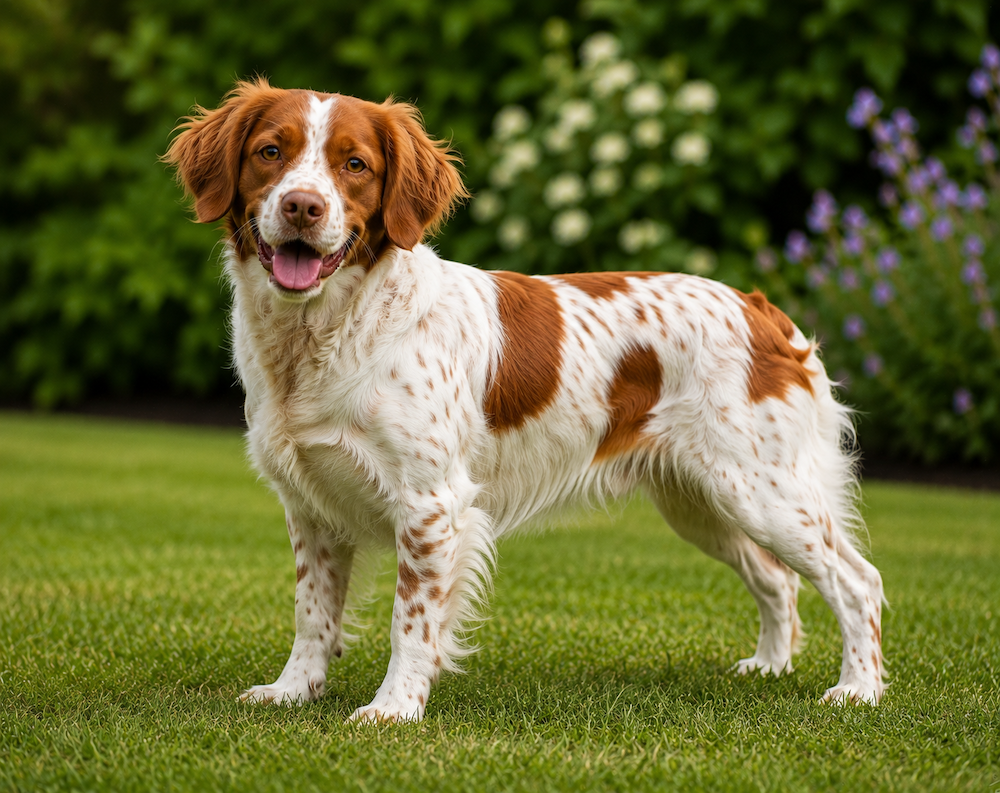







Energetic, intelligent, and eager to please — a versatile sporting dog that thrives on adventure and family life.
🧠 QUICK SNAPSHOT
- Temperament: Friendly, intelligent, energetic
- Energy Level: Very high
- Size: Medium
- Good With Families: Yes
- Trainability: Very high
- Grooming: Low to moderate
- Best For: Active families, hunters, outdoor enthusiasts
📚 OVERVIEW
The Brittany Spaniel, often simply called the Brittany, is an athletic sporting breed originally developed in France as a versatile bird dog. Renowned for its intelligence, speed, and eagerness to work, the Brittany excels both in the field and as an affectionate family companion.
These dogs thrive in active households where they can enjoy plenty of exercise, mental stimulation, and quality time with their family. Their friendly nature and enthusiasm make them a favourite among hunters, hikers, and outdoor adventurers alike.
✅ PROS & CONS
Pros
- Extremely intelligent and easy to train
- Friendly and affectionate with family
- Outstanding companion for active lifestyles
- Excellent sporting and agility dog
Cons
- Requires significant daily exercise
- Can become restless if under-stimulated
- Needs regular mental challenges
- May develop separation anxiety if left alone too long
Is a Brittany Spaniel a Good Family Dog?
Yes, the Brittany can be an excellent family dog for an active household.
Brittanys are typically affectionate, friendly and strongly attached to their people. They can be very good with children, particularly when raised and socialised appropriately.
However, this is an energetic working breed rather than a laid-back companion.
Families that enjoy hiking, running, exploring and spending time outdoors are generally a much better match than households wanting a dog content with occasional short walks.
How Much Exercise Does a Brittany Need?
Most adult Brittanys need around 90 minutes or more of substantial exercise each day.
They’re athletic gundogs developed to spend long periods searching countryside for game birds.
Running, hiking, retrieving, scent work, swimming and dog sports can all help satisfy their needs.
Mental stimulation is equally important.
A quick walk around the block is unlikely to impress a young Brittany that has generations of genetics telling it there is an entire countryside somewhere that urgently needs searching.
Is a Brittany Easy to Train?
Yes, Brittanys are generally highly intelligent, responsive and trainable.
They were bred to cooperate closely with hunters while still working independently at a distance.
Positive reinforcement tends to produce excellent results.
Many Brittanys are sensitive dogs, so unnecessarily harsh training methods can damage confidence.
Their intelligence and athleticism make them excellent candidates for obedience, agility, scent work, field trials and other canine sports.
Does a Brittany Shed?
Yes. Brittanys shed moderately throughout the year, with heavier shedding possible seasonally.
Their coat is relatively easy to maintain compared with many other sporting breeds.
Brushing once or twice a week is usually sufficient to remove loose hair and prevent minor tangles in feathered areas.
Their ears, feet and feathering should also be checked after outdoor adventures for grass seeds, burrs and other debris.
What Health Problems Are Common in Brittanys?
Brittanys are generally robust dogs, but several inherited health problems can occur.
Hip dysplasia is an important concern, along with certain eye disorders and epilepsy.
Thyroid disorders can also occur within the breed.
Because Brittanys are highly active outdoor dogs, owners should additionally watch for injuries, grass seeds, ticks and ear problems associated with their lifestyle.
Responsible breeders should undertake appropriate hip and eye screening and understand the health history of their breeding lines.
How Long Do Brittanys Live?
Brittanys commonly live around 12–14 years, with some reaching their mid-teens.
Their relatively athletic build helps avoid some problems associated with extremely large or heavily built breeds.
Maintaining a lean body condition is still important.
Regular exercise, quality nutrition, dental care and preventive veterinary treatment can all contribute to healthy ageing.
Many senior Brittanys retain considerable enthusiasm for outdoor adventures.
How Big Does a Brittany Get?
The Brittany is a medium-sized sporting dog, considerably lighter and more athletic than many traditional spaniels.
Adults typically stand around 44–52 cm at the shoulder and commonly weigh approximately 14–18 kg.
They’re compact but extremely athletic.
A Brittany should look capable of covering ground quickly and efficiently rather than heavy or cumbersome.
Their manageable size combined with considerable endurance is one reason they became so popular with bird hunters.
Can a Brittany Live in an Apartment?
A Brittany can live in an apartment, but only with a highly committed owner who provides substantial daily exercise.
Their physical size isn’t particularly difficult to accommodate.
Their energy level is.
A properly exercised adult may settle comfortably indoors, but an under-stimulated Brittany can become restless, vocal or destructive.
Access to safe outdoor areas for regular running and exploration makes life considerably easier.
Can a Brittany Be Left Alone?
Brittanys can learn to spend reasonable periods alone, but they’re strongly people-oriented dogs.
Many form very close attachments to their owners.
Long periods of isolation combined with insufficient exercise can contribute to separation-related behaviour, barking or destruction.
Gradual independence training during puppyhood is important.
Providing plenty of exercise before alone time can also make a significant difference.
Are Brittanys Good With Other Dogs?
Yes, Brittanys are generally sociable with other dogs, particularly when properly socialised.
Their sporting background didn’t require strong dog aggression, and many enjoy canine companionship.
Young Brittanys can be extremely enthusiastic players.
As with any breed, individual personalities vary, and introductions should be managed appropriately.
A compatible second dog can make an excellent companion, although it doesn’t replace human interaction or exercise.
Are Brittanys Good With Cats?
Brittanys can live successfully with cats, particularly when introduced carefully or raised alongside them.
However, they’re bird dogs with substantial prey and chase instincts.
A familiar household cat may be treated completely differently from an unfamiliar animal running outdoors.
Early socialisation, training and supervision are important.
Small pets and birds require considerably greater caution because searching and pursuing game are deeply embedded in the breed’s working heritage.
Do Brittanys Bark a Lot?
Brittanys aren’t generally considered extreme barkers, but they can become vocal when excited, bored or left alone too long.
Some make effective alert dogs and will announce visitors.
Exercise and mental stimulation can significantly influence barking behaviour.
A Brittany with an appropriate outlet for its energy is much more likely to relax at home than one whose working instincts have nowhere to go.
Do Brittanys Like Water?
Many Brittanys enjoy water and can become capable swimmers, although enthusiasm varies between individuals.
Their work as versatile bird dogs can involve retrieving and operating around wetlands.
However, they’re generally more strongly associated with upland bird hunting than specialised water retrieving.
Dogs should still be introduced to swimming gradually and supervised around deep or fast-moving water.
Can a Brittany Be Trusted Off Lead?
Brittanys can develop excellent recall, but their strong hunting instincts make off-lead training extremely important.
A scent, bird or sudden movement can trigger pursuit.
Their natural working style also involves ranging away from the handler while searching.
Recall training should therefore begin early and be practised extensively in controlled environments.
Until recall is reliable, a long line or secure fenced area is much safer.
Why Does a Brittany Point at Birds?
Pointing is an instinctive hunting behaviour deliberately strengthened through generations of selective breeding.
When a Brittany detects game, it may suddenly freeze with its body directed towards the bird, sometimes raising one front paw.
This indicates the location of the game without immediately flushing it.
Even Brittanys that have never been hunting may spontaneously point at birds or other interesting animals.
For some puppies, nobody needs to explain the job — the behaviour simply appears.
What Were Brittanys Originally Bred to Hunt?
Brittanys were primarily developed to hunt game birds.
They’re versatile pointing dogs capable of locating birds, pointing them and often retrieving shot game.
Historically, they were particularly valuable to hunters who needed an athletic, manageable dog capable of working varied French countryside.
Their versatility remains one of their defining characteristics.
Modern Brittanys continue to compete successfully in field trials and work as practical hunting companions.
Is a Brittany a Spaniel?
Despite frequently being called the Brittany Spaniel, the breed is more accurately classified as a pointing dog rather than a traditional flushing spaniel.
Spaniels such as the English Springer typically locate game and flush it from cover.
A Brittany’s characteristic hunting behaviour is to locate game and point.
This distinction eventually led several kennel organisations to drop “Spaniel” from the official breed name.
So “Brittany Spaniel” remains widely understood, but Brittany is the official name in a number of countries.
Why Was “Spaniel” Dropped From the Brittany’s Name?
The American Kennel Club officially changed the breed’s name from Brittany Spaniel to Brittany in 1982.
The reason was straightforward: the breed works primarily as a pointer, not as a conventional flushing spaniel.
Its hunting style and structure align more closely with versatile pointing breeds.
The shorter name also reflects the breed’s French identity.
Many people still casually use “Brittany Spaniel,” so both names remain familiar even though Brittany is now the official name in several major registries.
What Is the Difference Between a Brittany and an English Springer Spaniel?
The biggest difference is their traditional hunting style.
A Brittany is primarily a pointing dog. It searches for game and freezes to indicate its location.
An English Springer Spaniel is primarily a flushing spaniel, traditionally pushing birds from cover so the hunter can shoot.
Brittanys are also generally lighter and more leggy, while Springers typically have more substantial coats and longer ears.
Both are energetic, intelligent sporting dogs, but they were developed to perform different jobs.
Why Do Some Brittanys Have Short Tails?
Brittanys can be born with naturally short or bobbed tails, while others are born with longer tails.
Historically, longer tails were also docked in countries where the practice was permitted.
Tail docking is now prohibited or restricted in many places, including Australia.
Because naturally short tails occur within the breed, seeing a short-tailed Brittany doesn’t automatically mean the dog’s tail was surgically docked.
Tail length can therefore vary considerably.
What Colours Can Brittanys Be?
Brittanys are most famously orange and white or liver and white, often with ticking or roan patterning.
Some breed standards also recognise black, black-and-white and tricolour combinations, although accepted colours differ between kennel organisations and between American and European standards.
The orange-and-white Brittany remains particularly recognisable.
Working ability, health and temperament should always matter considerably more than coat colour.
What Is the Difference Between an American Brittany and a French Brittany?
“American Brittany” and “French Brittany” are terms commonly used to describe different breeding populations and styles, rather than universally recognised separate breeds.
French or European Brittanys may be somewhat smaller and can include colours such as black that aren’t traditionally accepted under some American standards.
American lines have often been selected for a larger-ranging field-trial style suited to expansive hunting terrain.
Considerable variation exists within both populations, so the distinction isn’t as simple as two completely separate breeds.
What Does the French Name Épagneul Breton Mean?
The breed’s French name is Épagneul Breton.
“Breton” means from Brittany, the region of north-western France where the breed developed.
“Épagneul” is traditionally translated into English as spaniel, which explains the familiar name Brittany Spaniel.
However, the modern Brittany’s pointing behaviour is one reason English-language kennel organisations increasingly favour simply Brittany.
Is the Brittany an Old Dog Breed?
Dogs resembling Brittany-type hunting dogs have been depicted in European artwork and descriptions for centuries, but the modern standardised breed developed much more recently.
The Brittany became clearly established as a recognisable French breed during the 19th and early 20th centuries.
Claims that today’s pedigree Brittany has existed unchanged for hundreds of years should therefore be treated cautiously.
It has deep regional hunting roots, but the modern breed is the product of organised selective breeding.
Where Does the Brittany Come From?
The Brittany comes from Brittany in north-western France, where local hunters developed compact, versatile bird dogs capable of working the region’s varied countryside.
During the 19th century, these local dogs were increasingly developed into the type recognised today. British sporting dogs visiting France with hunters may also have influenced some breeding lines, although the precise contribution is debated.
The breed was formally established in France during the early 20th century and subsequently became particularly popular in the United States.
Today, the Brittany remains what generations of breeding created it to be: a remarkably energetic bird dog packed into a relatively compact body.