





Intelligent, affectionate, and full of energy — a beautiful companion that combines elegance with a playful spirit.
🧠 QUICK SNAPSHOT
- Temperament: Friendly, intelligent, affectionate
- Energy Level: High
- Size: Medium to large
- Good With Families: Yes
- Trainability: Very high
- Grooming: Moderate to high
- Best For: Active families, companionship, outdoor lifestyles
📚 OVERVIEW
The Irish Doodle is a cross between an Irish Setter and a Poodle, combining the intelligence of the Poodle with the friendly, outgoing personality of the Irish Setter. Known for their beautiful coats and affectionate nature, Irish Doodles are energetic companions that love being involved in family life.
They are highly social dogs that thrive on companionship, exercise, and mental stimulation, making them an excellent choice for active households.
✅ PROS & CONS
Pros
- Extremely intelligent and trainable
- Friendly and affectionate with family
- Great with children and other pets
- Often low shedding depending on coat type
Cons
- Requires regular grooming
- High exercise and mental stimulation needs
- Can develop separation anxiety
- May become destructive if bored
Is an Irish Doodle a Good Family Dog?
Yes. Irish Doodles are generally affectionate, intelligent and energetic family dogs.
They combine the friendly nature of the Irish Setter with the intelligence and trainability of the Poodle.
They usually suit active households best because both parent breeds have genuine sporting-dog backgrounds and need more than a short daily walk.
What Breeds Make an Irish Doodle?
An Irish Doodle is a cross between an Irish Setter and a Poodle, usually a Standard Poodle.
Mini Irish Doodles are generally produced using Miniature Poodle ancestry or through multigenerational breeding.
They’re sometimes called Irish Setterpoos, Irish Setterdoodles or Irish Poo Setters, although Irish Doodle is by far the most familiar name.
Is an Irish Doodle the Same as an Irish Setterpoo?
Yes. Irish Setterpoo and Irish Doodle generally describe the same Irish Setter × Poodle cross.
Neither name represents a separate recognised breed.
Because designer-dog terminology isn’t formally regulated, the dog’s actual pedigree is always more informative than its marketing name.
How Much Exercise Does an Irish Doodle Need?
Most adult Irish Doodles need around 60–90 minutes of exercise each day, with particularly energetic individuals requiring more.
Walking, running, hiking, retrieving, swimming and scent games are excellent activities.
Mental stimulation is also important because this is usually a highly intelligent cross.
Is an Irish Doodle a High-Energy Dog?
Usually, yes.
Irish Setters are energetic sporting dogs bred to work across open country, while Poodles were athletic water retrievers.
An Irish Doodle may look like an oversized teddy bear, but underneath the coat is potentially a working sporting dog on both sides of the family tree.
Is an Irish Doodle Easy to Train?
Usually.
Both parent breeds are intelligent and capable of advanced training.
Poodles are particularly responsive, while Irish Setters can be enthusiastic, playful and somewhat distractible.
Positive reinforcement and short, interesting training sessions generally work best.
Are Irish Doodles Intelligent?
Yes. They can be exceptionally clever.
Poodles are renowned for intelligence, while Irish Setters were developed to locate game and work cooperatively with hunters.
Irish Doodles can excel at obedience, tricks, scent work and dog sports when given appropriate training.
Are Irish Doodles Stubborn?
Some can be.
Irish Setters can have an independent, exuberant streak, particularly during adolescence.
An Irish Doodle may therefore understand what its owner wants while deciding that a bird, smell or potential game is currently much more interesting.
Does an Irish Doodle Shed?
It varies considerably.
Some Irish Doodles shed very little, while others inherit more shedding from the Irish Setter side.
Generation labels such as F1 or F1B can influence probability, but they don’t guarantee a particular coat.
Is an Irish Doodle Hypoallergenic?
Not reliably.
No dog is completely hypoallergenic, and Irish Doodles can inherit different coat characteristics.
Some low-shedding individuals may be better tolerated by certain allergy sufferers, but allergens are also produced through saliva and skin secretions.
What Coat Types Can Irish Doodles Have?
Irish Doodles can have straight, wavy or curly coats.
Some resemble shaggy Irish Setters, while others develop tighter Poodle-style curls.
The soft wavy coat often marketed as “fleece” produces the classic Doodle appearance.
What Does Furnished Mean in an Irish Doodle?
Furnishings are the longer facial hairs that create the characteristic beard, moustache and eyebrows associated with Doodles.
Not every Irish Doodle inherits furnishings.
An unfurnished dog may have a smoother, more Setter-like face and potentially different shedding characteristics.
Can an Irish Doodle Have a Flat Coat?
Yes.
Some inherit a relatively straight or flat Irish Setter-style coat rather than a curly Doodle coat.
These dogs may lack the teddy-bear facial furnishings many buyers expect.
A flat-coated puppy is still an Irish Doodle.
Are Irish Doodles High-Maintenance to Groom?
Many are.
Wavy and curly coats can mat quickly because loose hairs become trapped within the coat.
Most require brushing several times each week, with long coats sometimes needing daily attention.
Professional grooming approximately every six to eight weeks is common.
How Often Should an Irish Doodle Be Groomed?
Most furnished Irish Doodles benefit from brushing at least three or four times a week, and some need daily brushing.
Professional clipping is often scheduled every six to eight weeks.
The ears, armpits, legs, collar area and tail are particularly prone to matting.
Why Does My Irish Doodle Mat So Easily?
The coat can combine long Setter hair with Poodle curl and density.
Loose hairs may remain trapped instead of falling away, eventually tangling around neighbouring hair.
A dog can therefore appear beautifully fluffy on top while developing tight mats close to the skin.
Can You Shave an Irish Doodle?
Yes.
Regular clipping is normal for many Poodle-influenced coats.
If severe matting develops, a short clip may be the kindest and safest solution rather than attempting to painfully brush out tight mats.
Why Does My Irish Doodle Look Different After Grooming?
The famous Doodle appearance depends heavily on coat length and grooming style.
A short clip can reveal a much leaner, more athletic dog underneath.
The difference can be dramatic enough that first-time owners occasionally wonder whether the groomer returned the correct dog.
What Health Problems Are Common in Irish Doodles?
Potential concerns include hip dysplasia, eye disorders, thyroid disease, epilepsy, skin problems and gastric dilatation-volvulus, along with inherited conditions occurring in either parent breed.
Poodle-related risks depend partly on the Poodle variety involved.
Responsible breeding requires health screening on both sides.
Are Irish Doodles Prone to Hip Dysplasia?
They can be.
Hip dysplasia occurs in both Irish Setters and Standard Poodles.
Breeding dogs should undergo appropriate formal hip evaluation.
Maintaining healthy body weight is also important for protecting joints.
Are Irish Doodles Prone to Bloat?
Larger Irish Doodles may be at risk of gastric dilatation-volvulus (GDV) because both Irish Setters and Standard Poodles are relatively deep-chested breeds.
Repeated unsuccessful attempts to vomit, abdominal enlargement, restlessness or collapse constitute a veterinary emergency.
Owners of large Irish Doodles should discuss GDV risk and preventive gastropexy with their veterinarian.
Do Irish Doodles Get Ear Infections?
They can.
Both parent breeds have drop ears, while a Doodle coat can add substantial hair around the ear canal.
Reduced ventilation and retained moisture can increase the risk of infection, particularly in dogs that swim frequently.
Are Irish Doodles Prone to Eye Problems?
Potential inherited eye disorders can occur through either parent breed.
Responsible breeders should use appropriate ophthalmic examinations and DNA tests where available.
Any sudden vision change, cloudiness, redness or eye pain warrants veterinary examination.
How Long Does an Irish Doodle Live?
Irish Doodles commonly live around 11–14 years, although individuals can live longer.
Mini Irish Doodles may potentially have somewhat greater longevity because smaller dogs often live longer on average.
Genetics, size and general health all matter.
How Big Does an Irish Doodle Get?
Standard Irish Doodles are medium-to-large dogs, often weighing around 20–32 kg, although some can be larger.
Height frequently falls somewhere around 55–70 cm, depending on the parents.
There is no universally accepted Irish Doodle breed standard.
What Is a Standard Irish Doodle?
A Standard Irish Doodle generally combines an Irish Setter with a Standard Poodle.
This produces an athletic medium-to-large dog.
Standard Irish Doodles usually need substantial exercise and can be considerably larger than their fluffy appearance initially suggests.
What Is a Mini Irish Doodle?
A Mini Irish Doodle incorporates Miniature Poodle ancestry to reduce adult size.
Because the Irish Setter is considerably larger than a Miniature Poodle, first-generation size can be difficult to predict.
Multigenerational breeding is often used to achieve smaller dogs more consistently.
How Big Does a Mini Irish Doodle Get?
Mini Irish Doodles are commonly advertised in ranges around 10–20 kg, but there is no official standard.
Some mature considerably larger than buyers expect.
Actual parental size and previous litters provide better guidance than the word “Mini.”
Are There Teacup Irish Doodles?
“Teacup Irish Doodle” isn’t a recognised size category.
Extreme miniaturisation would require substantial selective breeding and potentially additional generations involving very small Poodles.
Health and sound structure should take priority over producing an unusually tiny version of a naturally athletic cross.
Can an Irish Doodle Live in an Apartment?
Potentially, but they’re generally better suited to owners who can provide substantial daily activity.
A well-exercised Irish Doodle may relax indoors, but lack of exercise and stimulation can create behavioural problems.
Access to a backyard doesn’t replace walks and interaction.
Can an Irish Doodle Be Left Alone?
Some can learn to tolerate reasonable periods alone.
However, both parent breeds are generally social and people-oriented, so long daily periods of isolation aren’t ideal.
Gradual independence training from puppyhood can reduce separation-related problems.
Are Irish Doodles Prone to Separation Anxiety?
They can be.
Irish Setters and Poodles both tend to form strong relationships with people.
A puppy that’s constantly accompanied during its early months may struggle when suddenly expected to spend hours alone.
Independence should be taught gradually.
Are Irish Doodles Velcro Dogs?
Many are.
They often enjoy remaining close to family members and participating in household activity.
Some inherit more independence, but a substantial proportion become enthusiastic human shadows.
Are Irish Doodles Cuddly?
Many are extremely affectionate.
Their friendly temperament and soft coat contribute to their reputation as oversized teddy bears.
Individual personalities vary, and highly energetic adolescents may find remaining stationary for a cuddle particularly challenging.
Are Irish Doodles Good With Children?
Generally, yes.
Irish Setters and Poodles both have strong potential as family dogs.
Young Irish Doodles can be large, energetic and exuberant, so they may accidentally knock over small children.
Early manners training is valuable.
Are Irish Doodles Good With Other Dogs?
Usually.
Both parent breeds generally have good social potential.
Early positive socialisation helps ensure an Irish Doodle develops appropriate behaviour around dogs of different sizes and personalities.
Are Irish Doodles Good With Cats?
Many can live successfully with cats, particularly when raised together.
Irish Setters have sporting and bird-dog instincts, so some individuals may enjoy chasing smaller animals.
Careful introductions remain important.
Do Irish Doodles Have a Strong Prey Drive?
Usually moderate rather than extreme.
Irish Setters were developed to locate game birds, while Poodles were waterfowl retrievers.
A moving bird can therefore be exceptionally interesting.
Individual prey drive varies considerably.
Are Irish Doodles Good Off Leash?
They can be with strong recall training.
However, sporting-dog ancestry means birds, scents and movement can become powerful distractions.
Recall should be established gradually before allowing off-leash freedom in appropriate areas.
Do Irish Doodles Bark a Lot?
Most are moderate barkers.
Boredom, excitement, alert behaviour or separation distress can increase vocalisation.
Adequate exercise and teaching calm behaviour generally help.
Are Irish Doodles Good Guard Dogs?
Generally, no.
Their size may look impressive, and some will bark at unfamiliar activity, but both parent breeds are fundamentally sporting dogs rather than specialist guardians.
Many Irish Doodles are highly sociable with visitors.
Are Irish Doodles Protective?
Some may show natural watchfulness or loyalty towards their families.
However, protection behaviour isn’t a predictable defining characteristic.
An Irish Doodle shouldn’t be chosen primarily as a personal-protection or property-guarding dog.
When Do Irish Doodles Calm Down?
Many become noticeably calmer around two to three years of age.
Irish Setters are famous for retaining youthful exuberance for quite a long time, so some Irish Doodles mature slowly.
Teaching an off-switch is just as important as providing exercise.
Are Irish Doodles Good Running Dogs?
Yes. Healthy adult Irish Doodles can make excellent running companions.
Both parent breeds are athletic sporting dogs.
Structured distance running should wait until the dog’s joints and skeleton have matured.
Are Irish Doodles Good Hiking Dogs?
Usually excellent.
They often have the stamina, curiosity and athleticism required for substantial hikes.
Long coats should be checked carefully afterwards for grass seeds, burrs, ticks and debris.
Do Irish Doodles Like Water?
Many do.
Poodles were historically water retrievers, and Irish Setters can also enjoy swimming.
Individual enthusiasm varies, but water activities are often an excellent form of exercise.
Are Irish Doodles Good Swimmers?
Many are strong swimmers.
Standard Poodle ancestry provides a particularly strong genetic connection with water work.
Dogs should still be introduced gradually and supervised around deep, cold or moving water.
Do Irish Doodles Like Playing Fetch?
Many do.
Poodle ancestry contributes genuine retrieving instinct, while Irish Setters were developed to work closely with hunters around game birds.
Retrieving games provide useful physical exercise and mental stimulation.
Are Irish Doodles Good at Dog Sports?
Yes.
They can perform well in agility, obedience, scent work, rally, retrieving activities and other sports.
Their athleticism and intelligence make them versatile, although individual motivation varies.
Are Irish Doodles Good Therapy Dogs?
Suitable individuals can make excellent therapy dogs.
Their affectionate temperament and striking appearance can make them highly engaging.
Successful therapy dogs still require exceptional calmness, confidence and manners rather than simply friendliness.
Are Irish Doodles Good Service Dogs?
Some can be suitable.
Poodles have excellent service-dog potential, and Irish Setters are intelligent, cooperative dogs.
However, service work requires very stable temperament, excellent health and exceptional trainability, so only selected individuals will qualify.
What Does an Irish Doodle Look Like?
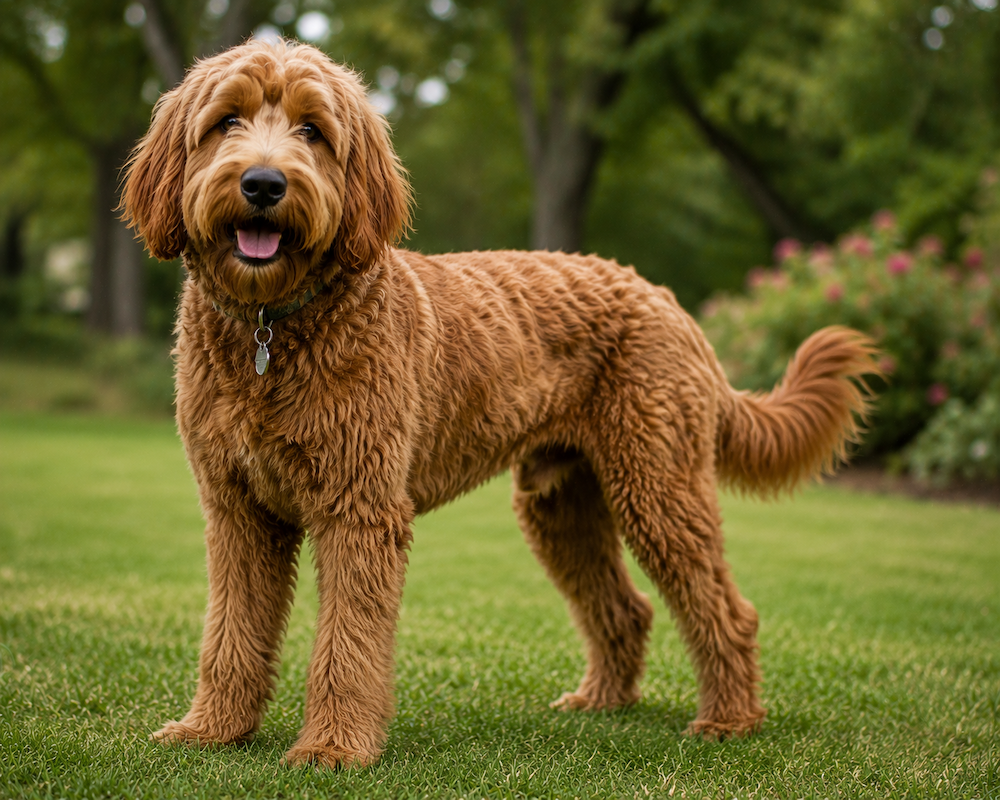
Irish Doodles are usually medium-to-large, athletic dogs with long legs, floppy ears and wavy or curly coats.
Many have the classic furnished Doodle face with a beard and eyebrows.
Others look much more obviously Setter-like.
What Colours Can Irish Doodles Be?
The most famous colour is red, reflecting Irish Setter ancestry.
Irish Doodles can also appear in apricot, cream, black, brown and various patterned combinations depending on Poodle genetics.
Colour can change significantly as the dog matures.
Why Are Most Irish Doodles Red?
The Irish Setter’s characteristic rich red coat strongly influences the cross.
Red and apricot Poodles can also reinforce this appearance.
As a result, deep red has become particularly associated with Irish Doodle marketing.
Can Irish Doodles Be Apricot?
Yes.
Apricot Irish Doodles are common, particularly when the Poodle parent carries appropriate colour genetics.
A red puppy may also lighten into an apricot shade as it matures.
Can Irish Doodles Be Black?
Yes.
Black can be inherited through Poodle ancestry.
Although red is much more strongly associated with the cross, black Irish Doodles are genetically possible.
Can Irish Doodles Be Chocolate?
Yes.
Brown or chocolate can occur through Poodle colour genetics.
These dogs are less typical of the classic red Irish Doodle appearance but are entirely possible.
Why Does My Irish Doodle’s Red Coat Fade?
Poodles can carry genetic factors that cause progressive fading or clearing of coat colour.
A deep-red puppy may therefore mature into a much lighter apricot or golden adult.
Colour change doesn’t usually indicate a health problem.
Can Irish Doodles Be Parti-Coloured?
Yes.
Poodle ancestry can introduce white spotting and parti patterns.
These dogs may have large areas of white combined with red, apricot, black or another colour.
Can Irish Doodles Be Merle?
Merle Irish Doodles deserve careful scrutiny.
Merle isn’t a traditional colour of either the Irish Setter or recognised purebred Poodle populations.
A merle Irish Doodle therefore generally indicates that another breed introduced the gene somewhere in the pedigree. Breeding merle to merle can also produce serious hearing and eye abnormalities.
Can an Irish Doodle Have Blue Eyes?
Blue eyes aren’t characteristic of either parent breed.
Occasional unusual pigmentation may occur, but persistent blue eyes — particularly alongside merle colouring — should prompt questions about ancestry.
Eye colour should never be prioritised over health.
What Is an F1 Irish Doodle?
An F1 Irish Doodle is a first-generation Irish Setter × Poodle cross.
Its average genetic ancestry is approximately 50% from each breed.
Appearance, shedding and temperament can still vary substantially among littermates.
What Is an F1B Irish Doodle?
An F1B Irish Doodle is usually produced by breeding an F1 Irish Doodle back to a Poodle.
The resulting puppies average approximately 75% Poodle ancestry.
This approach is commonly used to increase the likelihood of furnishings and reduced shedding.
Does an F1B Irish Doodle Definitely Not Shed?
No.
F1B dogs may have a greater probability of Poodle-like coats, but generation doesn’t guarantee shedding level.
Specific coat genetics are more informative.
What Is an F2 Irish Doodle?
An F2 Irish Doodle is generally produced by breeding two F1 Irish Doodles together.
Second-generation puppies can still vary dramatically because inherited characteristics recombine in numerous ways.
F2 doesn’t automatically mean more predictable.
What Is an F1BB Irish Doodle?
An F1BB Irish Doodle generally results from breeding an F1B Irish Doodle back to a Poodle again.
This creates a high average proportion of Poodle ancestry.
The goal is often increased coat predictability and reduced visible shedding.
What Is a Multigenerational Irish Doodle?
A multigenerational Irish Doodle has several generations of Irish Doodle ancestry.
Careful selection over generations can potentially make size, coat and temperament more predictable.
The word “multigen” by itself isn’t proof of responsible breeding.
Is an Irish Doodle a Recognised Breed?
No.
Major traditional kennel organisations recognise the Irish Setter and Poodle, but not the Irish Doodle as an established pedigree breed.
There is currently no universally accepted Irish Doodle breed standard.
Is an Irish Doodle a Designer Dog?
Yes.
The Irish Doodle belongs to the modern group of intentionally produced Poodle crosses commonly called designer dogs.
That label doesn’t indicate whether an individual breeder is responsible or irresponsible.
Breeding quality must be assessed separately.
Are Irish Doodles Healthier Than Purebred Dogs?
Not automatically.
Crossbreeding can increase genetic diversity and potentially reduce some recessive-disease risks.
However, Irish Doodles can still inherit complex and genetic disorders from both parent populations.
Health testing remains essential.
What Is Hybrid Vigour in Irish Doodles?
Hybrid vigour, or heterosis, describes biological advantages that can sometimes occur when genetically different populations are crossed.
It’s a legitimate concept, but it doesn’t mean a crossbreed is automatically healthy.
A poorly bred Irish Doodle can still inherit serious disease.
What Health Tests Should Irish Doodle Parents Have?
Screening should address important conditions found in both Irish Setters and the Poodle variety being used.
Depending on the breeding dogs, this can include hip assessments, eye examinations and relevant DNA tests.
Breeders should be able to explain the actual tests performed and provide results.
Is an Irish Doodle a Type of Poodle?
No.
An Irish Doodle is an Irish Setter-Poodle cross.
Even an F1B or multigenerational dog with substantial Poodle ancestry isn’t simply another Poodle variety.
Is an Irish Doodle the Same as a Goldendoodle?
No.
A Goldendoodle/Groodle combines Golden Retriever and Poodle, while an Irish Doodle combines Irish Setter and Poodle.
Both can be large, red, curly and extremely similar in appearance.
Their non-Poodle ancestry is completely different.
How Can You Tell an Irish Doodle From a Goldendoodle?
Sometimes you can’t reliably tell by appearance alone.
Both can have red or apricot wavy coats, furnished faces and similar body sizes.
Irish Doodles may inherit a leaner, longer-legged Setter build, but pedigree information is the only reliable way to establish ancestry.
Is an Irish Doodle the Same as an Irish Setter?
No.
The Irish Setter is an established purebred sporting dog with a predictable red coat and Setter structure.
The Irish Doodle adds Poodle ancestry, producing much greater variation in coat texture, shedding and appearance.
What Is an Irish Setter?
The Irish Setter is a sporting breed developed in Ireland to locate game birds for hunters.
It became famous for its elegant athletic build and brilliant red coat.
The breed’s energy and enthusiasm are important characteristics inherited by many Irish Doodles.
What Were Irish Setters Originally Bred For?
Irish Setters were developed to search for and indicate the location of game birds.
Their ancestors worked before modern firearms, when setting dogs would crouch or “set” near birds so hunters could capture game using nets.
Later they adapted to gun hunting.
Why Are They Called Setters?
The name comes from the historical behaviour of “setting” or crouching when game was located.
This allowed hunters to approach the birds.
The same working tradition produced other Setter breeds, including the English Setter and Gordon Setter.
What Were Poodles Originally Bred For?
Poodles were originally water retrievers, particularly associated with retrieving waterfowl.
Their famous show clips evolved from practical coat management traditions connected with water work.
This makes the Poodle far more athletic and work-oriented than its glamorous image sometimes suggests.
Does an Irish Doodle Have Hunting-Dog Ancestry on Both Sides?
Yes.
This is one of the most interesting things about the cross.
The Irish Setter is a bird-finding gundog, while the Poodle is historically a waterfowl retriever.
The Irish Doodle therefore combines two separate European sporting-dog traditions.
Why Do Irish Doodles Love Birds?
Some show intense interest in birds because both sides of their ancestry were developed around bird hunting.
The Setter located game birds, while the Poodle retrieved waterfowl.
A bird suddenly flying across the garden can therefore activate some very old instincts.
Why Were Irish Setters Crossed With Poodles?
The modern objective is generally to combine the Irish Setter’s friendly temperament, athleticism and striking red appearance with the Poodle’s intelligence and potential for reduced shedding.
The resulting dog can be highly appealing but remains genetically variable.
Where Does the Name Irish Doodle Come From?
The name combines Irish Setter with “Doodle,” the widely used term for Poodle crosses.
Unlike Labradoodle or Goldendoodle, the first part identifies the Setter’s geographic breed name rather than describing a colour.
Did the Irish Doodle Originate in Ireland?
There is no strong evidence that the modern Irish Doodle cross was actually developed in Ireland.
The Irish Setter originated in Ireland, but purposeful Irish Doodle breeding appears to be part of the much more recent international designer-dog movement.
Where Did the Irish Doodle Originate?
There is no reliably documented single country, breeder or date responsible for the first Irish Doodle.
Informal Irish Setter-Poodle crosses may have existed long before the modern name.
Purposeful breeding became increasingly visible during the late 20th and early 21st centuries, particularly as Poodle crosses became popular companion dogs.
Who Created the First Irish Doodle?
No individual is reliably recognised as the creator of the Irish Doodle.
Unlike the modern Labradoodle, which has a well-known documented development story, the Irish Doodle appears to have emerged through multiple independent breeders.
Did Wally Conron Create the Irish Doodle?
No.
Wally Conron is associated with the development of the modern Labradoodle in Australia while working with Guide Dogs Victoria.
He didn’t create the Irish Doodle.
However, the international attention given to Labradoodles helped drive later interest in numerous other Poodle crosses.
When Did Irish Doodles Become Popular?
Their popularity grew alongside the broader Doodle movement during the 1990s, 2000s and beyond.
The combination of a striking red coat, teddy-bear appearance and potentially reduced shedding made them particularly marketable.
Social media further increased their visibility.
Why Are Irish Doodles Less Common Than Goldendoodles?
Golden Retrievers are far more commonly used in modern companion and assistance-dog breeding, giving Goldendoodles a much larger foundation market.
Irish Setters are less numerous and more specialised sporting dogs.
Consequently, Irish Doodles remain a comparatively uncommon Doodle cross.
Could the Irish Doodle Become a Recognised Breed?
Potentially, but it would require generations of coordinated selective breeding.
Breeders would need to establish a consistent standard, reliable characteristics, pedigree records, health programmes and sufficient genetic diversity.
Simply breeding two Irish Doodles together doesn’t automatically create a stable new breed.
Is an Irish Doodle a Good First Dog?
It can be, particularly for an active owner prepared for grooming and training.
Their intelligence and friendly temperament are significant advantages.
The major challenges are high exercise needs, coat maintenance, potentially slow maturity and the enthusiasm of a large adolescent sporting dog.
Where Does the Irish Doodle Come From?
The Irish Doodle is a modern cross between the Irish Setter and Poodle, most commonly the Standard Poodle. There is no reliably documented single creator or exact founding date, and the cross appears to have emerged as part of the broader designer-dog movement rather than from a formal breed-development programme.
Its parent breeds, however, have fascinating working histories. The Irish Setter developed in Ireland as an athletic bird-finding gundog, while the Poodle developed in Europe as a highly intelligent water retriever.
That means the Irish Doodle isn’t simply a fashionable red dog created by adding curls to an Irish Setter. It combines two old sporting traditions — one dog bred to find birds and another bred to bring them back.
Add Poodle intelligence, Setter enthusiasm and a coat that may require professional attention every six weeks, and you get a dog capable of being extremely clever, extremely energetic and extremely well groomed while investigating every bird in the neighbourhood.