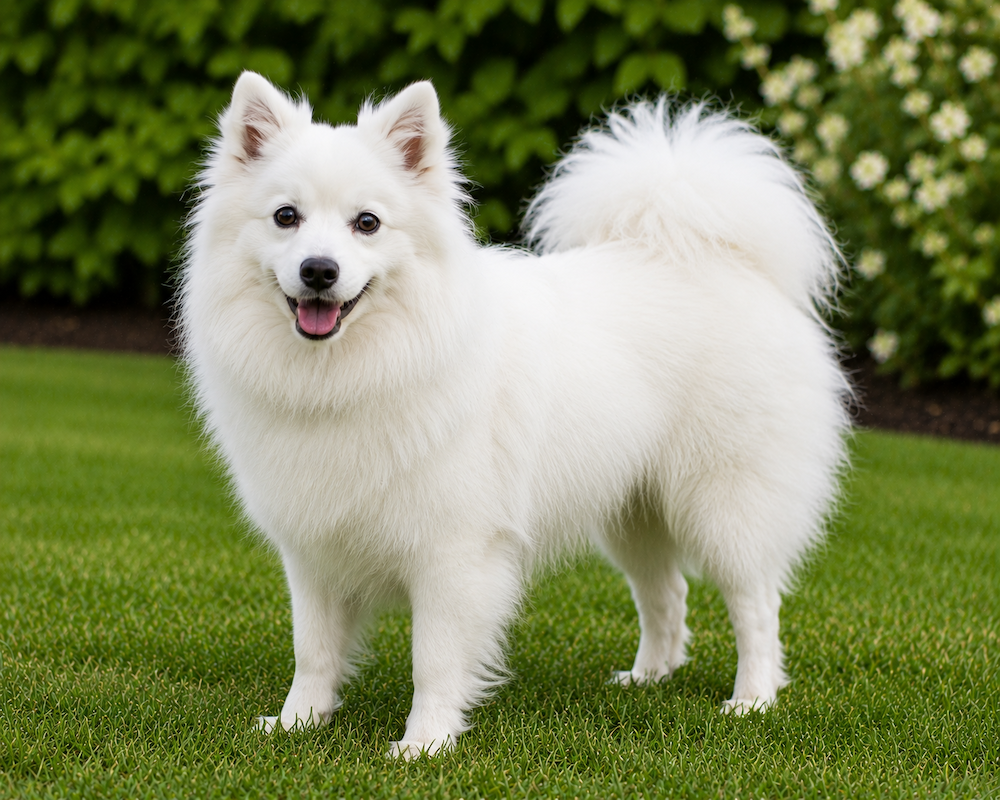







Beautiful, intelligent, and always smiling — a fluffy companion that loves learning, playing, and being with its family.
🧠 QUICK SNAPSHOT
- Temperament: Intelligent, friendly, alert
- Energy Level: High
- Size: Small to medium
- Good With Families: Yes
- Trainability: Very high
- Grooming: High
- Best For: Families, active owners, companionship
📚 OVERVIEW
The American Eskimo Dog is a striking Spitz breed known for its brilliant white coat, fox-like face, and bright intelligence. Despite its name, the breed was developed in the United States and became famous for performing in travelling circuses thanks to its eagerness to learn and impressive agility.
Friendly, affectionate, and highly trainable, the American Eskimo Dog thrives on spending time with its family and enjoys having both physical activity and mental challenges every day.
✅ PROS & CONS
Pros
- Extremely intelligent and easy to train
- Affectionate and family-oriented
- Excellent watchdog
- Beautiful, eye-catching appearance
Cons
- Heavy seasonal shedding
- Requires regular brushing
- Can become vocal if bored
- Needs plenty of exercise and mental stimulation
Is an American Eskimo Dog a Good Family Dog?
Yes, the American Eskimo Dog can be an excellent family companion for households prepared to provide plenty of interaction, training and mental stimulation.
Often called the “Eskie,” these dogs are intelligent, playful and strongly attached to their families. Many enjoy being involved in virtually everything their people are doing.
They can be very good with respectful children, although supervision is sensible, particularly with the smaller varieties.
Eskies tend to be alert and can initially be reserved with strangers, making early socialisation important.
This isn’t usually a dog that wants to live quietly in the background. An American Eskimo Dog tends to consider itself a full participant in family affairs.
How Much Exercise Does an American Eskimo Dog Need?
An adult American Eskimo Dog generally needs around 45–90 minutes of exercise each day, depending on its size, age and individual energy level.
Daily walks, games, training and opportunities to explore can all contribute.
Mental exercise is particularly important because Eskies are exceptionally intelligent. Puzzle toys, trick training, obedience, agility and scent games can help keep their minds occupied.
Without enough stimulation, they may invent their own entertainment — often involving barking, digging or rearranging household possessions.
The Eskie’s fluffy appearance can make it look like a decorative companion dog.
Underneath all that white fur is a surprisingly energetic little athlete.
Is an American Eskimo Dog Easy to Train?
Yes, American Eskimo Dogs are generally highly trainable and can learn new behaviours remarkably quickly.
Their intelligence and responsiveness helped make them successful performers in travelling circuses during the late 19th and early 20th centuries.
Positive reinforcement and varied, engaging training sessions usually work extremely well.
However, intelligence has another side.
Eskies can also quickly learn behaviours owners didn’t intend to teach them. If barking gets attention or stealing something starts a game of chase, the dog may happily repeat the experiment.
Training should therefore be consistent from puppyhood.
With the right approach, an Eskie can learn an impressive range of commands, tricks and dog sports.
Does an American Eskimo Dog Shed?
Yes. American Eskimo Dogs are heavy shedders.
Their beautiful white coat is a dense double coat consisting of a thick undercoat beneath a longer outer coat.
Regular brushing — usually several times each week — helps remove loose hair and prevent tangles.
Shedding becomes particularly heavy during seasonal coat changes when the undercoat is released.
Interestingly, the coat naturally repels a surprising amount of dirt, so Eskies don’t necessarily need constant bathing to remain white.
Their coat should not normally be shaved simply to reduce shedding.
If you want an Eskie, it’s worth accepting early that white dog hair will eventually become part of your interior decorating scheme.
What Health Problems Are Common in American Eskimo Dogs?
American Eskimo Dogs are generally relatively healthy, but several inherited conditions occur within the breed.
Progressive retinal atrophy (PRA) is an important inherited eye disorder that can eventually cause blindness.
Patellar luxation, where the kneecap moves out of its normal position, can also occur, particularly in smaller dogs.
Hip dysplasia is another concern, especially in larger Eskies.
Dental disease can become an issue, particularly in smaller individuals, making regular dental care important.
Responsible breeders should conduct appropriate health screening and genetic testing rather than relying simply on the healthy appearance of their dogs.
How Long Do American Eskimo Dogs Live?
American Eskimo Dogs typically live around 13–15 years, with some individuals living even longer.
Their relatively long lifespan means choosing an Eskie can represent a substantial commitment.
Maintaining an appropriate body weight, providing regular exercise, caring for the teeth and arranging routine veterinary examinations can all contribute to healthy ageing.
Mental stimulation remains important throughout life because Eskies tend to remain alert and interested in their surroundings well into their senior years.
An older Eskie may slow down physically, but there’s a reasonable chance it will still be keeping a close eye on everything you’re doing.
What Sizes Do American Eskimo Dogs Come In?
The American Eskimo Dog is traditionally recognised in three size varieties: Toy, Miniature and Standard.
Toy Eskies are the smallest, generally standing around 23–30 cm at the shoulder.
Miniatures are approximately 30–38 cm.
Standards are generally around 38–48 cm.
Weight varies substantially according to height and build.
Despite the size differences, all three varieties share the same characteristic white double coat, pointed ears, plumed tail and alert expression.
Essentially, the Eskie allows owners to choose how much white fluff they’d like their household to contain.
Can an American Eskimo Dog Live in an Apartment?
Yes, an American Eskimo Dog can adapt very well to apartment living, particularly the Toy and Miniature varieties.
However, their physical size isn’t the main challenge.
Eskies are energetic, intelligent and often highly alert. They still require daily exercise and substantial mental stimulation.
Barking can also become an issue in apartments because many Eskies are quick to announce unfamiliar sounds, visitors or activity outside.
Early training to encourage calm behaviour can therefore make a significant difference.
A small home can work perfectly well provided the dog’s life outside those four walls is sufficiently interesting.
Do American Eskimo Dogs Bark a Lot?
American Eskimo Dogs can be quite vocal, particularly when they’re excited, bored or alerting their owners to something unusual.
Historically, their alertness made them useful watchdogs.
Unfortunately, an Eskie’s definition of “something worth reporting” may include visitors, neighbouring dogs, delivery drivers and mysterious noises several houses away.
Training from puppyhood can help teach appropriate quiet behaviour.
Adequate exercise and mental stimulation are also important because boredom can increase nuisance barking.
They’re usually much better described as watchdogs than guard dogs — they’re excellent at announcing that somebody has arrived.
Are American Eskimo Dogs Aggressive?
American Eskimo Dogs should not normally be aggressive, although some can be naturally reserved or cautious around unfamiliar people.
Early socialisation is important to help puppies develop confidence around different people, dogs, environments and experiences.
An under-socialised Eskie may become excessively suspicious or reactive.
Their alertness makes them naturally effective watchdogs, but owners shouldn’t encourage defensive behaviour simply because the dog is small or attractive.
A well-socialised Eskie should be confident and manageable rather than fearful or unnecessarily confrontational.
Are American Eskimo Dogs Good With Other Dogs?
American Eskimo Dogs are generally capable of living successfully with other dogs, particularly when socialised from an early age.
Many enjoy canine companionship and can be enthusiastic playmates.
Individual personality still matters, and introductions should always be managed appropriately.
Their intelligence and confidence can sometimes produce surprisingly bossy behaviour from a relatively small dog.
Regular positive exposure to other dogs during puppyhood can help develop good social skills.
Can American Eskimo Dogs Be Left Alone?
American Eskimo Dogs generally prefer plenty of human companionship and may struggle when routinely left alone for long periods.
They were developed as highly interactive working and companion dogs and tend to form close attachments to their families.
Some individuals can develop separation-related behaviours, including barking, destructive chewing or restlessness.
Puppies should gradually be taught that short periods alone are normal and safe.
Exercise and enrichment before longer absences can also help.
An Eskie can certainly learn independence, but it isn’t generally a breed that dreams of spending ten hours every day entertaining itself.
Is the American Eskimo Dog Actually From Alaska?
No. Despite its name, the American Eskimo Dog did not originate in Alaska and wasn’t developed by Inuit or other Arctic peoples.
The breed’s ancestors were European German Spitz-type dogs brought to the United States by immigrants, particularly during the 19th century.
They became popular as farm dogs, watchdogs and companions.
The name “American Eskimo Dog” was adopted in the United States during the early 20th century.
So one of the most surprising facts about the breed is also one of the simplest:
the American Eskimo Dog isn’t actually an Eskimo dog at all.
Why Did the German Spitz Become Known as the American Eskimo Dog?
The change from German-associated naming to American Eskimo Dog occurred during the anti-German sentiment surrounding World War I.
German names and associations became unpopular in the United States during this period, affecting everything from foods to dog breeds.
The white German Spitz-type dogs already established in America gradually became known as American Eskimo Dogs.
The exact development of the name contains some historical uncertainty, but the breed’s German Spitz ancestry is well established.
The modern name therefore tells us more about 20th-century American history than the geographical origins of the dog.
Were American Eskimo Dogs Really Circus Performers?
Yes. American Eskimo Dogs became popular performers in travelling circuses, particularly during the late 19th and early 20th centuries.
Their intelligence, trainability, agility and striking white appearance made them excellent performance dogs.
They could learn complicated tricks and routines while remaining visually distinctive in the circus ring.
One famous Eskie named Stout’s Pal Pierre is traditionally credited with performing as a tightrope-walking dog with the Barnum & Bailey Circus.
Circus performances helped introduce the breed to a much wider American audience.
That history also explains something modern owners quickly discover:
The Eskie doesn’t just learn tricks easily.
It often seems to believe an audience should be provided as well.