




Fluffy, affectionate, and full of personality — a tiny companion that combines intelligence with irresistible charm.
🧠 QUICK SNAPSHOT
- Temperament: Affectionate, intelligent, playful
- Energy Level: Moderate
- Size: Small
- Good With Families: Yes
- Trainability: High
- Grooming: Moderate to high
- Best For: Families, apartment living, companionship
📚 OVERVIEW
The Pomapoo is a cross between a Pomeranian and a Poodle, creating a lively and affectionate companion with a soft, fluffy coat and a bright personality. These little dogs are known for their intelligence, playful nature, and love of human companionship.
Pomapoos adapt well to apartments and smaller homes, provided they receive regular exercise, mental stimulation, and plenty of attention from their family.
✅ PROS & CONS
Pros
- Extremely affectionate and family-oriented
- Intelligent and easy to train
- Compact size suits apartment living
- Often lower shedding than many small breeds
Cons
- Requires regular grooming
- Can develop separation anxiety
- May bark when excited or alerting owners
- Needs daily interaction and mental stimulation
Is a Pomapoo a Good Family Dog?
Yes. A Pomapoo can be an affectionate, intelligent and playful family companion, particularly for households wanting a small dog that enjoys plenty of interaction.
The Pomapoo is a cross between a Pomeranian and a Toy or Miniature Poodle, so temperament can vary. Some are outgoing and energetic, while others are more relaxed and cuddly.
Their small size means they’re best with families who understand how to handle little dogs carefully.
Are Pomapoos Good With Children?
Pomapoos can be good with gentle, respectful children, particularly older children.
Very small Pomapoos can be accidentally injured by rough handling, dropping or enthusiastic play.
Interactions with toddlers and young children should therefore be closely supervised.
How Much Exercise Does a Pomapoo Need?
Most Pomapoos need around 30–60 minutes of activity each day.
Daily walks, games and short training sessions usually provide sufficient exercise.
Dogs inheriting more of the Poodle’s athleticism may need considerably more activity than their tiny appearance suggests.
Is a Pomapoo Easy to Train?
Usually, yes.
Poodles are exceptionally trainable, while Pomeranians are intelligent and quick learners in their own right.
Pomapoos generally respond well to positive reinforcement, although some inherit an independent streak.
Are Pomapoos Difficult to Toilet Train?
Some can be.
Like many very small dogs, Pomapoo puppies have small bladders and require frequent opportunities to toilet outside.
Consistency, supervision and reward-based training are important.
Does a Pomapoo Shed?
It varies.
A Pomapoo inheriting a curly Poodle-like coat may shed very little, while one with more of the Pomeranian’s double coat may shed noticeably.
Even puppies from the same litter can develop quite different adult coats.
Is a Pomapoo Hypoallergenic?
A Pomapoo cannot be guaranteed to be hypoallergenic.
Some inherit a low-shedding Poodle-type coat and may release less loose hair around the home.
However, dog allergens are also found in saliva and skin flakes, so crossing a Pomeranian with a Poodle doesn’t guarantee an allergy-friendly dog.
How Often Does a Pomapoo Need Grooming?
Most Pomapoos need brushing several times a week, with curly or longer coats potentially requiring daily attention.
Poodle-like coats may also need professional grooming approximately every six to eight weeks.
Regular dental care is particularly important in such a small dog.
What Health Problems Are Common in Pomapoos?
Pomapoos can inherit health conditions associated with either parent breed, including patellar luxation, dental disease, eye disorders, Legg-Calvé-Perthes disease, tracheal problems and certain heart conditions.
Some Pomeranian lines are also affected by alopecia and other coat or skin disorders.
Crossbreeding doesn’t automatically prevent inherited disease, making health testing of both parents important.
How Long Does a Pomapoo Live?
Pomapoos commonly live around 12–16 years, although individual lifespan varies.
Both parent breeds are relatively long-lived.
Healthy body weight, dental care, appropriate exercise and responsible breeding can all contribute to longevity.
How Big Does a Pomapoo Get?
Most Pomapoos weigh approximately 2.5–7 kg, although there’s considerable variation.
A Pomapoo produced from a Pomeranian and Toy Poodle will generally be smaller than one with Miniature Poodle ancestry.
Because this is a cross rather than a standardised breed, there’s no official adult height or weight.
When Is a Pomapoo Fully Grown?
Most Pomapoos reach close to their adult height by around 9–12 months.
They may continue filling out and developing their mature coat after that.
The eventual size depends heavily on the size of the Poodle parent and the individual dog’s genetics.
Is There a Teacup Pomapoo?
There is no officially recognised Teacup Pomapoo.
“Teacup” is a marketing term commonly applied to exceptionally small dogs rather than a recognised size variety.
Extreme miniaturisation can increase risks such as hypoglycaemia, fragile bones and dental problems.
Can a Pomapoo Live in an Apartment?
Yes. Pomapoos can make excellent apartment dogs.
They’re small and can receive much of their activity through walks, training and indoor play.
Barking may be a bigger consideration than available space, particularly if the dog inherits the Pomeranian’s alert temperament.
Can a Pomapoo Be Left Alone?
Adult Pomapoos can learn to tolerate reasonable periods alone, but many become strongly attached to their owners.
Both parent breeds tend to enjoy human interaction.
Gradual independence training can reduce the likelihood of separation-related behaviour.
Are Pomapoos Cuddly?
Many are extremely affectionate and cuddly.
Some love sitting on laps and following their owners around the house.
Others inherit a slightly more independent personality, so affection levels vary between individuals.
Do Pomapoos Bark a Lot?
They can.
Pomeranians are famously alert and vocal, while Poodles can also be effective watchdogs.
A Pomapoo may therefore quickly announce visitors, neighbours or mysterious noises that apparently require immediate investigation.
Early training can help control excessive barking.
Are Pomapoos Good With Other Dogs?
Generally, yes, particularly with good socialisation.
Their tiny size can make interactions with much larger dogs risky even when everyone is friendly.
Some Pomapoos can also inherit the Pomeranian’s extraordinary confidence around dogs many times their size.
Are Pomapoos Good With Cats?
Many can live successfully with cats.
Neither parent breed is primarily defined by extremely strong prey drive, although individual dogs may still chase.
Early introductions and socialisation improve the chances of peaceful coexistence.
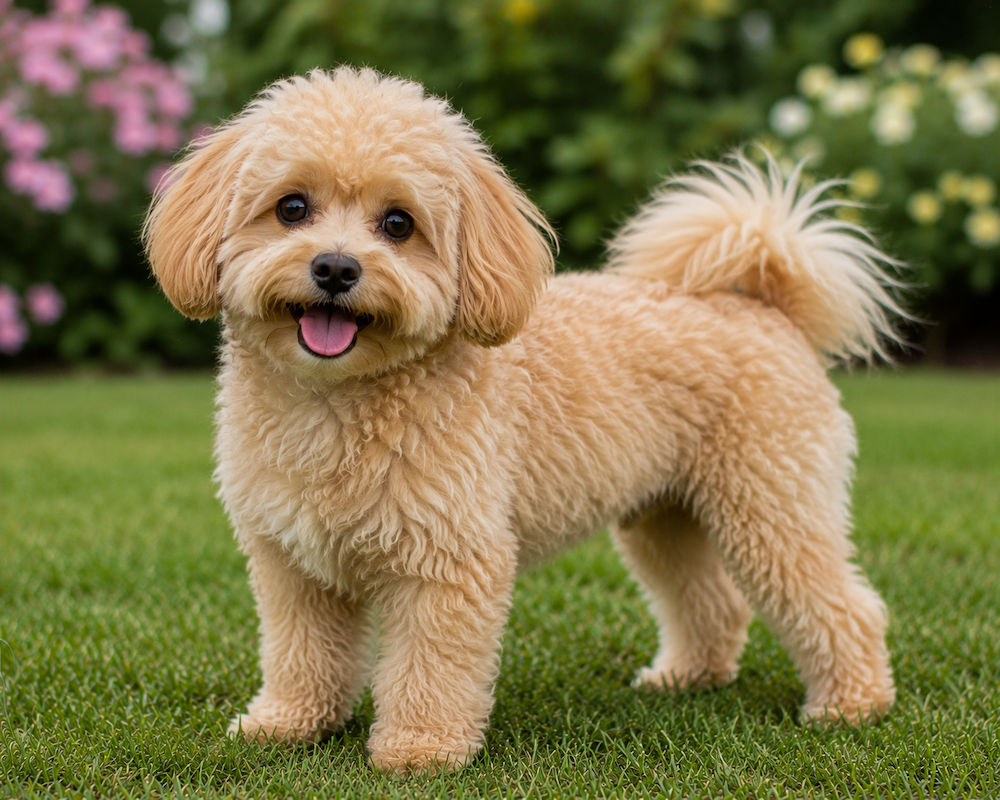
What Does a Pomapoo Look Like?
Pomapoos vary considerably.
They typically have a small body, expressive face and fluffy, wavy or curly coat.
Some look distinctly Poodle-like, while others inherit the Pomeranian’s pointed face, upright ears and very fluffy appearance.
There’s no single standard Pomapoo appearance.
What Colours Can Pomapoos Be?
Pomapoos can occur in numerous colours, including black, white, cream, apricot, red, brown, grey and combinations of these colours.
The wide range comes from the colour genetics of both Pomeranians and Poodles.
Some coats can also change noticeably as the dog matures.
What Is the Difference Between a Pomapoo and a Pomeranian?
A Pomeranian is an established purebred Spitz breed, while a Pomapoo is a Pomeranian × Poodle cross.
Pomapoos may have curlier, lower-shedding coats and somewhat different body proportions.
Their temperament can also combine the Pomeranian’s bold personality with the Poodle’s highly trainable nature.
What Is the Difference Between a Pomapoo and a Maltipoo?
A Pomapoo is Pomeranian × Poodle, while a Maltipoo is Maltese × Poodle.
Both are small Poodle crosses, but the Pomeranian brings Spitz ancestry, a dense double coat and a particularly alert personality.
The Maltese comes from a much older Mediterranean companion-dog tradition.
What Is the Difference Between a Pomapoo and a Peekapoo?
A Pomapoo combines a Pomeranian and Poodle, while a Peekapoo combines a Pekingese and Poodle.
Pomapoos are often somewhat more energetic and Spitz-like, while Peekapoos may inherit the Pekingese’s heavier build and shorter muzzle.
Individual dogs can vary substantially.
Is a Pomapoo a Purebred Dog?
No.
The Pomapoo is a cross between a Pomeranian and a Poodle.
It’s not recognised as a separate purebred breed by major traditional kennel clubs, and appearance, coat and temperament can therefore be less predictable than in a long-established breed.
What Does F1 Pomapoo Mean?
An F1 Pomapoo has one purebred Pomeranian parent and one purebred Poodle parent.
Genetically, the puppy receives approximately half its ancestry from each breed.
That doesn’t mean every visible characteristic will be an exact 50/50 combination.
What Is an F1B Pomapoo?
An F1B Pomapoo is generally produced by crossing an F1 Pomapoo back to one of the parent breeds, most commonly a Poodle.
This may increase the likelihood of a curlier, lower-shedding coat.
It still can’t guarantee coat type or hypoallergenic qualities.
Where Does the Pomapoo Come From?
The Pomapoo is a modern Poodle cross, generally associated with the growth of designer companion dogs in recent decades.
Pomeranian-Poodle crosses undoubtedly occurred previously, but there’s no well-documented single breeder, exact date or historical event that can reliably be described as the creation of the modern Pomapoo.
Its development is better understood as part of the broader popularity of small Poodle crosses.
Why Were Pomeranians Crossed With Poodles?
The combination aims to bring together characteristics associated with both breeds: the Pomeranian’s compact size and lively companion temperament with the Poodle’s intelligence and frequently low-shedding coat.
The results aren’t completely predictable, however.
A Pomapoo can inherit any mixture of characteristics from either side.
Is a Pomapoo Healthier Than a Purebred Dog?
Not automatically.
Crossbreeding can increase genetic diversity, but a Pomapoo can still inherit health conditions carried by either parent.
Responsible breeding requires appropriate health testing of the Pomeranian and Poodle parents, rather than assuming that being a crossbreed provides automatic protection from genetic disease.
Is a Pomapoo a Good Dog for Older People?
Often, yes.
Their small size, affectionate nature and manageable exercise requirements can make them excellent companions for older owners.
Potential owners should still consider grooming costs, barking and the physical fragility of exceptionally small individuals.
Is a Pomapoo a Good First Dog?
Yes. A Pomapoo can be a good choice for a first-time owner willing to provide regular grooming and training.
They’re generally intelligent, affectionate and physically manageable.
The biggest surprise for some owners is that a small fluffy dog isn’t necessarily a low-maintenance dog. Coat care, dental care, exercise and barking management can all require ongoing attention.
What Makes the Pomapoo Unique?
The Pomapoo combines two surprisingly different dogs.
The Pomeranian descends from much larger European Spitz dogs and somehow ended up as a tiny, fluffy companion that frequently behaves as though nobody informed it about the reduction in size.
The Poodle brings a working water-dog heritage, remarkable intelligence and its famous curly coat.
Put them together and you can get an affectionate, clever little dog with a huge personality — but not a completely predictable one.
One Pomapoo may have tight curls and barely shed.
Another may develop a fluffy Pomeranian-like coat.
One may be quiet and cuddly.
Another may consider itself responsible for reporting every person, bird and suspicious wheelie bin that passes the house.
That’s why the most important thing to understand about the Pomapoo is that it’s a genetic combination, not a fixed recipe.
And if it inherits the Pomeranian’s confidence along with the Poodle’s intelligence, there’s a reasonable chance it will eventually conclude that you’re the one being trained.