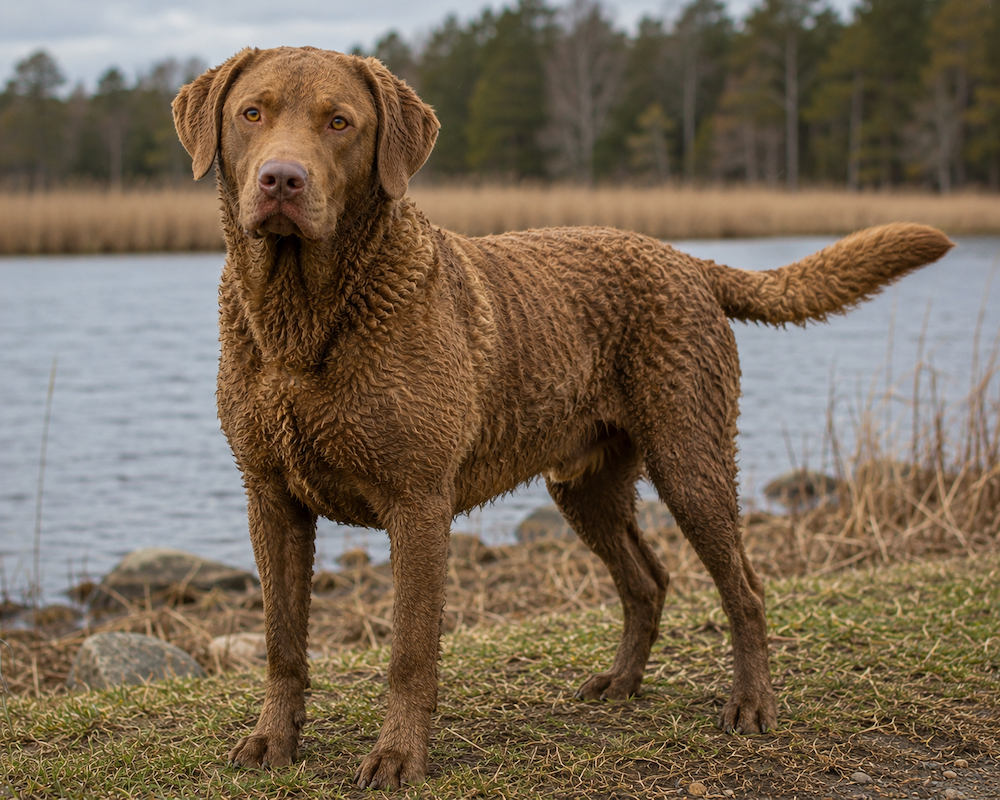







Powerful, loyal, and built for adventure — a hardworking retriever with an unwavering devotion to its family.
🧠 QUICK SNAPSHOT
- Temperament: Loyal, intelligent, determined
- Energy Level: High
- Size: Large
- Good With Families: Yes
- Trainability: High
- Grooming: Low
- Best For: Active families, hunters, outdoor enthusiasts
📚 OVERVIEW
The Chesapeake Bay Retriever, often called the “Chessie,” was developed along the rugged shores of the Chesapeake Bay in the United States to retrieve waterfowl in harsh weather conditions. Renowned for its strength, endurance, and distinctive waterproof coat, the Chessie is one of the toughest retriever breeds.
Unlike some retrievers, the Chesapeake Bay Retriever tends to be more reserved with strangers while remaining deeply loyal and affectionate with its family. It thrives in active homes where it has a job to do and plenty of opportunities to exercise.
✅ PROS & CONS
Pros
- Extremely loyal and devoted
- Highly intelligent and trainable
- Outstanding swimmer and retriever
- Excellent companion for active lifestyles
Cons
- Needs significant daily exercise
- Can be independent and strong-willed
- Requires early socialisation
- Best suited to experienced owners
Is a Chesapeake Bay Retriever a Good Family Dog?
Yes, the Chesapeake Bay Retriever can be an excellent family dog for active, experienced households.
Chessies are deeply loyal and tend to form strong bonds with their families. They can be affectionate and playful while retaining more independence and natural protectiveness than many other retriever breeds.
They are powerful working dogs and need training, exercise and socialisation.
Families expecting the universally outgoing personality often associated with a Labrador may find the Chesapeake noticeably more serious and reserved.
How Much Exercise Does a Chesapeake Bay Retriever Need?
Most adult Chesapeake Bay Retrievers need around 90 minutes or more of substantial daily exercise, ideally including activities that challenge their minds.
Swimming, retrieving, hiking, scent work and structured training are excellent options.
These dogs were developed for demanding days retrieving waterfowl in difficult conditions.
Simply walking around the block usually won’t satisfy a young, healthy Chessie.
Give one a combination of water, retrieving and a job to accomplish, and you’re getting very close to what the breed was built for.
Is a Chesapeake Bay Retriever Easy to Train?
Chesapeake Bay Retrievers are highly intelligent and trainable, but they can be independent and strong-minded.
They were bred to work in difficult conditions and make decisions without constant direction from a handler.
Positive, consistent training works best.
They can be sensitive to unfair or excessively harsh handling while simultaneously requiring clear boundaries.
For an experienced trainer, the Chessie’s combination of intelligence, determination and work ethic can be exceptional.
Does a Chesapeake Bay Retriever Shed?
Yes. Chesapeake Bay Retrievers shed considerably, particularly during seasonal coat changes.
They have a dense double coat designed to protect them in cold water.
Regular brushing helps remove dead undercoat, although excessive grooming that strips the coat’s natural oils isn’t desirable.
Their coat may be relatively short, but anyone expecting that to mean very little shedding may be surprised.
Is a Chesapeake Bay Retriever Hypoallergenic?
No. Chesapeake Bay Retrievers aren’t hypoallergenic.
They have dense double coats and shed throughout the year.
People with dog allergies react primarily to proteins found in dander, saliva and skin secretions rather than simply the visible hair.
The Chessie isn’t generally a suitable choice for someone specifically seeking a low-shedding breed.
What Health Problems Are Common in Chesapeake Bay Retrievers?
Chesapeake Bay Retrievers are generally robust working dogs, but several inherited conditions can occur.
Important concerns include hip and elbow dysplasia, progressive retinal atrophy and other eye disorders.
Degenerative myelopathy and exercise-induced collapse are also relevant in some lines, and responsible breeders can use available genetic testing alongside physical health screening.
As with other deep-chested dogs, owners should also understand the signs of gastric dilatation-volvulus, or bloat.
How Long Do Chesapeake Bay Retrievers Live?
Chesapeake Bay Retrievers commonly live around 10–13 years.
Good breeding, regular exercise, preventive veterinary care and maintaining a healthy body weight can all contribute to longevity.
Because they’re naturally powerful dogs, excess weight can place unnecessary stress on the hips, elbows and other joints.
A fit Chessie should look athletic and functional rather than excessively heavy.
How Big Does a Chesapeake Bay Retriever Get?
The Chesapeake Bay Retriever is a medium-to-large, powerfully built dog.
Males typically stand around 58–66 cm at the shoulder, while females are approximately 53–61 cm.
Males commonly weigh about 29–36 kg, with females generally around 25–32 kg.
They should combine strength with stamina and athleticism rather than looking like oversized, heavy retrievers.
Can a Chesapeake Bay Retriever Live in an Apartment?
Technically yes, but the Chesapeake Bay Retriever is rarely an ideal apartment breed.
A sufficiently exercised adult may settle calmly indoors.
However, Chessies are large, active working dogs that benefit from space, regular outdoor activity and substantial mental stimulation.
An apartment owner would need to make exercise and training a major part of everyday life.
A backyard alone isn’t enough either — these dogs need meaningful interaction and activity.
Can a Chesapeake Bay Retriever Be Left Alone?
Adult Chessies can generally learn to spend reasonable periods alone.
They’re often somewhat more independent than extremely people-dependent companion breeds.
However, they’re still strongly bonded to their families and shouldn’t routinely be isolated for long days.
An under-exercised Chesapeake can become destructive or develop unwanted behaviours.
Physical exercise and mental work before periods alone can make a substantial difference.
Are Chesapeake Bay Retrievers Good With Children?
Well-socialised Chesapeake Bay Retrievers can be very good with children within their family.
They’re typically loyal and affectionate with people they know.
However, they’re large, strong dogs capable of accidentally knocking over small children.
Their more protective nature also means owners should supervise interactions involving visiting children and teach the dog appropriate behaviour around energetic play.
Are Chesapeake Bay Retrievers Good With Other Dogs?
Chesapeake Bay Retrievers can live successfully with other dogs, although they’re often less universally sociable than Labradors or Golden Retrievers.
Some individuals can be assertive or selective, particularly as they mature.
Early socialisation and appropriate introductions are important.
Their strength means owners should take any developing dog-to-dog issues seriously rather than assuming every retriever automatically loves every other dog.
Are Chesapeake Bay Retrievers Good With Cats?
Chessies can live successfully with cats, particularly when raised alongside them.
However, they are hunting retrievers and can have considerable interest in moving animals.
Individual prey drive varies.
A household cat may be treated completely differently from an unfamiliar animal encountered outdoors.
Early introductions and training provide the best chance of peaceful coexistence.
Are Chesapeake Bay Retrievers Protective?
Yes. Chesapeake Bay Retrievers can possess a noticeably stronger protective instinct than many other retrievers.
They tend to be devoted to their families and may be reserved or watchful around strangers.
Historically, Chessies weren’t merely expected to retrieve birds — stories of their working role also include protecting boats, equipment and hunters’ possessions.
A stable Chesapeake should be confident and discerning rather than indiscriminately aggressive.
Are Chesapeake Bay Retrievers Aggressive?
A correctly bred Chesapeake Bay Retriever shouldn’t be unpredictably or indiscriminately aggressive.
However, the breed can be more assertive, reserved and protective than the stereotypical outgoing retriever.
Genetics, socialisation, training and management all matter.
Owners should aim for a confident dog that can calmly accept unfamiliar people and situations without needing to greet everyone enthusiastically.
Do Chesapeake Bay Retrievers Bark a Lot?
Chessies aren’t generally known as constant barkers.
However, their alert and protective nature means they may bark when someone approaches the property or something unusual occurs.
Boredom can increase vocal behaviour.
They tend to have a more serious watchdog instinct than many retriever breeds, so some alert barking should be expected.
Do Chesapeake Bay Retrievers Love Water?
Yes. A love of water is one of the Chesapeake Bay Retriever’s most famous characteristics.
The breed was developed specifically to retrieve waterfowl from the waters around Chesapeake Bay, often under extremely difficult conditions.
Many Chessies are powerful, enthusiastic swimmers.
Their coat, body structure and working temperament all reflect generations of selection for water work.
For many of them, finding water isn’t the problem — convincing them it’s time to come out can be.
Why Is a Chesapeake Bay Retriever Such a Strong Swimmer?
Chessies combine a powerful body, strong limbs, excellent stamina and water-resistant double coat.
Their feet are also well suited to swimming.
Most importantly, generations of working selection favoured dogs willing to repeatedly enter cold, rough water.
They weren’t bred simply to paddle recreationally.
A working Chesapeake needed to swim out, locate a downed bird, retrieve it and repeat the process many times.
Does a Chesapeake Bay Retriever Have Webbed Feet?
Yes. Chesapeake Bay Retrievers have well-developed webbing between their toes, which helps make the paws effective paddles.
Webbing isn’t unique to Chessies — many dogs have some degree of interdigital webbing.
However, it is particularly useful in breeds developed for water work.
Combined with their powerful swimming stroke and endurance, it helps explain the Chesapeake’s reputation as an exceptional aquatic retriever.
Why Does a Chesapeake Bay Retriever Have an Oily Coat?
The Chesapeake’s coat contains natural oils that help repel water.
It has a short, harsh outer coat and dense woolly undercoat.
This combination helps prevent icy water from penetrating quickly to the skin and provides insulation during cold-water retrieves.
A healthy Chessie coat may have a distinctive feel and sometimes a noticeable natural odour.
Frequent aggressive shampooing can remove the oils that help the coat perform its original function.
Why Is a Chesapeake Bay Retriever’s Coat Wavy?
A Chesapeake’s coat commonly develops waves over the shoulders, neck, back and loin, while the hair on the face and legs remains relatively short and straight.
The combination of texture, density and natural oil helps produce the breed’s characteristic water-resistant coat.
Excessively long or curly hair isn’t the goal.
This is fundamentally a functional working coat designed to keep a retriever operating in cold water.
What Colours Can Chesapeake Bay Retrievers Be?
Traditional Chesapeake Bay Retriever colours are various shades of brown, sedge and deadgrass.
These colours range from darker chocolate-like browns through reddish shades to faded tan or straw-like tones.
Small white markings may be permitted in limited areas under some breed standards.
The natural earth-toned colours helped working dogs blend into marshes, reeds and shoreline vegetation.
What Is “Deadgrass” in a Chesapeake Bay Retriever?
Deadgrass is a recognised Chesapeake coat colour resembling dried grass or straw.
It can range from a faded tan to a dull straw shade.
The unusual name makes perfect sense when a deadgrass Chessie is standing among winter marsh vegetation.
Rather than being developed primarily for visual novelty, the breed’s traditional colours harmonised naturally with the environment in which these dogs worked.
What Is “Sedge” in a Chesapeake Bay Retriever?
Sedge describes reddish or yellowish-red shades found in Chesapeake Bay Retrievers.
The term comes from the colour of vegetation commonly found around wetlands.
Together with brown and deadgrass, it forms part of the breed’s traditional natural colour palette.
These earthy shades are strongly associated with the marshland environment surrounding Chesapeake Bay.
Why Do Some Chesapeake Bay Retrievers Have Yellow or Amber Eyes?
The breed is known for relatively light yellowish or amber-coloured eyes.
This unusual eye colour contributes greatly to the Chesapeake’s distinctive expression.
Breed standards traditionally describe the eyes as yellowish or amber and relatively clear.
Combined with the brown, sedge or deadgrass coat, the light eyes can make a Chessie instantly recognisable to people familiar with the breed.
What Is the Difference Between a Chesapeake Bay Retriever and a Labrador Retriever?
Both are powerful retrieving breeds, but their personalities and histories differ considerably.
Labradors are generally famous for being highly sociable and outgoing, while Chessies tend to be more reserved, independent and naturally protective.
The Chesapeake’s coat is also distinctive, with its oily texture and characteristic waves.
Both can be outstanding working retrievers, but a Chessie often has a more serious, determined personality and may require a more experienced owner.
What Is the Difference Between a Chesapeake Bay Retriever and a Golden Retriever?
Golden Retrievers tend to be more openly sociable and eager to interact with unfamiliar people, while Chesapeake Bay Retrievers can be more reserved and protective.
Their coats are also completely different.
Goldens have long feathered coats, whereas Chessies have short, dense, oily, water-resistant double coats.
Both were developed as sporting retrievers, but the Chesapeake was particularly shaped by demanding cold-water work around Chesapeake Bay.
What Were Chesapeake Bay Retrievers Originally Bred to Do?
Chesapeake Bay Retrievers were developed primarily to retrieve ducks and other waterfowl for hunters.
Their work could involve cold water, strong currents, ice and repeated retrieves over considerable distances.
The dogs needed tremendous stamina and determination.
They were also valued for guarding boats, equipment and property.
The resulting breed wasn’t merely a friendly retriever — it was a rugged American working dog expected to perform in some extremely unpleasant conditions.
Could Chesapeake Bay Retrievers Really Retrieve Hundreds of Ducks in a Day?
Historical accounts sometimes claim exceptional Chesapeake Bay Retrievers retrieved 100, 200 or even more birds during major market-hunting shoots.
Such numbers are difficult to verify consistently and shouldn’t be treated as a normal daily workload.
However, commercial waterfowl hunting during the 19th century could involve enormous numbers of birds.
The breed unquestionably developed a reputation for repeated cold-water retrieves and extraordinary endurance, which is more important than any particular legendary number.
Did the Chesapeake Bay Retriever Begin With Two Shipwrecked Dogs?
The traditional origin story says yes.
In 1807, a ship reportedly rescued the crew of a wrecked vessel off the coast of Maryland. Two Newfoundland-type puppies aboard the rescued ship — a male named Sailor and a female named Canton — were subsequently kept in the Chesapeake Bay region.
Both became famous for their retrieving ability.
They weren’t bred to each other, but each reportedly contributed to local water-dog populations that eventually helped create the Chesapeake Bay Retriever.
Who Were Sailor and Canton?
Sailor and Canton were two Newfoundland-type dogs central to the Chesapeake Bay Retriever’s traditional foundation story.
They arrived in Maryland after a maritime rescue in 1807.
Sailor was described as a reddish male, while Canton was a darker female named after the ship involved in their journey.
Both reportedly became outstanding water retrievers and were bred to local dogs.
Their descendants were subsequently selected for the qualities needed by Chesapeake Bay hunters.
Is the Chesapeake Bay Retriever an American Breed?
Yes. The Chesapeake Bay Retriever is a distinctly American breed.
Its development centred around Chesapeake Bay on the Atlantic coast of Maryland and Virginia.
Local hunters selectively bred dogs capable of working in the bay’s cold water and difficult weather.
Although Newfoundland-type dogs played an important role in the breed’s ancestry, the Chesapeake itself was shaped in the United States for specifically American hunting conditions.
Was the Chesapeake Bay Retriever One of the First AKC-Recognised Breeds?
Yes. Chesapeake Bay Retrievers were among the breeds registered during the early years of the American Kennel Club in the late 19th century.
This reflects how well established the Chesapeake already was as an American sporting dog.
Formal standards eventually consolidated several regional Chesapeake retriever types into the breed recognised today.
Its history therefore predates many of the modern dog breeds that later became popular in the United States.
Is the Chesapeake Bay Retriever Maryland’s State Dog?
Yes. The Chesapeake Bay Retriever was designated the official state dog of Maryland in 1964.
Few breeds are as closely connected with a particular American landscape.
Its name, coat, working style and history are all tied directly to Chesapeake Bay.
It is also famously associated with the University of Maryland, Baltimore County, whose athletic teams are known as the Retrievers.
Where Does the Chesapeake Bay Retriever Come From?
The Chesapeake Bay Retriever comes from the Chesapeake Bay region of Maryland and Virginia in the United States.
Its traditional history begins with Sailor and Canton, two Newfoundland-type dogs brought ashore following a maritime rescue in 1807. Their descendants and other local dogs were selectively bred for exceptional water-retrieving ability.
Generations of hunters then shaped a dog capable of swimming through cold water, retrieving repeatedly, tolerating harsh weather and protecting valuable equipment.
Few breed names describe their history so perfectly: the Chesapeake Bay Retriever wasn’t merely named after the bay — it was quite literally built by it.