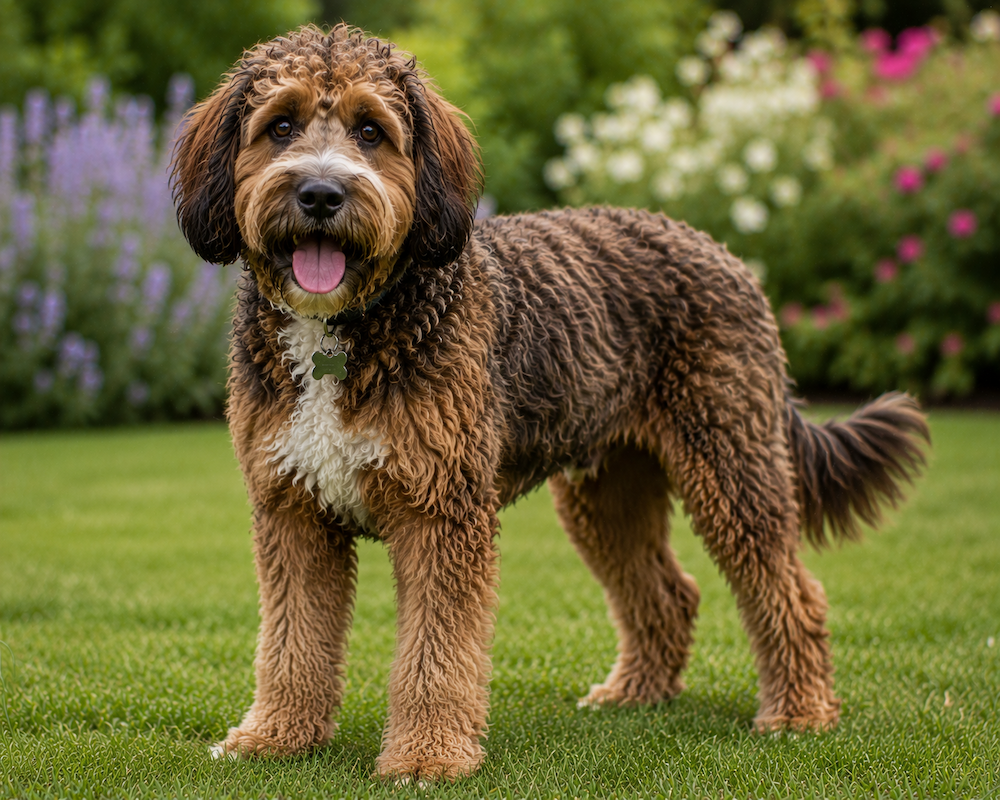






Intelligent, playful, and full of energy — a fun-loving companion that combines the athleticism of the Boxer with the intelligence of the Poodle.
🧠 QUICK SNAPSHOT
- Temperament: Friendly, intelligent, energetic
- Energy Level: High
- Size: Medium to large
- Good With Families: Yes
- Trainability: High
- Grooming: Moderate to high
- Best For: Active families, companionship, outdoor lifestyles
📚 OVERVIEW
The Boxerdoodle is a cross between a Boxer and a Poodle, creating an affectionate, intelligent, and athletic companion. This hybrid often inherits the Boxer’s playful personality and the Poodle’s quick mind, making it an engaging dog that loves learning and spending time with its family.
Boxerdoodles thrive in active households where they receive plenty of exercise, training, and companionship. Their appearance varies depending on the parent dogs, but most have a sturdy build and a soft, wavy or curly coat.
✅ PROS & CONS
Pros
- Highly intelligent and easy to train
- Loyal and affectionate with family
- Great with children and active households
- Often lower shedding than many large breeds
Cons
- Requires regular grooming
- High exercise and mental stimulation needs
- Can become bored if left inactive
- May develop separation anxiety if left alone too long
Is a Boxerdoodle a Good Family Dog?
Yes, a Boxerdoodle can be an excellent family dog, particularly for an active household wanting an affectionate, intelligent and playful companion.
The Boxerdoodle is a cross between a Boxer and a Poodle, usually a Standard Poodle. Both parent breeds tend to form strong relationships with people, so many Boxerdoodles become highly involved family dogs.
They can be very good with children, although their size and enthusiasm may overwhelm smaller youngsters.
Because the Boxerdoodle isn’t a standardised breed, temperament can vary considerably between individuals.
How Much Exercise Does a Boxerdoodle Need?
Most adult Boxerdoodles need around 60–90 minutes of exercise each day, along with regular mental stimulation.
Walking, hiking, retrieving, swimming, training and interactive games can all suit them.
Poodle influence can contribute considerable athleticism and intelligence, while Boxer influence often adds an enthusiastic approach to almost everything.
Dogs inheriting a shorter Boxer-like muzzle require additional care during strenuous exercise and hot weather.
This is generally an active cross rather than a low-energy companion.
Is a Boxerdoodle Easy to Train?
Boxerdoodles are usually intelligent and highly trainable.
Poodles are exceptionally trainable working dogs, while Boxers are intelligent but can bring a playful, independent streak.
Positive reinforcement and food rewards usually work well.
Training should begin early, particularly for loose-lead walking, recall and calm greetings.
The combination can produce a dog that learns new commands extremely quickly — including behaviours its owner didn’t actually intend to teach.
Does a Boxerdoodle Shed?
A Boxerdoodle’s shedding can range from very low to moderate, depending on which type of coat it inherits.
A curly Poodle-like coat may shed relatively little.
A short Boxer-like coat can shed more noticeably, while some Boxerdoodles develop a wavy or shaggy coat somewhere between the two.
Coat type can vary even among puppies in the same litter.
Having a Poodle parent therefore doesn’t guarantee a non-shedding Boxerdoodle.
Is a Boxerdoodle Hypoallergenic?
No Boxerdoodle can be guaranteed to be hypoallergenic.
Some curly-coated individuals may shed relatively little and could be better tolerated by certain allergy sufferers.
However, dog allergens are found in saliva, dander and other secretions rather than simply shed hair.
Dogs inheriting more Boxer coat characteristics may also shed considerably more than expected.
Anyone with significant allergies should spend time around similar adult dogs before choosing this cross.
How Often Does a Boxerdoodle Need Grooming?
Boxerdoodle grooming requirements depend heavily on coat type.
Curly or dense Poodle-like coats may require brushing several times a week or even daily, plus professional grooming approximately every six to eight weeks.
Wavy coats can also mat surprisingly quickly.
Dogs inheriting the Boxer’s short coat may need little more than regular brushing.
This means one Boxerdoodle might require professional clipping throughout its life while another needs only basic coat maintenance.
What Health Problems Are Common in Boxerdoodles?
Boxerdoodles can potentially inherit health conditions found in both Boxers and Poodles.
Boxer-related concerns include heart disease, certain cancers, hip problems and degenerative myelopathy. Shorter-faced individuals may also experience brachycephalic airway problems.
Poodles can be affected by hip dysplasia, inherited eye disorders, sebaceous adenitis and several other genetic conditions, depending partly on Poodle size.
Responsible breeders should undertake appropriate health screening of both parents.
Crossbreeding doesn’t automatically eliminate inherited disease.
How Long Do Boxerdoodles Live?
Boxerdoodles commonly live around 10–14 years, although lifespan varies according to size, genetics and health.
Dogs produced from smaller Poodles may sometimes be smaller and longer-lived than those produced from Standard Poodles, but there are no guarantees.
Maintaining a healthy body weight, providing regular exercise and arranging preventive veterinary care can support longevity.
Health history on both sides of the family remains particularly important.
How Big Does a Boxerdoodle Get?
Boxerdoodle size can vary considerably depending on the size of Poodle used in the cross.
Standard Boxerdoodles are generally medium-to-large dogs and may weigh somewhere around 20–32 kg or more.
Crosses involving smaller Poodles can produce considerably smaller dogs.
Terms such as “Mini Boxerdoodle” aren’t governed by one universal breed standard.
Prospective owners should therefore ask for the actual height and weight of both parents rather than relying entirely on size labels.
Can a Boxerdoodle Live in an Apartment?
A Boxerdoodle can live in an apartment, but it requires sufficient daily exercise and mental stimulation.
Smaller individuals may be physically easier to accommodate, but size isn’t the only consideration.
Young Boxerdoodles can be energetic, playful and enthusiastic indoors.
Regular walks, training and opportunities to explore are essential.
A well-exercised adult may settle beautifully, while a bored Boxerdoodle can turn a small apartment into a remarkably interactive environment.
Can a Boxerdoodle Be Left Alone?
Boxerdoodles can learn to spend reasonable periods alone, but many are strongly people-oriented.
Both Boxers and Poodles were developed to work closely with humans, and Boxers in particular tend to become deeply attached to their families.
Long periods of isolation can contribute to boredom or separation-related behaviour.
Gradual independence training during puppyhood is valuable.
Mental enrichment and sufficient exercise before alone time can also help.
Are Boxerdoodles Good With Other Dogs?
Boxerdoodles are generally good with other dogs when properly socialised.
Many inherit the Boxer’s enthusiasm for physical play and the Poodle’s sociability.
However, a large, energetic Boxerdoodle can overwhelm smaller or quieter dogs.
Some Boxers can also develop same-sex intolerance, so individual temperament matters.
Early socialisation should encourage calm interactions as well as energetic play.
Are Boxerdoodles Good With Cats?
Many Boxerdoodles can live successfully with cats, particularly when raised alongside them.
Individual prey drive varies.
Poodles have sporting and retrieving ancestry, while Boxers can enjoy chasing fast-moving animals.
A household cat may therefore be accepted while an unfamiliar running cat triggers pursuit.
Careful introductions and safe areas where cats can escape interaction are important.
Do Boxerdoodles Like Water?
Many Boxerdoodles enjoy swimming, particularly those strongly influenced by their Poodle ancestry.
Poodles were originally developed as water retrievers and are often excellent swimmers.
However, Boxer characteristics can alter both enthusiasm and swimming ability.
Dogs with short muzzles or particularly Boxer-like body proportions may be less efficient in the water.
Every dog should be introduced gradually and supervised around pools, rivers and open water.
Can Boxerdoodles Handle Hot Weather?
Boxerdoodles can be sensitive to hot weather, particularly if they inherit the Boxer’s shortened muzzle.
Brachycephalic airway anatomy can make panting less efficient and increase the risk of overheating.
Dogs with longer Poodle-like muzzles may have fewer breathing limitations, although all dogs still require protection from extreme heat.
Exercise should be scheduled during cooler periods, with constant access to shade and fresh water.
Facial structure matters considerably in this particular cross.
Are Boxerdoodles Good Guard Dogs?
A Boxerdoodle can make a good watchdog, although guarding behaviour varies significantly.
Boxers have a strong history as guardians and can be naturally protective of their families.
Poodles are also highly alert dogs but aren’t generally selected primarily for protection.
Some Boxerdoodles may therefore be watchful and reserved around unfamiliar people, while others enthusiastically welcome almost everyone.
Good socialisation should always be prioritised over encouraging unnecessary suspicion.
Are Boxerdoodles as Playful as Boxers?
Many Boxerdoodles are extremely playful, even well into adulthood.
Boxers are famous for retaining an almost puppy-like enthusiasm throughout much of their lives.
Poodles are also active, intelligent dogs that often enjoy retrieving and interactive games.
Combining the two can produce a dog that sees considerable potential for entertainment in ordinary household life.
A Boxerdoodle may mature physically long before it decides that acting like a puppy has become unnecessary.
What Colours Can Boxerdoodles Be?
Boxerdoodles can occur in a wide variety of colours and patterns.
Possible colours include black, brown, cream, apricot, red, fawn and brindle, along with dogs displaying substantial white markings.
The Poodle contributes considerable colour diversity, while the Boxer contributes characteristic fawn, brindle and white patterns.
Coat colour can also change as some dogs mature because certain Poodle colour genes cause progressive fading.
Colour should always be secondary to health and temperament.
Does a Boxerdoodle Look More Like a Boxer or a Poodle?
A Boxerdoodle can look strongly like either parent or somewhere in between.
Some have curly Poodle-like coats covering a relatively Boxer-like body.
Others develop shaggy or wavy coats, while occasional individuals may have much shorter hair.
Muzzle length, body shape, ears and overall size can also vary.
Even littermates can look surprisingly different.
This unpredictability is normal in a cross that hasn’t been selectively bred to a consistent standard over many generations.
What Is an F1, F1B or F2 Boxerdoodle?
An F1 Boxerdoodle is generally a first-generation Boxer crossed with a Poodle.
An F1B Boxerdoodle usually results from breeding an F1 Boxerdoodle back to one of the parent breeds, commonly a Poodle.
An F2 Boxerdoodle generally results from breeding two F1 Boxerdoodles.
These labels describe ancestry rather than guaranteed characteristics.
For example, an F1B puppy with greater Poodle ancestry isn’t automatically non-shedding or hypoallergenic.
Is a Boxerdoodle a Recognised Dog Breed?
The Boxerdoodle is generally considered a designer crossbreed rather than a standardised pedigree breed.
Major traditional kennel clubs don’t recognise it in the same way they recognise the Boxer or Poodle.
There is therefore no universally accepted standard for Boxerdoodle size, coat, colour or temperament.
Two dogs sold as Boxerdoodles can consequently look remarkably different.
Parent health, temperament and responsible breeding practices matter much more than the designer label.
Does Crossing a Boxer With a Poodle Make Boxerdoodles Healthier?
Crossbreeding can increase genetic diversity, but it doesn’t guarantee healthier puppies.
A Boxerdoodle can still inherit genetic conditions from either parent.
It may also inherit structural characteristics from the Boxer, such as a shortened muzzle, while carrying disease-associated genes from either family line.
Responsible breeding therefore requires appropriate health screening of both Boxers and Poodles.
“Hybrid vigour” can be a legitimate population-genetics concept, but it isn’t a substitute for careful breeding and health testing.
Where Did the Boxerdoodle Come From?
The exact origin of the Boxerdoodle is poorly documented, and there is no universally recognised individual credited with creating the cross.
Boxer–Poodle crosses almost certainly occurred occasionally long before the name Boxerdoodle became popular.
Deliberately bred Boxerdoodles became more visible during the broader expansion of Poodle crosses in the late 20th and early 21st centuries.
The attraction is easy to understand: combining the Boxer’s affectionate, playful personality with the Poodle’s intelligence and potentially lower-shedding coat.
The result, however, isn’t a perfectly predictable blend — it’s a genetic roll of the dice involving two very distinctive breeds.