






Alert, intelligent, and full of spirit — Finland's national dog is an energetic companion with a striking fox-like appearance.
🧠 QUICK SNAPSHOT
- Temperament: Friendly, intelligent, alert
- Energy Level: High
- Size: Medium
- Good With Families: Yes
- Trainability: Moderate
- Grooming: Moderate
- Best For: Active families, outdoor enthusiasts, experienced owners
📚 OVERVIEW
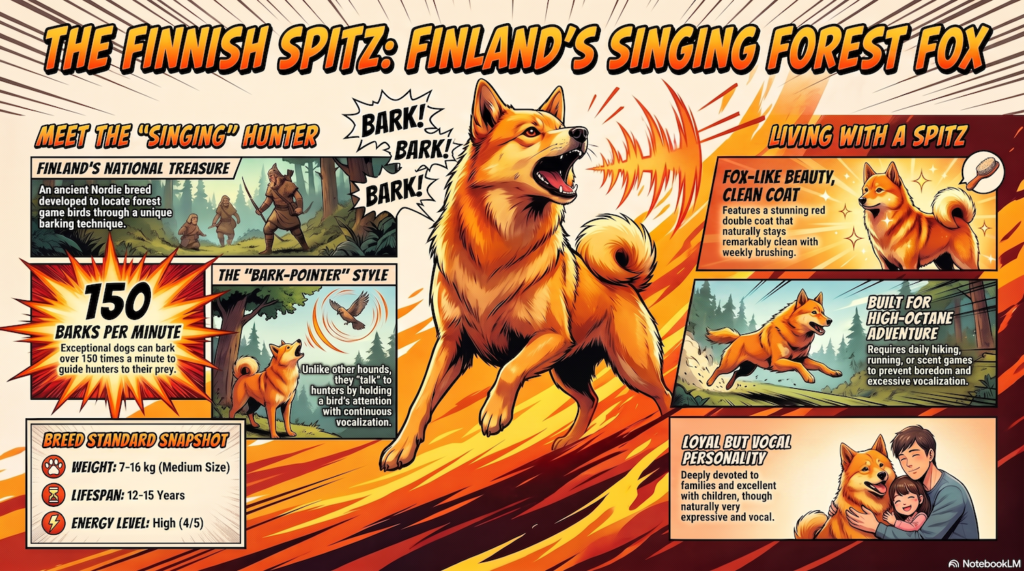
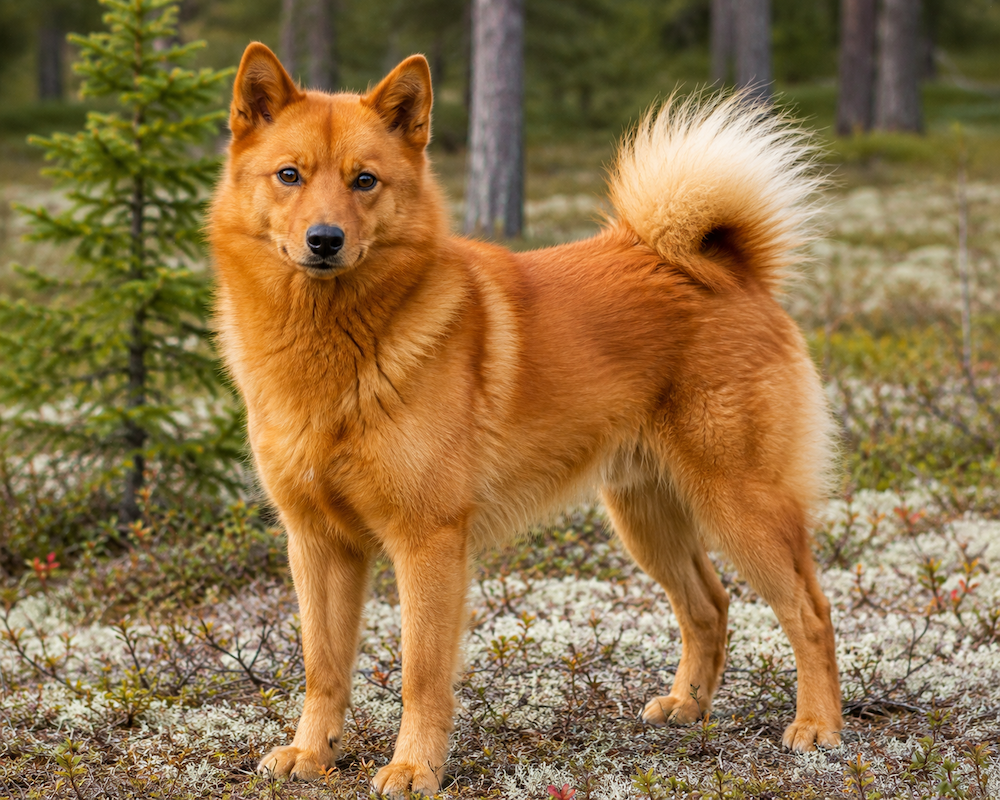
The Finnish Spitz is Finland’s national dog and has been used for centuries as a hunting companion, particularly for locating game birds. Recognisable by its rich golden-red coat, curled tail, and fox-like face, this breed is both beautiful and highly energetic.
Finnish Spitz dogs are affectionate with their families, intelligent, and naturally alert. They enjoy being active and are happiest in homes where they can explore, play, and spend plenty of time with their owners.
✅ PROS & CONS
Pros
- Friendly and affectionate with family
- Intelligent and highly alert
- Beautiful, distinctive appearance
- Excellent companion for active owners
Cons
- Can be very vocal
- Needs plenty of daily exercise
- Independent personality may make training challenging
- Heavy seasonal shedding
Is a Finnish Spitz a Good Family Dog?
Yes. The Finnish Spitz can be an excellent family dog for an active household comfortable with an intelligent, independent and famously vocal companion.
They’re typically affectionate and loyal with their family while retaining the self-confidence expected of a hunting Spitz.
They tend to be lively rather than hyperactive and often maintain a playful, almost puppy-like personality well into adulthood.
How Much Exercise Does a Finnish Spitz Need?
Most adult Finnish Spitz need around 60–90 minutes of exercise each day, along with mental stimulation.
Long walks, hiking, scent games and opportunities to explore suit them particularly well.
They’re hunting dogs with considerable stamina, so a quick walk around the block usually won’t provide enough stimulation for a young, healthy dog.
Is a Finnish Spitz Easy to Train?
Finnish Spitz are intelligent but independent, so training can require patience.
They were bred to hunt at a distance from their owners and make decisions without constant human direction.
Positive reinforcement, variety and short training sessions usually work best.
Repetitive drilling may quickly convince a Finnish Spitz that there are more interesting things it could be doing.
Does a Finnish Spitz Shed?
Yes. Finnish Spitz have a dense double coat and can shed extremely heavily, particularly during seasonal coat changes.
The soft undercoat may come out in remarkable quantities during major shedding periods.
Regular brushing helps remove dead hair and prevents it from spreading throughout the house.
Is a Finnish Spitz Hypoallergenic?
No. The Finnish Spitz isn’t considered hypoallergenic.
Its substantial double coat sheds and distributes dander around the environment.
Anyone with significant dog allergies should spend time around adult Finnish Spitz before considering ownership.
How Often Does a Finnish Spitz Need Grooming?
Most Finnish Spitz need brushing once or twice each week, with much more frequent grooming during seasonal coat blows.
Their coat is relatively clean and functional and doesn’t generally require extensive trimming.
Routine nail, dental and ear care remains important.
Should You Shave a Finnish Spitz?
Generally, no.
The Finnish Spitz’s double coat provides insulation and environmental protection.
Routine shaving can interfere with normal coat function and regrowth.
Removing loose undercoat through appropriate brushing is preferable unless clipping is medically necessary.
What Health Problems Are Common in Finnish Spitz?
The Finnish Spitz is generally regarded as a relatively healthy and robust breed, but inherited conditions can still occur.
Potential concerns include patellar luxation, hip or elbow problems, epilepsy and certain eye disorders in some lines.
Responsible breeders should use appropriate health screening rather than assuming a traditional working breed is automatically free from genetic disease.
How Long Do Finnish Spitz Live?
Finnish Spitz commonly live around 12–15 years, with some individuals living longer.
Their moderate size and generally functional structure contribute to a respectable lifespan.
Genetics, body condition, exercise and preventive veterinary care all influence longevity.
How Big Does a Finnish Spitz Get?
The Finnish Spitz is a medium-small Spitz breed.
Adults are generally around 39–50 cm tall at the shoulder, with males larger than females.
Many weigh approximately 9–14 kg.
Their thick coats and upright posture can make them appear larger than their actual weight suggests.
Can a Finnish Spitz Live in an Apartment?
Yes, but there’s one major complication: barking.
Physically, the Finnish Spitz is a manageable size and can settle indoors when adequately exercised.
However, barking was deliberately cultivated as part of the breed’s hunting technique.
Thin apartment walls and a Finnish Spitz can therefore require exceptionally understanding neighbours.
Do Finnish Spitz Bark a Lot?
Yes. Finnish Spitz are among the most naturally vocal dog breeds.
Unlike breeds where excessive barking is an accidental behavioural problem, barking was deliberately selected because it was essential to the Finnish Spitz’s traditional hunting technique.
Training can establish reasonable boundaries, but expecting complete silence conflicts with centuries of breeding.
Why Does the Finnish Spitz Bark So Much?
The Finnish Spitz is a specialised bark-pointing hunting dog.
When it locates game, particularly birds in trees, it barks repeatedly to indicate the animal’s position to the hunter.
The barking also helps hold the quarry’s attention while the hunter approaches.
For this breed, barking isn’t merely communication — historically, barking was the job.
How Fast Can a Finnish Spitz Bark?
Experienced Finnish Spitz working at hunting trials can produce well over 100 barks per minute, with exceptionally rapid barking highly valued.
Finnish hunting competitions have traditionally measured barking performance alongside the dog’s ability to locate and hold game.
The speed can become so rapid that individual barks almost merge into a continuous sound.
Are There Barking Competitions for Finnish Spitz?
Yes. Finland has a long tradition of hunting trials in which Finnish Spitz are judged on their ability to locate game and bark effectively.
The dog’s barking frequency, persistence and ability to hold the bird’s attention can all matter.
There are even prestigious competitions associated with determining outstanding “King Barkers.”
Few breeds can claim that barking exceptionally well is a competitive achievement.
What Is the Finnish Spitz “King Barker”?
Finland has prestigious hunting competitions in which top Finnish Spitz compete for recognition based on their bird-finding and bark-pointing performance.
The title is commonly translated into English as King of the Barkers or King Barker.
It’s an extraordinary reversal of normal dog ownership: behaviour that might earn complaints in suburbia can earn trophies in Finland.
Can You Train a Finnish Spitz Not to Bark?
You can teach when barking is appropriate and when to stop, but eliminating barking entirely is unrealistic.
The instinct has been deliberately reinforced through generations of selective breeding.
A “quiet” cue, sufficient exercise and preventing habitual boredom barking can make the breed much easier to live with.
The goal should be control rather than complete suppression.
Can a Finnish Spitz Be Left Alone?
Adult Finnish Spitz can learn to spend reasonable periods alone, but they’re generally social dogs that enjoy family involvement.
Long periods of boredom can lead to barking or destructive behaviour.
Exercise, enrichment and gradual independence training are important.
They’re generally better suited to households where they receive meaningful daily interaction.
Are Finnish Spitz Good With Children?
Yes. Finnish Spitz are generally considered good family dogs and often enjoy children.
They’re typically playful, lively and affectionate.
Children should still learn respectful handling and dogs should always have somewhere quiet to retreat.
Their energetic play can be particularly enjoyable for active older children.
Are Finnish Spitz Good With Other Dogs?
Generally, yes, especially when properly socialised.
Finnish Spitz can be confident and occasionally assertive, so individual compatibility varies.
Early social experiences help develop appropriate canine communication.
They’re not generally expected to display indiscriminate aggression towards other dogs.
Are Finnish Spitz Good With Cats?
Finnish Spitz can live with cats, particularly when raised alongside them, but their hunting heritage needs to be considered.
They were developed to locate various game animals.
A household cat may be treated very differently from an unfamiliar animal running outdoors.
Careful introductions and supervision are important.
Do Finnish Spitz Have a Strong Prey Drive?
Yes. Finnish Spitz are genuine hunting dogs with significant prey drive.
Birds can be particularly fascinating, but the breed has historically been used for various types of game.
Movement, scent and wildlife can therefore become powerful distractions.
Secure fencing and recall training are important.
Can a Finnish Spitz Be Trusted Off Leash?
Some can develop reliable recall, but the breed’s independent hunting instincts make off-leash reliability challenging.
A Finnish Spitz was historically expected to range away from the hunter while searching for game.
Wildlife can quickly become more interesting than an owner’s recall cue.
Secure areas are the safest option for many individuals.
Are Finnish Spitz Good Hiking Dogs?
Yes. Finnish Spitz make excellent hiking companions.
They’re agile, athletic and historically accustomed to travelling considerable distances through forest and difficult northern terrain.
Cool-weather hiking particularly suits them.
Their dense coats require additional caution in hot conditions.
Are Finnish Spitz Good Running Dogs?
Healthy adult Finnish Spitz can enjoy running and possess excellent natural endurance.
They’re relatively light and athletic.
Structured distance running should wait until physical maturity, and exercise should be reduced significantly in hot weather.
Do Finnish Spitz Like Water?
Some Finnish Spitz enjoy swimming, while others aren’t particularly interested.
They’re forest hunting dogs rather than specialised water dogs, so enthusiasm for swimming varies.
Their dense coats become extremely wet and should be allowed to dry thoroughly after swimming.
Do Finnish Spitz Handle Cold Weather Well?
Yes. Finnish Spitz are exceptionally well adapted to cold climates.
Their dense double coats evolved in Finland’s demanding northern conditions.
Many become particularly energetic during cool weather.
Cold tolerance doesn’t mean they should be isolated outdoors; they’re still family-oriented dogs.
Do Finnish Spitz Handle Hot Weather Well?
Hot weather requires careful management.
Their dense northern double coat makes strenuous exercise during high temperatures inappropriate.
Walks should occur during cooler parts of the day with constant access to shade, fresh water and cool indoor areas.
This is particularly relevant for Finnish Spitz living in Australia.
What Does a Finnish Spitz Look Like?
The Finnish Spitz is a fox-like, red-gold Spitz dog with erect pointed ears, a wedge-shaped head, dark expressive eyes and a heavily feathered tail curled over the back.
Its body is athletic and relatively light beneath the substantial coat.
The breed should look functional rather than excessively heavy.
Why Does the Finnish Spitz Look Like a Fox?
Its pointed muzzle, erect ears, red-gold coat and lively expression create an obvious resemblance to a red fox.
However, Finnish Spitz aren’t fox hybrids.
They’re fully domestic dogs.
The resemblance results from Spitz-type anatomy and colour rather than recent relationship with foxes.
Is the Finnish Spitz Part Fox?
No. Finnish Spitz contain no fox ancestry.
Dogs and foxes are distinct branches of the canid family and don’t contribute to normal Finnish Spitz breeding.
The fox-like appearance is purely superficial.
A pointed face plus red coat is enough to create a very convincing illusion.
Why Is the Finnish Spitz Red?
The characteristic golden-red coat became a defining feature of the breed through selective breeding.
Colour can range from pale honey-gold to rich red.
Interestingly, the coat isn’t necessarily uniformly coloured.
The undercoat is often lighter, creating the breed’s characteristic glowing appearance.
Are Finnish Spitz Puppies Born Red?
Finnish Spitz puppies can be born considerably darker than their eventual adult colour, sometimes with extensive dark or greyish shading.
The coat typically lightens as the puppy grows.
A dark youngster can therefore mature into a brilliant golden-red adult.
Why Does a Finnish Spitz Coat Seem to Glow?
The coat often contains different shades across the outer coat and lighter undercoat, rather than one flat colour.
This creates depth and a luminous golden-red appearance, particularly in sunlight.
The visual effect is one reason the breed can look dramatically different under different lighting conditions.
Can a Finnish Spitz Be Black?
A mature purebred Finnish Spitz shouldn’t be solid black under the recognised breed standard.
Puppies may show substantial dark shading that fades with age.
Small amounts of black hair can occur in particular areas, especially during development, but the characteristic adult appearance is golden-red.
Can a Finnish Spitz Have White Markings?
Limited white markings can occur, including small areas on the chest and feet, depending on the breed standard.
Large white patches aren’t characteristic.
The overall impression should remain that of a predominantly golden-red dog.
Why Does a Finnish Spitz Have a Curled Tail?
The tightly curled tail is a classic northern Spitz characteristic.
It contributes strongly to the breed’s distinctive silhouette.
The tail is heavily coated and carried forward over the back.
Tail carriage is sufficiently important that it forms a significant part of the breed’s recognised appearance.
Is a Finnish Spitz the Same as a Finnish Lapphund?
No. They’re completely separate Finnish breeds with different traditional jobs.
The Finnish Spitz is primarily a hunting dog specialising particularly in bark-pointing game birds.
The Finnish Lapphund became strongly associated with reindeer herding.
Lapphunds are heavier-coated, occur in many colours and generally have a more herding-oriented temperament.
What Is the Difference Between a Finnish Spitz and a Finnish Lapphund?
The Finnish Spitz is generally lighter, foxier and almost always golden-red, while the Finnish Lapphund has a much heavier coat and enormous colour variation.
Their behaviour reflects different jobs.
Finnish Spitz hunted independently and barked to indicate game.
Finnish Lapphunds worked cooperatively with people to manage reindeer.
Is a Finnish Spitz the Same as a Norwegian Elkhound?
No. They’re distinct Nordic hunting breeds.
The Finnish Spitz is a smaller golden-red bark-pointing dog, while the Norwegian Elkhound is generally heavier and grey.
Both can hunt by locating game and using their voices, but their histories, appearance and traditional quarry differ.
Is a Finnish Spitz Related to the Karelian Bear Dog?
Both are Finnish/northern hunting Spitz breeds with regional historical connections, but they’re distinct breeds.
The Karelian Bear Dog is black and white, more powerful and particularly associated with large-game hunting.
The Finnish Spitz is lighter, golden-red and especially famous for hunting forest birds.
Is a Finnish Spitz Related to the Russian-European Laika?
Finnish Spitz and various Laika breeds belong to the broader family of northern Eurasian hunting Spitz dogs.
They share characteristics such as erect ears, curled tails, independence and hunting by scent and sound.
Modern breeds, however, developed as distinct populations with separate standards.
What Is the Finnish Name for the Finnish Spitz?
In Finland, the breed is known as the Suomenpystykorva.
The name refers essentially to the Finnish erect-eared or Spitz-type dog.
It’s a considerably more specific cultural name than the simple English label “Finnish Spitz.”
What Does Suomenpystykorva Mean?
The Finnish name can broadly be understood as “Finnish prick-eared dog” or Finnish Spitz-type dog.
“Pystykorva” refers to erect or upright ears.
It’s an extremely appropriate name for a breed whose sharply upright ears form such a prominent part of its fox-like appearance.
Is the Finnish Spitz Finland’s National Dog?
Yes. The Finnish Spitz is officially regarded as Finland’s national dog.
Its deep association with Finnish hunting culture and forests made it an appropriate national canine symbol.
The designation also reflects efforts to preserve a native breed that once came dangerously close to losing its distinct identity.
What Were Finnish Spitz Originally Bred For?
Finnish Spitz were developed as versatile hunting dogs, with forest birds becoming their most famous speciality.
They could locate game independently and then use distinctive barking to indicate its position.
Historically, they were also associated with hunting various other animals depending on region and need.
What Birds Does the Finnish Spitz Hunt?
The breed is particularly famous for hunting forest game birds such as capercaillie and black grouse.
These birds may escape into trees.
The Finnish Spitz tracks their location and then barks beneath the tree, allowing the hunter to approach.
This specialised technique explains much of the breed’s behaviour.
What Is a Capercaillie?
The capercaillie is a very large woodland grouse found across parts of northern Europe and Asia.
Males can be impressively large birds.
They inhabit forest environments where Finnish Spitz traditionally worked.
Locating a capercaillie hidden high in a tree demonstrates why an excellent nose, sharp hearing and persistent barking were so valuable.
How Does a Finnish Spitz Hunt Birds in Trees?
The dog searches independently until it locates a bird and follows its movement into a tree.
It then positions itself below and begins barking.
The barking signals the location to the hunter and can help focus the bird’s attention on the dog.
Meanwhile, the hunter approaches as quietly as possible.
Why Doesn’t the Bird Simply Fly Away When the Finnish Spitz Barks?
The hunting technique relies partly on the dog’s ability to hold the bird’s attention without immediately frightening it away.
The barking and movement below can keep the bird focused downward.
Meanwhile, the hunter approaches from elsewhere.
A skilled dog therefore needs more than volume — timing, positioning and persistence matter.
Does the Finnish Spitz Point Like an English Setter?
Not in the conventional pointing-dog sense.
An English Setter typically indicates game through a stationary pointing or setting posture.
The Finnish Spitz indicates treed game primarily through persistent barking.
This is why it’s commonly described as a bark-pointer.
What Is a Bark-Pointing Dog?
A bark-pointer locates game and then uses repeated barking to indicate where the animal is located.
Rather than retrieving or physically confronting the quarry, the dog maintains contact and directs the hunter towards it.
This hunting method occurs among several northern Spitz and Laika-type breeds.
The Finnish Spitz is one of its most famous specialists.
Can Finnish Spitz Hunt More Than Birds?
Historically, Finnish Spitz-type dogs were used for a variety of game, potentially including squirrels and larger animals depending on local hunting traditions.
The breed became especially specialised and famous for forest birds.
Its versatility reflects the practical demands placed on traditional northern hunting dogs.
Were Finnish Spitz Ever Used to Hunt Elk or Moose?
Northern Spitz dogs, including Finnish hunting dogs, have historically been associated with larger game as well as birds.
However, the modern Finnish Spitz’s defining speciality is bird hunting.
Other Nordic breeds, including the Norwegian Elkhound and some Laikas, became more strongly specialised for large-game work.
How Old Is the Finnish Spitz Breed?
The Finnish Spitz descends from old northern hunting-dog populations, but the modern standardised breed emerged during the late 19th century.
Its ancestors existed long before kennel clubs.
However, claims that today’s Finnish Spitz has remained completely unchanged for thousands of years should be treated cautiously.
Did Finnish Spitz Dogs Arrive With Early Finno-Ugric Peoples?
Breed histories often connect Finnish Spitz ancestors with northern peoples migrating into what is now Finland, accompanied by Spitz-type hunting dogs.
The broad concept is plausible given the long history of northern hunting dogs.
Precise claims about an unbroken pedigree stretching thousands of years aren’t something modern records can establish.
Why Did the Finnish Spitz Almost Disappear?
By the 19th century, improved transport and increased movement between regions allowed local dog populations to interbreed more extensively.
Distinctive Finnish hunting dogs were increasingly crossed with other dogs.
The original type became difficult to find in many areas.
Preservation eventually depended on locating relatively isolated populations that still retained traditional characteristics.
Who Saved the Finnish Spitz?
Two Finnish sportsmen, Hugo Roos and Hugo Sandberg, are particularly important in the breed’s preservation history.
During the late 19th century they recognised that traditional Finnish hunting dogs were disappearing.
They travelled to remote regions searching for dogs that retained the original type.
Their efforts became crucial to the breed’s survival.
Who Was Hugo Sandberg?
Hugo Sandberg was a Finnish hunter and writer who became concerned about the disappearance of Finland’s traditional native hunting Spitz.
He helped promote recognition and preservation of the breed during the late 19th century.
His descriptions contributed to the development of an organised breed standard.
Who Was Hugo Roos?
Hugo Roos was another major figure in preserving the Finnish Spitz.
He spent decades breeding and promoting dogs selected from surviving traditional hunting populations.
His work helped transform a disappearing regional dog into an established modern breed.
Without preservationists such as Roos, the Finnish Spitz might look very different today — or might not exist as a distinct breed at all.
When Was the First Finnish Spitz Breed Standard Written?
The emerging Finnish kennel organisation established an early breed standard in the 1890s.
The breed’s name and standard subsequently evolved as breeders refined its identity.
This was a crucial transition from traditional regional hunting dog to formally recognised pedigree breed.
Was the Finnish Spitz Always Called the Finnish Spitz?
No. The breed’s official terminology changed during its early standardisation.
Names referring to a Finnish barking bird dog or Finnish Spitz-type dog were used during its development.
The modern Finnish and international names became established as the breed’s identity solidified.
When Did the Finnish Spitz Become Finland’s National Dog?
The Finnish Spitz was officially designated Finland’s national dog in 1979.
The recognition celebrated its unique connection with Finnish hunting culture and national heritage.
For a breed once threatened with disappearing through crossbreeding, becoming the country’s national dog represented a remarkable turnaround.
Are Finnish Spitz Still Used for Hunting Today?
Yes. Finnish Spitz remain working hunting dogs in Finland and elsewhere.
Traditional bird-hunting trials continue to test the abilities for which the breed was developed.
This isn’t merely a historical breed whose original job has disappeared.
Its working culture remains very much alive.
Why Are Finnish Spitz Hunting Trials So Important?
Hunting trials help preserve functional characteristics rather than appearance alone.
Dogs are assessed on their ability to search, locate game, maintain contact and bark effectively.
That helps breeders retain the behavioural traits that made the Finnish Spitz useful in the first place.
The breed remains connected to its original purpose rather than becoming exclusively a show dog.
Is the Finnish Spitz a Rare Breed?
Outside Finland and parts of northern Europe, the Finnish Spitz remains relatively uncommon.
It has established populations in several countries but has never achieved the global popularity of breeds such as the Siberian Husky.
Its distinctive barking and hunting temperament probably limit its appeal as a mainstream suburban companion.
Why Isn’t the Finnish Spitz More Popular?
The breed has many appealing qualities, but frequent barking, significant shedding, prey drive and independent hunting instincts aren’t ideal for every household.
Its rarity also means puppies may be difficult to find in some countries.
For owners who understand its personality, however, the Finnish Spitz can be an exceptionally engaging companion.
Where Does the Finnish Spitz Come From?
The Finnish Spitz comes from Finland’s old northern hunting-dog tradition, where red-gold Spitz dogs helped hunters locate game in vast forests.
By the late 1800s, the traditional type was disappearing through crossbreeding until enthusiasts including Hugo Sandberg and Hugo Roos searched remote areas for surviving dogs and helped preserve them.
Today it is Finland’s national dog and still performs its extraordinary traditional job: finding forest birds hidden high in trees and directing hunters towards them with rapid, persistent barking.
For most dog breeds, more than 100 barks a minute would be a behavioural problem. For an outstanding Finnish Spitz, it can practically be a résumé.