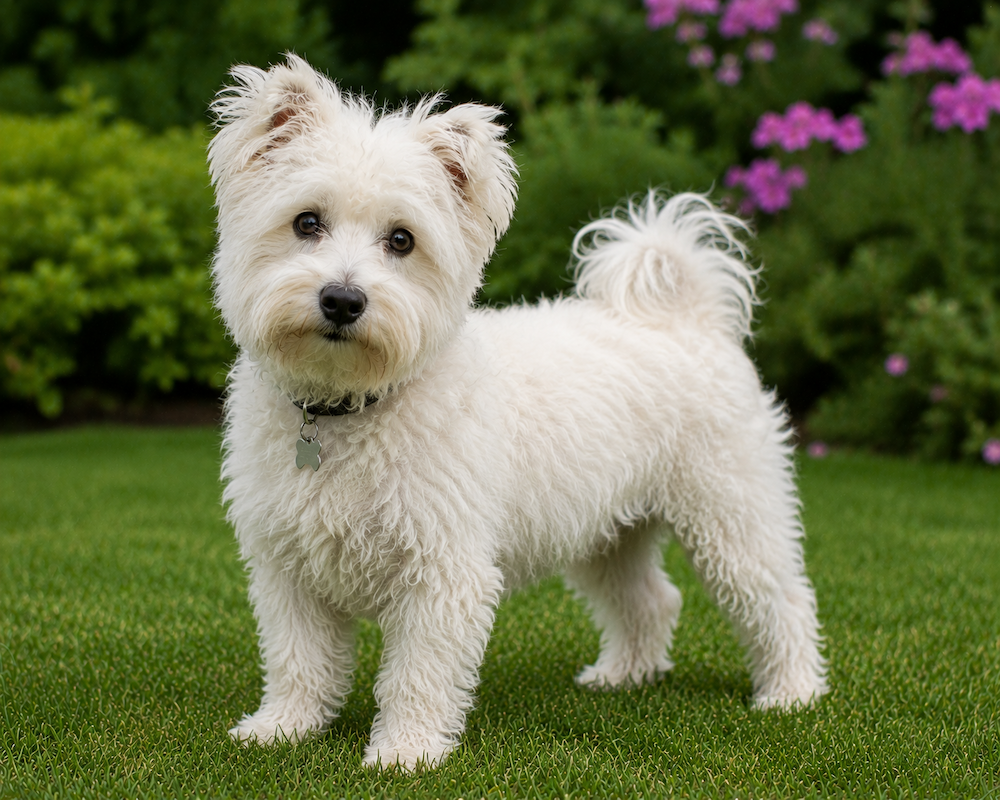







Bright, affectionate, and full of fun — a charming companion that combines the confidence of the West Highland White Terrier with the intelligence of the Poodle.
🧠 QUICK SNAPSHOT
- Temperament: Friendly, intelligent, playful
- Energy Level: Moderate
- Size: Small
- Good With Families: Yes
- Trainability: High
- Grooming: Moderate to high
- Best For: Families, apartment living, companionship
📚 OVERVIEW
The Westiepoo is a cross between a West Highland White Terrier (Westie) and a Poodle, creating an affectionate and intelligent companion with a lively personality. These dogs combine the confidence and determination of the Westie with the Poodle’s eagerness to learn, making them entertaining and highly trainable pets.
Westiepoos thrive on companionship and enjoy being involved in family life. Their adaptable nature makes them well suited to both apartments and larger homes, provided they receive plenty of attention and daily exercise.
✅ PROS & CONS
Pros
- Affectionate and family-oriented
- Highly intelligent and easy to train
- Often low shedding depending on coat type
- Adaptable to many living situations
Cons
- Requires regular grooming
- Can develop separation anxiety
- Needs daily mental stimulation
- May inherit a stubborn terrier streak
Is a Westiepoo a Good Family Dog?
Yes. Westiepoos can make affectionate, intelligent and lively family dogs.
A Westiepoo is usually a cross between a West Highland White Terrier and a Poodle, most commonly a Miniature or Toy Poodle. Individual dogs can inherit very different combinations of traits from the two parent breeds.
Are Westiepoos Good With Children?
Generally, yes, particularly with respectful older children.
Westiepoos are playful and affectionate, but smaller individuals can be vulnerable to rough handling.
Their terrier ancestry can also give them a confident personality, so interactions with young children should be supervised.
How Much Exercise Does a Westiepoo Need?
Most Westiepoos need around 45–60 minutes of exercise each day, along with regular play and mental stimulation.
Walks, retrieving, scent games and training can all provide useful outlets.
They’re usually considerably more active than their teddy-bear appearance suggests.
Are Westiepoos Easy to Train?
Usually, yes.
Poodles are exceptionally trainable, while Westies are intelligent but can be more independent.
A Westiepoo may therefore be a quick learner with an occasional terrier opinion about whether following instructions is necessary.
Positive, interesting training sessions generally work best.
Do Westiepoos Shed?
Many Westiepoos shed relatively little, but shedding varies according to the coat they inherit.
A curlier Poodle-like coat may shed very little, while a more Westie-like coat can behave differently.
Crossbreeding doesn’t guarantee a non-shedding dog.
Are Westiepoos Hypoallergenic?
No Westiepoo can be guaranteed to be hypoallergenic.
Both parent breeds are relatively low shedding, so some Westiepoos may be better tolerated by certain allergy sufferers.
However, dog allergens are also present in saliva and skin secretions, not simply shed hair.
How Often Should You Groom a Westiepoo?
Most Westiepoos need brushing several times a week, with curly or longer coats potentially requiring daily attention.
Professional grooming is commonly needed every six to eight weeks.
Grooming requirements can vary considerably depending on whether the coat resembles the Poodle, Westie or something between the two.
What Health Problems Are Common in Westiepoos?
Potential health concerns include patellar luxation, hip problems, eye disorders, Legg-Calvé-Perthes disease, dental problems and skin conditions inherited from either parent line.
Westies are particularly associated with allergic skin disease.
Crossbreeding doesn’t automatically eliminate inherited health problems, so health testing of both parents remains important.
How Long Do Westiepoos Live?
Westiepoos commonly live around 12–15 years, with some potentially living longer.
Their relatively small size contributes to a good potential lifespan.
Genetics, healthy body weight, dental care, exercise and preventive veterinary care all influence longevity.
How Big Does a Westiepoo Get?
Westiepoos are generally small dogs, commonly weighing around 6–12 kg, although size can vary considerably.
The size of the Poodle parent is particularly important.
There is no official Westiepoo breed standard defining exact adult height or weight.
What Does a Westiepoo Look Like?
Westiepoos vary considerably in appearance.
Many have wavy or curly coats, compact bodies and expressive faces, often producing the popular teddy-bear appearance.
Others may inherit a more wiry Westie-style coat or stronger Poodle characteristics.
Can a Westiepoo Live in an Apartment?
Yes. Westiepoos can adapt very well to apartment living.
Their small size is convenient, provided they receive sufficient daily exercise and mental stimulation.
Alert barking can be a consideration in homes with close neighbours.
Can Westiepoos Be Left Alone?
Adult Westiepoos can learn to tolerate reasonable periods alone.
However, the Poodle side can contribute a strong desire for companionship, while an under-stimulated Westie side may find creative ways to stay occupied.
Gradual alone-time training and enrichment are useful.
Do Westiepoos Bark a Lot?
They can.
Westies are naturally alert terriers, and Poodles are also observant dogs, so a Westiepoo may be quick to announce visitors, unfamiliar noises or suspicious activity outside.
Early training can help prevent excessive barking.
Are Westiepoos Affectionate?
Yes. Westiepoos are generally affectionate and strongly attached to their families.
Many enjoy cuddling and staying close to their owners while retaining enough independence to have their own personality.
Individual temperament varies depending on the traits inherited from each parent.
Are Westiepoos Good With Other Dogs?
Generally, yes.
Well-socialised Westiepoos can live successfully with other dogs.
Some may inherit the Westie’s confident terrier personality, making early positive experiences with dogs particularly useful.
Are Westiepoos Good With Cats?
Many Westiepoos can live successfully with cats, particularly when raised alongside them.
However, West Highland White Terriers were developed to hunt quarry, so some Westiepoos may inherit a noticeable prey drive.
Careful introductions are important.
Do Westiepoos Have a High Prey Drive?
Some do.
The Westie’s working history can contribute a strong instinct to chase rodents and other small moving animals.
How strongly this appears in an individual Westiepoo is unpredictable.
Do Westiepoos Dig?
Some Westiepoos love digging.
Westies are genuine earth terriers whose ancestors pursued quarry through rough terrain and underground.
A Westiepoo inheriting those instincts may consider an immaculate garden less a landscaping achievement and more an unfinished excavation project.
Are Westiepoos High-Energy Dogs?
Westiepoos are generally moderately energetic.
They enjoy walks, games and training but usually don’t require the enormous exercise commitment associated with larger working breeds.
Mental stimulation is particularly useful because both parent breeds are intelligent.
Are Westiepoos Smart?
Yes. Westiepoos can be extremely intelligent dogs.
The Poodle contributes exceptional trainability and problem-solving ability, while the Westie brings its own clever and independent terrier intelligence.
Puzzle toys, scent games and trick training can provide valuable mental stimulation.
What Colours Do Westiepoos Come In?
Unlike the always-white West Highland White Terrier, Westiepoos can occur in numerous colours because of their Poodle ancestry.
Possible colours include white, cream, black, apricot, brown and combinations of these colours.
Coat colour and texture can change as a puppy matures.
What Is an F1 Westiepoo?
An F1 Westiepoo is a first-generation cross between a West Highland White Terrier and a Poodle.
The term describes parentage rather than guaranteeing particular characteristics.
An F1 puppy can inherit a wide variety of coat, appearance and temperament traits from either parent.
What Is an F1B Westiepoo?
An F1B Westiepoo is usually produced by crossing an F1 Westiepoo back to a Poodle.
This may increase the likelihood of certain Poodle-like coat characteristics.
However, F1B puppies still aren’t guaranteed to be completely non-shedding or hypoallergenic.
What Is the Difference Between a Westiepoo and a Westie?
A Westie is a recognised pedigree West Highland White Terrier, while a Westiepoo is a Westie–Poodle cross.
Westies have a predictable white, harsh double coat and established breed standard.
Westiepoos vary more in size, coat texture, colour and appearance.
Is a Westiepoo a Recognised Dog Breed?
No. The Westiepoo isn’t generally recognised as a standardised pedigree breed by major kennel clubs.
It’s a West Highland White Terrier–Poodle cross.
There is consequently no official breed standard guaranteeing its size, coat, appearance or temperament.
Where Did the Westiepoo Come From?
Westie–Poodle crosses may have occurred for many years, while deliberately bred Westiepoos became more visible during the increasing popularity of Poodle crosses.
There isn’t a reliably documented single creator, place or exact date of origin for the Westiepoo.
Is a Westiepoo a Good First Dog?
Yes. A Westiepoo can be a good first dog for an owner prepared for regular grooming and training.
They’re generally small, intelligent, affectionate and manageable in their exercise requirements.
Potential challenges include barking, coat maintenance, terrier prey drive and independent behaviour.
What Makes the Westiepoo Unique?
The Westiepoo combines two very different forms of canine intelligence.
On one side is the Poodle — famously trainable, quick to learn and descended from highly capable working water dogs.
On the other is the Westie — a determined Scottish terrier developed to pursue quarry into places where sensible humans weren’t going to follow.
The result can be an adorable curly little dog with an impressive brain and a surprising amount of determination.
That teddy-bear appearance can therefore be deceptive.
A Westiepoo may learn a new trick in minutes…
then use the same intelligence to work out how to reach something you’ve deliberately placed out of reach.
And if it inherits the Westie’s enthusiasm for digging, you may discover another important talent:
landscape redesign.