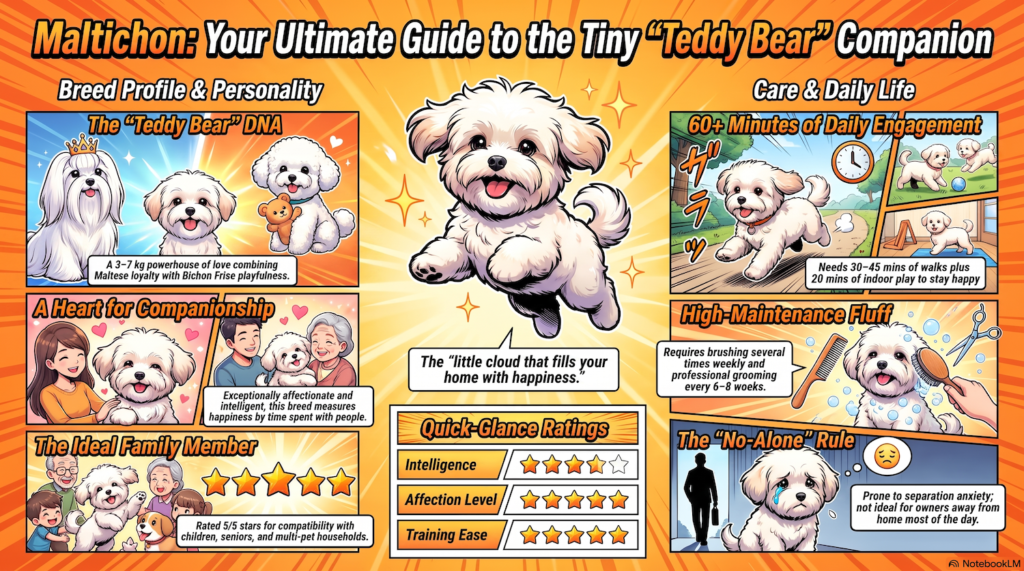


Sweet, playful, and irresistibly fluffy — a cheerful companion that loves people and thrives on family life.
🧠 QUICK SNAPSHOT
- Temperament: Affectionate, friendly, playful
- Energy Level: Moderate
- Size: Small
- Good With Families: Yes
- Trainability: High
- Grooming: Moderate to high
- Best For: Families, apartment living, companionship
📚 OVERVIEW
The Maltichon is a delightful cross between a Maltese and a Bichon Frise, combining the gentle nature of the Maltese with the cheerful personality of the Bichon. These small dogs are affectionate, intelligent, and love being the centre of family life.
Known for their soft, fluffy coats and happy disposition, Maltichons adapt well to apartments and larger homes alike, provided they receive plenty of attention, regular exercise, and grooming.
✅ PROS & CONS
Pros
- Extremely affectionate and family-oriented
- Intelligent and easy to train
- Friendly with children and other pets
- Often low shedding with regular grooming
Cons
- Requires frequent brushing and grooming
- Can develop separation anxiety
- Needs daily companionship and interaction
- Coat requires regular maintenance to prevent matting
Is a Maltichon a Good Family Dog?
Yes. The Maltichon is generally an affectionate, playful, sociable and people-oriented family companion.
It combines the Maltese with the Bichon Frise, two breeds developed primarily for companionship. Both parent breeds tend to form strong bonds with people, so Maltichons often thrive in households where they receive plenty of interaction.
Their small size means young children should be taught gentle handling.
What Is a Maltichon?
A Maltichon is a cross between a Maltese and a Bichon Frise.
It’s also sometimes called a Maltese Bichon, Maltese Frise or Bichon Maltese.
The Maltichon is a designer cross rather than a formally standardised breed, so appearance and temperament can vary between individual dogs.
How Much Exercise Does a Maltichon Need?
Most Maltichons need around 30–60 minutes of daily exercise, divided between walks and play.
Their small size means indoor games can also provide meaningful exercise.
They generally enjoy activity without requiring the intensive workload of a working or sporting breed.
Is a Maltichon a High-Energy Dog?
Usually moderately energetic.
Young Maltichons can be extremely playful and may race around the house in short bursts.
Adults generally settle well after exercise and are usually happy combining daily walks with considerable sofa time.
Is a Maltichon Easy to Train?
Usually, yes.
Both Maltese and Bichon Frise are intelligent companion breeds that respond well to positive reinforcement.
Maltichons can learn household routines, obedience commands and tricks quickly when training is consistent and enjoyable.
Are Maltichons Intelligent?
Yes.
They’re typically bright, observant dogs that quickly learn how their household operates.
Puzzle toys, trick training and interactive games can provide useful mental stimulation.
Unfortunately, their intelligence can also be directed towards discovering exactly which family member is easiest to persuade into providing an extra treat.
Are Maltichons Stubborn?
Some can have an independent streak.
Neither parent breed is usually considered extremely difficult to train, but small companion dogs can become demanding if owners are inconsistent.
Clear boundaries and reward-based training work well.
Are Maltichons Difficult to Toilet Train?
Some can require patience.
Small dogs have small bladders, and both parent breeds can sometimes take longer to house-train than owners expect.
Frequent toilet opportunities, supervision and a consistent routine are important during puppyhood.
Does a Maltichon Shed?
Usually very little.
Both parent breeds are relatively low-shedding, making a low-shedding coat likely.
However, because the Maltichon is a cross, coat characteristics aren’t completely predictable.
Is a Maltichon Hypoallergenic?
No dog is completely hypoallergenic.
Both Maltese and Bichon Frise are popular among allergy sufferers because they shed relatively little, so Maltichons may also be suitable for some people.
However, allergens are present in saliva, skin secretions and dander as well as hair.
What Type of Coat Does a Maltichon Have?
The coat can range from silky and relatively straight to wavy, fluffy or curly.
A Maltese-like dog may have finer, straighter hair, while a Bichon-influenced coat can be denser and curlier.
Even puppies from the same litter can develop noticeably different adult coats.
Does a Maltichon Have Hair or Fur?
The coat is commonly described as hair because both parent breeds have relatively long-growing, low-shedding coats.
Biologically, hair and fur are the same substance.
The practical difference is that a Maltichon’s coat generally requires regular trimming rather than simply shedding out seasonally.
How Often Should You Groom a Maltichon?
Most need thorough brushing and combing at least several times each week, with longer coats potentially requiring daily attention.
Areas behind the ears, under the legs and around the collar can mat particularly quickly.
Regular grooming should begin during puppyhood so the dog learns to accept handling.
Do Maltichons Mat Easily?
Yes.
Low shedding doesn’t mean low maintenance.
Loose hairs can remain trapped within the coat, where they combine with surrounding hair and form mats.
Curly Bichon-like coats can be especially demanding.
How Often Does a Maltichon Need a Haircut?
Many need professional grooming approximately every four to eight weeks, depending on coat type and desired length.
A short puppy-style clip is popular because it’s easier to maintain.
Longer teddy-bear styles require substantially more home grooming.
Why Does My Maltichon Get Tear Stains?
Tear staining is highly visible on pale coats and can occur in both parent breeds.
Contributors can include normal tear pigments, excessive tearing, blocked tear drainage, eye irritation and hair rubbing around the eyes.
Persistent or worsening tearing should be investigated rather than treated purely as a cosmetic issue.
What Health Problems Are Common in Maltichons?
Potential concerns include patellar luxation, dental disease, eye disorders, allergies, heart problems and liver abnormalities, depending on inherited risk from either parent.
Small dogs can also be susceptible to tracheal problems.
Responsible breeders should screen the Maltese and Bichon Frise parents for relevant inherited conditions.
Are Maltichons Healthier Than Purebred Dogs?
Not automatically.
Crossbreeding can increase genetic diversity, but it doesn’t prevent a puppy inheriting health problems from either parent.
The Maltese itself has recognised risks including patellar luxation, dental disease, liver shunts and tracheal collapse.
Healthy, properly screened parents are far more important than simply describing a puppy as a “hybrid.”
Are Maltichons Prone to Patellar Luxation?
They can be.
Patellar luxation occurs in both small breeds and causes the kneecap to move out of its normal position.
Affected dogs may intermittently skip, hop or carry a hind leg.
Are Maltichons Prone to Dental Problems?
Yes.
Small jaws can produce crowded teeth and increase the risk of periodontal disease.
Daily tooth brushing is one of the most useful preventive habits an owner can establish.
Are Maltichons Prone to Allergies?
Some can be.
Bichon Frise in particular can experience skin and allergy problems.
Persistent itching, paw licking, recurring ear infections or inflamed skin should be investigated by a veterinarian.
Are Maltichons Prone to Ear Infections?
They can be.
Floppy ears and substantial hair around the ear canal can reduce airflow and retain moisture.
Regular monitoring is important, particularly after bathing.
How Long Does a Maltichon Live?
Maltichons commonly live around 12–15 years, and some may live longer.
Both parent breeds are relatively long-lived small dogs.
Healthy weight, dental care and preventive veterinary attention become particularly important as they age.
How Big Does a Maltichon Get?
Most adult Maltichons weigh approximately 3–7 kg and stand around 20–30 cm tall.
Exact size depends on the parents.
The Bichon Frise is generally larger and more robust than the Maltese, so puppies can vary considerably.
Is There a Mini Maltichon?
“Mini Maltichon” isn’t a recognised size variety.
Both parent breeds are already small.
Breeders may use “mini” simply as a marketing description rather than to identify a genetically distinct type.
Is There a Teacup Maltichon?
There’s no recognised Teacup Maltichon.
Extreme miniaturisation can increase risks involving fragile bones, dental crowding, hypoglycaemia and other health problems.
Very small size shouldn’t be treated as automatically desirable.
Can a Maltichon Live in an Apartment?
Yes.
Maltichons are generally excellent apartment dogs because of their small size and manageable exercise requirements.
Potential barking and separation anxiety are more likely to cause problems than lack of space.
Does a Maltichon Need a Backyard?
No.
Daily walks, indoor play and mental stimulation can provide sufficient activity.
A secure garden is convenient but unnecessary.
Can a Maltichon Be Left Alone?
Adult Maltichons can learn to tolerate reasonable periods alone.
However, both parent breeds were developed primarily for companionship, so many strongly prefer having people nearby.
Gradual independence training should begin early.
Are Maltichons Prone to Separation Anxiety?
They can be.
Combining two highly companion-oriented breeds can produce a dog that becomes extremely attached to its family.
Owners should deliberately teach puppies that short periods alone are safe and normal.
Are Maltichons Velcro Dogs?
Many are.
They often follow their owners from room to room and want to participate in whatever is happening.
A closed bathroom door can occasionally be interpreted as a serious breach of the Maltichon companionship agreement.
Are Maltichons Cuddly?
Usually extremely.
Both parent breeds have long histories as close human companions.
Many Maltichons enthusiastically occupy laps, sofas and beds.
Are Maltichons Good With Children?
Usually, particularly with respectful children.
They’re playful and affectionate but still small enough to be injured by rough handling.
Supervision is particularly important around toddlers.
Are Maltichons Good With Other Dogs?
Generally, yes.
Both parent breeds tend to be sociable.
Early socialisation helps prevent fear or overconfidence around much larger dogs.
Are Maltichons Good With Cats?
Many live successfully with cats.
Their prey drive is generally relatively low.
Slow introductions remain important, particularly when either animal hasn’t previously lived with the other species.
Do Maltichons Have a Strong Prey Drive?
Usually not.
Both parent breeds have been primarily companion dogs for many generations.
Individuals may chase birds or rodents, but intense predatory behaviour isn’t generally a defining characteristic.
Are Maltichons Good Off Leash?
They can develop good recall with consistent training.
However, their small size makes traffic and larger animals significant hazards.
Secure off-leash areas remain the safest option.
Do Maltichons Bark a Lot?
Some do.
Both parent breeds can be alert and responsive to noises, visitors and activity outside.
Without training, barking can become particularly problematic in apartments.
Are Maltichons Good Watchdogs?
They can be surprisingly effective alarm dogs.
Many quickly notice unfamiliar sounds or visitors.
Their ability to physically deal with whatever they’ve discovered is considerably more limited.
Are Maltichons Good Guard Dogs?
No.
They’re far too small for serious physical protection.
A Maltichon can tell you somebody has arrived; anything after that requires management.
Are Maltichons Aggressive?
Aggression shouldn’t be considered normal.
Well-bred, properly socialised Maltichons are generally affectionate and sociable.
Fear, poor socialisation and allowing undesirable behaviour because the dog is tiny can create behavioural problems.
Are Maltichons Friendly With Strangers?
Usually.
The Bichon Frise is generally very sociable, while Maltese can range from outgoing to somewhat more reserved.
Many Maltichons therefore become friendly quickly once introduced.
When Does a Maltichon Calm Down?
Many become noticeably more settled between one and two years old.
They often retain a playful, puppy-like personality throughout adulthood.
Small companion breeds can remain surprisingly lively into their senior years.
Do Maltichons Get the Zoomies?
Absolutely.
Both parent breeds are capable of sudden bursts of high-speed activity.
A Maltichon at full speed can resemble a small white cloud experiencing serious navigational problems.
Are Maltichons Good Walking Dogs?
Yes.
They’re small but generally enthusiastic walkers.
Regular walks provide exercise, socialisation and mental stimulation.
They shouldn’t automatically be carried everywhere simply because they’re portable.
Can Maltichons Go Hiking?
Healthy adults can enjoy shorter or moderate hikes.
Terrain, weather and individual fitness should determine distance.
A particularly small Maltichon won’t have the endurance or stride length of a larger hiking breed.
Can Maltichons Swim?
Most can swim physically, although enthusiasm varies.
Bichon-type dogs have historical connections with Mediterranean maritime communities, but that doesn’t mean every modern Maltichon will enjoy water.
Long coats can also become heavy when wet.
Do Maltichons Get Cold Easily?
They can.
Their small body size means they lose heat relatively quickly.
Dogs wearing short clips may benefit from additional protection during genuinely cold weather.
Can Maltichons Handle Hot Weather?
Generally, although extreme heat still requires care.
Exercise should be scheduled during cooler periods, particularly in Australian summers.
Fresh water, shade and access to cool indoor areas are important.
What Does a Maltichon Look Like?
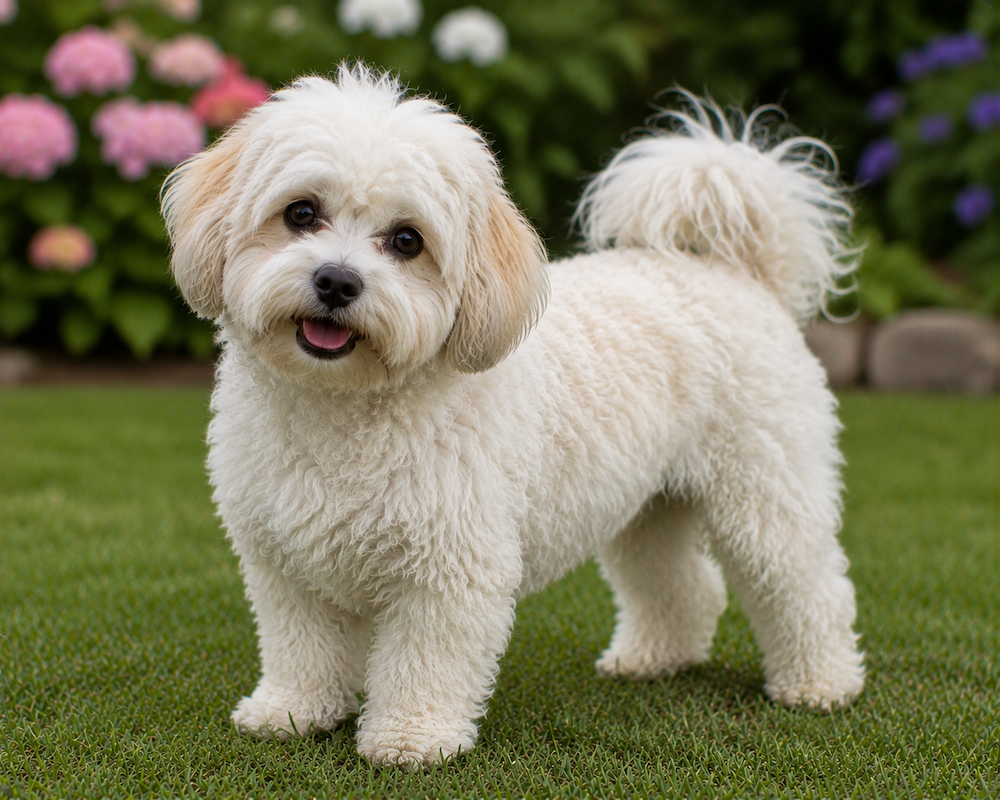
Most are small, fluffy dogs with dark eyes, drop ears, compact bodies and white or pale coats.
Some look strongly Maltese, with finer and straighter hair.
Others inherit the Bichon’s rounder appearance and dense curly coat.
What Colours Can Maltichons Be?
White is by far the most characteristic colour because both parent breeds are predominantly white.
Cream, pale apricot or light tan shading can sometimes occur.
The exact colouring depends on the genes inherited from the parents.
Can a Maltichon Be Black?
A genuine first-generation Maltese × Bichon Frise wouldn’t normally be expected to have a solid black coat.
Neither modern parent breed has black as a standard coat colour.
A black dog marketed as a Maltichon should therefore prompt questions about its ancestry.
Can a Maltichon Be Brown?
Solid brown isn’t typical of a genuine Maltese × Bichon Frise cross.
Pale cream, buff or apricot shading is much more plausible.
Strong chocolate colouring could indicate additional breed ancestry.
Can a Maltichon Be Merle?
Merle isn’t a traditional colour in either the Maltese or Bichon Frise.
A merle dog marketed as a Maltichon therefore indicates additional ancestry somewhere in the pedigree.
Merle isn’t simply a rare colour that spontaneously appears from these two breeds.
Why Does My Maltichon Look More Like a Maltese?
Crossbreeding doesn’t produce a perfect visual average of the parents.
A puppy may inherit the Maltese’s finer body, straighter coat and narrower facial features.
Another puppy in the same litter may look far more like a Bichon.
Why Does My Maltichon Look More Like a Bichon Frise?
A Maltichon inheriting a dense curly coat, broader appearance and rounder head can strongly resemble a Bichon Frise.
Genetic inheritance reshuffles traits rather than blending them evenly.
Appearance alone can’t tell you exactly how every characteristic was inherited.
Is a Maltichon the Same as a Maltese?
No.
The Maltese is an established pedigree breed with ancient Mediterranean roots. Its modern form is known for a long, straight, silky white coat.
A Maltichon combines Maltese and Bichon Frise ancestry.
Is a Maltichon the Same as a Bichon Frise?
No.
A Bichon Frise is an established breed.
The Maltichon is a cross between a Bichon Frise and a Maltese.
Is a Maltichon the Same as a Maltipoo?
No.
A Maltipoo is Maltese × Poodle, while a Maltichon is Maltese × Bichon Frise.
The Maltipoo may inherit Poodle curls and working-dog characteristics, while both sides of the Maltichon come from closely related companion-dog traditions.
Is a Maltichon the Same as a Cavachon?
No.
A Cavachon combines the Cavalier King Charles Spaniel and Bichon Frise.
Both crosses can produce small teddy-bear-like companion dogs, but their ancestry differs substantially.
Is a Maltichon the Same as a Shichon?
No.
A Shichon generally combines a Shih Tzu and Bichon Frise.
The Maltichon replaces the Shih Tzu ancestry with Maltese.
Is a Maltichon a Doodle?
No, not technically.
“Doodle” generally refers to a dog with Poodle ancestry.
Neither the Maltese nor Bichon Frise is a Poodle, so the Maltichon isn’t a Poodle cross.
Is a Maltichon a Purebred Dog?
No.
A Maltichon is deliberately produced from two established breeds.
Even multigenerational Maltichons aren’t currently recognised as a standardised pure breed by the major traditional kennel organisations.
Is the Maltichon a Recognised Dog Breed?
Generally, no.
Major kennel clubs don’t recognise the Maltichon as a distinct pedigree breed.
Some designer-dog registries may record the cross, but registration isn’t the same as recognition as an established breed.
What Is an F1 Maltichon?
An F1 Maltichon is a first-generation cross between a purebred Maltese and a purebred Bichon Frise.
Pedigree ancestry is approximately 50% of each breed.
That doesn’t mean every visible or behavioural trait will be expressed exactly halfway between the parents.
What Is an F1B Maltichon?
An F1B is produced by breeding an F1 Maltichon back to one of its parent breeds.
That could theoretically be either Maltese or Bichon Frise.
Buyers should therefore ask which breed was used rather than assuming the meaning from “F1B” alone.
What Is an F2 Maltichon?
An F2 Maltichon is generally produced by breeding two F1 Maltichons together.
Second-generation puppies can still vary substantially.
Multiple genes influence coat texture, size, temperament and appearance.
Why Were Maltese Crossed With Bichon Frise?
The likely aim was to produce a small, affectionate, low-shedding companion combining desirable characteristics from two popular breeds.
Unlike some designer crosses that combine dramatically different working histories, the Maltichon’s parents already have remarkably similar companion-dog backgrounds.
That makes this cross particularly interesting.
Are Maltese and Bichon Frise Related?
Broadly, yes.
Both belong to the historical family of small Mediterranean and European companion dogs often grouped under the Bichon-type tradition.
The Maltese has especially ancient associations with Malta and the central Mediterranean.
Their modern pedigree populations are distinct, but their deeper histories overlap.
Does the Maltichon Have Ancient Ancestry?
Its two parent breeds certainly have very old roots.
Maltese-type companion dogs were described in classical Mediterranean sources, while the Bichon family also developed from old Mediterranean companion-dog populations.
The Maltichon itself, however, is a modern cross, not an ancient breed.
Where Does the Maltichon Come From?
The precise origin of the modern Maltichon isn’t well documented.
It likely emerged during the late 20th-century or early 21st-century growth in deliberate companion-dog crossbreeding.
There’s no reliably documented single country, breeder or foundation litter recognised as the beginning of the Maltichon.
Who Created the First Maltichon?
No single breeder is reliably credited with creating the Maltichon.
Maltese and Bichon Frise dogs could have been crossed accidentally or deliberately long before the name became commercially popular.
Modern designer-dog breeding simply turned that combination into an identifiable type.
Was the Maltichon Created in Australia?
There’s no strong evidence that Australia was the specific birthplace of the Maltichon.
Australia played a major role in popularising certain modern companion crosses, particularly the Labradoodle and Cavoodle, but that history shouldn’t automatically be applied to every designer cross.
Did Wally Conron Create the Maltichon?
No.
Wally Conron is associated with the development and international story of the modern Labradoodle.
He didn’t create the Maltichon.
The subsequent popularity of Poodle and companion-dog crosses helped create a market in which combinations such as the Maltichon became increasingly popular.
Does a Maltichon Have Working-Dog Ancestry?
Much less than many modern crosses.
Both the Maltese and Bichon Frise have extraordinarily long histories centred primarily on human companionship rather than specialised hunting, herding or guarding.
That helps explain why the Maltichon is usually so people-focused.
Were the Maltichon’s Ancestors Sailors’ Dogs?
The history is complicated.
Bichon-type dogs travelled extensively through Mediterranean maritime trading networks, and dogs accompanying sailors undoubtedly helped spread these populations between ports.
The Maltese also developed within a Mediterranean world dominated by sea travel.
However, describing the Maltichon’s ancestors as specialist ship-working dogs would be an exaggeration.
Were the Maltichon’s Ancestors Royal Lap Dogs?
Yes, broadly.
Both Maltese and Bichon-type dogs became fashionable among wealthy European households and aristocratic courts.
The Maltese in particular has a remarkably long association with elite companionship extending back through European and classical Mediterranean history.
Why Does the Maltichon Make Such a Natural Companion Dog?
Because both sides of its ancestry were already heavily selected for companionship.
Some crosses attempt to combine dramatically different jobs.
The Maltichon essentially combines one historical lap dog with another historical lap dog.
The result is unsurprisingly enthusiastic about people.
Could the Maltichon Eventually Become a Recognised Breed?
Potentially, but it would require a long-term organised breeding programme.
Breeders would need to establish a consistent standard, maintain pedigrees, select predictable traits, conduct health screening and preserve sufficient genetic diversity over many generations.
Simply breeding Maltichons to Maltichons doesn’t automatically create a new breed.
Why Are Maltichons Called Teddy Bear Dogs?
Their dark eyes, fluffy pale coats, rounded grooming styles and compact bodies can create a striking teddy-bear appearance.
The effect becomes especially pronounced with a short rounded facial trim.
Unlike an actual teddy bear, however, the Maltichon requires considerably more grooming.
Why Does My Maltichon Follow Me Everywhere?
Both sides of its ancestry provide an explanation.
Maltese have been bred for close human companionship for centuries, while Bichons also developed as highly social companion dogs.
For many Maltichons, following a person from room to room isn’t clinginess in their minds.
It’s simply quality control.
Why Does My Maltichon Want to Sit on My Lap?
Because lap-dog behaviour runs extremely deep on both sides of the family.
Unlike crosses combining a companion breed with a hunter or working dog, the Maltichon inherits companionship from both parents.
A vacant human lap may therefore be regarded less as furniture and more as an unclaimed Maltichon bed.
Are Maltichons Good Therapy Dogs?
They can be excellent candidates.
Their small size, affectionate temperament and interest in people are useful qualities for therapy work.
Individual dogs still need appropriate training and confidence around unfamiliar people and environments.
Are Maltichons Good at Dog Sports?
Yes.
Despite their teddy-bear appearance, they can enjoy agility, rally, obedience and trick training.
Small size doesn’t prevent them from being active, athletic dogs.
Is a Maltichon a Good Dog for Older People?
Often, yes.
Their manageable size, moderate exercise requirements and affectionate temperament can make them excellent companions.
Owners should still consider professional grooming costs and the breed’s strong need for human interaction.
Is a Maltichon a Good First Dog?
Yes, for many people.
They’re generally affectionate, intelligent, small and adaptable.
The main challenges are coat maintenance, dental care, toilet training, barking and teaching enough independence to reduce the risk of separation problems.
What Makes the Maltichon Unique?
The Maltichon is unusual among designer crosses because its parent breeds aren’t wildly different.
The Maltese and Bichon Frise both belong to the ancient world of small Mediterranean companion dogs. Their ancestors travelled through trading ports, aristocratic households and European courts while larger dogs were busy hunting, guarding livestock and fighting wars.
The Maltese eventually became famous for its spectacular straight white coat, while the Bichon Frise developed its characteristic cloud-like curls.
Modern breeders brought those two old companion traditions back together in the Maltichon.
That means the cross can vary in appearance — one puppy may have silky Maltese-like hair while another looks much more like a fluffy Bichon — but one characteristic is particularly difficult to escape.
For centuries, both sides of the family tree had essentially the same job:
stay close to humans and make yourself impossible not to love.