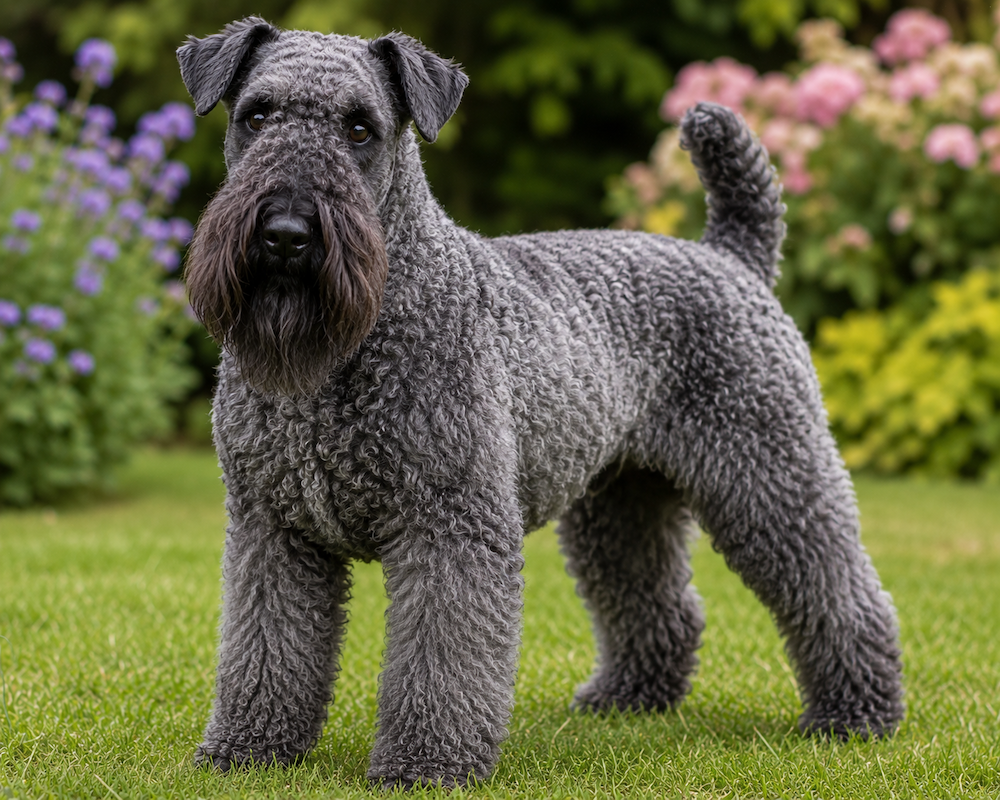







Intelligent, spirited, and unmistakably stylish — a versatile Irish terrier with a loyal heart and a distinctive blue-grey coat.
🧠 QUICK SNAPSHOT
- Temperament: Intelligent, confident, loyal
- Energy Level: High
- Size: Medium
- Good With Families: Yes
- Trainability: High
- Grooming: High
- Best For: Active families, experienced owners, companionship
📚 OVERVIEW
The Kerry Blue Terrier originated in County Kerry, Ireland, where it was bred as an all-purpose farm dog capable of herding livestock, hunting vermin, guarding property, and retrieving game. Instantly recognisable by its soft blue-grey coat, the Kerry Blue is both elegant and athletic.
This breed forms strong bonds with its family and is known for its intelligence, confidence, and lively personality. Given the right training and plenty of activity, the Kerry Blue Terrier becomes a devoted and entertaining companion.
✅ PROS & CONS
Pros
- Highly intelligent and trainable
- Loyal and affectionate with family
- Low-shedding coat
- Excellent watchdog
Cons
- Requires professional or regular grooming
- Strong prey drive
- Needs daily exercise and mental stimulation
- Can be dominant with unfamiliar dogs without proper socialisation
Is a Kerry Blue Terrier a Good Family Dog?
Yes. A well-bred Kerry Blue Terrier can be an affectionate, loyal, playful and entertaining family dog.
They’re energetic and strongly attached to their people, but they also have genuine terrier confidence and determination.
They’re usually best suited to families prepared to provide consistent training, exercise and regular grooming.
How Much Exercise Does a Kerry Blue Terrier Need?
Most Kerry Blues need around 60–90 minutes of exercise each day, along with mental stimulation.
They enjoy brisk walks, running, games, training, hiking and dog sports.
They’re active dogs rather than decorative terriers despite their distinctive show-ring appearance.
Is a Kerry Blue Terrier Easy to Train?
They’re highly intelligent and capable of learning quickly, but they’re not always easy.
Kerry Blues can be independent, confident and determined.
Positive reinforcement, consistency and interesting training sessions usually produce the best results.
Are Kerry Blue Terriers Intelligent?
Yes.
They were developed as versatile working dogs capable of tackling numerous jobs rather than performing one narrow task.
This required intelligence, adaptability and considerable initiative.
Are Kerry Blue Terriers Stubborn?
They can be.
Like many terriers, Kerry Blues were expected to think and act independently.
An owner who combines patience with firm, consistent boundaries generally has much greater success than someone attempting to overpower the dog.
Does a Kerry Blue Terrier Shed?
Very little.
The breed’s soft, dense, wavy coat continuously grows and generally releases relatively little loose hair around the house.
However, low shedding comes with substantial grooming requirements.
Is a Kerry Blue Terrier Hypoallergenic?
Kerry Blues are often described as hypoallergenic because they shed very little.
However, no dog is completely allergen-free, because allergens are also found in saliva and skin secretions.
People with allergies should spend time around the breed before committing to ownership.
What Type of Coat Does a Kerry Blue Terrier Have?
The Kerry Blue has a soft, dense and wavy coat that feels very different from the harsh wiry coat found on many terriers.
It continues growing and requires regular trimming.
The famous beard and facial furnishings form part of the traditional appearance.
How Often Should You Groom a Kerry Blue Terrier?
The coat should usually be brushed and combed several times each week.
Professional trimming is commonly required around every six to eight weeks.
Without regular grooming, the soft coat can develop mats and tangles.
Does a Kerry Blue Terrier Need Haircuts?
Yes.
Unlike naturally short-coated terriers, Kerry Blues need regular trimming to maintain a practical coat.
Show grooming is particularly specialised and produces the breed’s distinctive flowing outline.
Can You Shave a Kerry Blue Terrier?
The coat can be clipped for practical reasons, but completely shaving it isn’t usually necessary.
Most owners maintain a shorter pet trim while preserving some characteristic beard and furnishings.
A professional groomer familiar with Kerry Blue coats can be valuable.
Why Does a Kerry Blue Terrier Have a Beard?
The beard is part of the traditional terrier furnishings and contributes greatly to the breed’s distinctive appearance.
Historically, facial hair may also have provided some protection during rough working activities.
Today it mostly guarantees that drinking water will occasionally be transported across the kitchen floor.
What Health Problems Are Common in Kerry Blue Terriers?
Potential concerns include hip dysplasia, eye disorders, skin problems and certain inherited neurological or metabolic conditions.
Historically recognised conditions include cerebellar abiotrophy and some blood-clotting abnormalities.
Responsible breeders should use appropriate health screening and understand disease history within their lines.
What Is Cerebellar Abiotrophy in Kerry Blue Terriers?
Cerebellar abiotrophy is an inherited neurological disorder involving degeneration within the cerebellum.
Affected dogs can develop poor coordination, tremors and abnormal movement.
Careful breeding has made inherited disease screening an important part of responsible Kerry Blue breeding.
Are Kerry Blue Terriers Prone to Skin Problems?
They can be.
Skin cysts, allergies and other dermatological conditions occur within the breed.
Regular grooming provides a useful opportunity to inspect the skin beneath the dense coat.
Are Kerry Blue Terriers Prone to Eye Problems?
Several eye conditions can occur within the breed.
Responsible breeders should follow appropriate eye-screening recommendations.
Persistent redness, cloudiness, pain or visual changes should receive veterinary attention.
How Long Does a Kerry Blue Terrier Live?
Kerry Blue Terriers commonly live around 12–15 years.
Their medium size and athletic structure contribute to relatively good longevity.
Healthy weight, regular exercise and responsible breeding remain important.
How Big Does a Kerry Blue Terrier Get?
Adults generally stand around 44–49 cm at the shoulder and commonly weigh approximately 15–18 kg, although males can be somewhat heavier.
They’re medium-sized terriers with a strong but athletic build.
Is There a Miniature Kerry Blue Terrier?
No.
There is no recognised Miniature Kerry Blue Terrier.
The breed has one standard size.
Is There a Teacup Kerry Blue Terrier?
No recognised Teacup Kerry Blue exists.
Extreme miniaturisation isn’t part of the breed’s history or standard.
Anyone advertising one should be approached cautiously.
Can a Kerry Blue Terrier Live in an Apartment?
Yes, provided its exercise needs are properly met.
They’re medium-sized and can settle indoors after sufficient activity.
Their energy and alertness mean an under-exercised Kerry may find apartment life considerably less successful.
Does a Kerry Blue Terrier Need a Backyard?
No, although secure outdoor space is useful.
Daily walks, training and interaction matter more than simply having access to a garden.
A bored Kerry Blue can create its own entertainment regardless of yard size.
Can a Kerry Blue Terrier Be Left Alone?
Adult dogs can learn to tolerate reasonable periods alone.
However, Kerry Blues are strongly attached to their families and can become bored without sufficient stimulation.
Gradual independence training is beneficial.
Are Kerry Blue Terriers Velcro Dogs?
Many are very devoted to their owners.
They often want to participate in household activities and may follow their favourite person around.
Their affection is combined with considerably more terrier independence than many traditional lapdogs.
Are Kerry Blue Terriers Cuddly?
Many are affectionate and enjoy physical contact with their family.
Individual personality varies.
A Kerry may spend the afternoon behaving like a serious working terrier and the evening attempting to occupy most of the sofa.
Are Kerry Blue Terriers Good With Children?
They can be excellent companions for respectful children.
Their sturdy medium size makes them less physically fragile than Toy breeds.
Supervision remains important, particularly around very young children.
Are Kerry Blue Terriers Good With Other Dogs?
This can be challenging.
Kerry Blues have historically had a reputation for dog-to-dog assertiveness, particularly with unfamiliar dogs.
Early socialisation, responsible breeding and careful management are important.
Are Kerry Blue Terriers Aggressive With Other Dogs?
Some individuals can be dog-selective or confrontational.
Terrier confidence and historical selection for toughness contribute to this tendency.
It doesn’t mean every Kerry Blue will fight other dogs, but owners shouldn’t ignore the breed’s potential for assertive behaviour.
Are Kerry Blue Terriers Good With Cats?
Some live successfully with cats, especially when raised together.
However, their terrier ancestry can produce substantial prey drive.
Introductions should be controlled and supervised.
Are Kerry Blue Terriers Good With Rabbits and Guinea Pigs?
Caution is strongly recommended.
Kerry Blues historically hunted and controlled small animals.
A familiar household animal may still trigger instinctive prey behaviour.
Do Kerry Blue Terriers Have a Strong Prey Drive?
Many do.
They were developed as practical farm and hunting terriers rather than purely companion dogs.
Moving wildlife can quickly attract their attention.
Are Kerry Blue Terriers Good Off Leash?
Some can develop excellent recall, but terrier prey drive can make reliability challenging.
Once a Kerry decides something needs investigating, enthusiasm may temporarily exceed obedience.
Secure off-leash areas are safest.
Do Kerry Blue Terriers Dig?
They can.
Digging is common across many terrier breeds because their ancestors were expected to pursue quarry around or below ground.
Providing acceptable outlets can help protect gardens.
Are Kerry Blue Terriers Escape Artists?
Some can be.
They’re athletic, intelligent and persistent enough to exploit weaknesses in fencing.
Secure boundaries are particularly important if wildlife regularly appears nearby.
Do Kerry Blue Terriers Bark a Lot?
They’re generally alert and can be vocal, but aren’t necessarily relentless barkers.
Boredom, insufficient exercise and territorial behaviour can increase barking.
Training from puppyhood is helpful.
Are Kerry Blue Terriers Good Watchdogs?
Yes.
They’re naturally alert and tend to notice visitors quickly.
Their confidence and substantial bark can make them effective watchdogs.
Are Kerry Blue Terriers Good Guard Dogs?
They can be protective and courageous, but they’re not specialised modern protection dogs.
Their medium size and confidence can nevertheless make them a convincing deterrent.
Are Kerry Blue Terriers Protective?
Many are strongly loyal to their family and naturally watchful.
The ideal temperament should remain stable and controllable rather than indiscriminately suspicious.
Early socialisation is particularly important.
Are Kerry Blue Terriers Friendly With Strangers?
They can be somewhat reserved until they assess someone.
Well-socialised dogs should accept appropriately introduced visitors.
They’re often less instantly enthusiastic toward strangers than breeds such as Golden Retrievers.
When Does a Kerry Blue Terrier Calm Down?
Many become noticeably more settled around two to three years old.
However, the breed remains lively and playful well into adulthood.
A mature Kerry still expects daily activity.
Do Kerry Blue Terriers Get the Zoomies?
Yes.
Their athleticism and playful temperament can produce spectacular bursts of speed.
The carefully groomed beard and furnishings do nothing to make the performance look more dignified.
Are Kerry Blue Terriers Good Running Dogs?
Healthy adults can make good moderate running companions.
They’re athletic and have useful stamina.
Structured running should wait until the dog’s bones and joints are physically mature.
Are Kerry Blue Terriers Good Hiking Dogs?
Yes.
Their combination of strength, stamina and curiosity can make them excellent hiking companions.
Recall and wildlife management remain important because of their prey drive.
Can Kerry Blue Terriers Swim?
Many are capable swimmers and some genuinely enjoy water.
This isn’t surprising given that historical Kerry Blues were versatile farm dogs and were sometimes used around waterways.
Individual enthusiasm varies.
Were Kerry Blue Terriers Used to Hunt Otters?
Yes, historical accounts associate Kerry Blues with hunting otters and other quarry, alongside their many farm duties.
They were expected to be versatile rather than narrowly specialised.
Their willingness to enter water was therefore useful.
Were Kerry Blue Terriers Used to Hunt Badgers?
Historical Kerry terriers were associated with difficult quarry including badgers, reflecting the toughness expected of old working terriers.
Modern owners obviously shouldn’t attempt to recreate such historical activities.
The history helps explain the breed’s confidence and determination.
Were Kerry Blue Terriers Used for Ratting?
Yes.
Vermin control was an important job for practical farm terriers.
Rats and other pests threatened stored food and farm environments, so an efficient terrier was valuable.
Were Kerry Blue Terriers Used for Herding?
Surprisingly, yes.
The Kerry Blue developed as a versatile Irish farm dog and has historically been credited with helping move cattle and sheep, in addition to hunting vermin and guarding property.
Few modern terriers have such a varied résumé.
Were Kerry Blue Terriers Used as Farm Dogs?
Absolutely.
This is essential to understanding the breed.
The Kerry wasn’t simply a show terrier. It was expected to control vermin, hunt, help with livestock, guard property and accompany the family.
Versatility was central to its development.
Were Kerry Blue Terriers Used as Guard Dogs?
Yes.
Farm households valued a dog that would alert them to unusual activity and defend property if necessary.
The Kerry’s courage and loyalty made it useful in this role alongside its hunting and stock work.
Why Is the Kerry Blue Terrier So Versatile?
Rural Irish families couldn’t necessarily afford to maintain a different specialist dog for every task.
A practical dog that could hunt, control vermin, watch property and help with livestock was considerably more useful.
This multipurpose background helped create the breed’s remarkable adaptability.
What Does a Kerry Blue Terrier Look Like?
The Kerry Blue is a medium-sized terrier with a soft wavy blue-grey coat, long head, small folded ears, dark eyes, beard and athletic square outline.
The carefully shaped coat gives show dogs an especially distinctive silhouette.
Are Kerry Blue Terriers Born Blue?
No — and this is one of the breed’s most fascinating characteristics.
Kerry Blue puppies are typically born very dark or black.
Their coat gradually lightens as they mature.
Why Do Kerry Blue Puppies Turn Blue?
The breed carries genetics that cause the dark puppy coat to progressively fade or clear into shades of blue-grey.
The transformation can continue for many months.
The adult dog may look dramatically different from the puppy that originally came home.
When Does a Kerry Blue Terrier Turn Blue?
The colour usually begins changing during puppyhood and continues as the dog matures.
Final adult colour may not become fully apparent until around 18 months or later.
Individual dogs clear at different rates.
What Colour Is Kerry Blue?
“Blue” in this context means shades of blue-grey or slate grey, not literal bright blue.
Adults can range from deep slate to considerably lighter blue-grey.
Darker points may remain.
Can a Kerry Blue Terrier Stay Black?
Puppies begin extremely dark, but the coat should progressively clear toward the characteristic blue-grey adult colour.
A mature dog remaining completely black would be atypical for the recognised breed appearance.
Can a Kerry Blue Terrier Be Silver?
Some mature dogs become quite light and may appear silver-grey.
There’s considerable variation within the acceptable blue spectrum.
The colour can also change throughout the dog’s life.
Why Does My Kerry Blue Change Colour?
Progressive coat fading is genetically programmed into the breed.
It’s one of the Kerry Blue’s signature characteristics.
Owners effectively buy a dark puppy without knowing precisely which shade of blue-grey will eventually emerge.
Does a Kerry Blue Terrier’s Coat Feel Like a Poodle’s?
There can be superficial similarities because both breeds have soft, continuously growing, relatively low-shedding coats.
However, the ideal Kerry coat is distinctly soft and wavy, with its own texture and grooming style.
The breeds aren’t simply variations of one another.
Is a Kerry Blue Terrier Related to the Poodle?
There’s no well-established evidence that the modern Kerry Blue simply descends from Poodles.
Various theories have proposed influences from other curly or water-associated dogs, but the breed’s exact early ancestry isn’t completely documented.
Is a Kerry Blue Terrier Related to the Irish Terrier?
Both are native Irish terriers and share broad terrier heritage.
However, they’re distinct breeds.
The Irish Terrier has a harsh red coat, while the Kerry Blue has its characteristic soft blue-grey coat.
Is a Kerry Blue Terrier Related to the Soft Coated Wheaten Terrier?
They likely share broader ancestry among old Irish farm terrier populations.
Both developed as versatile Irish working dogs and have relatively soft coats compared with many British terriers.
Their modern breeds nevertheless have clearly distinct histories and standards.
Is a Kerry Blue Terrier Related to the Irish Wolfhound?
Not closely in the sense of being a miniature version or direct descendant.
Both are Irish breeds but were developed for very different jobs.
Claims of simple Irish Wolfhound ancestry in the Kerry Blue are speculative.
What Are the Four Native Irish Terrier Breeds?
The four commonly recognised native Irish terriers are the Kerry Blue Terrier, Irish Terrier, Soft Coated Wheaten Terrier and Glen of Imaal Terrier.
Each developed somewhat differently while reflecting Ireland’s long tradition of practical farm terriers.
Where Does the Kerry Blue Terrier Come From?
The Kerry Blue Terrier comes from Ireland, with its name particularly associated with County Kerry.
Dogs of this general type were kept as versatile rural working terriers.
Their early history predates detailed pedigree records, so the exact ingredients behind the breed remain uncertain.
Why Is It Called the Kerry Blue Terrier?
“Kerry” refers to County Kerry in southwestern Ireland, while “Blue” describes the characteristic adult coat colour.
The name therefore effectively means the blue-grey terrier associated with Kerry.
Is the Kerry Blue Terrier an Ancient Irish Breed?
Its rural ancestors are old, but claims that the modern Kerry Blue has existed unchanged for many centuries should be treated cautiously.
Practical blue-grey terriers were known in Ireland before formal kennel-club recognition.
The standardised pedigree breed emerged mainly during the late 19th and early 20th centuries.
What Were the Ancestors of the Kerry Blue Terrier?
No definitive historical pedigree survives.
The breed likely developed from local Irish working terriers, with various theories suggesting contributions from other terriers or water-associated dogs.
Claims involving specific breeds should be treated as theories rather than established fact.
Did a Shipwrecked Dog Create the Kerry Blue Terrier?
One famous legend claims that a blue-coated dog survived a shipwreck off the Irish coast and bred with local terriers.
Versions of the story sometimes describe the mysterious dog as a Portuguese Water Dog or another exotic blue dog.
It’s wonderful folklore, but there’s no strong historical evidence proving the story.
What Is the Kerry Blue Shipwreck Legend?
According to the legend, a dog from a wrecked ship swam ashore near County Kerry and became famous for its attractive coat and working ability.
It supposedly bred with local terriers and helped create the Kerry Blue.
Like many colourful breed-origin stories, it should be enjoyed as folklore rather than treated as documented genealogy.
Did Kerry Blue Terriers Come From Portuguese Water Dogs?
This has been suggested, often through the shipwreck legend, but it isn’t established history.
The coat resemblance makes the idea appealing.
Without reliable pedigree evidence, Portuguese Water Dog ancestry remains speculative.
Why Was the Kerry Blue Once Called the Irish Blue Terrier?
Before the modern name became universal, dogs of this type were often known as Irish Blue Terriers.
The name reflected both their nationality and their unusual adult colouring.
“Kerry Blue Terrier” eventually became the standard international name.
When Were Kerry Blue Terriers First Shown?
Kerry Blues began appearing at organised dog shows during the late 19th and early 20th centuries.
Formal showing helped transform diverse working farm terriers into a more consistently standardised breed.
Why Was the Kerry Blue Important to Irish Nationalists?
During the early 20th century, the Kerry Blue became associated with Irish national identity and nationalist dog enthusiasts.
At a time when many organised dog institutions in Ireland were strongly linked to British structures, promoting an unmistakably Irish breed carried cultural significance beyond ordinary dog showing.
Did Michael Collins Own a Kerry Blue Terrier?
Yes. Irish revolutionary leader Michael Collins is strongly associated with the breed and owned a Kerry Blue named Convict 224.
His interest contributed to the breed’s connection with Irish nationalism during a pivotal period in Irish history.
Why Was Michael Collins’ Kerry Blue Called Convict 224?
The unusual name Convict 224 reflected the politically charged atmosphere surrounding Collins and Irish nationalism.
The dog became part of Kerry Blue folklore and reinforced the breed’s status as a distinctly Irish symbol.
Was the Kerry Blue Considered for Ireland’s National Dog?
The breed became such a strong symbol of Irish identity that enthusiasts promoted it as a distinctly national breed.
While Ireland doesn’t have a simple universally official “national dog” designation equivalent to a legal national emblem, the Kerry Blue has long been described as one of the country’s most iconic native breeds.
Did Kerry Blue Terriers Help Create the Irish Kennel Club?
Kerry Blue enthusiasts played an important role in the early history of the Irish Kennel Club, founded in the 1920s.
The breed’s popularity among prominent Irish dog enthusiasts made it particularly significant during the development of independent organised dog showing in Ireland.
Were Early Kerry Blue Shows Politically Important?
In some cases, yes.
Breed gatherings occurred during a period of intense political change in Ireland, and Kerry Blue ownership could carry nationalist symbolism.
This gives the breed an unusually close connection between dog-show history and Irish political history.
When Was the Kerry Blue Terrier Officially Recognised?
Formal recognition developed during the early 20th century as breed clubs and kennel organisations established consistent standards.
The breed became internationally established during the 1920s, spreading from Ireland into Britain, Europe and North America.
When Did the AKC Recognise the Kerry Blue Terrier?
The American Kennel Club recognised the Kerry Blue Terrier in 1922.
This occurred during the period when international interest in the distinctive Irish breed was growing rapidly.
Why Did the Kerry Blue Become Popular in America?
Its unusual colour, dramatic grooming and lively temperament made it stand out in the show ring.
American enthusiasts were also attracted to its reputation as a genuine multipurpose Irish working terrier, rather than merely an ornamental show dog.
Why Is the Kerry Blue Terrier Rare Today?
The breed requires considerable grooming, substantial exercise and confident training.
Potential dog-to-dog assertiveness can also make it less straightforward than many popular family breeds.
Those characteristics have probably limited mass popularity while preserving a dedicated enthusiast community.
Are Kerry Blue Terriers Good at Dog Sports?
Yes.
They can excel in agility, obedience, rally, scent work and other activities.
Their combination of intelligence, athleticism and determination makes them highly capable competitors.
Do Kerry Blue Terriers Still Work?
Some still participate in activities that reflect their historical abilities, although most modern Kerry Blues are companions or show dogs.
Their versatility remains evident in dog sports and advanced training.
The working instincts haven’t disappeared simply because the haircut became more sophisticated.
Is a Kerry Blue Terrier a Good First Dog?
It can be, but it’s not one of the easiest terriers for an inexperienced owner.
Prospective owners need to manage regular professional grooming, substantial exercise, prey drive, strong personality and possible dog-selective behaviour.
Someone who enjoys training and wants an active, intelligent dog may find the breed enormously rewarding.
What Makes the Kerry Blue Terrier Unique?
The Kerry Blue combines features that seem almost contradictory.
It has the elegant sculpted coat of a sophisticated show dog, yet its ancestors were expected to kill vermin, hunt difficult quarry, guard farms, work around livestock and accompany ordinary rural families.
Its puppies begin life black and gradually transform into shades of blue-grey. It became intertwined with Irish national identity, attracted figures such as Michael Collins and helped establish Ireland’s independent pedigree-dog culture.
Underneath the carefully shaped beard is still a genuine working terrier.
The Kerry Blue may look as though it has just left an expensive salon, but historically it was expected to leave the farm only after dealing with the rats, checking the livestock and investigating whatever was hiding near the river.