






Calm, intelligent, and deeply devoted — a balanced companion that combines beauty, loyalty, and a gentle temperament.
🧠 QUICK SNAPSHOT
- Temperament: Calm, intelligent, loyal
- Energy Level: Moderate
- Size: Medium to large
- Good With Families: Yes
- Trainability: High
- Grooming: Moderate
- Best For: Families, companionship, active households
📚 OVERVIEW
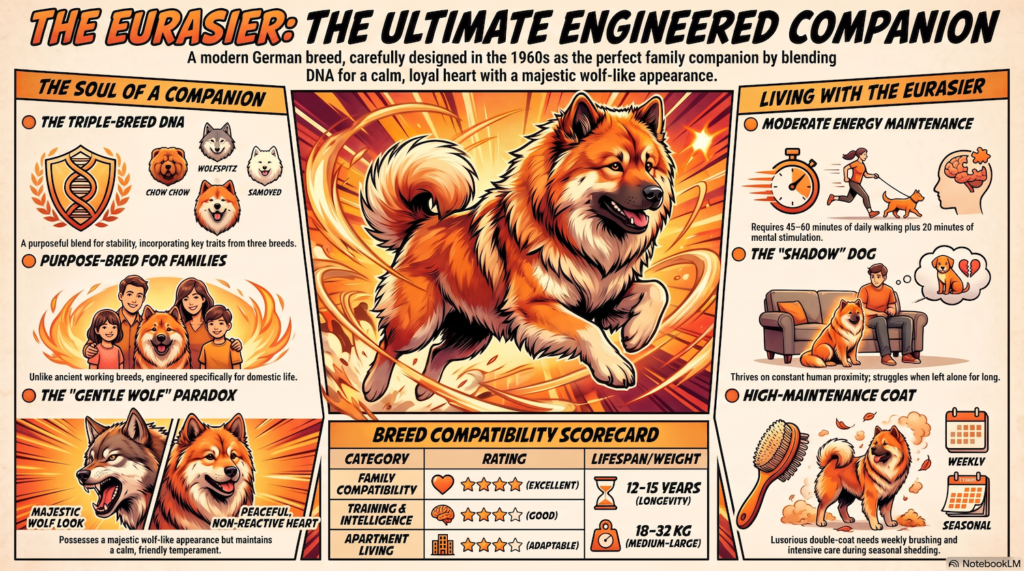
The Eurasier is a relatively modern breed developed in Germany by combining the Chow Chow, Wolfspitz (Keeshond), and Samoyed. The result is a well-balanced companion known for its calm nature, striking appearance, and deep loyalty to its family.
Eurasiers are affectionate without being overly demanding and tend to be reserved with strangers while forming exceptionally strong bonds with those they know and trust.
✅ PROS & CONS
Pros
- Calm and affectionate family companion
- Highly intelligent and adaptable
- Loyal and devoted to its owners
- Generally good with children and other pets
Cons
- Heavy seasonal shedding
- Doesn’t enjoy being left alone for long periods
- Can be reserved around strangers
- Needs regular exercise and mental stimulation
Is a Eurasier a Good Family Dog?
Yes. The Eurasier is generally an excellent family dog for households wanting a calm, affectionate and deeply devoted companion.
Eurasiers tend to form very strong bonds with their families while remaining reserved around strangers. They were deliberately developed as companion dogs rather than specialised hunters, herders or guards.
They usually do best when genuinely included in family life rather than spending long periods isolated outside.
How Much Exercise Does a Eurasier Need?
Most adult Eurasiers need around 60 minutes of daily exercise, although younger and particularly active dogs may enjoy considerably more.
Regular walks, hiking, play and exploratory outings generally suit them well.
They’re usually less intensely driven than breeds such as Huskies, Malinois or Border Collies.
Mental stimulation and opportunities to explore are still important.
Is a Eurasier Easy to Train?
Eurasiers are intelligent but can be independent thinkers.
They usually learn quickly but aren’t necessarily motivated by repetitive obedience exercises.
Calm, positive reinforcement works much better than harsh handling.
Their Chow Chow and Spitz heritage can contribute independence, while the breed’s strong family attachment encourages cooperation with trusted owners.
Does a Eurasier Shed?
Yes. Eurasiers can shed very heavily, particularly during seasonal coat changes.
They have a dense double coat consisting of protective outer hair and substantial undercoat.
During major shedding periods, enormous amounts of loose undercoat can be released over a relatively short time.
Regular brushing becomes particularly important during these coat “blows.”
Is a Eurasier Hypoallergenic?
No. The Eurasier isn’t considered hypoallergenic.
Its substantial double coat sheds and distributes dander throughout the environment.
People with significant dog allergies should spend time around adult Eurasiers before considering ownership.
The magnificent coat comes with magnificent quantities of hair.
How Often Does a Eurasier Need Grooming?
Eurasiers generally need thorough brushing once or twice each week, increasing considerably during seasonal shedding.
Their coat shouldn’t normally require shaving or extensive trimming.
Regular attention should also be given to nails, ears and teeth.
The double coat naturally provides insulation and protection when properly maintained.
Should You Shave a Eurasier?
Generally, no.
The Eurasier’s double coat provides insulation and protection, and routine shaving can interfere with its normal function and regrowth.
Removing loose undercoat through appropriate brushing is preferable.
Medical procedures or severe matting may occasionally require clipping, but cosmetic shaving isn’t normally appropriate.
What Health Problems Are Common in Eurasiers?
Potential health concerns include hip dysplasia, patellar luxation, certain eye disorders and thyroid disease.
Responsible breeding programmes place substantial emphasis on health screening.
Because the Eurasier was deliberately developed from a relatively limited foundation population, careful pedigree management and genetic diversity remain important.
Are Eurasiers Prone to Thyroid Problems?
Hypothyroidism is among the health conditions that responsible Eurasier breeding programmes monitor.
Symptoms can include lethargy, unexplained weight gain, coat changes and reduced tolerance of exercise.
These signs have many possible causes, so veterinary testing is required rather than diagnosing thyroid disease from appearance alone.
How Long Do Eurasiers Live?
Eurasiers commonly live around 12–14 years.
Some individuals live longer.
Responsible breeding, healthy body weight, appropriate exercise, good nutrition and preventive veterinary care all influence longevity.
For a medium-sized Spitz breed, the Eurasier generally has a respectable lifespan.
How Big Does a Eurasier Get?
Eurasiers are medium-sized dogs.
Adults generally stand around 48–60 cm at the shoulder, with males typically larger than females.
Weight commonly ranges approximately 18–32 kg.
Their enormous coats can make them appear substantially heavier than they actually are.
Can a Eurasier Live in an Apartment?
Yes. Eurasiers can adapt surprisingly well to apartment living if their exercise needs are consistently met.
They’re generally calmer indoors than many high-energy Spitz breeds.
Their relatively restrained barking can also be advantageous.
However, access to outdoor exercise and companionship remains essential.
Can a Eurasier Be Left Alone?
Eurasiers generally don’t thrive when regularly left alone for very long periods.
The breed was deliberately developed to be closely attached to its human family.
Some individuals can develop separation-related distress when isolated excessively.
Gradual independence training is important, but this isn’t an ideal breed for someone routinely absent from home all day.
Do Eurasiers Bark a Lot?
Usually not.
Eurasiers are generally regarded as relatively quiet dogs.
They may bark to alert their family when something unusual happens, but persistent unnecessary barking isn’t considered characteristic.
Their reserved nature means they often prefer observing unfamiliar situations before deciding whether intervention is necessary.
Are Eurasiers Good Watchdogs?
Yes. Eurasiers can be excellent alert watchdogs because they’re naturally observant and somewhat reserved with strangers.
They often notice unusual activity quickly.
However, the breed wasn’t developed as an aggressive protection dog.
A Eurasier will commonly announce someone’s arrival and then wait for its owner to decide whether the visitor belongs there.
Are Eurasiers Good Guard Dogs?
They’re generally watchdogs rather than specialised guard dogs.
Their size, substantial coat and reserved behaviour may appear imposing.
However, deliberate aggression isn’t a desirable Eurasier trait.
The breed’s creators specifically wanted a stable family companion rather than an unnecessarily sharp protection dog.
Are Eurasiers Aggressive?
Well-bred Eurasiers shouldn’t be indiscriminately aggressive.
They’re often reserved or aloof with unfamiliar people, which shouldn’t be confused with aggression.
Good socialisation helps puppies develop confidence without forcing them to enthusiastically greet everyone.
Fearfulness or uncontrolled aggression isn’t desirable.
Are Eurasiers Friendly With Strangers?
Eurasiers are typically reserved rather than immediately friendly with strangers.
They may prefer observing someone before deciding whether to interact.
Once they accept a person, they can become warm and affectionate.
Owners shouldn’t expect Labrador-style enthusiasm towards every stranger encountered.
Why Is My Eurasier So Aloof With Strangers?
Reserve around unfamiliar people is characteristic of the breed.
Eurasiers were developed to form particularly strong bonds with their own families without automatically treating every stranger as a new best friend.
Proper socialisation should produce confidence rather than universal friendliness.
A Eurasier politely ignoring someone can be completely normal behaviour.
Are Eurasiers Good With Children?
Yes. Well-socialised Eurasiers are generally gentle and affectionate with children in their family.
Their calmer temperament can make them pleasant family companions.
As with every breed, children should learn respectful handling and interactions should be supervised.
Dogs should always have somewhere quiet to retreat when they want space.
Are Eurasiers Good With Other Dogs?
Generally, yes.
Eurasiers can be social and tolerant with other dogs when properly socialised.
Individual compatibility still varies.
Because they’re generally less intensely competitive or reactive than some working Spitz breeds, many integrate well into multidog households.
Are Eurasiers Good With Cats?
Many Eurasiers can live successfully with cats, particularly when raised alongside them.
The breed wasn’t developed primarily for hunting, so prey drive is often more manageable than in many northern Spitz breeds.
However, individual chase instinct varies.
Careful introductions are still essential.
Do Eurasiers Have a Strong Prey Drive?
Prey drive is usually moderate and variable rather than extreme.
The Eurasier wasn’t specifically developed as a hunting dog.
However, its Spitz ancestry means some individuals may still chase wildlife.
Reliable recall and appropriate management remain important.
Can a Eurasier Be Trusted Off Leash?
Many Eurasiers can develop good off-leash reliability with consistent recall training.
They tend to remain connected with their families and generally aren’t as strongly inclined to roam as some northern breeds.
However, wildlife or interesting scents can still override training.
Off-leash freedom should be introduced gradually in safe environments.
Are Eurasiers Good Hiking Dogs?
Yes. Healthy Eurasiers can make excellent hiking companions.
They’re sturdy, athletic and generally enjoy exploring with their owners.
Their heavy coat makes cool-weather adventures particularly comfortable.
Hot conditions require considerably more caution.
Do Eurasiers Like Water?
Some do, while others show relatively little interest.
The Eurasier wasn’t developed as a water-working breed, so swimming enthusiasm isn’t especially predictable.
Individuals introduced positively to water while young may enjoy swimming.
Their dense coats become extremely heavy when wet and require thorough drying.
Do Eurasiers Handle Cold Weather Well?
Yes. Their dense double coat provides excellent protection in cold conditions.
The breed’s Chow Chow and Wolfspitz ancestry contributes substantial insulation.
Many Eurasiers become noticeably more energetic when temperatures fall.
Cold-weather suitability doesn’t mean they should simply be left outdoors; they’re strongly family-oriented dogs.
Do Eurasiers Handle Hot Weather Well?
Eurasiers require careful management during hot weather.
Their dense double coats make strenuous exercise during high temperatures inappropriate.
Walks should be scheduled for cooler parts of the day, with constant access to shade and fresh water.
Australia’s hotter regions can require particularly thoughtful heat management.
Why Does My Eurasier Have a Blue or Black Tongue?
Some Eurasiers inherit dark pigmentation on the tongue from their Chow Chow ancestry.
The tongue may be entirely dark or contain blue-black spots.
Other Eurasiers have predominantly pink tongues.
Variation is normal within the breed.
Do All Eurasiers Have Blue Tongues?
No.
Some Eurasiers have blue-black tongues, partially pigmented tongues or pink tongues with dark markings, while others may show much less pigmentation.
Chow Chow ancestry makes dark tongue pigmentation unsurprising, but a completely blue-black tongue isn’t required for every Eurasier.
Is a Eurasier Related to the Chow Chow?
Yes. The Chow Chow is one of the three foundation breeds used to create the Eurasier.
The original breeding programme began with Wolfspitz and Chow Chow.
The Samoyed was introduced later.
Chow ancestry contributed to the Eurasier’s appearance, reserve and distinctive pigmentation.
Is a Eurasier Related to the Samoyed?
Yes. Samoyed ancestry was deliberately introduced during the Eurasier’s development.
The Samoyed helped contribute traits including friendliness, elegance and companionability.
However, Eurasiers aren’t simply differently coloured Samoyeds.
The two breeds have very different histories and typical temperaments.
Is a Eurasier Related to the Keeshond?
Yes. One of the Eurasier’s principal foundation breeds was the Wolfspitz, the German variety closely associated with what is internationally known as the Keeshond.
Wolfspitz ancestry contributed heavily to the Eurasier’s Spitz appearance.
The terminology can be confusing because kennel organisations have historically classified Keeshond and Wolfspitz differently.
What Three Breeds Created the Eurasier?
The Eurasier was created primarily from three breeds:
Wolfspitz, Chow Chow and Samoyed.
The original Wolfspitz × Chow Chow dogs were called Wolf-Chows.
Samoyed blood was later introduced into the developing population.
After this addition, the breed eventually became known as the Eurasier.
Is the Eurasier a Wolf Hybrid?
No. Despite its Spitz appearance and the historical name Wolf-Chow, the Eurasier isn’t a wolf hybrid.
“Wolf” referred to the Wolfspitz foundation breed.
Eurasiers are entirely domestic dogs.
Their wolf-like appearance comes from Spitz characteristics rather than recent wolf ancestry.
What Is a Wolf-Chow?
The Wolf-Chow was the original precursor to the Eurasier.
German breeder Julius Wipfel began crossing Wolfspitz dogs with Chow Chows during the 1960s.
These dogs combined European and Asian Spitz ancestry.
After Samoyed ancestry was later introduced, the developing breed was renamed Eurasier.
Who Created the Eurasier?
The Eurasier was primarily developed by Julius Wipfel in Germany during the 1960s and 1970s.
Wipfel wanted to create a medium-sized family companion combining desirable characteristics of European and Asian Spitz dogs.
Unlike many breeds that emerged gradually over centuries, the Eurasier has a remarkably well-documented modern origin.
Why Did Julius Wipfel Create the Eurasier?
Wipfel wanted a dog combining the attractive qualities of different Spitz breeds while functioning primarily as a stable family companion.
His inspiration was influenced by dogs he had previously owned and his interest in creating a balanced temperament.
The project wasn’t simply about producing a fashionable appearance.
Temperament and family attachment were central goals from the beginning.
Did Julius Wipfel Own a Dog That Inspired the Eurasier?
Yes. Accounts of the breed’s creation frequently describe a Spitz-type dog named Canadier that had a profound effect on the Wipfel family.
After experiencing this dog’s distinctive temperament, Julius Wipfel became interested in recreating desirable characteristics through a planned breeding programme.
That ambition eventually led to the Eurasier.
Was Konrad Lorenz Involved in Creating the Eurasier?
The famous Austrian zoologist and ethologist Konrad Lorenz became associated with and supportive of the developing breed, although Julius Wipfel was its principal creator.
Lorenz had considerable interest in dog behaviour and Chow-type dogs.
His connection has become an interesting part of Eurasier history.
He shouldn’t, however, replace Wipfel as the breed’s primary founder in historical accounts.
Who Was Konrad Lorenz?
Konrad Lorenz was a prominent Austrian zoologist and ethologist known for research into animal behaviour.
He shared the 1973 Nobel Prize in Physiology or Medicine with Nikolaas Tinbergen and Karl von Frisch.
Lorenz was particularly famous for studies of imprinting in birds and also wrote extensively about dogs.
His later association with the Eurasier brought unusual scientific attention to the young breed.
Did Konrad Lorenz Own a Eurasier?
Yes. Lorenz reportedly owned a female Eurasier named Babett, and he spoke favourably about the breed’s temperament.
His interest helped provide credibility to Wipfel’s breeding project.
The association is particularly remarkable because very few modern dog breeds can point to a Nobel Prize-winning animal behaviour scientist among their early supporters.
Why Was the Samoyed Added to the Eurasier?
Samoyed ancestry was introduced to refine the developing Wolf-Chow population, particularly aspects of temperament and appearance.
The addition broadened the breed’s foundation beyond the original Wolfspitz-Chow combination.
Once Samoyed blood became part of the population, the breed’s identity changed sufficiently that a new name became appropriate.
Why Is the Breed Called Eurasier?
The name reflects the breed’s combination of European and Asian ancestry.
The Wolfspitz represented European Spitz heritage, while the Chow Chow contributed Asian ancestry, with the Samoyed adding another northern Eurasian element.
“European + Asian” effectively became Eurasier.
Few dog breed names describe their genetic concept quite so neatly.
Is It Eurasier or Eurasian?
The recognised breed name is Eurasier.
“Eurasian” is sometimes used informally or mistakenly, particularly because the word Eurasian already describes something relating to Europe and Asia.
In kennel-club terminology, however, the dog breed is the Eurasier.
When Was the Eurasier Created?
Development began in Germany during the 1960s.
The first stage involved crossing Wolfspitz and Chow Chow dogs.
Samoyed ancestry was subsequently introduced during the early 1970s.
This makes the Eurasier extraordinarily young compared with breeds whose histories stretch back hundreds of years.
When Was the Eurasier Officially Recognised?
The breed achieved international recognition through the Fédération Cynologique Internationale (FCI) during the 1970s, following its development in Germany.
Its formal recognition occurred remarkably quickly compared with many breeds.
That reflects the organised nature of Wipfel’s breeding programme and the establishment of a defined breed population.
Is the Eurasier a Designer Dog?
No, not in the modern sense.
Although the Eurasier began through deliberate crossbreeding, it was subsequently developed over generations into a standardised, recognised breed with its own breeding population and breed standard.
This is fundamentally different from repeatedly producing first-generation crosses and marketing them under a designer name.
Virtually every established breed ultimately developed through selection from earlier dog populations.
Is the Eurasier Still Crossed With Chow Chows or Samoyeds?
No. Modern pedigree Eurasiers are bred Eurasier to Eurasier.
The foundation breeds were used during the creation of the breed.
Once a stable population and breed standard were established, continued routine crossing with Chow Chows, Wolfspitz or Samoyeds wasn’t necessary.
A modern Eurasier isn’t simply a newly produced three-way cross.
What Does a Eurasier Look Like?
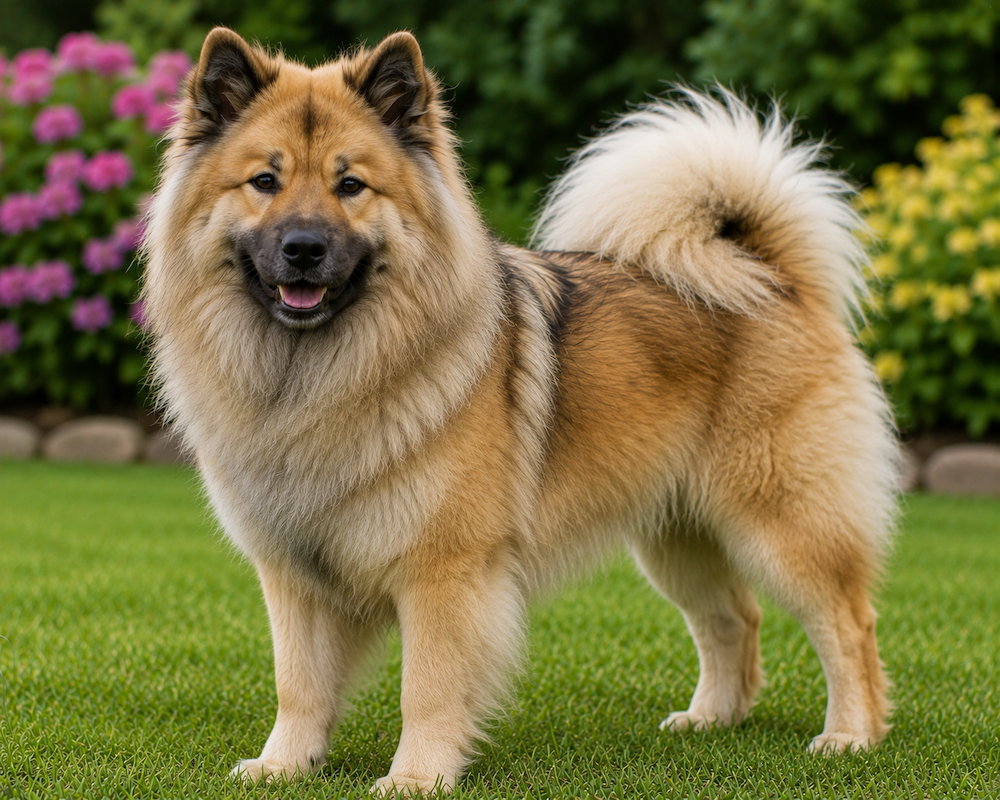
The Eurasier is a medium-sized Spitz dog with erect triangular ears, a wedge-shaped head, dense double coat and a bushy tail carried curled or curved over the back.
Its appearance combines features reminiscent of its foundation breeds without looking exactly like any one of them.
The overall expression is alert but generally calm.
What Colours Can Eurasiers Be?
Eurasiers occur in a surprisingly broad range of colours, including red, fawn, wolf-grey, black, black-and-tan and various shaded combinations.
Certain colour patterns aren’t accepted under the breed standard.
The range makes Eurasiers much more visually diverse than breeds such as the Samoyed, where colour is much more restricted.
Can a Eurasier Be Black?
Yes. Solid black Eurasiers exist and can be particularly striking.
The heavy coat and Spitz silhouette can make black individuals appear especially dramatic.
Colour doesn’t fundamentally change the breed’s expected temperament or exercise requirements.
Can a Eurasier Be Red?
Yes. Red and reddish-fawn coats are found in Eurasiers.
Some strongly reveal the visual influence of the Chow Chow, although their structure and temperament remain distinctly Eurasier.
Coat colour can also change somewhat as puppies mature.
Can a Eurasier Be Wolf Grey?
Yes. Wolf-grey is one of the breed’s characteristic colour possibilities.
These dogs can strongly display the Wolfspitz influence behind the breed.
Despite the name and appearance, wolf-grey colouring has nothing to do with actual wolf hybridisation.
Can Eurasiers Have White Markings?
Small amounts of white may occasionally occur, but large irregular white patches and predominantly white coats aren’t characteristic of the recognised breed standard.
The Samoyed contributed to the Eurasier’s ancestry, but the goal wasn’t to create another white Spitz breed.
Modern Eurasier colours reflect the combined foundation population.
Why Does a Eurasier Have Such a Thick Coat?
The Eurasier inherited a dense northern Spitz double coat from its foundation breeds.
Wolfspitz, Chow Chows and Samoyeds all possess substantial coats suited to challenging climates.
The undercoat provides insulation while the outer coat offers protection.
The result is beautiful, practical — and capable of producing extraordinary amounts of loose fur during shedding season.
Why Does a Eurasier’s Tail Curl Over Its Back?
A curled or curved tail is a classic Spitz characteristic.
All three foundation breeds belong to the broader Spitz family and display variations of this trait.
The Eurasier therefore inherited the characteristic naturally during its development.
A richly coated tail carried over the back also contributes strongly to the breed’s distinctive silhouette.
Why Does My Eurasier Look Like a Chow Chow?
Some Eurasiers inherit particularly obvious Chow-like characteristics, including head shape, coat density, colouring and dark tongue pigmentation.
Others look more strongly Wolfspitz or Samoyed influenced.
The breed was deliberately developed to blend these populations, so variation in which ancestral features appear most obvious isn’t surprising.
Why Does My Eurasier Look Like a Samoyed?
Lighter-coloured Eurasiers with abundant coats and smiling expressions can show obvious Samoyed influence.
However, pure white isn’t the defining Eurasier appearance, and the typical temperament is often more reserved with strangers than that of a Samoyed.
Appearance alone can therefore be misleading.
Why Does My Eurasier Look Like a Keeshond?
Wolfspitz ancestry forms a major part of the Eurasier’s foundation.
Wolf-grey Eurasiers can therefore resemble Keeshond/Wolfspitz-type dogs, particularly in coat and overall silhouette.
Differences in head, markings, proportions and temperament become more obvious when the breeds are compared closely.
Is the Eurasier a Rare Dog Breed?
Yes. The Eurasier remains a relatively uncommon breed internationally.
Breeders have generally prioritised controlled development rather than rapid mass popularity.
In some countries, prospective owners may need to wait for puppies from responsible breeders.
Rarity also makes careful management of genetic diversity particularly important.
Why Are Eurasier Breeders So Selective About Owners?
Responsible Eurasier breeding communities often place considerable emphasis on protecting temperament, health and responsible ownership.
The breed was specifically developed as a family companion, and many breeders want puppies placed in homes where they’ll genuinely live as family members.
This culture has also helped prevent the breed from becoming as heavily commercially exploited as some fashionable Spitz breeds.
Is a Eurasier a Good First Dog?
Potentially, yes.
A committed first-time owner can succeed with a Eurasier because the breed is generally less intensely driven than many working Spitz breeds.
However, owners still need to understand socialisation, independent behaviour, substantial shedding and the breed’s need for companionship.
Choosing a responsible breeder with stable family-oriented lines is particularly important.
Why Is the Eurasier So Attached to Its Family?
Strong family attachment wasn’t accidental — it was one of the central goals of the breed’s development.
Julius Wipfel wanted a dog that combined Spitz characteristics with a stable companion temperament.
Generations of selective breeding reinforced close bonds with household members.
A Eurasier often isn’t interested in loving everyone it meets because it reserves its strongest relationships for its own people.
Is the Eurasier a Natural Breed?
No. The Eurasier is a deliberately created modern breed with unusually well-documented origins.
Unlike landrace breeds that developed gradually through geography and function, the Eurasier resulted from a planned breeding programme beginning in 1960s Germany.
That doesn’t make it less legitimate as a breed.
It simply means we know considerably more about who created it, why they created it and which dogs contributed.
Where Does the Eurasier Come From?
The Eurasier comes from Germany, where Julius Wipfel began a deliberate breeding programme during the 1960s using Wolfspitz and Chow Chow dogs, later adding Samoyed ancestry.
The resulting Wolf-Chow eventually became the Eurasier, a name representing its blend of European and Asian Spitz heritage.
It’s an unusual breed because its history isn’t hidden behind centuries of folklore. We know roughly who created it, when it was created and what he was trying to achieve — a beautiful Spitz that wasn’t primarily a hunter, sled dog or guard, but something far simpler: a dog specifically designed to be part of the family.