




Affectionate, playful, and wonderfully entertaining — a lovable companion that combines the charm of the Pug with the intelligence of the Poodle.
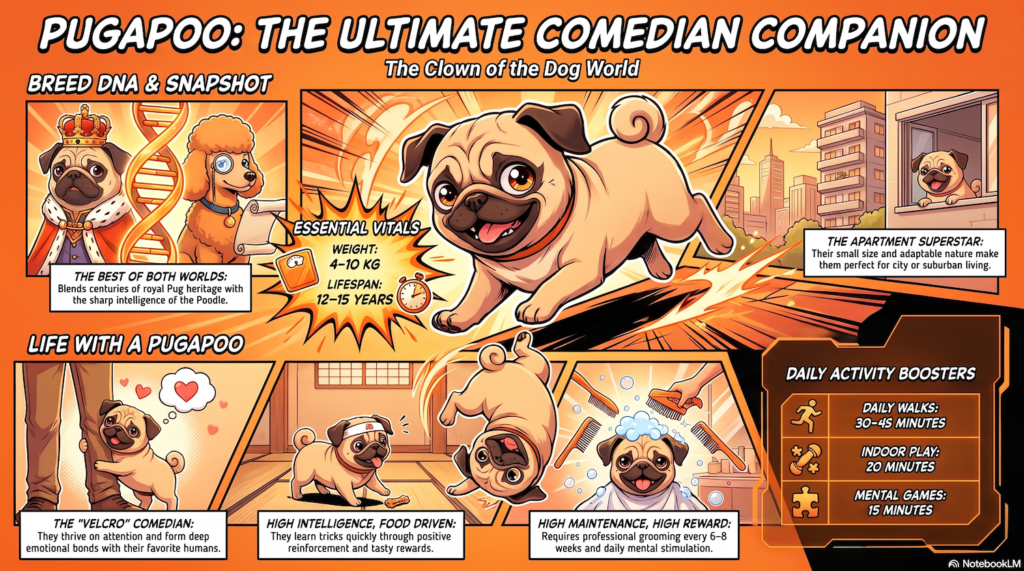
🧠 QUICK SNAPSHOT
- Temperament: Affectionate, playful, intelligent
- Energy Level: Moderate
- Size: Small
- Good With Families: Yes
- Trainability: High
- Grooming: Moderate
- Best For: Families, apartment living, companionship
📚 OVERVIEW
The Pugapoo is a cross between a Pug and a Poodle, creating a friendly, intelligent, and affectionate companion. Depending on which parent they take after, Pugapoos may have a curly, wavy, or short coat, but they almost always inherit a cheerful personality and a strong desire to be close to their family.
Adaptable and social, the Pugapoo fits comfortably into apartments, townhouses, and larger homes, provided it receives regular exercise and plenty of companionship.
✅ PROS & CONS
Pros
- Loving and affectionate companion
- Highly intelligent and easy to train
- Adaptable to many living situations
- Friendly with children and other pets
Cons
- May inherit breathing issues from the Pug parent
- Requires regular grooming if the coat is curly
- Can develop separation anxiety
- Needs regular exercise to maintain a healthy weight
Is a Pugapoo a Good Family Dog?
Yes. A Pugapoo can be an affectionate, playful and intelligent family companion.
The Pugapoo is a cross between a Pug and a Toy or Miniature Poodle, so temperament can vary. Many inherit the Pug’s sociable, entertaining personality together with the Poodle’s intelligence and trainability.
They’re generally happiest in homes where they receive plenty of companionship.
Are Pugapoos Good With Children?
Generally, yes.
Pugapoos are often playful and affectionate with children, particularly when properly socialised.
Small individuals should be handled carefully, and all interactions with young children should be supervised.
How Much Exercise Does a Pugapoo Need?
Most Pugapoos need around 30–60 minutes of daily activity, depending on their size, age and physical structure.
A dog inheriting more Poodle characteristics may be surprisingly energetic.
A Pugapoo with a very short Pug-like muzzle may have reduced exercise tolerance and should never be pushed to exercise when struggling to breathe.
Is a Pugapoo Easy to Train?
Usually, yes.
Poodles are exceptionally trainable, while Pugs are often highly motivated by food and attention.
Some Pugapoos inherit the Pug’s stubborn streak, but positive reinforcement and short, enjoyable training sessions generally work well.
Does a Pugapoo Shed?
It varies considerably.
A Pugapoo with a curly Poodle-like coat may shed relatively little, while one inheriting more of the Pug’s coat can be a moderate or even heavy shedder.
Coat type can vary even between puppies from the same litter.
Is a Pugapoo Hypoallergenic?
No Pugapoo can be guaranteed to be hypoallergenic.
Some inherit a low-shedding Poodle-type coat and may release less hair around the home.
However, Pugs can shed heavily, and dog allergens are also present in saliva and skin secretions. Crossing a Pug with a Poodle doesn’t guarantee an allergy-friendly puppy.
How Often Should You Groom a Pugapoo?
Grooming requirements depend heavily on coat type.
Curly or wavy Pugapoos may need brushing several times a week or daily, plus professional grooming approximately every six to eight weeks.
Shorter Pug-like coats are easier to maintain but may shed considerably more. Dogs with facial wrinkles also need their skin folds checked and kept clean and dry.
What Health Problems Are Common in Pugapoos?
Pugapoos can inherit health problems from either parent, including patellar luxation, eye disorders, dental disease, Legg-Calvé-Perthes disease and certain inherited Poodle conditions.
Dogs inheriting a short, flat Pug-like face can also develop brachycephalic obstructive airway syndrome (BOAS).
Responsible breeding should prioritise health-tested parents and functional structure rather than assuming crossbreeding automatically eliminates Pug health problems.
Can Pugapoos Have Breathing Problems?
Yes.
A Pugapoo that inherits significant brachycephalic features from the Pug can experience narrowed airways and breathing difficulties.
A longer Poodle-influenced muzzle may reduce some conformational risk, but it doesn’t guarantee healthy airways. Persistent snoring, noisy breathing, exercise intolerance or respiratory distress shouldn’t be dismissed as normal.
How Long Does a Pugapoo Live?
Pugapoos commonly live around 12–15 years, although there is limited large-scale lifespan data specifically for this cross.
Adult size, genetics, breathing health, weight and veterinary care can all influence longevity.
Keeping a Pugapoo lean is particularly important.
How Big Does a Pugapoo Get?
Most Pugapoos are small dogs, commonly weighing around 4–10 kg, although individuals can fall outside this range.
Size depends partly on whether a Toy or Miniature Poodle is used.
Because the Pugapoo isn’t a standardised breed, breeders can’t guarantee an exact adult size.
When Is a Pugapoo Fully Grown?
Most Pugapoos reach close to their adult height at around 9–12 months.
They may continue filling out after this.
Pugapoos with Miniature Poodle ancestry may take somewhat longer to reach full physical maturity than very small Toy Poodle crosses.
Is There a Teacup Pugapoo?
There is no officially recognised Teacup Pugapoo.
“Teacup”, “Micro” and similar descriptions are marketing terms rather than established breed sizes.
Extreme miniaturisation can introduce additional risks including fragile bones, dental crowding and hypoglycaemia.
Can a Pugapoo Live in an Apartment?
Yes. Pugapoos can be excellent apartment dogs.
They’re generally small and have manageable exercise requirements.
They still need daily walks, play, mental stimulation and companionship regardless of how much indoor space is available.
Can a Pugapoo Be Left Alone?
Adult Pugapoos can learn to tolerate reasonable periods alone, but many become strongly attached to their owners.
Both Pugs and Poodles are highly people-oriented.
Gradual independence training from puppyhood can help prevent separation-related behaviour.
Are Pugapoos Cuddly?
Many are extremely cuddly.
Pugs have centuries of history as companion dogs, while Poodles also form strong relationships with their owners.
A Pugapoo may therefore spend a considerable amount of time attempting to convert its owner into furniture.
Do Pugapoos Bark a Lot?
They can be moderately vocal, but excessive barking isn’t inevitable.
Poodle influence may contribute alert barking, while individual Pugs vary considerably in vocal behaviour.
Training, exercise and mental stimulation can help prevent barking caused by boredom or attention seeking.
Are Pugapoos Good With Other Dogs?
Generally, yes.
Both parent breeds are typically sociable, and properly socialised Pugapoos often enjoy living with other dogs.
Compatibility still depends on individual temperament and appropriate introductions.
Are Pugapoos Good With Cats?
Many can live successfully with cats.
Neither parent breed is generally associated with extremely strong prey drive, although individual dogs may still chase.
Early introductions and socialisation usually provide the best results.
Can Pugapoos Handle Hot Weather?
Care is needed, particularly with short-muzzled individuals.
Pug-like facial structure can reduce the dog’s ability to cool itself efficiently through panting.
During hot Australian weather, exercise should take place during cooler periods, with constant access to water and a cool indoor environment.
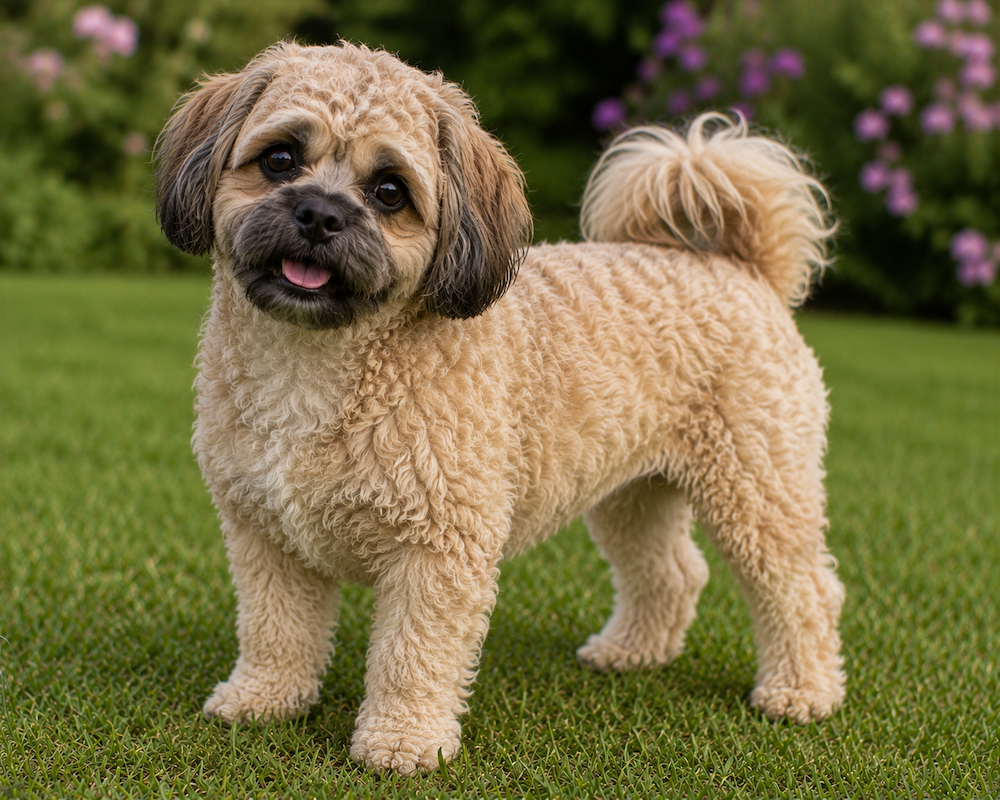
What Does a Pugapoo Look Like?
Pugapoos can vary dramatically.
Some have curly Poodle coats with relatively long muzzles, while others inherit a stockier Pug body, shorter face and straighter coat.
Many fall somewhere between the two, with wavy coats, floppy ears and expressive faces.
There is no single standard Pugapoo appearance.
What Colours Can Pugapoos Be?
Pugapoos can occur in colours including black, fawn, cream, apricot, brown, white and combinations of these colours.
Poodle genetics can introduce considerably more colour variation than is normally seen in Pugs.
Some coats may also lighten as the dog matures.
What Is the Difference Between a Pugapoo and a Pug?
A Pug is an established purebred companion breed, while a Pugapoo combines Pug and Poodle ancestry.
Pugapoos may have longer muzzles, curlier coats, lower shedding and a somewhat lighter build.
None of these characteristics is guaranteed, however.
What Is the Difference Between a Pugapoo and a Poochon?
A Pugapoo is Pug × Poodle, while a Poochon is Bichon Frise × Poodle.
Poochons have two relatively low-shedding parent breeds, making low shedding more predictable.
Pugapoos have greater variation because the Pug has a very different coat and body structure from the Poodle.
Is a Pugapoo a Purebred Dog?
No.
The Pugapoo is a Pug × Poodle cross rather than an established purebred breed.
It’s also sometimes called a Pugoodle or Pug-Poodle mix.
Its size, coat, muzzle length and temperament can therefore vary substantially.
What Does F1 Pugapoo Mean?
An F1 Pugapoo has one purebred Pug parent and one purebred Poodle parent.
The puppy receives approximately half its ancestry from each breed.
That doesn’t mean its physical characteristics will appear in a perfect 50/50 combination.
What Is an F1B Pugapoo?
An F1B Pugapoo is generally produced by crossing an F1 Pugapoo back to one of its parent breeds, commonly the Poodle.
This may increase the likelihood of a curly, low-shedding coat.
It still can’t guarantee coat type, allergy suitability, size or temperament.
Where Does the Pugapoo Come From?
The Pugapoo is a modern Poodle cross that became increasingly familiar during the wider growth of designer companion dogs.
There’s no reliably documented single breeder, exact date or country that can confidently be described as the origin of the Pugapoo.
Pug-Poodle crosses almost certainly existed before the modern name became popular.
Why Were Pugs Crossed With Poodles?
The combination aims to bring together characteristics of two very different companion dogs.
The Pug contributes its affectionate, sociable and entertaining personality, while the Poodle can contribute intelligence, trainability and a potentially lower-shedding coat.
A longer muzzle may occur, but breeding a Pug with a Poodle doesn’t guarantee that puppies will avoid brachycephalic health problems.
Is a Pugapoo Healthier Than a Pug?
Potentially, but not automatically.
Some Pugapoos inherit a longer muzzle and less extreme body structure, which may reduce certain conformational problems associated with Pugs.
Others can still inherit short muzzles, airway problems, eye issues or other conditions from the Pug side, as well as inherited diseases from the Poodle.
Health-tested parents and functional structure remain much more important than the “designer dog” label.
Is a Pugapoo a Good First Dog?
Yes. A Pugapoo can be a good first dog for someone prepared for grooming, training and potential health considerations.
They’re generally affectionate, intelligent and manageable in size.
Prospective owners should pay particular attention to the dog’s breathing, coat type and inherited health, because these can vary much more than the cute puppy photographs suggest.
What Makes the Pugapoo Unique?
The Pugapoo combines two dogs whose histories could hardly look more different.
The Pug spent centuries as a companion dog, becoming famous for its compact body, flat face and devotion to people.
The Poodle developed from athletic European water dogs and became renowned for intelligence, trainability and its curly low-shedding coat.
Mixing them can produce some extraordinary variation.
One Pugapoo may have curls, long legs and a noticeably longer muzzle.
Another may be stockier, straighter-coated and unmistakably Pug-like.
That’s why a Pugapoo shouldn’t be sold as a guaranteed “healthier Pug that doesn’t shed.” Genetics aren’t that predictable.
A responsibly bred Pugapoo may combine some very appealing qualities from both breeds, but the important things aren’t whether the puppy has perfect curls or an especially cute face.
It should be able to breathe comfortably, move freely and live an active life.
And if it also inherits the Poodle’s intelligence and the Pug’s obsession with food, don’t be surprised if it works out exactly where the treats are kept — and then develops a surprisingly sophisticated strategy for getting them.