






Bold, intelligent, and endlessly curious — a small watchdog with a huge personality and boundless confidence.
🧠 QUICK SNAPSHOT
- Temperament: Alert, intelligent, confident
- Energy Level: High
- Size: Small
- Good With Families: Yes
- Trainability: High
- Grooming: Moderate
- Best For: Active families, companionship, experienced owners
📚 OVERVIEW
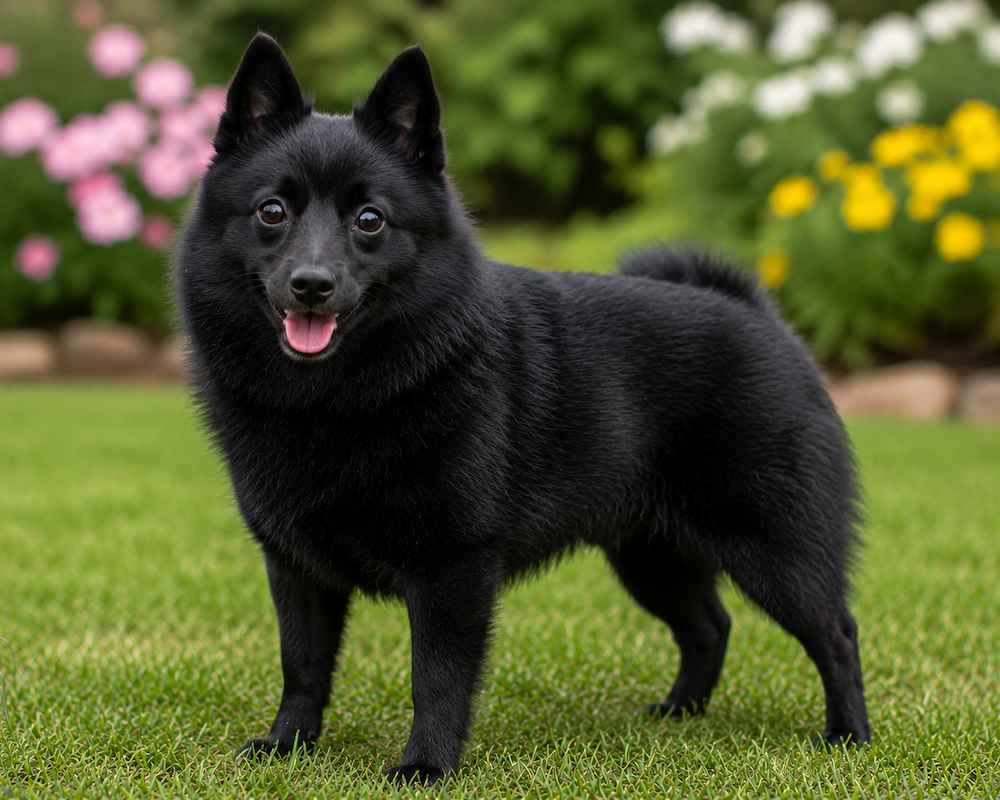
The Schipperke is a spirited Belgian breed originally developed as a watchdog and vermin hunter on canal boats and farms. Recognisable by its fox-like face, thick black coat, and lively expression, the Schipperke is packed with personality despite its compact size.
Curious, fearless, and always eager to explore, these dogs thrive in homes where they receive plenty of exercise, mental stimulation, and opportunities to be involved in family life.
✅ PROS & CONS
Pros
- Extremely intelligent and quick to learn
- Loyal and devoted to family
- Excellent watchdog
- Compact size with a big personality
Cons
- Can be vocal
- Strong prey drive and curiosity
- Needs regular exercise and mental stimulation
- May be wary of strangers without early socialisation
Is a Schipperke a Good Family Dog?
Yes. Schipperkes can be affectionate, loyal and entertaining family dogs, particularly for active households.
They’re small dogs with remarkably big personalities and tend to be curious, confident and highly involved in family life.
Their energy, independence and tendency to bark mean they aren’t necessarily the easiest small companion breed.
Are Schipperkes Good With Children?
Schipperkes can be good with respectful children, especially when raised with them.
They’re sturdy for their size and often enjoy games and activity.
As with any small dog, children should be taught appropriate handling and interactions with younger children should be supervised.
How Much Exercise Does a Schipperke Need?
Most Schipperkes need around 45–60 minutes of daily exercise, along with mental stimulation.
Walks, games, training and opportunities to explore suit their energetic personalities.
Don’t assume their small size means they’re content with a sedentary lifestyle — the Schipperke was developed as an active working dog.
Are Schipperkes Easy to Train?
Schipperkes are very intelligent but can be independent and strong-minded.
They learn quickly, including behaviours their owners didn’t intend to teach them.
Short, varied training sessions using positive reinforcement tend to work best, with early recall and impulse-control training particularly valuable.
Do Schipperkes Shed a Lot?
Yes. Schipperkes have a dense double coat and can shed considerably, particularly during seasonal coat changes.
For much of the year shedding may be moderate, but when the undercoat is released it can become much more noticeable.
Regular brushing helps control loose hair.
Are Schipperkes Hypoallergenic?
No.
Schipperkes aren’t considered hypoallergenic.
Their double coat sheds, and they produce the same skin and saliva-associated allergens found in other dogs.
How Often Should You Groom a Schipperke?
Schipperkes are relatively easy to groom despite their substantial coat.
Weekly brushing is generally adequate, with more frequent brushing during seasonal shedding.
Their natural coat doesn’t require elaborate trimming, although routine nail, dental and ear care remain important.
What Health Problems Are Common in Schipperkes?
Potential health concerns include patellar luxation, eye disorders, thyroid problems and Legg-Calvé-Perthes disease.
An especially important inherited condition in the breed is mucopolysaccharidosis type IIIB (MPS IIIB), a progressive neurological disorder for which genetic testing is available.
Responsible breeders should use appropriate health and DNA screening.
How Long Do Schipperkes Live?
Schipperkes commonly live around 13–16 years, with some surviving even longer.
Their relatively long lifespan means purchasing or adopting one can involve a commitment lasting well into its teenage years.
Healthy weight, exercise, good breeding and regular veterinary care can all contribute to longevity.
How Big Does a Schipperke Get?
Schipperkes are small dogs that commonly weigh approximately 5–8 kg, although breed standards vary somewhat between countries.
Their sturdy body, thick coat and confident posture can make them appear more substantial than their weight suggests.
Can a Schipperke Live in an Apartment?
Yes, provided its exercise and mental-stimulation needs are met.
Their small size is well suited to compact homes, but barking can be an issue in apartments.
A bored Schipperke with a view of everything happening outside can appoint itself neighbourhood security officer surprisingly quickly.
Can Schipperkes Be Left Alone?
Adult Schipperkes can learn to tolerate reasonable periods alone.
However, they’re active, intelligent dogs that can become bored when regularly left without sufficient stimulation.
Exercise, training and enrichment are important for preventing destructive or excessively vocal behaviour.
Do Schipperkes Bark a Lot?
They can.
Schipperkes are naturally alert and watchful dogs and are often quick to announce visitors, unusual sounds or activity around their territory.
Early training can help prevent alert barking from becoming excessive.
Are Schipperkes Good Watchdogs?
Yes. Despite their small size, Schipperkes can be excellent watchdogs.
They’re naturally alert, curious and often suspicious of unusual activity.
They don’t have the physical size of a traditional guard dog, but they’re exceptionally capable of letting everyone know that something has happened.
Are Schipperkes Good With Other Dogs?
Generally, yes, particularly when properly socialised.
Schipperkes can be confident dogs and may occasionally behave as though they’re considerably larger than they really are.
Early positive experiences with different dogs can help develop appropriate social behaviour.
Are Schipperkes Good With Cats?
Many Schipperkes can live successfully with cats, especially when raised together.
However, their historical role included controlling vermin, and some individuals retain a strong instinct to chase smaller animals.
Introductions should therefore be gradual and supervised.
Do Schipperkes Have a High Prey Drive?
They can.
Schipperkes historically performed tasks that included vermin control, so rodents and other small, fast-moving animals may attract considerable attention.
Secure fencing and good recall training are important, although instinct can sometimes override training.
Are Schipperkes Good Off Leash?
Schipperkes can be challenging off leash because they’re curious, independent and potentially interested in chasing small animals.
Recall should be trained from puppyhood.
Secure fenced areas are generally the safest places for unrestricted running if an individual dog has unreliable recall.
Why Are Schipperkes Usually Black?
Solid black is the colour most strongly associated with the Schipperke and is required by some major breed standards.
Other colours can occur and are recognised by certain kennel organisations depending on the country.
The black coat combined with the distinctive ruff around the neck gives the breed its characteristic silhouette.
Are Schipperkes Born Without Tails?
Some Schipperkes can be naturally born with shortened tails, but others are born with full-length tails.
Historically, tail docking became strongly associated with the breed in some countries, which created the impression that Schipperkes naturally have no tail.
Where docking is prohibited or uncommon, full-tailed Schipperkes are readily seen.
What Is the Difference Between a Schipperke and a Pomeranian?
Their black coats, pointed ears and Spitz-like appearance can make them look superficially similar, but they’re distinct breeds.
Schipperkes are generally more robust and workmanlike, with a historical background as Belgian watchdogs and vermin controllers.
Pomeranians are smaller companion dogs descended from the German Spitz family and carry a much more profuse coat.
Is a Schipperke a Spitz?
The Schipperke certainly looks like a small Spitz, with upright ears, a dense coat and fox-like expression.
However, its historical development is Belgian and closely associated with small shepherd-type dogs rather than simply being a miniature northern Spitz.
Its precise classification has sometimes caused confusion because its appearance suggests one thing while its documented breed history suggests another.
What Were Schipperkes Originally Bred For?
Schipperkes developed as versatile watchdogs and vermin controllers, particularly around homes, workshops, waterways and barges in Belgium.
Their small size, alert temperament and willingness to tackle rodents made them useful working dogs.
This history helps explain why modern Schipperkes are so curious about everything happening around them.
Were Schipperkes Barge Dogs?
Yes. Schipperkes became strongly associated with Belgian canal boats and barges, where they could act as watchdogs and help control rats and mice.
This association became so famous that they’re frequently described as Belgian barge dogs.
However, their historical use wasn’t restricted to boats; they were also kept by tradespeople and households on land.
What Does Schipperke Mean?
“Schipperke” is often popularly translated as “little captain”, reinforcing the breed’s famous connection with canal boats.
However, the name is more convincingly linked to Flemish terminology meaning “little shepherd”, reflecting the breed’s relationship to Belgian shepherd-type dogs.
The “little captain” explanation is one of the breed’s most persistent historical misconceptions.
Where Does the Schipperke Come From?
The Schipperke comes from Belgium, particularly the Flemish regions around Brussels and Leuven.
Its development is associated with a larger black shepherd-type dog known as the Leauvenaar, which is also linked historically with Belgian shepherd dogs.
Smaller dogs were valued as watchdogs and vermin hunters and eventually developed into the Schipperke.
Is a Schipperke a Good First Dog?
A Schipperke can suit a committed first-time owner, but it isn’t necessarily an easy small dog.
They’re intelligent, energetic, vocal and independent, and their curiosity can make consistent training essential.
Someone wanting a quiet lap dog may be surprised by just how much working-dog personality can fit inside a 5–8 kg body.
What Makes the Schipperke Unique?
The Schipperke is a perfect example of why judging a dog by size can be dangerous.
At only around 5–8 kg, it looks as though it should be a straightforward little companion dog.
Historically, however, Schipperkes earned their keep as watchdogs and vermin hunters, becoming particularly famous aboard Belgian canal boats.
Even their name contains a good story.
You’ll often see “Schipperke” translated as “little captain”, which sounds wonderfully appropriate for a tiny black dog standing proudly on a barge.
But the stronger historical interpretation is closer to “little shepherd.”
That makes considerably more sense when the breed’s Belgian shepherd ancestry is considered.
And it also helps explain the modern Schipperke personality.
Small body. Huge confidence. Constant curiosity.
A Schipperke doesn’t necessarily need to know what you’re doing.
It just considers it completely unacceptable that you might be doing it without supervision.