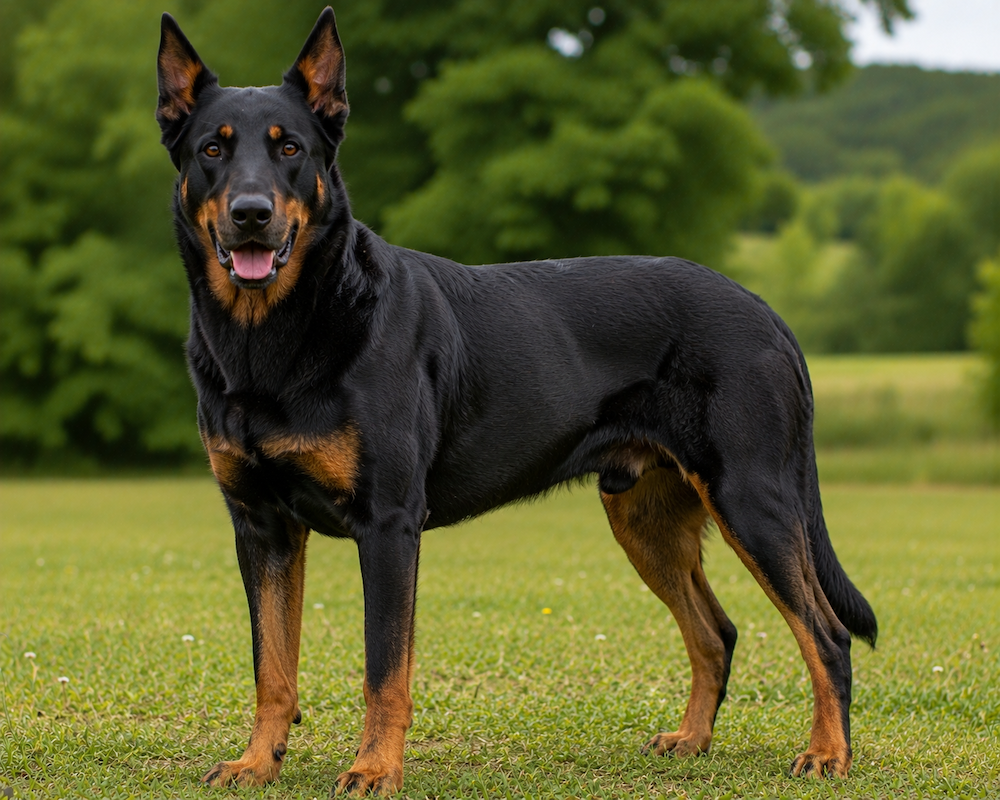







Powerful, intelligent, and unwaveringly loyal — a versatile French working dog built for both protection and companionship.
🧠 QUICK SNAPSHOT
- Temperament: Loyal, intelligent, confident
- Energy Level: Very high
- Size: Large
- Good With Families: Yes
- Trainability: Very high
- Grooming: Low
- Best For: Active families, experienced owners, working homes
📚 OVERVIEW
The Beauceron is one of France’s oldest herding and guarding breeds, prized for its intelligence, strength, and versatility. Originally developed to herd and protect livestock, the Beauceron is now highly regarded as a working dog in police, military, search and rescue, and competitive dog sports.
Despite its powerful appearance, the Beauceron is deeply devoted to its family and forms strong, lasting bonds with its owners. This breed thrives when given plenty of exercise, mental challenges, and a meaningful role within the household.
✅ PROS & CONS
Pros
- Exceptionally intelligent and trainable
- Loyal and protective of family
- Athletic and versatile working dog
- Low-maintenance coat
Cons
- Requires extensive daily exercise
- Needs constant mental stimulation
- Best suited to experienced owners
- Can be reserved with strangers without early socialisation
Is a Beauceron a Good Family Dog?
Yes, a Beauceron can be an exceptionally loyal and devoted family dog, but it is generally best suited to experienced owners.
Beaucerons form strong bonds with their families and are naturally watchful and protective. They can be affectionate with children they know, although their large size, strength and energetic nature require supervision around younger children.
Early socialisation is particularly important. A well-bred Beauceron should be confident and stable rather than unnecessarily suspicious or aggressive.
This isn’t usually an ideal breed for someone simply wanting an easygoing household pet.
The Beauceron tends to want a family, a purpose and preferably a job description.
How Much Exercise Does a Beauceron Need?
An adult Beauceron generally needs around 90 minutes to two hours of exercise each day, together with substantial mental stimulation.
These are powerful working dogs with excellent stamina.
Long walks, running, hiking, tracking, obedience, herding and dog sports can all provide useful outlets.
Mental work is equally important. Beaucerons were developed to make decisions while controlling livestock and can become frustrated when given nothing interesting to do.
Simply putting one in a large backyard isn’t sufficient.
A Beauceron doesn’t merely need space.
It needs something worthwhile to do with it.
Is a Beauceron Easy to Train?
Beaucerons are highly intelligent and extremely trainable, but they aren’t necessarily easy dogs for inexperienced owners.
They learn quickly and have been used for herding, military work, police work, protection, tracking and competitive dog sports.
Their intelligence is combined with confidence and independence, so training needs to be consistent and fair.
Positive reinforcement and clear boundaries generally produce the best results.
Early socialisation, impulse control, recall and loose-lead walking are particularly important because an adult Beauceron is an extremely powerful dog.
The challenge usually isn’t teaching a Beauceron to learn.
It’s making sure the human remains the one designing the curriculum.
Does a Beauceron Shed?
Yes, Beaucerons shed moderately throughout the year and can shed heavily during seasonal coat changes.
They have a short, dense double coat consisting of a weather-resistant outer layer and softer undercoat.
Weekly brushing is usually sufficient during normal periods, with more frequent brushing when the undercoat is being shed.
Their coat doesn’t require professional trimming or elaborate maintenance.
Beaucerons aren’t considered hypoallergenic.
Grooming is relatively straightforward — although during shedding season, owners may briefly wonder how one dog managed to produce enough hair for another one.
What Health Problems Are Common in Beaucerons?
Beaucerons are generally robust dogs, but several health conditions deserve attention.
Hip dysplasia is an important concern, and elbow dysplasia can also occur.
Inherited eye problems and certain cardiac conditions may affect some lines.
Because the Beauceron is a large, deep-chested breed, gastric dilatation-volvulus (GDV or bloat) is another serious risk. GDV is a life-threatening emergency requiring immediate veterinary treatment.
Responsible breeders should perform appropriate orthopaedic, cardiac and eye screening.
Maintaining a lean body condition and choosing health-tested breeding lines are particularly important.
How Long Do Beaucerons Live?
Beaucerons typically live around 10–12 years, although some individuals live longer.
Genetics, body condition, exercise, nutrition and preventive veterinary care all influence lifespan.
Maintaining an appropriate weight is particularly important for protecting joints.
Owners should also understand the symptoms of GDV because rapid veterinary intervention can be lifesaving.
Despite their substantial size, Beaucerons often remain energetic and mentally engaged well into adulthood.
How Big Does a Beauceron Get?
The Beauceron is a large, powerful and athletic dog.
Adults generally stand around 61–70 cm at the shoulder, with males usually larger than females.
Weight commonly falls somewhere around 30–45 kg, although individual dogs vary.
Despite their size, Beaucerons shouldn’t appear cumbersome or excessively heavy. They were developed to cover substantial distances while working livestock and should retain an athletic build.
This combination of size, strength and agility is one reason early training is so important.
A poorly mannered 40 kg Beauceron can turn an ordinary walk into an unexpected strength-training session.
Can a Beauceron Live in an Apartment?
A Beauceron can technically live in an apartment, but it isn’t generally the easiest environment for the breed.
These are large, active working dogs requiring substantial daily exercise and mental stimulation.
They also tend to be naturally alert to activity around their home, which can make busy communal areas challenging without good socialisation.
An extremely active owner may successfully keep a Beauceron in a smaller home, but access to suitable outdoor exercise areas is essential.
A large property is helpful, but even acreage doesn’t replace training and interaction.
The Beauceron needs work and engagement more than simply square metres.
Are Beaucerons Aggressive?
A well-bred Beauceron should not be indiscriminately aggressive, but the breed is naturally confident, watchful and protective.
Historically, Beaucerons guarded livestock as well as moving it, so awareness of potential threats was useful.
They may be reserved with unfamiliar people and are typically much more serious than highly social breeds such as Labradors.
Poor breeding, inadequate socialisation or inappropriate training can create behavioural problems in such a powerful dog.
Owners should focus on developing a stable dog capable of distinguishing normal everyday situations from genuine threats.
A good Beauceron doesn’t need to treat every stranger as an emergency.
Are Beaucerons Good Guard Dogs?
Yes, Beaucerons can be excellent natural guardians.
Their size, confidence, intelligence and strong attachment to their families can make them naturally protective of the home.
They tend to be observant and may initially remain reserved around unfamiliar people.
However, responsible owners shouldn’t deliberately encourage uncontrolled aggression.
Obedience, socialisation and emotional stability are far more important than teaching an already protective breed to become suspicious.
In many situations, the appearance of an alert adult Beauceron standing beside its owner provides more than enough deterrence without any additional theatrics.
Are Beaucerons Good With Other Dogs?
Beaucerons can live successfully with other dogs, particularly when properly socialised from puppyhood.
However, some individuals can be assertive, especially with dogs of the same sex.
Their large size and physical style of play can also overwhelm smaller or quieter dogs.
Early socialisation and carefully managed introductions are important.
Owners should aim for calm, controlled behaviour around other dogs rather than assuming every Beauceron needs to enjoy uncontrolled dog-park play.
Are Beaucerons Good With Cats?
Beaucerons can sometimes live successfully with cats, especially when raised alongside them.
However, individual prey drive varies, and their herding instincts may lead to chasing or attempts to control a cat’s movement.
Early training should discourage persistent chasing.
Cats should also have safe areas where they can escape unwanted attention.
A Beauceron that lives peacefully with its own cat may still respond differently to unfamiliar cats or wildlife outdoors.
Can a Beauceron Be Left Alone?
A mature Beauceron can learn to tolerate reasonable periods alone, but the breed generally thrives on interaction and purposeful activity.
Beaucerons were developed to work closely with people and can become bored or frustrated if routinely isolated.
Insufficient stimulation may lead to destructive behaviour, excessive barking or attempts to create their own entertainment.
Puppies should gradually learn independence rather than suddenly being left for an entire working day.
This is generally a better breed for someone wanting a dog actively involved in their lifestyle than a pet expected to occupy itself indefinitely in the backyard.
Why Does the Beauceron Have Double Dewclaws?
One of the Beauceron’s most distinctive physical characteristics is the presence of double dewclaws on each hind leg.
These extra toes are an established feature of the breed and are required by traditional breed standards.
Their exact historical functional advantage isn’t completely clear, although extra rear toes have been suggested to provide additional traction or stability when working over uneven terrain.
Whatever their original purpose, they’ve become an unmistakable part of Beauceron identity.
Look at the back feet and you’ll find something unusual:
the Beauceron comes with extra toes as standard equipment.
What Colours Can a Beauceron Be?
The best-known Beauceron colour is black with rich tan markings, including characteristic tan markings above the eyes, on the muzzle, chest and legs.
This pattern contributed to the breed’s traditional French nickname Bas-Rouge, meaning “red stockings.”
Another recognised colour is harlequin, consisting of a mottled grey, black and tan pattern associated with the merle gene.
Harlequin Beaucerons can have a striking appearance, but responsible breeding should always prioritise health and temperament rather than producing unusual colours.
The classic black-and-tan Beauceron’s red lower legs make the old nickname particularly easy to understand.
What Is the Difference Between a Beauceron and a Doberman?
The Beauceron and Doberman can look superficially similar, particularly in their black-and-tan colouring, but they’re separate breeds with different histories.
The Beauceron is an old French herding and guardian breed.
The Doberman was developed in Germany during the 19th century primarily as a personal protection and working dog.
Beaucerons are generally heavier-boned and retain their distinctive rear double dewclaws.
There are historical suggestions that Beauceron-type dogs may have contributed to the development of the Doberman, but the precise ancestry of the early Doberman isn’t completely documented.
They may look like relatives, but a Beauceron isn’t simply a long-tailed French Doberman.
Is the Beauceron Related to the Briard?
Yes. The Beauceron and Briard share historical connections as French shepherd dogs.
Both were used to manage and protect livestock, but they developed very different appearances.
The Beauceron has a short coat, while the Briard has a long, shaggy coat.
Historically, the terms associated with the two breeds reflected coat type: the short-haired shepherd became associated with the Beauce, while the long-haired type became associated with the Brie.
Both retain strong herding instincts, intelligence and guarding ability.
They’re essentially two distinctive branches of France’s rich sheepdog tradition.
What Were Beaucerons Originally Bred to Do?
Beaucerons were developed as versatile French farm and livestock dogs, particularly for moving and protecting large flocks of sheep.
Unlike herding breeds specialising in close, eye-intensive control, Beaucerons were capable of covering considerable distances while keeping livestock together and guarding them from threats.
Their intelligence, stamina and courage later made them valuable for many other working roles.
Beaucerons have been used in police, military, tracking and protection work.
The breed’s modern versatility makes much more sense once you realise it was never designed to perform just one simple task.
Were Beaucerons Used During the World Wars?
Yes, Beaucerons served in military roles during both World Wars.
Their intelligence, courage and trainability made them useful as messenger dogs and for other wartime duties.
Dogs were required to work through extremely difficult and dangerous conditions while carrying messages or assisting soldiers.
The breed later continued to find roles in military and police work.
This working history helps explain why modern Beaucerons combine athletic ability with confidence and an unusually serious attitude toward tasks.
Where Does the Beauceron Come From?
The Beauceron comes from France and is one of the country’s historic shepherd breeds.
Despite its name, the breed wasn’t necessarily confined specifically to the Beauce region. The name became a convenient way of distinguishing the short-coated French shepherd from the long-coated Briard.
During the 19th century, French authorities and dog enthusiasts began more formally separating and documenting these shepherd types.
The name Berger de Beauce — Shepherd of Beauce — became associated with the breed, while Bas-Rouge, or “red stockings,” referred to its distinctive tan leg markings.
The modern Beauceron remains relatively uncommon outside France, but its combination of herding ability, guarding instinct, intelligence and military history makes it one of Europe’s most fascinating working breeds.