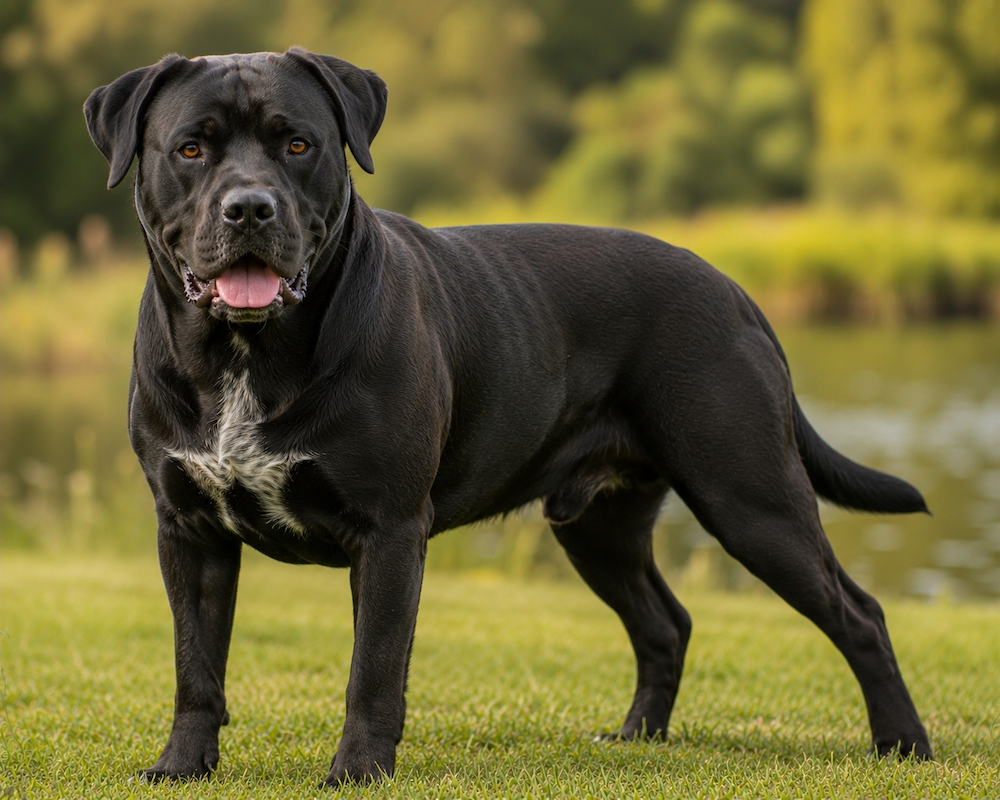







Loyal, playful, and full of strength — a family-focused companion that combines the friendliness of the Labrador with the confidence of the Bulldog.
🧠 QUICK SNAPSHOT
- Temperament: Friendly, loyal, affectionate
- Energy Level: Moderate to high
- Size: Large
- Good With Families: Yes
- Trainability: High
- Grooming: Low
- Best For: Families, active households, companionship
📚 OVERVIEW
The Bullador is a cross between a Labrador Retriever and a Bulldog, creating a strong, affectionate, and people-oriented companion. Depending on which parent it takes after more strongly, the Bullador may be athletic and energetic like the Labrador or stockier and more relaxed like the Bulldog.
These dogs are known for their loyalty and friendly nature, making them well suited to family life when given regular exercise, training, and plenty of interaction.
✅ PROS & CONS
Pros
- Loyal and affectionate with family
- Friendly and social personality
- Intelligent and generally easy to train
- Low-maintenance coat
Cons
- Can gain weight easily
- May inherit breathing issues from the Bulldog parent
- Needs regular exercise and mental stimulation
- Size and strength require early training
Is a Bullador a Good Family Dog?
Yes, a Bullador can be an excellent family dog, particularly for an active household.
The name Bullador most commonly refers to a cross between an English Bulldog and Labrador Retriever, although the term is sometimes used inconsistently for other Bulldog–Labrador crosses.
Many Bulladors are affectionate, sociable and strongly attached to their families. Labrador influence can bring friendliness and enthusiasm, while Bulldog influence often contributes a calmer, devoted personality.
Their temperament isn’t completely predictable, however, because they’re a cross rather than a standardised breed.
How Much Exercise Does a Bullador Need?
Most Bulladors need around 45–75 minutes of exercise each day, although individual requirements can vary considerably.
A more Labrador-like Bullador may be energetic and enjoy long walks, retrieving and swimming.
A heavier, shorter-faced Bulldog-type individual may require considerably more moderate exercise.
Heat and breathing ability are particularly important considerations.
Owners should exercise the dog in accordance with its actual physical structure and fitness, rather than assuming every Bullador can match a Labrador’s endurance.
Is a Bullador Easy to Train?
Bulladors are generally intelligent and trainable, although some can inherit the Bulldog’s independent streak.
Labradors have a long history of working cooperatively with people and are usually extremely food motivated.
Positive reinforcement can therefore be highly effective.
Early training should concentrate on recall, loose-lead walking, impulse control and calm greetings.
A Bullador that inherits Labrador enthusiasm inside a Bulldog-influenced body can become an impressively powerful bundle of excitement.
Does a Bullador Shed?
Yes. Bulladors generally shed moderately, and some may shed quite heavily during seasonal changes.
Both English Bulldogs and Labrador Retrievers shed.
A Bullador inheriting the Labrador’s dense double coat may release considerably more hair than one with a thinner Bulldog-like coat.
Weekly brushing usually helps control loose hair.
Dogs with skin folds may also require regular cleaning and monitoring to prevent irritation and infection.
Is a Bullador Hypoallergenic?
No, the Bullador isn’t considered hypoallergenic.
Both parent breeds shed and produce the proteins responsible for dog allergies.
Short hair doesn’t prevent allergens from spreading around the home.
Anyone with significant dog allergies should spend time around similar adult dogs before considering a Bullador.
What Health Problems Are Common in Bulladors?
Bulladors can potentially inherit health problems from both English Bulldogs and Labrador Retrievers.
Hip and elbow dysplasia are important concerns.
Bulldog ancestry can contribute brachycephalic airway problems, skin-fold infections, eye problems and difficulty tolerating heat. Labradors can contribute inherited eye diseases, exercise-induced collapse and a tendency towards obesity.
Joint disease can be particularly problematic in an overweight dog.
Responsible breeding should include appropriate health testing of both parents rather than assuming crossbreeding automatically removes inherited disease.
How Long Do Bulladors Live?
Bulladors commonly live around 10–13 years, although there is considerable variation.
Dogs with more moderate anatomy and fewer inherited health problems may have an advantage over individuals with extremely exaggerated Bulldog features.
Body weight is especially important.
Both parent breeds can be enthusiastic eaters, and obesity increases the burden on joints, breathing and cardiovascular health.
Keeping a Bullador lean may be one of the most valuable things an owner can do for its long-term health.
How Big Does a Bullador Get?
A Bullador is generally a medium-to-large dog, commonly weighing somewhere around 23–36 kg, although individuals can fall outside this range.
Height and body shape can vary substantially.
Some Bulladors are relatively tall and athletic like Labradors, while others inherit the Bulldog’s shorter legs, broader chest and heavier build.
Because there is no universal breed standard, the size of the actual parents provides a better guide than the Bullador name alone.
Can a Bullador Live in an Apartment?
Yes, a Bullador can live successfully in an apartment if its exercise and environmental needs are met.
A more Bulldog-like adult may actually be relatively relaxed indoors.
A Labrador-influenced Bullador can be considerably more energetic.
Space isn’t the only consideration. Owners need convenient access to outdoor exercise and, in warm climates, a reliable way of keeping the dog cool.
A Bullador with significant brachycephalic features can be particularly vulnerable to overheating.
Can a Bullador Be Left Alone?
Bulladors can learn to spend reasonable periods alone, but many are strongly people-oriented.
Both Labradors and Bulldogs generally form close bonds with their families.
Long periods of isolation can contribute to boredom, chewing or separation-related behaviour.
Gradual independence training during puppyhood is valuable.
Exercise and appropriate enrichment before alone time can also help considerably.
Are Bulladors Good With Children?
Many Bulladors are excellent with children, particularly when properly socialised.
Both parent breeds have reputations for being affectionate family companions.
However, Bulladors can be strong and enthusiastic, especially when young.
Even a friendly dog can accidentally knock over a small child.
Interactions between dogs and young children should always be supervised, and children should learn how to treat dogs respectfully.
Are Bulladors Good With Other Dogs?
Bulladors are generally good with other dogs when properly socialised, although individual temperament varies.
Labrador influence often contributes sociability.
English Bulldogs can also live very successfully with other dogs, although some individuals may be selective.
Early positive experiences with different dogs are valuable.
A Bullador’s physical play style can sometimes be boisterous, so compatibility with smaller or quieter dogs should be considered.
Are Bulladors Good With Cats?
Many Bulladors can live successfully with cats, particularly when raised alongside them.
Individual prey drive varies.
Labradors were developed primarily to retrieve rather than independently hunt and kill prey, while modern English Bulldogs are predominantly companion dogs.
Careful introductions are still important.
A familiar household cat may also receive a very different response from an unfamiliar cat running through the garden.
Do Bulladors Bark a Lot?
Bulladors aren’t generally expected to be extreme barkers, although individual behaviour varies.
They may bark when someone approaches the home, when excited or when bored.
Labrador influence may produce an enthusiastic alert, while Bulldog influence can bring a relatively relaxed household temperament.
Adequate exercise, socialisation and training can help prevent nuisance barking.
Are Bulladors Good Guard Dogs?
A Bullador can make a useful watchdog, but guarding ability varies substantially.
Its broad head, muscular body and deep bark may provide a significant visual deterrent.
However, Labrador Retrievers are famously sociable dogs, and many Bulladors may be more interested in greeting a visitor than intimidating one.
Stable temperament and good socialisation are much more important than encouraging aggressive guarding behaviour.
Can Bulladors Handle Hot Weather?
Bulladors can be particularly vulnerable to hot weather if they inherit the English Bulldog’s short muzzle and restricted airway anatomy.
Brachycephalic dogs have greater difficulty cooling themselves through panting.
A Bullador with a longer Labrador-like muzzle may have better heat tolerance, but all dogs still require protection from excessive temperatures.
Exercise should be reduced during hot weather and moved to cooler parts of the day.
Breathing ability should always be taken seriously in this cross.
Do Bulladors Like Water?
Some Bulladors love water, particularly those strongly influenced by their Labrador ancestry.
Labradors were developed as water retrievers and are naturally powerful swimmers.
However, Bulldog-like anatomy can produce a very different result.
A broad chest, heavy body, short legs and shortened muzzle can make swimming difficult or even dangerous.
Never assume a Bullador can swim simply because it’s half Labrador. Supervision and a canine life jacket can be extremely important.
Why Are Bulladors So Food Motivated?
Many Bulladors are extremely enthusiastic about food.
Labradors are famous for their appetite, and a proportion carry a variant involving the POMC gene associated with increased food motivation and obesity risk.
English Bulldogs can also gain weight readily.
The combination makes portion control particularly important.
Food motivation can be extremely useful during training, but owners need to count training treats as part of the dog’s overall food intake.
A Bullador may confidently insist that it hasn’t eaten for several weeks despite finishing breakfast five minutes earlier.
Does a Bullador Have a Flat Face?
Some Bulladors develop a shortened Bulldog-like muzzle, while others have a much longer Labrador-style face.
Many fall somewhere between the two.
This variation matters for more than appearance.
Dogs with shorter muzzles may be at greater risk of breathing difficulties, overheating and exercise intolerance.
When selecting a puppy, functional airway anatomy should be prioritised over an exaggerated “cute” flat-faced appearance.
What Colours Can Bulladors Be?
Bulladors can occur in many colours and patterns.
Possible colours include black, chocolate, yellow or cream, fawn, red, brindle and combinations with white markings.
The Labrador contributes its familiar black, chocolate and yellow genetics, while Bulldog ancestry can introduce additional colours and patterns.
Appearance can vary considerably even among puppies from the same litter.
Colour should always rank far below health, temperament and sound physical structure when choosing a dog.
Does a Bullador Look More Like a Bulldog or a Labrador?
A Bullador can resemble either parent or an unpredictable combination of both.
Some have Labrador-like height and legs combined with a broad Bulldog head.
Others are shorter, stockier and much more obviously Bulldog-influenced.
Muzzle length, ears, coat, tail and overall body shape can all vary.
Even littermates can look surprisingly different.
A first-generation cross doesn’t simply create a perfectly averaged dog halfway between both parents.
What Is an F1, F1B or F2 Bullador?
An F1 Bullador generally refers to a first-generation English Bulldog crossed with a Labrador Retriever.
An F1B Bullador usually results from breeding an F1 Bullador back to one of its parent breeds.
An F2 Bullador generally results from breeding two F1 Bulladors.
These labels describe ancestry, not guaranteed appearance or temperament.
An F1 puppy can still strongly resemble one parent because genetic inheritance doesn’t divide every characteristic neatly into equal halves.
Is a Bullador a Recognised Dog Breed?
The Bullador is generally considered a crossbreed rather than a formally standardised pedigree breed.
Major kennel clubs don’t recognise it in the same way they recognise the Labrador Retriever or English Bulldog.
There is therefore no universally accepted Bullador standard governing size, coat, head shape or temperament.
This makes responsible selection of the parent dogs particularly important.
The word “Bullador” itself also needs clarification because different breeders have occasionally used it for different Bulldog–Labrador combinations.
Does Crossing a Bulldog With a Labrador Make Bulladors Healthier?
Crossbreeding can increase genetic diversity, but it doesn’t automatically create a healthier dog.
A Bullador can inherit health problems from either parent.
Most importantly, crossing a Bulldog with a longer-muzzled Labrador doesn’t guarantee that every puppy will have healthy airway anatomy.
Some may still inherit significant brachycephalic characteristics.
Responsible breeding should focus on health-tested parents, functional anatomy and good temperament rather than relying on “hybrid vigour” as a substitute for careful selection.
Is a Bullador the Same as an American Bullador?
Not always. Bullador terminology isn’t completely standardised.
Bullador most commonly refers to an English Bulldog–Labrador Retriever cross, but names such as American Bullador may be used for crosses involving an American Bulldog and Labrador Retriever.
Those combinations can produce substantially different dogs.
American Bulldogs are generally taller, more athletic and more traditionally guardian-oriented than English Bulldogs.
Anyone considering a Bullador should therefore ask exactly which breeds are actually behind the dog.
Where Did the Bullador Come From?
There is no well-documented single origin for the Bullador.
English Bulldog–Labrador crosses almost certainly occurred accidentally long before anyone deliberately marketed them under a designer name.
Intentional breeding became more visible during the broader popularity of designer crossbreeds in the late 20th and early 21st centuries.
The appeal is understandable: breeders hoped to combine the Labrador’s sociable, trainable nature with the Bulldog’s affectionate, sturdy personality.
But the result isn’t a standardised blend. Every Bullador is ultimately its own genetic combination of two remarkably different breeds.