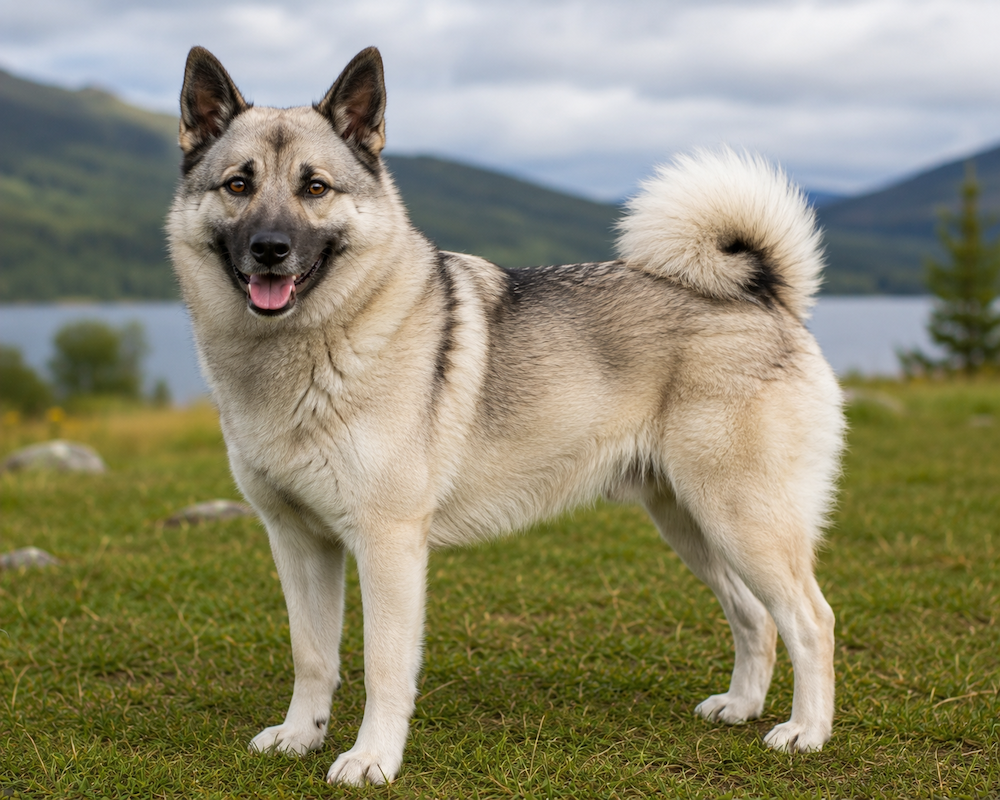







Intelligent, energetic, and deeply loyal — a cheerful Norwegian herding dog with Viking heritage and a love of adventure.
🧠 QUICK SNAPSHOT
- Temperament: Friendly, intelligent, alert
- Energy Level: High
- Size: Medium
- Good With Families: Yes
- Trainability: High
- Grooming: Moderate
- Best For: Active families, outdoor enthusiasts, dog sports
📚 OVERVIEW
The Norwegian Buhund is an ancient Nordic spitz breed with a history stretching back to the Viking Age. Originally used as an all-purpose farm dog, the Buhund helped herd livestock, guard property, and accompany its owners through the rugged Norwegian countryside.
Friendly, confident, and highly intelligent, the Norwegian Buhund forms strong bonds with its family and loves being involved in everyday life. This energetic breed thrives in active homes where it receives plenty of exercise, training, and mental stimulation.
✅ PROS & CONS
Pros
- Highly intelligent and trainable
- Loyal and affectionate with family
- Excellent companion for active lifestyles
- Versatile in obedience and canine sports
Cons
- Needs significant daily exercise
- Can be very vocal
- Heavy seasonal shedding
- May become restless or destructive if under-stimulated
Is a Norwegian Buhund a Good Family Dog?
Yes. The Norwegian Buhund can be an affectionate, cheerful, intelligent and energetic family dog.
Buhunds typically form strong relationships with their families and enjoy being actively involved in everyday life. They’re playful, alert and generally outgoing rather than aloof.
They’re best suited to households that can provide plenty of exercise, training and mental stimulation.
Are Norwegian Buhunds Good With Children?
Generally, yes.
Well-socialised Buhunds are usually playful and affectionate with children and can make enthusiastic family companions.
Their energy can make them boisterous around very small children, so normal supervision and early training are important.
How Much Exercise Does a Norwegian Buhund Need?
Most Norwegian Buhunds need around 60–90 minutes of exercise each day, with energetic individuals happily doing more.
Walking alone may not completely satisfy them.
Training, running, hiking, scent games, dog sports and interactive play provide valuable mental as well as physical exercise.
Is a Norwegian Buhund a High-Energy Dog?
Yes.
The Buhund is an active working breed developed for demanding farm and herding work.
It generally needs considerably more activity than a typical companion breed and can become noisy or destructive when bored.
Is a Norwegian Buhund Easy to Train?
Generally, yes.
Norwegian Buhunds are intelligent, responsive and usually enjoy working with people.
They can think independently, but positive, varied training tends to produce excellent results.
Are Norwegian Buhunds Intelligent?
Very.
Historically, they needed enough intelligence to herd livestock, guard property and perform numerous jobs around Norwegian farms.
Modern Buhunds often excel in obedience, agility, rally, scent work and other activities requiring rapid learning.
Are Norwegian Buhunds Stubborn?
They can have an independent streak.
Like many traditional farm dogs, Buhunds weren’t developed simply to wait for instructions.
They needed to assess situations and work with some independence, which can occasionally look like stubbornness in a modern home.
Are Norwegian Buhunds Difficult to Toilet Train?
Usually not.
They’re intelligent, clean dogs that generally respond well to a consistent routine.
Frequent outdoor opportunities and positive reinforcement usually make house training relatively straightforward.
Does a Norwegian Buhund Shed?
Yes — considerably.
The Buhund has a dense double coat consisting of a soft insulating undercoat and harsher outer coat.
It sheds year-round and can shed extremely heavily during seasonal coat changes.
Is a Norwegian Buhund Hypoallergenic?
No.
Buhunds shed heavily and produce normal canine allergens.
They’re not suitable for someone specifically seeking a low-shedding breed.
How Often Should You Groom a Norwegian Buhund?
Usually once or twice a week, increasing to daily grooming during heavy seasonal shedding.
The coat doesn’t generally require complicated professional grooming.
A good brushing routine is far more important than haircuts.
Does a Norwegian Buhund Need Haircuts?
No.
Its natural double coat should generally be left intact.
Routine clipping or shaving can interfere with the coat’s protective function and isn’t necessary for normal maintenance.
Should You Shave a Norwegian Buhund in Summer?
Generally, no.
The double coat helps protect the skin and provides insulation.
During hot weather, focus on removing loose undercoat through grooming, providing shade and water, and exercising during cooler periods.
What Health Problems Are Common in Norwegian Buhunds?
The Norwegian Buhund is generally considered a relatively robust breed, but potential concerns include hip dysplasia and inherited eye disorders.
Some lines can also experience other conditions that responsible breeders monitor through health testing.
Prospective owners should ask specifically about hip and eye screening in the parents.
Are Norwegian Buhunds Prone to Hip Dysplasia?
Hip dysplasia can occur.
Responsible breeders screen breeding dogs to reduce the likelihood of passing significant hip problems to future generations.
Keeping a Buhund lean and appropriately exercised also helps reduce unnecessary joint stress.
Are Norwegian Buhunds Prone to Eye Problems?
Inherited eye conditions occur within the breed.
Regular ophthalmic screening of breeding dogs is therefore important.
Any noticeable change in vision should receive veterinary assessment.
How Long Does a Norwegian Buhund Live?
Norwegian Buhunds commonly live around 12–15 years.
They’re generally a long-lived medium-sized working breed.
Maintaining a healthy body weight and providing regular physical and mental exercise can help support healthy ageing.
How Big Does a Norwegian Buhund Get?
Adult Buhunds generally stand around 41–47 cm at the shoulder and weigh approximately 12–18 kg, with males typically larger than females.
They’re medium-sized dogs with compact, athletic bodies.
Their substantial coat can make them look heavier than they actually are.
Is There a Miniature Norwegian Buhund?
No.
There’s no recognised Miniature Norwegian Buhund.
The breed naturally occupies a relatively compact medium-sized range.
Is There a Teacup Norwegian Buhund?
No.
“Teacup Norwegian Buhund” isn’t a recognised breed or variety.
Extreme miniaturisation would be inconsistent with the structure and working purpose of the breed.
Can a Norwegian Buhund Live in an Apartment?
Potentially, but it can be challenging.
Buhunds are energetic and famously vocal, so apartment living requires substantial exercise and careful barking management.
An active owner can make it work, but the breed is generally easier to manage with more space.
Does a Norwegian Buhund Need a Backyard?
A backyard is useful but doesn’t replace proper exercise.
Buhunds thrive when they have opportunities to walk, explore, train and work with their owners.
Secure fencing is important.
Can a Norwegian Buhund Be Left Alone?
Adult Buhunds can learn to tolerate reasonable periods alone, but they’re highly social dogs.
They were historically developed to work alongside people and tend to prefer being involved with their families.
Long periods of isolation can lead to boredom and excessive vocalisation.
Are Norwegian Buhunds Prone to Separation Anxiety?
Some can be.
Their strong attachment to people means independence should be taught gradually.
Exercise and mental enrichment before periods alone can also help.
Are Norwegian Buhunds Velcro Dogs?
Many are highly people-oriented.
They often want to accompany their owners from room to room and participate in whatever is happening.
This close relationship was useful in a dog expected to spend its working life alongside a farming family.
Are Norwegian Buhunds Cuddly?
Many are affectionate and enjoy close physical contact.
Others prefer remaining nearby rather than constantly sitting on someone.
They’re generally warm, sociable dogs with their families.
Are Norwegian Buhunds Good With Other Dogs?
Generally, yes.
Early socialisation is still important, but many Buhunds interact well with other dogs.
Their historical farm environment required them to function around both animals and people.
Are Norwegian Buhunds Good With Cats?
They can live successfully with cats, particularly when raised together.
However, individual prey and herding instincts vary.
Introductions should be gradual and supervised.
Can Norwegian Buhunds Live With Livestock?
Yes.
Livestock work is central to the breed’s history.
Buhunds were used to help manage sheep and other farm animals and can still display strong herding instincts.
Do Norwegian Buhunds Have a Strong Prey Drive?
Usually moderate rather than extreme.
They’re primarily herding and farm dogs rather than specialised hunting hounds.
However, some individuals will enthusiastically chase wildlife.
Do Norwegian Buhunds Herd People?
They can.
Dogs with strong herding instincts may attempt to control the movement of children, other pets or even adults.
This can include circling, blocking movement or following closely.
Appropriate training and herding-style activities can provide better outlets.
Do Norwegian Buhunds Nip at Heels?
Some may use nipping or body positioning when excited or attempting to herd.
This shouldn’t simply be accepted because it’s instinctive.
Early training can teach appropriate ways to interact with people.
Are Norwegian Buhunds Good Off Leash?
Many can develop reliable recall with consistent training.
They’re generally cooperative and handler-focused.
Wildlife, livestock and interesting scents can still create distractions, so off-leash freedom should only occur where it’s safe and legal.
Do Norwegian Buhunds Bark a Lot?
Yes. Barking is one of the most important things prospective owners should know about the breed.
Buhunds are naturally vocal dogs.
Historically, barking was useful for alerting people, guarding property and helping control livestock, so silence was never a major breeding objective.
Why Is My Norwegian Buhund So Vocal?
Vocal communication was useful to its ancestors.
A farm dog needed to alert the household to visitors, communicate during livestock work and report unusual activity.
Modern Buhunds can apply this historical communication system to visitors, dogs, birds, delivery drivers and occasionally events that nobody else has managed to identify.
Can You Train a Norwegian Buhund Not to Bark?
You can usually reduce unnecessary barking, but expecting complete silence is unrealistic.
Teaching cues such as “quiet”, rewarding calm behaviour and providing sufficient exercise can help enormously.
Prospective owners should nevertheless be comfortable living with a naturally vocal breed.
Are Norwegian Buhunds Good Watchdogs?
Excellent.
They’re extremely alert and quick to announce unusual activity.
Their barking provides an effective early-warning system.
Are Norwegian Buhunds Good Guard Dogs?
They’re better watchdogs than specialist protection dogs.
Buhunds can be courageous and protective of their homes, but they aren’t generally bred for aggressive confrontation.
Their principal defensive tool has historically been alertness and alarm barking.
Are Norwegian Buhunds Aggressive?
Aggression isn’t characteristic of a well-bred Buhund.
The breed should generally be confident, energetic and friendly.
Fear, poor socialisation or inappropriate breeding can still create behavioural problems.
Are Norwegian Buhunds Friendly With Strangers?
Many are relatively outgoing.
They may initially bark because someone unfamiliar has arrived, then become friendly once they understand that the visitor is welcome.
Good early socialisation is important.
When Does a Norwegian Buhund Calm Down?
Many become noticeably more settled between two and three years old.
However, the breed often remains active and playful throughout adulthood.
A mature Buhund is generally calmer than a puppy without becoming a couch potato.
Do Norwegian Buhunds Get the Zoomies?
Absolutely.
Their athletic bodies and considerable enthusiasm can produce spectacular bursts of speed.
A bored Buhund can also invent exercise programmes that the household didn’t request.
Are Norwegian Buhunds Fast?
Yes.
They’re agile, quick-moving dogs capable of rapidly changing direction.
This athleticism was useful when controlling livestock across uneven terrain.
Are Norwegian Buhunds Good Running Dogs?
Yes.
Healthy, physically mature Buhunds can make excellent running companions when gradually conditioned.
Cool weather suits them particularly well.
Care is required during hot conditions because of their dense double coat.
Are Norwegian Buhunds Good Hiking Dogs?
Excellent.
Their stamina, athleticism and history in rugged Norwegian landscapes make them natural hiking companions.
They generally enjoy having a physical purpose and exploring alongside their owners.
Can Norwegian Buhunds Swim?
Yes, many can swim, although they’re not specialised water-retrieving dogs.
Individual enthusiasm varies.
Their dense coat becomes extremely heavy when wet, so sensible supervision remains important.
Do Norwegian Buhunds Like Snow?
Usually.
Their dense double coat was developed for a northern climate and provides excellent protection in cold conditions.
Many appear thoroughly comfortable playing and exercising in snow.
Do Norwegian Buhunds Get Cold Easily?
Generally, no.
They’re exceptionally well equipped for cold weather.
Their insulating undercoat and weather-resistant outer coat developed in a country where winter conditions could be severe.
Can Norwegian Buhunds Handle Hot Weather?
Heat requires considerably more care than cold.
Exercise should be scheduled during cooler periods, particularly in Australian summers.
Shade, water and cool indoor areas are essential, and strenuous activity should be avoided during extreme heat.
What Does a Norwegian Buhund Look Like?
The Norwegian Buhund is a medium-sized, squarely built Spitz dog with erect triangular ears, a wedge-shaped head, dense double coat and tightly curled tail carried over the back.
Its appearance is alert, athletic and distinctly Nordic.
It should look capable of genuine farm work rather than excessively heavy or refined.
Why Does a Norwegian Buhund Have a Curled Tail?
The curled tail is characteristic of many Spitz breeds.
In the Buhund it should be carried tightly over the back.
Tail carriage forms part of the classic Nordic Spitz silhouette.
Why Does a Norwegian Buhund Have Pointed Ears?
The breed’s erect triangular ears contribute to its alert expression.
Mobile upright ears are effective at detecting and locating sounds.
For a multipurpose farm watchdog, excellent awareness of the surroundings was extremely useful.
What Colours Can Norwegian Buhunds Be?
The two principal traditional colours are wheaten and black.
Wheaten can range from relatively pale cream through richer golden or reddish shades.
Small amounts of white may be permitted depending on the breed standard.
What Is a Wheaten Norwegian Buhund?
Wheaten refers to the breed’s characteristic pale-to-rich golden colouring.
The shade can vary considerably.
Some dogs also have darker-tipped hairs, although excessive dark shading may be undesirable under particular standards.
Can a Norwegian Buhund Be Black?
Yes.
Solid black is a recognised traditional colour.
Black Buhunds can look dramatically different from the much more familiar wheaten dogs while retaining the same characteristic Spitz structure.
Can a Norwegian Buhund Be White?
Predominantly white isn’t a standard Buhund colour.
Small white markings can occur in recognised dogs, but a completely white dog wouldn’t represent the traditional breed standard.
Can a Norwegian Buhund Be Merle?
No.
Merle isn’t a traditional Norwegian Buhund colour.
A merle dog being marketed as a purebred Buhund should raise questions about ancestry.
Is a Norwegian Buhund a Spitz?
Yes.
The Buhund belongs to the Nordic Spitz family, characterised by features such as erect ears, dense double coats and tails carried over the back.
However, “Spitz” describes a broad group of related dog types rather than one single breed.
Is a Norwegian Buhund a Husky?
No.
Both have Nordic Spitz characteristics, but the Buhund is a distinct Norwegian farm and herding breed.
Siberian Huskies were primarily developed for sled work, while Buhunds performed multiple jobs around farms.
Is a Norwegian Buhund Related to the Norwegian Elkhound?
They’re distinct breeds but share ancient Nordic Spitz ancestry and many physical characteristics.
The Norwegian Elkhound developed primarily as a hunting dog, particularly for large game.
The Buhund was much more strongly associated with farm work and herding.
Is a Norwegian Buhund Related to the Icelandic Sheepdog?
Yes, broadly.
Both are Nordic Spitz-type farm and herding dogs with historical connections to Scandinavian settlement.
They share several physical and behavioural characteristics, although they’re established as separate breeds.
Is a Norwegian Buhund Related to the Swedish Vallhund?
They’re different breeds but share a broader Scandinavian farm-dog heritage.
The Swedish Vallhund is considerably shorter-legged and has its own distinctive history.
Both demonstrate how Nordic farmers developed versatile dogs rather than animals specialised for only one job.
Is a Norwegian Buhund Related to the Finnish Spitz?
They’re members of the wider Nordic Spitz family but developed for different purposes.
The Finnish Spitz became strongly associated with hunting.
The Buhund’s primary historical identity is that of a versatile Norwegian farm dog.
What Does the Name Norwegian Buhund Mean?
The Norwegian word “bu” is associated with a farm, homestead or dwelling, while “hund” means dog.
Buhund can therefore be understood approximately as farm dog, homestead dog or farmstead dog.
Few breed names describe the dog’s historical occupation quite so neatly.
Where Does the Norwegian Buhund Come From?
The Norwegian Buhund comes from Norway, where Spitz-type dogs worked around farms for centuries.
They helped herd livestock, guard homesteads and accompany farming families during everyday work.
The modern breed was formalised much later from this longstanding Norwegian working-dog tradition.
What Was the Norwegian Buhund Originally Bred For?
The Buhund was a multipurpose farm dog.
It could herd sheep and cattle, watch the property, alert people to strangers and accompany its family through demanding rural environments.
Versatility was more valuable than extreme specialisation.
Were Norwegian Buhunds Sheepdogs?
Yes.
Herding sheep became one of the breed’s important traditional roles.
Their agility, intelligence and willingness to communicate vocally made them useful livestock workers.
Did Norwegian Buhunds Herd Cattle?
They could work with cattle as well as sheep.
Traditional farm dogs needed enough versatility to handle whatever livestock was kept on the property.
Modern Buhunds can still display strong natural herding behaviour.
Were Norwegian Buhunds Guard Dogs?
They functioned as farm watchdogs.
Their acute hearing and natural tendency to bark made them effective at alerting people to approaching strangers or unusual activity.
They weren’t developed primarily as large physical protection dogs.
Were Norwegian Buhunds Hunting Dogs?
Hunting wasn’t their primary specialisation, although versatile farm dogs could accompany people during many outdoor activities.
Other Norwegian breeds, particularly the Norwegian Elkhound, became much more specifically associated with hunting.
Is the Norwegian Buhund an Ancient Breed?
Its type and working tradition are ancient, but the modern pedigree breed is much newer.
Spitz-type farm dogs existed in Scandinavia long before organised kennel clubs.
It would be misleading, however, to claim that today’s registered Buhund has remained genetically unchanged for a thousand years.
Did Vikings Have Norwegian Buhunds?
Viking Age Scandinavians certainly kept dogs, including Spitz-type animals that share similarities with modern Nordic breeds.
Archaeological discoveries demonstrate that dogs accompanied people in Viking Age Norway.
However, calling every ancient Norwegian Spitz skeleton a modern purebred Buhund goes beyond what the evidence can prove.
Have Buhund-Like Dogs Been Found in Viking Graves?
Dog remains have been found in Viking Age burials in Norway, including famous archaeological sites.
Some breed histories connect these Spitz-type dogs with ancestors of the modern Buhund.
The evidence supports an ancient Nordic dog tradition, but not a perfectly documented pedigree running directly from a particular Viking dog to today’s breed.
Were Dogs Buried With Vikings?
Yes.
Dogs were sometimes included in Viking Age burials, reflecting their practical and possibly symbolic importance.
They could serve as working animals, hunting companions, guardians and valued members of a household.
Their inclusion in burials demonstrates that dogs occupied a significant place in Norse society.
Did Vikings Take Dogs on Ships?
Almost certainly.
Norse settlers transported livestock and domestic animals as they established communities around the North Atlantic.
Dogs accompanied Scandinavian settlement and contributed to the development of related Nordic dog populations in places such as Iceland.
Did Norwegian Dogs Help Create the Icelandic Sheepdog?
Dogs brought by Norse settlers to Iceland contributed to the population from which the Icelandic Sheepdog eventually developed.
The modern Norwegian Buhund and Icelandic Sheepdog therefore reflect related Scandinavian farm-dog traditions.
It’s more accurate to describe shared historical ancestry than to say today’s Buhund directly created today’s Icelandic Sheepdog.
How Old Is the Norwegian Buhund Type?
Nordic Spitz-type dogs have existed for many centuries, potentially extending back well into the Viking Age and earlier.
The recognisable modern Buhund, however, was standardised primarily during the 20th century.
This distinction between ancient ancestry and modern breed formation is important.
Why Did Norwegian Farmers Need Buhunds?
Traditional farms required dogs capable of performing multiple jobs without specialised equipment or extensive supervision.
A useful Buhund could move livestock, watch the property, alert the household and accompany people across difficult terrain.
For a relatively small farm, one versatile dog could be extremely valuable.
Why Are Norwegian Buhunds So Vocal?
Barking was useful.
A herding dog could use its voice while controlling livestock, while a watchdog needed to alert the household to visitors or danger.
Humans therefore had little historical reason to select the Buhund for silence.
How Was the Modern Norwegian Buhund Standardised?
Interest in preserving Norway’s traditional farm dogs increased during the early 20th century.
Breeders began identifying suitable dogs, organising exhibitions and establishing more systematic breeding.
This gradually transformed a regional working type into a documented modern breed.
Who Helped Preserve the Norwegian Buhund?
John Sæland is particularly associated with the breed’s modern development in Norway.
He and other enthusiasts promoted organised breeding and exhibitions during the early 20th century.
Their efforts helped preserve a traditional Norwegian farm dog at a time when agricultural practices were changing.
When Were Early Norwegian Buhund Shows Held?
Organised Buhund exhibitions began appearing in Norway during the 1920s, particularly in connection with efforts to preserve and standardise the breed.
These gatherings allowed breeders to compare dogs and establish a more consistent type.
Why Did the Norwegian Buhund Nearly Lose Its Traditional Job?
Mechanisation transformed agriculture.
Fencing, machinery and changing livestock-management practices reduced demand for traditional all-purpose farm dogs.
Breed enthusiasts therefore became increasingly important in preserving dogs whose original working environment was disappearing.
When Did Norwegian Buhunds Reach Britain?
The breed became established in Britain during the mid-20th century, after enthusiasts imported dogs from Scandinavia.
British breeders subsequently helped develop an important population outside Norway.
When Did the AKC Recognise the Norwegian Buhund?
The American Kennel Club fully recognised the Norwegian Buhund in 2009.
It’s placed within the Herding Group in the United States.
Despite its ancient working heritage, formal recognition there is therefore surprisingly recent.
Why Is the Norwegian Buhund Rare?
The breed has never achieved the international popularity of German Shepherds, Border Collies or Siberian Huskies.
Its relatively small founding population and limited numbers outside Scandinavia contribute to its rarity.
Responsible management of genetic diversity is therefore particularly important.
Are Norwegian Buhunds Rare Outside Norway?
Yes.
They have established populations in countries including Britain and the United States, but remain uncommon compared with mainstream herding breeds.
Many people can go their entire lives without meeting one.
Are Norwegian Buhunds Still Used for Herding?
Yes.
Some continue working livestock, while others participate in organised herding activities.
Even companion Buhunds may demonstrate herding behaviours around people or other animals.
Are Norwegian Buhunds Used as Hearing Dogs?
Yes, individual Buhunds have successfully worked as hearing assistance dogs.
Their alertness, intelligence, responsiveness to sound and close relationship with people can suit this work particularly well.
It’s an interesting modern application of qualities once used around Norwegian farms.
Are Norwegian Buhunds Good at Agility?
Excellent.
They’re quick, athletic and highly trainable.
Agility provides both physical exercise and the mental challenge this intelligent breed needs.
Are Norwegian Buhunds Good at Obedience?
Yes.
Their intelligence and enthusiasm for interaction can make them excellent obedience and rally dogs.
Training is most successful when sessions remain interesting and rewarding.
Are Norwegian Buhunds Good at Scent Work?
Yes.
Scent games provide valuable mental stimulation and allow the dog to use natural investigative behaviour.
They’re particularly useful when weather makes intense physical exercise inappropriate.
Are Norwegian Buhunds Good Therapy Dogs?
Individual Buhunds with calm, sociable temperaments can succeed in therapy work.
Their friendliness and enthusiasm for people can be assets.
However, highly vocal or excitable individuals may require considerable training before they’re suitable.
Is a Norwegian Buhund a Good Dog for Older People?
Potentially, for very active older owners.
The breed is a manageable medium size but requires substantial exercise and mental stimulation.
Someone looking for a quiet, low-energy companion would generally find easier breeds.
Is a Norwegian Buhund a Good First Dog?
It can be for an active and committed first-time owner.
They’re intelligent, trainable and generally sociable.
The main challenges are high exercise requirements, heavy shedding, vocal behaviour and the need to keep an intelligent working dog mentally occupied.
Why Does My Norwegian Buhund Follow Me Everywhere?
Working closely with people has been part of the breed’s history for generations.
A farm dog needed to know where its people and livestock were.
The modern Buhund often maintains that same desire to stay involved.
Why Does My Norwegian Buhund Bark at Everything?
From the dog’s perspective, it may not be “everything.”
It could be reporting a visitor, movement outside, another animal, an unusual noise or something it believes the household should know about.
The challenge is teaching the dog which reports actually require management attention.
Why Does My Norwegian Buhund Circle People?
Circling can be related to herding instincts.
The dog may instinctively attempt to influence movement or keep members of a group together.
Redirecting this behaviour into structured training or herding activities can be helpful.
Why Does My Norwegian Buhund Watch Everything I Do?
Buhunds are highly observant dogs.
Historically, paying attention to people, livestock and the surrounding environment was fundamental to their work.
A modern Buhund may therefore treat ordinary household life as a full-time supervisory position.
What Makes the Norwegian Buhund Unique?
The Norwegian Buhund is a breed whose name almost perfectly explains its history.
“Bu” relates to the farm or homestead. “Hund” means dog.
This was, quite literally, Norway’s farm dog.
For generations, dogs of this type lived alongside rural families, herding livestock, watching the property, announcing visitors and accompanying people across a landscape of mountains, snow and long Scandinavian winters.
Go further back and the story becomes even more fascinating.
Archaeology shows that Spitz-type dogs were important to people in Viking Age Norway. Dogs were buried with humans and travelled with Norse settlers across the North Atlantic. We can’t simply label every Viking dog a purebred Norwegian Buhund — the modern breed didn’t exist in that formal sense — but the Buhund clearly belongs to a remarkably old Scandinavian working-dog tradition.
Then agriculture changed.
Machinery and modern farming reduced the need for the all-purpose homestead dog. During the 20th century, enthusiasts including John Sæland helped preserve and standardise the Buhund rather than allowing this traditional Norwegian dog to disappear.
Today, much of the old farm dog remains completely obvious.
It still wants to work.
It still wants to know where everyone is.
It still wants to organise things that are moving.
And it still believes that almost every development around the property deserves to be reported immediately.
So if your Norwegian Buhund suddenly starts barking at something you consider completely unimportant, remember:
its ancestors spent centuries being rewarded for exactly that sort of customer service.