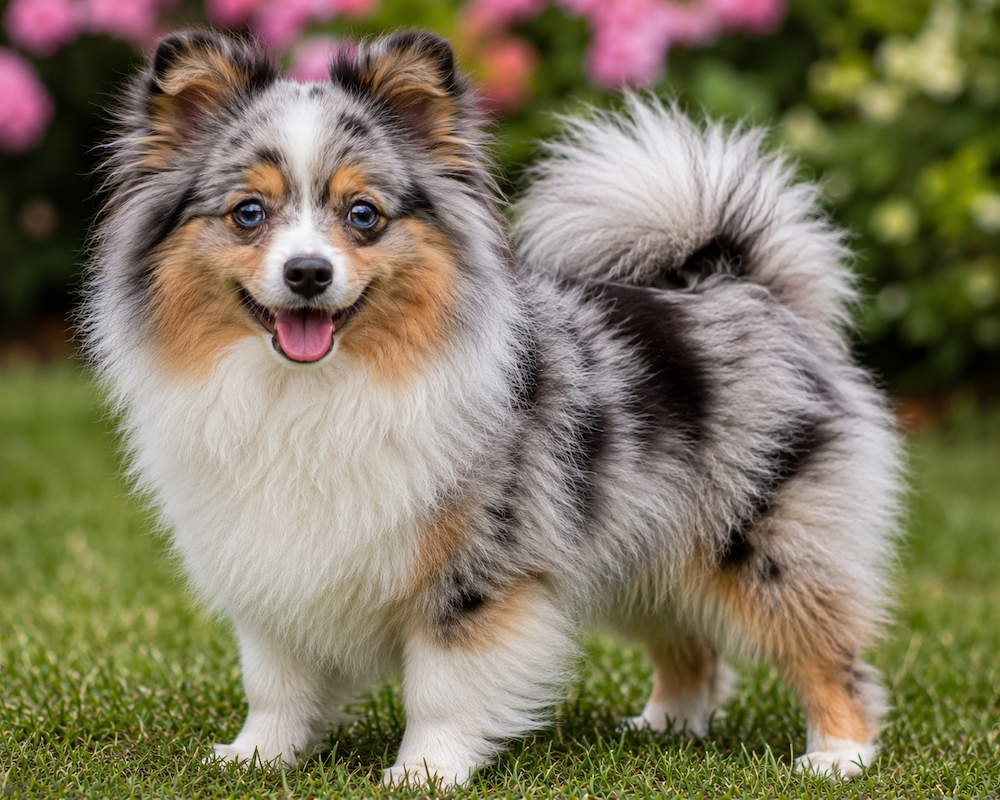







Intelligent, playful, and wonderfully fluffy — a lively companion that combines the cleverness of the Australian Shepherd with the charm of the Pomeranian.
🧠 QUICK SNAPSHOT
- Temperament: Intelligent, affectionate, playful
- Energy Level: High
- Size: Small to medium
- Good With Families: Yes
- Trainability: High
- Grooming: Moderate to high
- Best For: Active families, companionship, dog sports
📚 OVERVIEW
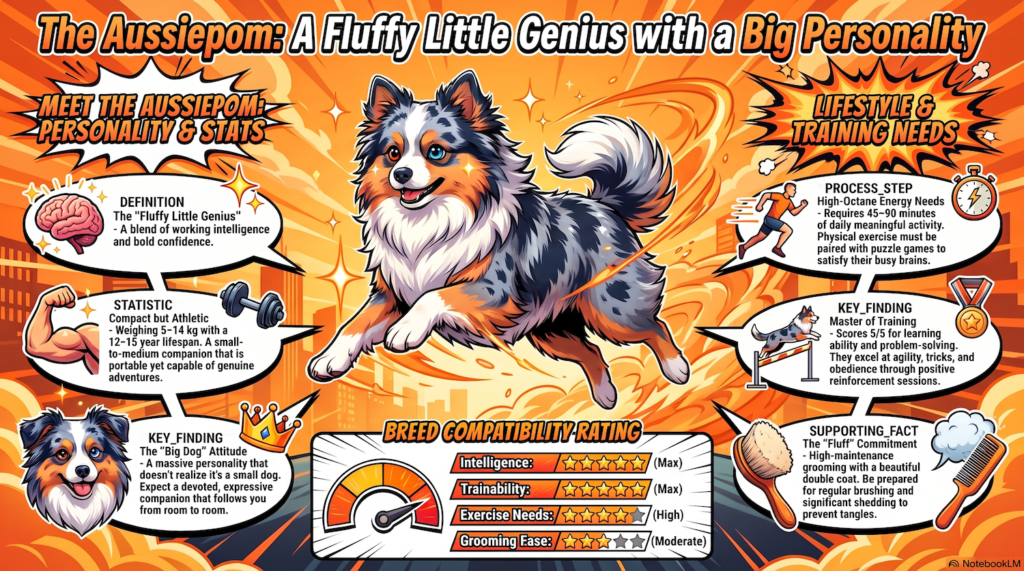
The Aussiepom is a cross between an Australian Shepherd and a Pomeranian, creating an intelligent, energetic, and affectionate companion. Depending on the size of the Australian Shepherd parent, Aussiepoms can vary considerably in size and appearance, but they often inherit a fluffy coat, expressive face, and lively personality.
These clever dogs thrive on companionship and enjoy being involved in family life. With their combination of intelligence and energy, Aussiepoms do best in homes that can provide regular exercise, training, and plenty of mental stimulation.
✅ PROS & CONS
Pros
- Highly intelligent and trainable
- Affectionate and devoted to family
- Playful and entertaining personality
- Excellent companion for active owners
Cons
- Requires regular brushing and coat maintenance
- Needs plenty of exercise and mental stimulation
- Can be vocal
- May inherit strong herding instincts
Is an Aussiepom a Good Family Dog?
Yes, an Aussiepom can be an affectionate, playful and entertaining family dog, particularly for households prepared to provide plenty of interaction and mental stimulation.
The Aussiepom is a cross between an Australian Shepherd and a Pomeranian. Many inherit the intelligence and working instincts of the Australian Shepherd alongside the lively, people-oriented personality of the Pomeranian.
They can be good with respectful children, although size varies considerably and smaller Aussiepoms require careful handling.
Individual temperament can also vary because the Aussiepom is a crossbreed rather than a standardised breed.
For the right family, this can be an enormously engaging little companion — essentially a surprising amount of personality packed underneath a surprising amount of fluff.
How Much Exercise Does an Aussiepom Need?
Most Aussiepoms need around 45–90 minutes of daily exercise and play, depending on their size, age and which parent breed they most resemble.
Some inherit substantial Australian Shepherd energy and may require considerably more activity than their small appearance suggests.
Daily walks, retrieving games, training, puzzle toys and scent activities can all help.
Mental stimulation is particularly important because both parent breeds are intelligent and alert.
An Aussiepom doesn’t necessarily need acreage, but it does need something interesting to do.
Otherwise, this clever little dog may begin developing its own household entertainment program.
Is an Aussiepom Easy to Train?
Aussiepoms are generally intelligent and capable of learning very quickly, although some can have an independent streak.
Australian Shepherds are highly trainable working dogs, while Pomeranians are clever companion dogs that often learn tricks exceptionally well.
Positive reinforcement, short sessions and plenty of variety usually produce the best results.
Early socialisation is important because some Aussiepoms can become cautious around unfamiliar people or overly alert to everything happening around them.
Recall, loose-lead walking and calm behaviour should be taught early.
Their intelligence is an advantage — provided owners remember that smart dogs are equally capable of learning bad habits.
Does an Aussiepom Shed?
Yes, most Aussiepoms should be expected to shed at least moderately and potentially quite heavily.
Both the Australian Shepherd and Pomeranian have double coats.
An Aussiepom may inherit a thick, fluffy coat that sheds throughout the year with heavier seasonal coat changes.
Regular brushing — often several times each week — helps remove loose undercoat and prevent tangles.
Dogs with particularly thick or long coats may need even more frequent grooming.
The Aussiepom isn’t generally a good choice for someone specifically seeking a low-shedding dog.
There may be two different breeds behind the coat, but unfortunately neither one received the memo about keeping its hair to itself.
What Health Problems Are Common in Aussiepoms?
Aussiepoms can potentially inherit health conditions found in either Australian Shepherds or Pomeranians.
Potential concerns include hip dysplasia, patellar luxation and inherited eye disorders.
Australian Shepherd ancestry can introduce the MDR1 gene variant, which can cause dangerous sensitivity to certain medications in affected dogs.
Pomeranian ancestry can contribute risks including dental disease, collapsing trachea and kneecap problems, particularly in smaller Aussiepoms.
The precise risks vary according to the parent dogs.
Responsible breeders should perform health and genetic testing appropriate to both parent breeds rather than assuming crossbreeding automatically prevents inherited disease.
How Long Do Aussiepoms Live?
Aussiepoms commonly live around 12–15 years, although lifespan varies according to size, genetics and overall health.
Smaller individuals may potentially live longer than larger dogs.
Maintaining a healthy body weight, providing regular exercise, good dental care and arranging routine veterinary checks can help support longevity.
Because Aussiepoms vary considerably in size and ancestry, there isn’t one precise lifespan that applies to every dog.
Choosing health-tested parents is particularly important when buying a crossbreed puppy.
How Big Does an Aussiepom Get?
Aussiepoms can vary considerably in size because Australian Shepherds and Pomeranians are dramatically different-sized parent breeds.
Many Aussiepoms are small to medium dogs, but adult size depends heavily on the dogs used in the breeding.
Some crosses use a Miniature American Shepherd or dogs marketed as “Mini Australian Shepherds” rather than a standard Australian Shepherd, which can further change expected size.
Prospective owners should ask for the actual adult weights and heights of both parents.
Terms such as “Mini Aussiepom” aren’t consistently standardised.
With this cross, photographs of the parents are often considerably more informative than a creative size label in an advertisement.
Can an Aussiepom Live in an Apartment?
Yes, many Aussiepoms can live successfully in apartments, provided they receive enough daily exercise and mental stimulation.
Their generally manageable size makes apartment living physically practical.
However, both parent breeds can be alert and vocal, so barking may become a bigger challenge than space.
Daily walks, training and interactive play are essential.
Providing vertical views from windows can be entertaining, although owners may need to discourage barking at every pedestrian, dog and suspicious-looking leaf outside.
A small home can work perfectly well.
A boring life usually won’t.
Do Aussiepoms Bark a Lot?
Aussiepoms can be quite vocal, particularly if they inherit the alertness of the Pomeranian or Australian Shepherd.
They may bark when visitors arrive, other dogs pass the house or something unusual catches their attention.
Boredom and insufficient exercise can make barking worse.
Early training can teach an Aussiepom when alerting is appropriate and when it’s time to settle.
Socialisation can also help prevent unfamiliar sights and sounds from becoming reasons for constant alarm.
Without training, an Aussiepom can become a remarkably efficient small, fluffy neighbourhood notification system.
Can an Aussiepom Be Left Alone?
Aussiepoms generally prefer regular companionship and may struggle if routinely left alone for very long periods.
Both parent breeds tend to form strong relationships with their owners.
Some individuals can develop separation-related behaviours such as barking, pacing or destructive chewing.
Puppies should gradually learn to spend reasonable periods alone rather than suddenly being left for an entire working day.
Exercise and enrichment before absences can also help.
An Aussiepom can certainly develop independence, but it’s generally better suited to a household where it receives substantial daily interaction.
Are Aussiepoms Good With Other Dogs?
Aussiepoms can generally get along well with other dogs, particularly when appropriately socialised from puppyhood.
Many are playful and enjoy canine companionship.
Their play style can vary considerably depending on size and inherited temperament.
Smaller Aussiepoms should be supervised around much larger dogs because accidental injury can occur during rough play.
Some individuals may also attempt to herd other dogs if they inherit strong Australian Shepherd behaviours.
Gradual introductions and positive experiences are the best foundation for a multi-dog household.
Are Aussiepoms Good With Cats?
Many Aussiepoms can live successfully with cats, particularly when introduced carefully or raised alongside them.
However, Australian Shepherd ancestry can contribute chasing and herding behaviours.
A running cat may therefore become extremely interesting to some Aussiepoms.
Early training can teach appropriate boundaries, and cats should always have safe areas where the dog cannot disturb them.
Individual prey drive varies considerably.
Living peacefully with a familiar household cat also doesn’t automatically mean the dog won’t chase unfamiliar cats outdoors.
Do Aussiepoms Try to Herd People?
Some Aussiepoms may inherit herding behaviours from their Australian Shepherd ancestry.
This can include circling, chasing moving children or attempting to control where people and other animals go.
Occasionally, heel-nipping behaviour can appear.
These instincts should be redirected rather than encouraged.
Training, agility, retrieving games and other structured activities can give an energetic Aussiepom more appropriate ways to use its brain.
Not every Aussiepom will behave like a miniature sheepdog, but crossing an Australian Shepherd with a Pomeranian doesn’t necessarily mean the herding software gets deleted.
What Colours Can Aussiepoms Be?
Aussiepoms can appear in a wide variety of colours and patterns because both parent breeds contribute considerable coat-colour diversity.
Possible appearances include black, red, cream, orange, sable, blue merle, red merle and various combinations with white or tan markings.
Some may inherit striking blue eyes or differently coloured eyes from Australian Shepherd ancestry.
However, colour should never be prioritised over health and temperament when choosing a puppy.
Particular care is required with merle-to-merle breeding, which can significantly increase the risk of puppies being born with hearing and vision abnormalities.
Is an Aussiepom a Recognised Dog Breed?
The Aussiepom is generally considered a designer crossbreed rather than a formally standardised pedigree breed recognised by major international kennel clubs.
It combines Pomeranian and Australian Shepherd ancestry, although some breeders use smaller shepherd-type dogs in the cross.
Because there is no universal Aussiepom breed standard, appearance, size, coat and temperament can vary substantially.
This makes the quality and health testing of the parent dogs particularly important.
A cute name doesn’t create predictable genetics.
Where Did the Aussiepom Come From?
The exact origin of the Aussiepom is not well documented.
It appears to have developed as part of the broader designer-dog trend in which established breeds are intentionally crossed to produce companion dogs combining characteristics from both parents.
The attraction is easy to understand: Australian Shepherds contribute intelligence, athleticism and striking colours, while Pomeranians contribute compact size, an enormous fluffy coat and an equally enormous personality.
However, puppies don’t inherit precisely half of every desired characteristic.
One Aussiepom may strongly resemble a small Australian Shepherd, another may look much more Pomeranian-like, and another may land somewhere completely unexpected in between.
That’s one of the defining realities of the Aussiepom:
the name describes the parents more reliably than it predicts the puppy.