






Bright, agile, and beautifully distinctive — a lively Dutch sporting dog with a clever mind and a devoted nature.
🧠 QUICK SNAPSHOT
- Temperament: Intelligent, cheerful, alert
- Energy Level: High
- Size: Small to medium
- Good With Families: Yes
- Trainability: High
- Grooming: Moderate
- Best For: Active families, outdoor lifestyles, dog sports
📚 OVERVIEW
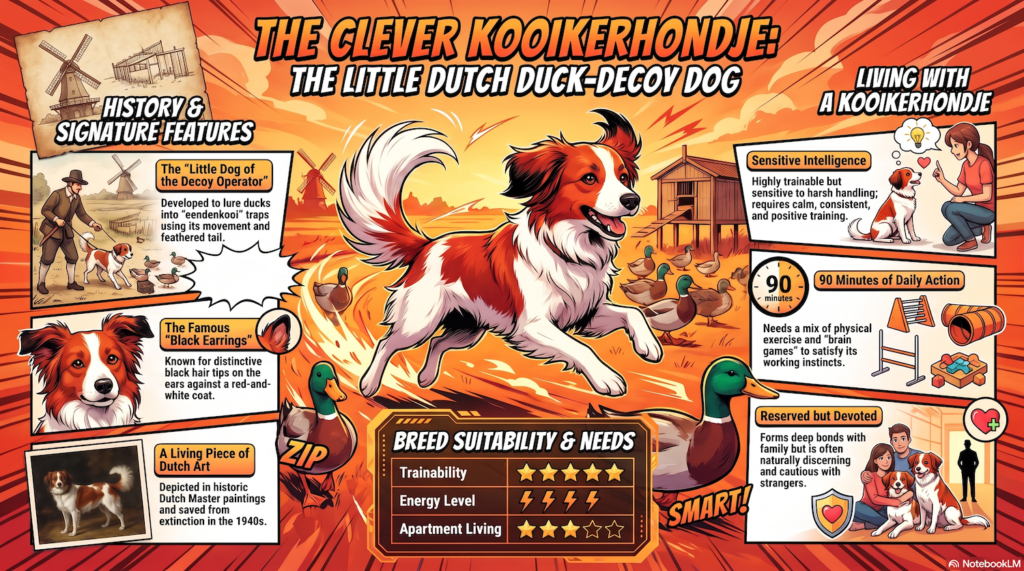
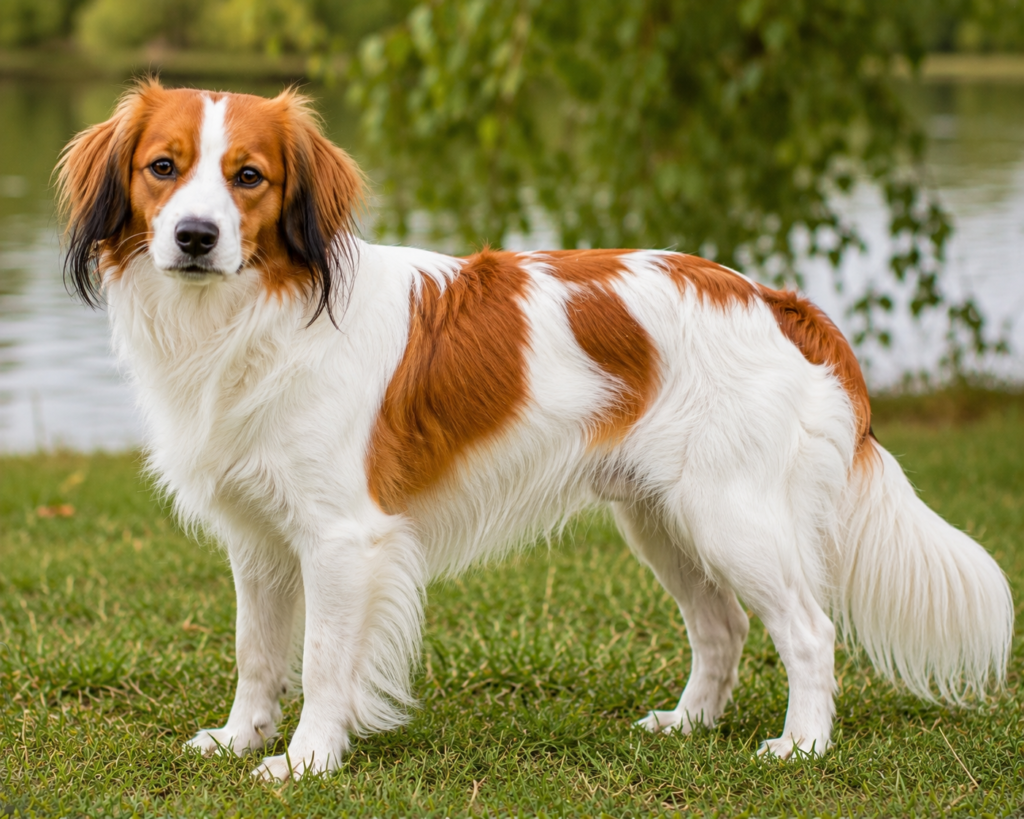
The Kooikerhondje is a historic Dutch breed originally developed to help lure ducks into specialised trapping systems known as eendenkoois. Recognisable by its beautiful orange-red and white coat, feathered tail, and distinctive black ear tips known as “earrings,” this elegant little sporting dog is both intelligent and agile.
Kooikerhondjes form close bonds with their families and thrive when given regular exercise, training, and mental challenges. They can be sensitive and somewhat reserved with strangers, making early socialisation particularly important.
✅ PROS & CONS
Pros
- Highly intelligent and trainable
- Loyal and affectionate with family
- Athletic and excellent at canine sports
- Convenient medium-sized companion
Cons
- Can be reserved with strangers
- Needs plenty of daily exercise and mental stimulation
- Sensitive temperament requires patient training
- May have a strong prey drive
Is a Kooikerhondje a Good Family Dog?
Yes. The Kooikerhondje can be an affectionate, cheerful and devoted family dog, particularly in an active household.
They tend to bond closely with their family but can be more sensitive and reserved than breeds such as Golden Retrievers.
Early socialisation and respectful handling are particularly important.
How Much Exercise Does a Kooikerhondje Need?
Most adults need around 60–90 minutes of daily exercise, along with mental stimulation.
They enjoy walking, hiking, retrieving, swimming, scent games and dog sports.
They’re active sporting dogs but usually have a useful “off switch” once their needs are met.
Is a Kooikerhondje Easy to Train?
Generally, yes, although they can be sensitive and independent.
Kooikerhondjes are intelligent, attentive and capable of learning quickly.
Positive, reward-based training works particularly well; harsh correction can undermine confidence.
Are Kooikerhondjes Intelligent?
Yes.
Their traditional work required them to cooperate with a human while performing a highly unusual and precise task around ducks.
Modern Kooikerhondjes often excel at agility, obedience, scent work and trick training.
Are Kooikerhondjes Sensitive Dogs?
Very often.
They’re known for being responsive to their surroundings and their owner’s mood.
This sensitivity can make them excellent training partners but also means chaotic households or harsh handling may be difficult for some individuals.
Are Kooikerhondjes Stubborn?
They can have an independent streak.
They’re intelligent enough to understand a request while still deciding whether it’s worth doing.
Interesting training and appropriate rewards usually work better than repetition.
Does a Kooikerhondje Shed?
Yes.
The breed has a medium-length, weather-resistant coat and sheds moderately, with heavier seasonal shedding.
Regular brushing helps control loose hair.
Is a Kooikerhondje Hypoallergenic?
No.
Kooikerhondjes shed and produce normal canine allergens through skin and saliva.
They’re not considered a hypoallergenic breed.
How Often Should You Groom a Kooikerhondje?
Brushing once or twice each week is usually sufficient.
More frequent grooming may be helpful during seasonal shedding.
Particular attention should be paid to feathering around the ears, legs and tail where tangles can develop.
Does a Kooikerhondje Need Haircuts?
Usually not.
The natural coat should retain its characteristic feathering and sporting-dog appearance.
Routine trimming is generally limited to minor tidying when necessary.
Should You Shave a Kooikerhondje?
Generally, no.
Its natural coat provides useful environmental protection.
Regular brushing is preferable to routine shaving.
What Health Problems Are Common in Kooikerhondjes?
Potential concerns include patellar luxation, eye disorders, hereditary necrotising myelopathy and von Willebrand disease.
Polymyositis has also become an important health concern within the breed.
Because the Kooikerhondje has a relatively small breeding population, careful health testing and genetic diversity are particularly important.
What Is Hereditary Necrotising Myelopathy in Kooikerhondjes?
Hereditary necrotising myelopathy, sometimes historically called ENM, is a serious inherited neurological disorder associated with the breed.
It affects the spinal cord and can cause progressive weakness and movement problems.
Modern DNA testing allows responsible breeders to make informed breeding decisions and avoid producing affected puppies.
What Is Kooikerhondje Polymyositis?
Polymyositis is an inflammatory muscle disease recognised as an important health issue in the breed.
Symptoms can include muscle weakness, difficulty swallowing, reduced stamina and problems eating or drinking.
Research into its inheritance and management has become an important part of Kooikerhondje health programmes.
Are Kooikerhondjes Prone to Von Willebrand Disease?
The inherited bleeding disorder von Willebrand disease occurs within the breed.
DNA testing can help breeders identify genetic status and make appropriate breeding decisions.
Are Kooikerhondjes Prone to Patellar Luxation?
They can be.
Patellar luxation occurs when the kneecap moves out of its normal position.
Responsible breeders should assess patellar health before breeding.
How Long Does a Kooikerhondje Live?
Kooikerhondjes commonly live around 12–15 years.
Good breeding, healthy weight, exercise and preventive veterinary care can all contribute to longevity.
How Big Does a Kooikerhondje Get?
The Kooikerhondje is a small-to-medium dog, typically standing around 35–42 cm at the shoulder.
Many adults weigh approximately 9–14 kg.
They’re lightly built and athletic rather than heavy.
Is There a Miniature Kooikerhondje?
No.
There is no recognised Miniature Kooikerhondje.
The standard breed is already relatively compact.
Is There a Teacup Kooikerhondje?
No recognised Teacup variety exists.
Deliberate extreme miniaturisation isn’t part of the breed’s traditional structure or purpose.
Can a Kooikerhondje Live in an Apartment?
Yes, provided it receives sufficient exercise and stimulation.
Its relatively compact size is useful for apartment living.
However, sensitivity to noise and alert barking can create challenges in busy buildings.
Does a Kooikerhondje Need a Backyard?
No.
A securely fenced garden is useful but doesn’t replace daily walks, training and mental activity.
The breed’s exercise needs can be met without owning a large property.
Can a Kooikerhondje Be Left Alone?
Adult dogs can learn to tolerate reasonable periods alone.
However, they’re strongly attached to their families and generally prefer human companionship.
Gradual independence training from puppyhood is beneficial.
Are Kooikerhondjes Prone to Separation Anxiety?
Some can be.
Their close attachment to people and sensitive temperament may make sudden prolonged isolation difficult.
Teaching puppies to relax independently can help reduce the risk.
Are Kooikerhondjes Velcro Dogs?
Many are strongly attached to a particular person or family.
They often like knowing where their humans are without necessarily demanding constant physical attention.
Their traditional work also involved close cooperation with a handler.
Are Kooikerhondjes Cuddly?
Many are affectionate with their family, although individual personalities vary.
Some are enthusiastic snugglers while others prefer simply being nearby.
They’re often more reserved than indiscriminately affectionate.
Are Kooikerhondjes Good With Children?
They can be good with respectful children, particularly when raised together.
However, their sensitivity means rough handling or chaotic play may make some uncomfortable.
They’re often best suited to children who understand how to interact calmly with dogs.
Are Kooikerhondjes Good With Other Dogs?
Usually, with appropriate socialisation.
Some can be selective or reserved around unfamiliar dogs.
Early positive experiences are important.
Are Kooikerhondjes Good With Cats?
Many can live successfully with cats, particularly when introduced young.
However, they retain hunting and chase instincts.
Individual prey drive should always be considered.
Do Kooikerhondjes Have a Strong Prey Drive?
They can have a moderate prey drive.
Their traditional work involved waterfowl, although they didn’t perform the same job as conventional bird-hunting spaniels.
Small moving animals can still attract their attention.
Are Kooikerhondjes Good Off Leash?
They can develop excellent recall with consistent training.
Their responsiveness to owners can help, but wildlife and interesting scents may still be distracting.
Secure environments are safest until recall is reliable.
Do Kooikerhondjes Bark a Lot?
They can be alert barkers.
Historically, they also served useful watchdog functions around farms and duck-decoy properties.
Early training can help prevent excessive barking.
Are Kooikerhondjes Good Watchdogs?
Yes.
They’re observant and usually quick to notice unfamiliar people or activity.
Their sensitivity to environmental changes makes them effective little alarm dogs.
Are Kooikerhondjes Good Guard Dogs?
No.
They’re too small to be serious protection dogs and aren’t bred for confrontation with people.
Their strength lies in alerting rather than guarding.
Are Kooikerhondjes Aggressive?
They shouldn’t be indiscriminately aggressive.
However, some individuals can be reserved, sensitive or defensive if poorly socialised or overwhelmed.
Stable temperament should be an important consideration when selecting a breeder.
Are Kooikerhondjes Friendly With Strangers?
They’re often reserved initially.
Unlike extremely outgoing retrievers, many Kooikerhondjes prefer to assess unfamiliar people before interacting.
They should be confident rather than fearful.
When Does a Kooikerhondje Calm Down?
Many become noticeably more settled between two and three years old.
They generally retain a lively, playful personality throughout adulthood.
Adequate exercise makes adolescent life considerably easier.
Do Kooikerhondjes Get the Zoomies?
Yes.
They’re agile, quick dogs and can produce impressive bursts of speed.
The elegant feathering does little to disguise the fact that a Kooikerhondje can suddenly become a very fast orange-and-white blur.
Are Kooikerhondjes Good Running Dogs?
Healthy adults can enjoy moderate running.
They’re athletic but aren’t specialised long-distance endurance dogs.
Structured running should begin only after physical maturity.
Are Kooikerhondjes Good Hiking Dogs?
Yes.
Their manageable size, agility and stamina can make them excellent hiking companions.
Wildlife distraction and recall need to be considered.
Can Kooikerhondjes Swim?
Yes, and many enjoy water.
Their traditional work was closely associated with waterways and ducks.
Swimming can provide excellent exercise for healthy individuals.
What Does a Kooikerhondje Look Like?
The Kooikerhondje is an elegant small sporting dog with a white coat covered by distinct orange-red patches, feathered ears, a plumed tail and a lively expression.
One of its most distinctive features is the black hair at the tips of the ears.
What Colours Can Kooikerhondjes Be?
The characteristic coat is white with clearly defined orange-red patches.
The colour can vary somewhat in richness.
Strong black body patches aren’t characteristic of the standard breed.
What Are the Black Tips on a Kooikerhondje’s Ears Called?
The distinctive black hair at the ear tips is known as earrings.
Well-developed earrings are highly characteristic and give the breed an instantly recognisable expression.
Not every individual has equally dramatic black fringes.
Why Does a Kooikerhondje Have a White Plumed Tail?
The white tail was central to the breed’s unusual traditional work.
Its conspicuous movement could attract the curiosity of ducks.
This makes the Kooikerhondje’s beautiful tail much more than decoration — historically, it was part of the equipment.
Why Does a Kooikerhondje Wave Its Tail?
Tail movement played an important role in attracting ducks toward a decoy system.
The dog’s white plume repeatedly appeared and disappeared as it moved along screens beside the water.
Curious ducks could follow the moving visual stimulus.
Is a Kooikerhondje a Spaniel?
It’s a small Dutch sporting dog with obvious spaniel-like characteristics, and it has historically been described as a Dutch decoy spaniel.
However, its specialised traditional work differs from that of conventional flushing spaniels.
Is a Kooikerhondje Related to the Nederlandse Kooikerhondje?
They’re exactly the same breed.
Nederlandse Kooikerhondje is the full Dutch breed name.
“Kooikerhondje” is the commonly shortened international form.
What Does Kooikerhondje Mean?
The name is wonderfully literal once broken down.
A kooiker was the person who operated a duck decoy, while hondje means “little dog.”
Kooikerhondje therefore essentially means “the duck-decoy keeper’s little dog.”
How Do You Pronounce Kooikerhondje?
The Dutch pronunciation can be challenging for English speakers, particularly the “ui” sound in kooiker and the ending of hondje.
English-speaking breed enthusiasts often use an approximation, but authentic Dutch pronunciation differs from simply reading the spelling as English.
What Is an Eendenkooi?
An eendenkooi is a traditional Dutch duck-decoy system consisting of a pond connected to curved, narrowing channels known as pipes.
Vegetation and screens concealed the operator and dog from the ducks.
The system allowed wild ducks to be guided from the pond into a catching area.
What Did a Kooikerhondje Originally Do?
Its principal traditional job was to help a kooiker operate a duck decoy.
The dog moved silently along the bank, repeatedly appearing and disappearing behind screens.
Its conspicuous white tail attracted curious ducks toward the narrowing decoy pipe.
Did Kooikerhondjes Hunt Ducks?
Not in the conventional gun-dog sense.
They didn’t primarily chase, flush or retrieve ducks for a hunter.
Instead, their movement lured curious ducks deeper into an eendenkooi, where the kooiker could capture them.
Did Kooikerhondjes Kill Ducks?
No — that wasn’t the dog’s primary job.
The dog functioned as a visual lure.
The human operator controlled what happened after the ducks entered the trapping system.
Why Would Ducks Follow a Kooikerhondje?
Ducks can be remarkably curious about certain moving animals.
The dog’s conspicuous white tail repeatedly appearing and disappearing behind screens attracted their attention.
Rather than pursuing the ducks, the Kooikerhondje encouraged the ducks to follow it.
How Did a Kooikerhondje Lure Ducks Without Scaring Them?
The system depended on controlled movement.
The dog appeared briefly between specially arranged screens and then disappeared again.
The ducks saw enough of the dog to become curious without seeing the hidden human operator.
Did Kooikerhondjes Have to Work Silently?
Yes.
Noise or uncontrolled chasing could frighten the ducks and ruin the entire process.
The dog’s ability to work calmly, precisely and in cooperation with the kooiker was extremely important.
Why Was the Kooikerhondje’s Size Important?
The dog needed to be small and agile enough to move easily around the narrow banks and screens of a duck decoy.
A huge dog would also have been considerably more intimidating to ducks.
Its compact size was therefore practical.
Did Kooikerhondjes Do Anything Besides Lure Ducks?
Yes.
Around the eendenkooi they could also act as companions, watchdogs and vermin controllers.
Their usefulness extended beyond the specialised duck-luring task.
Did Kooikerhondjes Catch Rats?
Historically, dogs around farms and duck-decoy properties could help control vermin.
The breed’s alertness and hunting instincts made this a useful secondary role.
However, duck decoy work remains its defining historical speciality.
Is the Kooikerhondje a Dutch Breed?
Yes.
The breed is strongly associated with the Netherlands and its centuries-old duck-decoy culture.
Its name, appearance and working history are distinctly Dutch.
How Old Is the Kooikerhondje?
Dogs closely resembling modern Kooikerhondjes appear in Dutch artwork dating back several centuries.
However, as with many old dog populations, dogs in historical paintings shouldn’t automatically be assumed to represent a modern closed pedigree breed.
Formal standardisation came much later.
Are Kooikerhondjes Shown in Old Dutch Paintings?
Yes.
Small orange-and-white spaniel-like dogs appear repeatedly in paintings from the Dutch Golden Age.
Their resemblance to modern Kooikerhondjes is one of the most fascinating aspects of the breed’s cultural history.
Did Rembrandt Paint a Kooikerhondje?
A small dog resembling a Kooikerhondje appears in Rembrandt’s famous 1642 painting The Night Watch.
It’s often cited by breed enthusiasts as evidence of how long this general type of dog has existed in the Netherlands.
Calling the painted dog a genetically documented modern Kooikerhondje would go beyond the evidence, but the resemblance is striking.
Which Other Artists Painted Kooikerhondje-Like Dogs?
Small orange-and-white dogs resembling the breed appear in works by several Dutch artists of the 17th century.
These paintings provide valuable evidence for a longstanding Dutch population of dogs with a similar appearance.
They also make the Kooikerhondje one of the breeds with an unusually rich artistic record.
Was the Kooikerhondje a Dog of the Dutch Golden Age?
Dogs of remarkably similar type were certainly present during the 17th-century Dutch Golden Age.
Their appearance in domestic and hunting scenes suggests they were familiar rather than extraordinary animals.
The modern pedigree breed ultimately grew from this broader Dutch tradition.
Did William of Orange Own a Kooikerhondje?
A famous story links William II, Prince of Orange, with a small dog named Kuntze.
According to tradition, the dog alerted William to approaching attackers and helped save his life.
The dog is often described retrospectively as Kooikerhondje-like, although assigning a modern breed identity to a 16th-century dog should be done cautiously.
Who Was Kuntze?
Kuntze was the small dog traditionally associated with William of Orange.
Legend says the dog awakened or warned his master during a surprise attack by Spanish forces.
The story became part of Dutch canine folklore and is frequently connected with the Kooikerhondje.
Did a Kooikerhondje Save William of Orange’s Life?
Breed histories frequently tell this story, but historical caution is needed.
A small dog associated with William of Orange is said to have alerted him to danger, and later images show him with a small spaniel-like dog.
Whether that dog should literally be called a modern Kooikerhondje is less certain.
Did Kooikerhondjes Nearly Become Extinct?
Yes.
By the early 20th century, traditional duck-decoy practices had declined and the old Dutch dogs associated with them had become increasingly rare.
World War II pushed the population even closer to disappearance.
Why Did the Kooikerhondje Almost Disappear?
Changing hunting methods, declining use of traditional eendenkooien, modernisation and wartime disruption all contributed.
Once the dog’s highly specialised occupation became less common, there was far less practical reason to maintain the population.
Who Saved the Kooikerhondje?
Baroness van Hardenbroek van Ammerstol played the central role in rescuing the breed during the 20th century.
Interestingly, she was also an important figure in the preservation of the Keeshond.
She searched the Netherlands for surviving dogs resembling the traditional type and began a breeding programme.
When Was the Kooikerhondje Revived?
The rescue effort began during the 1940s, when the breed was perilously rare.
The Baroness used historical descriptions and images to help locate suitable surviving dogs.
From a tiny population, dedicated breeders rebuilt the breed.
Who Was Tommy the Kooikerhondje?
A female named Tommy, found in Friesland, became one of the most important foundation dogs in the modern revival.
She closely matched the type Baroness van Hardenbroek was seeking.
Tommy and other carefully selected dogs helped establish the modern population.
Did Someone Travel Around the Netherlands Looking for Kooikerhondjes?
Yes.
The Baroness reportedly used an image or description of the desired dog and enlisted help in searching rural areas for surviving examples.
This makes the Kooikerhondje’s recovery a genuine breed-rescue detective story.
How Many Kooikerhondjes Survived World War II?
The surviving population was extremely small, but precise numbers quoted in popular accounts vary.
The important point is that modern Kooikerhondjes descend from a restricted foundation population, making careful genetic management particularly important today.
When Was the Kooikerhondje Officially Recognised?
The revived breed gained formal Dutch recognition during the 20th century, after breeders had established a more consistent population.
International recognition followed as numbers increased outside the Netherlands.
Why Is Genetic Diversity Important in Kooikerhondjes?
The breed recovered from a small founder population.
That creates a greater risk that rare inherited variants can become widespread.
Modern breeders therefore need to consider not only individual disease tests but also pedigree diversity and population-wide genetic health.
Are Kooikerhondjes Rare?
Yes.
Their population has grown substantially since the mid-20th-century rescue, but they remain uncommon compared with mainstream sporting breeds.
Outside Europe, many people have never encountered one.
When Did the Kooikerhondje Become Recognised in America?
The breed gradually developed an American following before receiving full American Kennel Club recognition in 2018.
That relatively recent recognition explains why many American dog owners are still unfamiliar with it.
Why Is the Kooikerhondje Becoming More Popular?
Its attractive size, striking orange-and-white coat, intelligence and unusual history have increased international interest.
However, potential owners sometimes underestimate its sensitivity, exercise requirements and reserved temperament because it looks like an easygoing little spaniel.
Is a Kooikerhondje Related to the Nova Scotia Duck Tolling Retriever?
The resemblance in both appearance and unusual duck-related work has generated considerable speculation.
Historical theories sometimes suggest connections between European decoy dogs and the ancestry behind the Nova Scotia Duck Tolling Retriever.
A simple direct pedigree relationship, however, isn’t conclusively documented.
Is a Kooikerhondje a Duck Toller?
Functionally, there are strong similarities.
Both Kooikerhondjes and Nova Scotia Duck Tolling Retrievers use conspicuous movement to stimulate the curiosity of waterfowl.
The Kooikerhondje’s traditional work occurred specifically around Dutch duck-decoy ponds and pipes.
What Does “Tolling” Mean in Dog Work?
Tolling involves using a dog’s visible movement to attract curious waterfowl closer.
Rather than chasing ducks, the dog effectively makes the ducks interested in the dog.
It’s one of the more unusual examples of humans exploiting animal curiosity during hunting.
Is a Kooikerhondje Related to the Cavalier King Charles Spaniel?
They share a broad resemblance to small European spaniel-type dogs, but a simple direct relationship isn’t well established.
European art demonstrates that small red-and-white spaniel-like dogs existed in several regions for centuries.
Is a Kooikerhondje Related to the Brittany?
They’re both compact sporting dogs with orange-and-white colouring in some individuals, but they’re distinct breeds with very different working histories.
The Brittany developed as a pointing bird dog.
The Kooikerhondje specialised in duck-decoy work.
Is a Kooikerhondje the Same as a Nederlandse Kooikerhondje?
Yes.
Nederlandse Kooikerhondje is the breed’s full official Dutch name.
The shorter Kooikerhondje is commonly used in everyday English.
Is the Kooikerhondje a Good First Dog?
It can be, particularly for an active owner interested in training.
However, prospective owners should understand the breed’s sensitivity, reserve with strangers, exercise needs and potential inherited health concerns.
It isn’t simply a miniature easygoing retriever.
What Makes the Kooikerhondje Unique?
The Kooikerhondje has one of the strangest traditional jobs in the dog world.
Instead of chasing ducks, it was trained to make ducks chase it.
Its orange-and-white body and flashing white tail appeared and disappeared behind screens beside a Dutch decoy pond, exploiting the birds’ curiosity until they followed the dog deeper into the system.
Dogs resembling it appear in centuries-old Dutch paintings, a similar little dog became connected with William of Orange, and the entire breed came perilously close to disappearing before being rescued during the 20th century.
Even those beautiful black “earrings” and that extravagant white tail aren’t merely decorative.
The Kooikerhondje is essentially a centuries-old Dutch lesson in doing something very clever with a dog: if you can’t successfully chase the ducks, persuade the ducks to follow you instead.