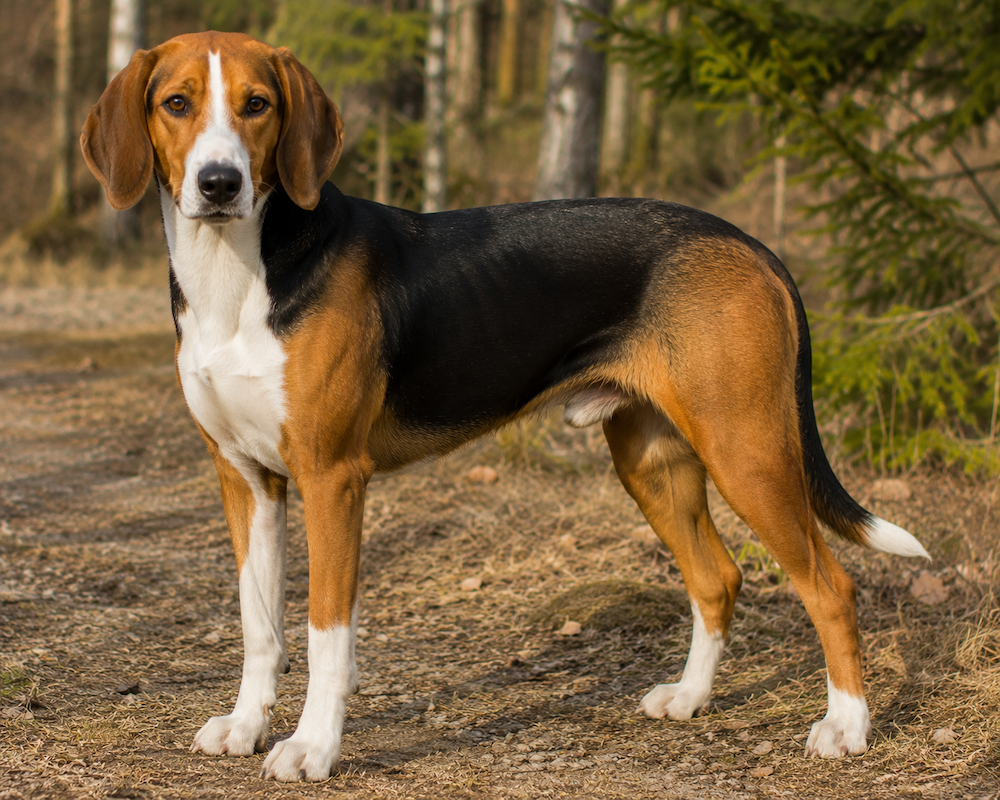







Friendly, athletic, and unmistakably Swedish — the Hamiltonstövare is a handsome scent hound known for its exceptional nose, impressive stamina, and affectionate nature with its family.
🧠 QUICK SNAPSHOT
- Temperament: Friendly, intelligent, even-tempered
- Energy Level: High
- Size: Medium
- Good With Families: Yes
- Trainability: Moderate
- Grooming: Low
- Best For: Active families, experienced hound owners, homes with secure outdoor space
📚 OVERVIEW
The Hamiltonstövare is a Swedish scent hound developed during the 19th century and named after Count Adolf Patrick Hamilton, a prominent figure in Swedish dog breeding and one of the founders of the Swedish Kennel Club. Its ancestry includes several European hound types that were selectively bred to create a capable hunting dog suited to Sweden’s forests and challenging terrain.
Traditionally used to hunt hare and fox, the Hamiltonstövare was bred to follow scent independently rather than hunt as part of a large pack. That working history explains much about the modern breed: it has an exceptional nose, tremendous endurance, an independent mind, and a strong desire to explore.
Its appearance is classically hound-like, with a short tricolour coat, long ears, athletic body, and expressive face. While serious and determined when following a scent, Hamiltonstövares are typically friendly and affectionate at home.
For active owners who understand scent hounds, the Hamiltonstövare offers an appealing combination of working ability, good nature, and handsome Scandinavian looks.
✅ PROS & CONS
Pros
- Friendly and affectionate with family
- Excellent endurance and athletic ability
- Generally even-tempered
- Straightforward grooming requirements
- Intelligent and enthusiastic
- Excellent companion for active owners
Cons
- Strong instinct to follow scents
- Recall can be challenging
- Requires substantial daily exercise
- Can become vocal
- Independent during training
- Secure fencing is important
Is a Hamiltonstövare a Good Family Dog?
Yes, the Hamiltonstövare is generally a very good family dog for an active household. Despite being developed primarily as a hunting breed, it is typically friendly, affectionate, and even-tempered around the people it knows.
Hamiltonstövares can be excellent companions for respectful children and often enjoy participating in family activities. Their energetic personality makes them particularly well suited to families who enjoy walking, hiking, exploring, and spending time outdoors.
They can usually live successfully with other dogs when properly socialised. Smaller animals require more careful consideration because the Hamiltonstövare’s strong hunting instincts can trigger chasing behaviour. Early introductions may help, but owners should never assume training will completely eliminate prey drive.
This is a social breed that generally enjoys companionship and involvement in everyday life. A family able to provide regular exercise, mental stimulation, and plenty of interaction is much more likely to experience the Hamiltonstövare’s affectionate and relaxed side around the home.
How Much Exercise Does a Hamiltonstövare Need?
A Hamiltonstövare generally needs around 90 to 120 minutes of exercise each day. This is an endurance hound developed to follow scent across substantial distances, so a short daily walk is unlikely to satisfy a healthy adult.
Long walks, hiking, running, scent work, tracking, and exploring varied environments are excellent activities. Nose-based games are particularly valuable because they allow the Hamiltonstövare to use the ability that generations of selective breeding have developed so strongly.
Secure areas are important for off-lead exercise. Once a Hamiltonstövare discovers an interesting scent, its hunting instincts may override even well-practised recall.
Mental stimulation should complement physical exercise. Hide-and-seek, scent trails, puzzle feeders, and training games can help satisfy the dog’s curiosity and reduce boredom.
When its exercise needs are met, the Hamiltonstövare can be pleasantly relaxed around the home. Without sufficient activity, however, restlessness, vocalisation, digging, or escape attempts may become problematic.
Is a Hamiltonstövare Easy to Train?
The Hamiltonstövare is intelligent and capable of learning quickly, but it is moderately challenging to train because of its independent scent-hound instincts. This breed was developed to pursue quarry while making decisions away from its handler, so unquestioning obedience was never the objective.
Positive reinforcement using food rewards, praise, toys, and games generally produces the best results. Training should be interesting and varied, as repetitive exercises can quickly lose the attention of a dog whose nose is constantly detecting more exciting possibilities.
Recall training should begin during puppyhood and continue throughout life. Even then, owners need realistic expectations when exercising the breed around wildlife.
Early socialisation with different people, dogs, environments, sounds, and everyday experiences helps create a confident adult.
First-time owners can potentially succeed with a Hamiltonstövare, but patience and an understanding of hound behaviour are important. Training works best when owners learn to cooperate with the dog’s natural instincts rather than constantly fighting against them.
Does a Hamiltonstövare Shed?
Yes, the Hamiltonstövare sheds lightly to moderately throughout the year, with some increase during seasonal coat changes. Its short, dense coat is nevertheless very straightforward to maintain.
Weekly brushing with a rubber grooming mitt or short-bristled brush is usually sufficient to remove loose hair and keep the coat looking healthy. More frequent brushing during heavier shedding periods can help control hair around the home.
Bathing is generally required only when necessary. The breed’s hanging ears deserve more regular attention because reduced airflow can create conditions favourable to irritation or infection. Owners should inspect the ears routinely, particularly after swimming or adventures through wet vegetation.
Regular nail trimming and dental care complete the grooming routine.
The Hamiltonstövare is not considered hypoallergenic, but owners wanting an active breed without complicated professional grooming requirements will find its coat relatively easy to manage.
What Health Problems Are Common in a Hamiltonstövare?
The Hamiltonstövare is generally considered a healthy and robust working breed, commonly living around 11 to 13 years, although individual longevity varies. Because it remains relatively uncommon outside Scandinavia and parts of Europe, published health information is less extensive than for many globally popular breeds.
Potential concerns can include hip dysplasia and certain inherited eye conditions, making appropriate screening of breeding dogs worthwhile. Its long, hanging ears can also be susceptible to ear infections, particularly in dogs that regularly swim or work in damp environments.
As with any athletic breed, maintaining a lean body condition helps protect joints and allows the dog to remain active throughout life.
Prospective owners should seek responsible breeders who can explain the health history of their breeding lines and provide results from appropriate health testing rather than simply claiming that the breed is naturally healthy.
Regular veterinary examinations, good nutrition, dental care, parasite prevention, and plenty of appropriate exercise all contribute to long-term wellbeing.
⭐ What Was the Hamiltonstövare Bred to Do?
The Hamiltonstövare was developed primarily for hunting hare and fox in Sweden, and its hunting style helps explain many of the characteristics owners see today.
Rather than relying on speed alone, the Hamiltonstövare uses its exceptional nose to locate and follow a scent trail across forests and countryside. It was expected to work with considerable independence and persistence while remaining capable of communicating its progress to the hunter.
That explains why a modern Hamiltonstövare may suddenly become fascinated by a scent its owner cannot even detect — and why calling it away can sometimes be considerably harder than expected.
Its original work required stamina, intelligence, determination, and confidence. Those characteristics remain firmly embedded in the breed.
For modern owners, scent work, tracking games, long countryside walks, and other nose-based activities provide an excellent way to give the Hamiltonstövare an outlet for the instincts that have defined the breed for generations.