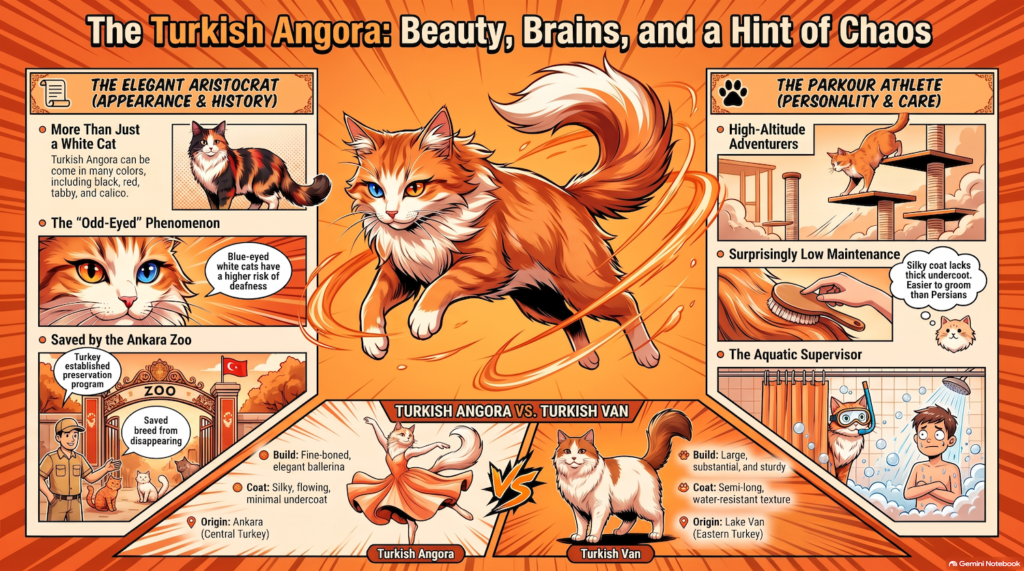
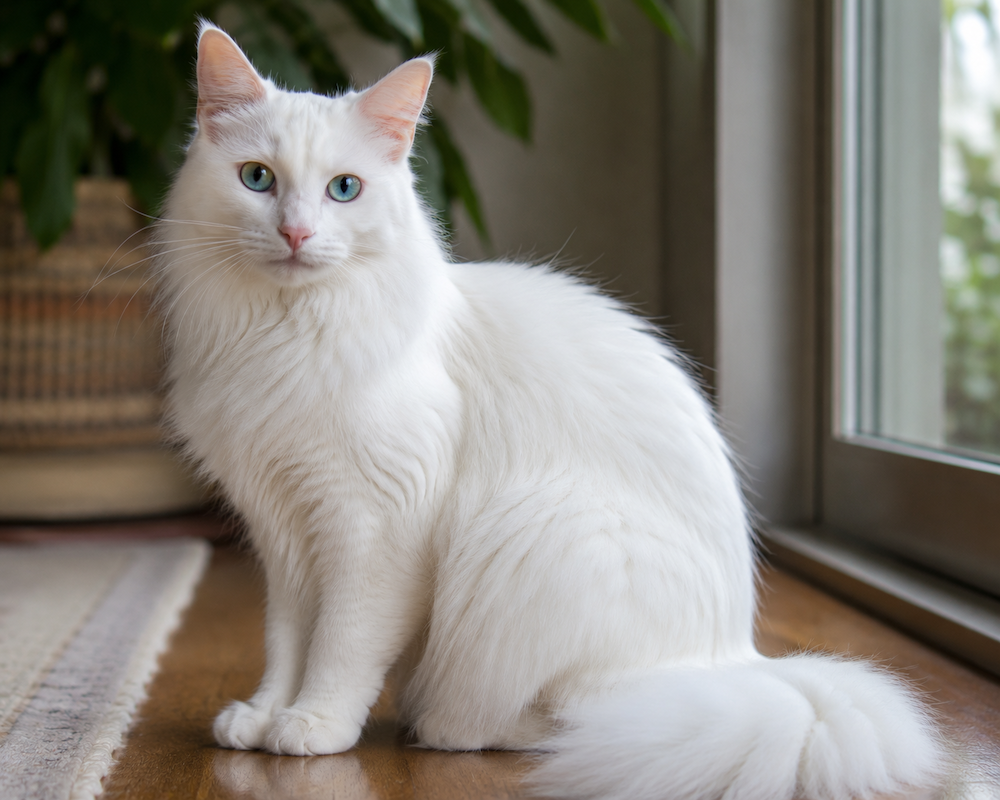







Elegant, intelligent, and endlessly curious — the Turkish Angora is an ancient natural breed famous for its silky coat, graceful athleticism, and confident personality that ensures it is rarely just a quiet decoration around the house.
🧠 QUICK SNAPSHOT
- Temperament: Intelligent, affectionate, curious
- Energy Level: High
- Size: Small to Medium
- Good With Families: Yes
- Indoor Living: Excellent with sufficient enrichment
- Trainability: High
- Grooming: Moderate
- Best For: Interactive families, active households, experienced or enthusiastic cat owners
- Typical Lifespan: Around 12–18 years
📚 OVERVIEW
The Turkish Angora is an ancient natural cat breed associated with Ankara, Turkey, historically known in Europe as Angora. Long-haired cats from the region were known outside Turkey centuries ago, making the Turkish Angora part of a much older feline history than many modern pedigree breeds.
Graceful and finely built, the Turkish Angora has a silky semi-long coat, plumed tail, large ears, and an elegant body that can look delicate until you see one in action. These are athletic cats capable of impressive climbing, jumping, and household exploration.
White Turkish Angoras with brilliant blue, amber, or odd-coloured eyes are particularly famous, but Turkish Angoras aren’t exclusively white. Modern breed standards recognise a variety of colours and patterns.
Temperament is another important part of their appeal. Turkish Angoras tend to be intelligent, playful, confident, and strongly interested in whatever their humans are doing. Many form particularly close relationships with one person while remaining involved with the entire household.
This is an excellent breed for someone wanting an interactive companion rather than a cat that spends most of its day quietly keeping to itself.
✅ PROS & CONS
Pros
- Highly intelligent and interactive
- Affectionate with its family
- Playful and athletic
- Beautiful silky coat
- Coat is easier to maintain than many people expect
- Can learn tricks and interactive games
Cons
- Needs substantial mental stimulation
- Can become mischievous when bored
- Likes climbing onto high surfaces
- May be determined to get its own way
- White cats with blue eyes have an increased risk of congenital deafness
- Doesn’t suit owners wanting a very passive cat
Is a Turkish Angora a Good Family Cat?
Yes, the Turkish Angora can be an excellent family cat, particularly in an interactive household that wants an intelligent and involved companion. These cats tend to form strong relationships with their people and often want to know exactly what everyone is doing.
Turkish Angoras can get along very well with respectful children who understand feline body language and don’t force unwanted handling. Their playful nature makes interactive games particularly enjoyable for older children.
They can also live successfully with other cats and cat-friendly dogs when introductions are gradual. However, the Turkish Angora’s confidence means it may attempt to establish itself as an important member of the household rather quickly.
Some individuals become particularly attached to one favourite person, following them from room to room and supervising everything from computer work to cooking.
Families wanting a quiet, undemanding cat may find the breed surprisingly energetic. Those wanting an affectionate cat with intelligence, curiosity, and plenty of personality are much more likely to appreciate the Turkish Angora.
Can a Turkish Angora Live Indoors or in an Apartment?
Yes, a Turkish Angora can live very happily indoors or in an apartment, but its environment needs to provide opportunities for climbing, exploration, play, and mental stimulation.
Floor space isn’t necessarily the most important consideration. Turkish Angoras are athletic climbers, so creating vertical territory with tall cat trees, shelves, window perches, and other safe elevated areas can dramatically increase the usable space available to them.
They also need scratching posts, interactive toys, hiding places, and regular play with their owners. Puzzle feeders and rotating toys can help prevent an intelligent cat from becoming bored with its surroundings.
Secure indoor living also protects cats from traffic, disease, fights, poisoning, predators, and other outdoor hazards. A secure cat enclosure can provide additional outdoor stimulation where practical.
The important point is that apartment living should not mean an inactive lifestyle. Give a Turkish Angora an interesting three-dimensional environment and it can adapt exceptionally well to indoor life.
How Much Exercise and Play Does a Turkish Angora Need?
The Turkish Angora is an active and athletic cat that needs daily interactive play. Several 10–15 minute sessions throughout the day are a useful starting point, with younger and particularly energetic individuals often wanting more.
Fishing-wand toys, feather toys, balls, tunnels, climbing towers, and games involving stalking and chasing allow the cat to express natural hunting behaviours. Many Turkish Angoras also enjoy retrieving toys and learning simple tricks.
Climbing is especially important. Don’t be surprised to discover a Turkish Angora surveying its kingdom from the highest accessible piece of furniture in the room.
Mental stimulation matters just as much as physical exercise. Food puzzles, treat hunts, clicker training, rotating toys, and learning new behaviours can keep its intelligent mind occupied.
Without sufficient enrichment, a bored Turkish Angora may simply create its own entertainment — which may involve cupboards, shelves, ornaments, or other things its owner didn’t intend to become cat toys.
Does a Turkish Angora Shed?
Yes, the Turkish Angora does shed, but its elegant coat is often surprisingly manageable. Unlike some heavily coated long-haired breeds, the Turkish Angora typically has a fine, silky single coat with little or no woolly undercoat.
This reduces the tendency to form dense mats and means grooming is generally easier than its luxurious appearance might suggest.
Brushing around once or twice each week is often sufficient to remove loose hair and prevent small tangles. More frequent brushing can help during periods of seasonal shedding.
The breed normally requires little or no professional trimming. Occasional bathing may be useful, particularly for white cats, while routine nail trimming, dental care, and ear checks should form part of normal maintenance.
Despite its relatively straightforward coat, the Turkish Angora is not considered hypoallergenic. Allergens are primarily associated with proteins produced by cats rather than simply the length or quantity of their fur.
What Health Problems Are Common in a Turkish Angora?
The Turkish Angora is generally a healthy and long-lived breed, with many cats reaching 12–18 years, but there are several health considerations prospective owners should understand.
One of the best known is congenital deafness, particularly in completely white cats with one or two blue eyes. Importantly, white colour or blue eyes do not automatically mean a cat is deaf. Hearing can be assessed using a BAER test, and responsible breeding practices help manage the risk.
Hypertrophic cardiomyopathy (HCM), a disease involving abnormal thickening of the heart muscle, can also occur in cats and should be discussed with breeders and veterinarians.
A rare neurological disorder known as hereditary ataxia has also been associated with Turkish Angora kittens and affects coordination and movement.
Responsible breeders should be transparent about health within their lines. Regular veterinary examinations, dental care, good nutrition, weight management, and early investigation of behavioural or physical changes all contribute to a Turkish Angora’s long-term health.
⭐ Are All Turkish Angoras White?
No — and this is one of the most common misconceptions about the breed.
The image most people associate with the Turkish Angora is a spectacular pure-white cat with blue, amber, green, or odd-coloured eyes. White cats became so strongly associated with the breed that many people understandably assume it is the only possible colour.
Turkish Angoras can actually occur in numerous other colours and patterns, including black, blue, red, cream, tabby, tortoiseshell, and combinations involving white, depending on the registry’s breed standard.
The obsession with white cats also created an unfortunate connection between the breed and deafness. The increased deafness risk is associated with the genetics of dominant white colouring, particularly when combined with blue eyes — it isn’t something inherent to every Turkish Angora.
So a black, tabby, or tortoiseshell Turkish Angora isn’t somehow less authentic because it isn’t white.
Underneath the colour is the same elegant, athletic, intelligent cat.
⭐ Is the Turkish Angora Really an Ancient Cat Breed?
Yes, although claims about exact dates and pedigrees should be treated carefully.
Long-haired cats associated with the region around modern-day Turkey were documented in Europe centuries ago, and the name Angora comes from the historical European name for Ankara.
The breed also holds considerable cultural significance in Turkey. During the 20th century, Turkish Angoras were maintained through breeding programs at Ankara Zoo, which played an important role in preserving cats of the traditional type.
The breed later became established internationally, although breeding standards outside Turkey developed their own characteristics.
This history makes the Turkish Angora particularly interesting. It wasn’t simply created recently by crossing two established pedigree breeds to achieve a certain appearance.
Its story is intertwined with the much longer history of naturally occurring long-haired cats in the region — making today’s elegant Turkish Angora part of a fascinating feline heritage extending back centuries.