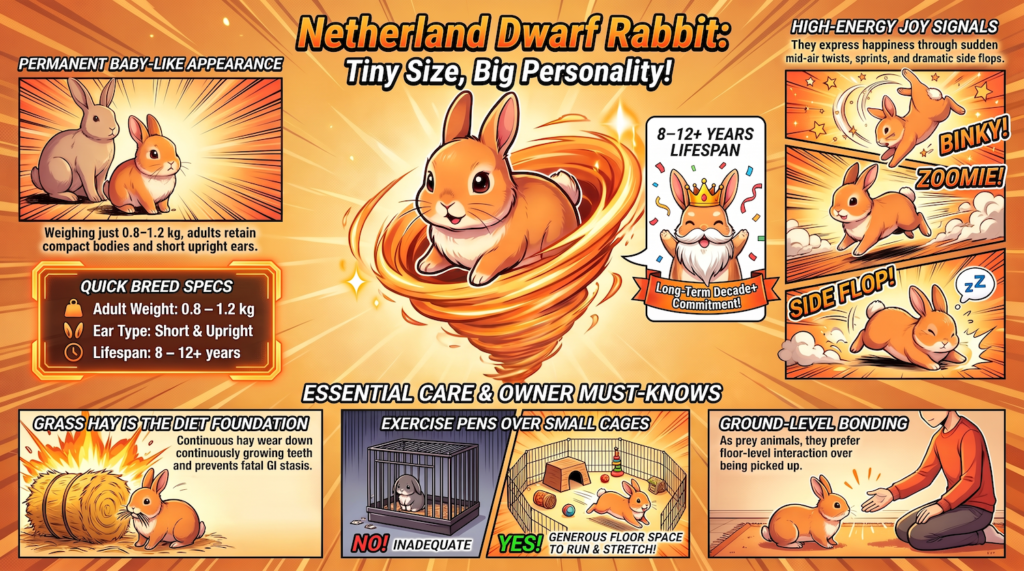
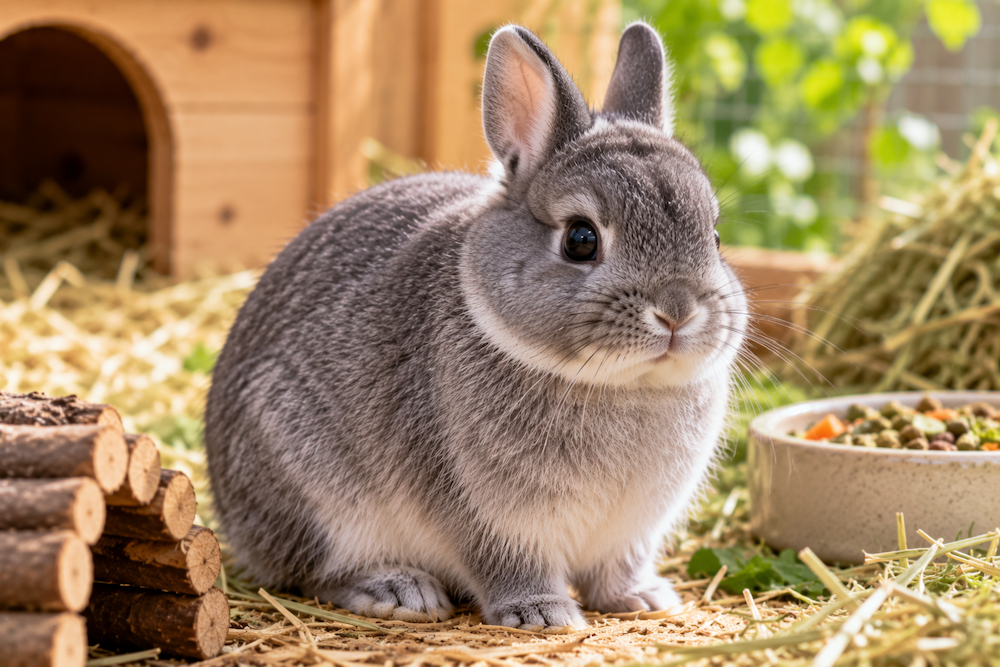






Tiny, bright-eyed and packed with personality, the Netherland Dwarf is one of the smallest domestic rabbit breeds. Its compact body and baby-faced appearance are irresistible.
🧠 QUICK SNAPSHOT
| Trait | Netherland Dwarf Rabbit |
|---|---|
| Species | Domestic Rabbit (Oryctolagus cuniculus domesticus) |
| Breed Type | Dwarf rabbit |
| Origin | Netherlands |
| Typical Lifespan | Around 7–12 years |
| Adult Weight | Commonly around 0.8–1.2 kg |
| Diet | Herbivore |
| Activity | Most active around dawn and dusk |
| Temperament | Intelligent, energetic and sometimes cautious |
| Coat | Short and dense |
| Famous Feature | Extremely small size and compact features |
| Social Needs | High |
| Beginner Friendly? | Moderate |
📚 OVERVIEW
The Netherland Dwarf is one of the world’s smallest recognised rabbit breeds, developed in the Netherlands and known for its compact body, short ears, round head and large eyes.
Despite its tiny appearance, this is an energetic and intelligent rabbit. Netherland Dwarfs need room to run, explore, forage and display normal rabbit behaviours rather than spending their lives in a small cage.
Some can initially be more cautious or independent than larger rabbit breeds, but patient socialisation can produce confident, interactive companions.
Like all rabbits, they require unlimited grass hay, appropriate fresh foods, exercise, enrichment and good dental care.
✅ PROS & CONS
Pros
- One of the smallest rabbit breeds
- Intelligent and curious
- Playful and energetic
- Short, relatively easy-care coat
- Can form strong bonds with owners
- Can learn litter habits and routines
- Generally quiet
- Potential lifespan of a decade or more
Cons
- Can be shy or cautious initially
- Very small and physically delicate
- Needs much more space than its size suggests
- Usually doesn’t enjoy being carried
- Requires unlimited hay and careful nutrition
- Teeth grow continuously
- Needs daily exercise and enrichment
- Can live for 10 years or longer
Are Netherland Dwarf Rabbits Good Pets?
Yes. Netherland Dwarfs can make excellent companions for owners who appreciate an active, intelligent and relatively independent rabbit.
They’re tiny, but their exercise, social and enrichment needs are just as important as those of larger rabbits.
Are Netherland Dwarf Rabbits Good for Beginners?
They can be, although their small size and sometimes cautious temperament can make them less straightforward than expected.
Patient handling and a good understanding of rabbit behaviour are particularly important.
Are Netherland Dwarf Rabbits Good With Children?
They can live successfully in families, but their tiny bodies make them relatively delicate.
They’re generally better suited to calm, respectful interaction at ground level than frequent picking up and carrying.
Adults should remain responsible for their care.
How Long Do Netherland Dwarf Rabbits Live?
Netherland Dwarfs commonly live around 7–12 years with good care.
Diet, genetics, housing, exercise and veterinary care can all influence lifespan.
Their small size shouldn’t be mistaken for a short-term commitment.
How Big Do Netherland Dwarf Rabbits Get?
Netherland Dwarfs are among the smallest domestic rabbits.
Adults commonly weigh around 0.8–1.2 kg, although individual size varies.
Their compact body and proportionally large head make them appear particularly tiny.
Why Are Netherland Dwarf Rabbits So Small?
Their size results from selective breeding and dwarf genetics.
The dwarf gene influences more than body size, contributing to the breed’s characteristic short ears, compact body, round head and large-eyed appearance.
What Do Netherland Dwarf Rabbits Eat?
The foundation of an adult rabbit’s diet should be unlimited good-quality grass hay, supplemented with suitable leafy greens and a measured amount of nutritionally balanced rabbit pellets.
Fresh drinking water should always be available.
Why Is Hay Important for Netherland Dwarf Rabbits?
Hay provides essential fibre for healthy digestion and encourages the prolonged chewing rabbits need.
Rabbit teeth grow continuously, so fibrous foods help provide natural dental wear.
A tiny rabbit still needs a substantial supply of hay.
How Much Space Does a Netherland Dwarf Rabbit Need?
Far more than its body size suggests.
A Netherland Dwarf needs enough permanent space to hop, stretch, stand upright and move naturally, together with regular access to a larger exercise area.
A traditional tiny rabbit cage isn’t an appropriate complete home.
Can Netherland Dwarf Rabbits Live Indoors?
Yes. They can make excellent indoor companions when provided with adequate space and a rabbit-safe environment.
Electrical cables, houseplants, furniture and other chewable objects may need protection.
Can Netherland Dwarf Rabbits Be Litter Trained?
Yes. Many rabbits can learn to use a litter tray because they naturally prefer particular toilet areas.
Good enclosure design and consistency can encourage reliable litter habits.
Are Netherland Dwarf Rabbits Affectionate?
They can be.
Some become extremely interactive and enjoy approaching familiar people for attention and gentle stroking.
Others remain more independent, making individual personality particularly important.
Do Netherland Dwarf Rabbits Like Being Held?
Many rabbits dislike being lifted because they’re prey animals whose instinct is to keep their feet firmly on the ground.
Netherland Dwarfs are also particularly small and delicate.
Interaction on the floor is often safer and more enjoyable for the rabbit.
Do Netherland Dwarf Rabbits Bite?
They can bite if frightened, territorial, in pain or handled in a way they dislike.
They’re not inherently aggressive rabbits.
Patient socialisation and respecting their body language can make an enormous difference.
Do Netherland Dwarf Rabbits Need a Companion?
Rabbits are social animals and often benefit greatly from living with a compatible bonded rabbit.
The companion doesn’t need to be another Netherland Dwarf.
Careful introductions are important because unfamiliar rabbits shouldn’t simply be placed together.
Do Netherland Dwarf Rabbits Need Exercise?
Absolutely.
Despite their miniature size, Netherland Dwarfs are energetic and need opportunities to run, hop, explore, dig and forage every day.
Exercise supports both physical health and mental wellbeing.
Why Does My Netherland Dwarf Rabbit Binky?
A binky is an enthusiastic leap that may include twists and kicks in mid-air.
It’s commonly associated with excitement and playful behaviour.
Netherland Dwarfs may combine binkies with sudden high-speed zoomies around their exercise area.
Why Does My Rabbit Thump?
Rabbits use their powerful hind legs to thump the ground when they’re alarmed, frightened or sometimes annoyed.
In wild rabbits, this behaviour can help warn others that potential danger is nearby.
Why Does My Netherland Dwarf Grind Its Teeth?
Gentle tooth purring or quiet grinding can occur when a relaxed rabbit is being stroked.
However, loud or persistent tooth grinding can indicate pain, particularly when accompanied by changes in posture, appetite or activity.
Context is extremely important.
Do Netherland Dwarf Rabbits Shed?
Yes. Their short coat sheds and may moult more heavily at certain times.
Regular brushing helps remove loose fur, particularly during heavier moults.
Because rabbits can’t vomit, reducing the amount of loose hair swallowed during grooming is useful.
What Health Problems Are Common in Netherland Dwarf Rabbits?
Potential concerns include dental disease, gastrointestinal stasis, respiratory problems and obesity.
Their compact head structure can make dental health particularly important.
Any significant reduction in eating or droppings should be treated seriously.
What Is GI Stasis in Rabbits?
Gastrointestinal stasis occurs when normal movement through the digestive system slows dramatically.
Warning signs can include reduced appetite, fewer droppings, lethargy and discomfort.
It can become life-threatening and requires prompt veterinary attention.
What Colours Do Netherland Dwarf Rabbits Come In?
Netherland Dwarfs are bred in a remarkable range of colours and patterns.
These include varieties based around black, blue, chocolate, white, orange, chestnut and shaded colourings, among many others.
Their coat remains short and dense regardless of colour.
What Is the Difference Between a Netherland Dwarf and a Holland Lop?
Both are small rabbit breeds, but they’re easily distinguished.
The Netherland Dwarf has short upright ears, while the Holland Lop is larger and has characteristic floppy ears.
They also differ in body type, breed history and typical appearance.
Where Did the Netherland Dwarf Rabbit Come From?
The Netherland Dwarf was developed in the Netherlands during the early 20th century.
Breeders combined very small rabbits over generations to establish the compact size and distinctive appearance associated with the modern breed.
Is a Netherland Dwarf a Good First Rabbit?
It can be, particularly for someone willing to build trust patiently.
The biggest mistake is assuming its miniature size means miniature care.
A Netherland Dwarf still needs substantial exercise space, excellent nutrition, companionship and potentially a decade or more of care.
What Makes the Netherland Dwarf Rabbit Unique?
The Netherland Dwarf looks almost permanently young.
Tiny ears.
Huge eyes.
Round head.
Compact little body.
That baby-faced appearance isn’t an accident — it’s partly connected to the dwarf genetics that created the breed’s extraordinary size and proportions.
But don’t confuse miniature with timid.
Give a confident Netherland Dwarf enough space and you may see explosive zoomies, spectacular binkies and a rabbit investigating everything within reach.
Something suspicious happens?
THUMP.
Something exciting happens?
Run at maximum speed.
Dinner arrives?
Suddenly that cautious little rabbit knows exactly where you are.
The Netherland Dwarf may be one of the smallest rabbits in the world.
Fortunately, nobody shrank the personality to match.
Discover why Netherland Dwarf Rabbits are so tiny, what their dwarf genetics mean, why rabbits binky and thump, and what these miniature companions really need to thrive.