







Colourful, playful and bursting with personality, Conures are among the most entertaining companion parrots. These intelligent little birds are famous for their affectionate nature.
🧠 QUICK SNAPSHOT
Trait | Conure |
|---|---|
Scientific Classification | Various genera, including Pyrrhura and Aratinga |
Other Names | Conure Parrot, Small Parakeet |
Pet Type | Parrot / Companion bird |
Natural Origin | Central and South America |
Typical Lifespan | Around 15–30+ years, depending on species |
Adult Size | Approximately 22–38 cm, depending on species |
Adult Weight | Around 60–130 g for many popular species |
Diet | Omnivore |
Activity | Diurnal |
Temperament | Playful, curious, affectionate and energetic |
Noise Level | Moderate to very loud |
Social Needs | Very high |
Trainability | Excellent |
Housing | Spacious cage or aviary with daily exercise |
Beginner Friendly? | Some species, with preparation |
Famous Feature | Vibrant plumage and playful personalities |
📚 OVERVIEW
Conures are a diverse group of small to medium-sized parrots native to Central and South America. Known for their bright colours, intelligence and lively personalities, they have become popular companion birds worldwide.
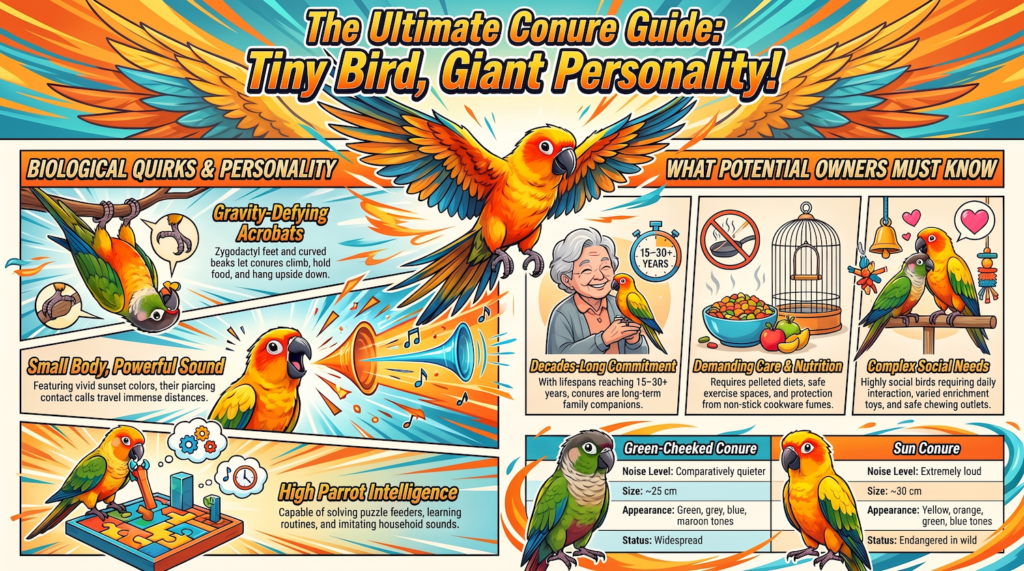
Popular varieties include the Green-Cheeked Conure, Sun Conure, Jenday Conure, Nanday Conure and Blue-Crowned Conure. Each has different colours, temperaments and noise levels.
Conures are highly social birds that enjoy climbing, playing, exploring and interacting with their surroundings. Many develop strong relationships with familiar caregivers and can learn tricks, routines and simple words.
However, they require daily social interaction, mental stimulation, a balanced diet and plenty of exercise. Their natural vocalisations and energetic behaviour make them unsuitable for households seeking a quiet, low-maintenance pet.
✅ PROS & CONS
👍 Pros
Colourful and beautiful plumage
Playful, entertaining personalities
Highly intelligent
Can form strong social bonds
Excellent trainability
Relatively compact size
Enjoy interactive toys and games
Long potential lifespan
👎 Cons
Some species are extremely loud
Require substantial daily attention
Can become destructive when bored
May bite when frightened or overstimulated
Need regular exercise outside their cage
Can develop behavioural problems
Require specialised avian veterinary care
Long-term commitment
Are Conures Good Pets?
Yes. Conures can make wonderful companions for people who enjoy active, intelligent birds.
They’re playful, curious and often affectionate towards familiar caregivers.
However, their social needs, noise levels and daily care requirements make them more demanding than many prospective owners expect.
Are Conures Good for Beginners?
Some Conures are suitable for well-prepared beginners.
The Green-Cheeked Conure is often recommended because of its relatively manageable size and generally quieter nature.
However, even smaller Conures require considerable interaction, enrichment and appropriate husbandry.
How Long Do Conures Live?
Conures commonly live around 15–30 years, although lifespan varies significantly between species.
Some larger species may live considerably longer with excellent care.
Their longevity makes responsible long-term planning essential.
How Big Do Conures Get?
Most commonly kept Conures measure approximately 22–38 cm in length, including their tails.
Green-Cheeked Conures are relatively small, while Sun and Blue-Crowned Conures are generally larger.
Body size and weight vary considerably between species.
What Are the Different Types of Conures?
Popular Conures include:
Green-Cheeked Conure — playful and relatively quiet
Sun Conure — spectacular yellow, orange and green plumage
Jenday Conure — colourful and energetic
Nanday Conure — distinctive black head and green body
Blue-Crowned Conure — intelligent and sociable
Pineapple Conure — a colour mutation of the Green-Cheeked Conure
Black-Capped Conure — smaller, curious and active
Each variety has different characteristics and care requirements.
Are Conures Affectionate?
Many Conures form strong bonds with familiar people.
Some enjoy head scratches, sitting near their caregivers and participating in daily activities.
However, affection varies between individuals, and interactions should always respect the bird’s body language.
Do Conures Recognise Their Owners?
Yes.
Conures can recognise familiar people through visual cues, voices and established routines.
They may respond enthusiastically when a favourite caregiver approaches.
Can Conures Talk?
Some Conures can imitate human speech.
However, their speaking abilities vary considerably, and many learn only a few words or sounds.
Conures are generally better known for their playful behaviour than extensive vocabularies.
Are Conures Intelligent?
Absolutely.
Conures can learn tricks, recognise routines, solve simple puzzles and manipulate objects.
Their intelligence means they need regular mental stimulation.
Foraging toys and positive reinforcement training are particularly valuable.
Are Conures Loud?
Noise levels vary significantly between species.
Sun Conures and Jenday Conures are particularly famous for their powerful calls.
Green-Cheeked Conures are generally quieter, although they can still produce sharp, repetitive vocalisations.
Are Green-Cheeked Conures Quieter Than Sun Conures?
Generally, yes.
Green-Cheeked Conures usually produce less intense vocalisations than Sun Conures.
However, no Conure is completely quiet, and individual noise levels vary.
Why Does My Conure Scream?
Screaming can be a natural form of communication.
Conures may call loudly when excited, alarmed, seeking contact or responding to environmental changes.
Excessive screaming may also indicate boredom, frustration or unmet behavioural needs.
Do Conures Bite?
Yes. Conures can bite when frightened, overstimulated or uncomfortable.
Their beaks are powerful enough to cause painful injuries.
Learning to recognise warning signals and using positive reinforcement training can help reduce biting.
What Do Conures Eat?
Conures need a balanced, species-appropriate diet.
A suitable formulated parrot pellet should generally form the foundation of their diet, supplemented with fresh vegetables, leafy greens and limited fruit.
Seeds and nuts can be offered in controlled amounts, particularly as training rewards.
Can Conures Eat Fruit?
Yes.
Conures can enjoy suitable fruits such as apple without seeds, berries, mango and papaya.
However, fruit should be offered in moderation because of its sugar content.
Vegetables and balanced formulated food should make up a larger proportion of the diet.
What Foods Are Toxic to Conures?
Foods including avocado, chocolate, caffeine and alcohol can be dangerous.
Apple seeds and certain other fruit seeds or pits should also be avoided.
Always check food safety before offering unfamiliar items.
How Big Should a Conure Cage Be?
Conures need spacious cages that allow climbing, movement and full wing extension.
For a small Conure, a cage approximately 90 × 60 × 90 cm is a useful starting point, with larger enclosures strongly preferred.
Bigger species need more space, and daily supervised exercise outside the cage remains essential.
Do Conures Need Time Outside Their Cage?
Yes.
Conures are energetic birds that require regular opportunities to fly, climb, explore and interact with their surroundings.
A safe, bird-proofed environment and supervised exercise help maintain physical and mental wellbeing.
Do Conures Need Toys?
Absolutely.
Conures enjoy chewing, climbing, shredding and solving foraging puzzles.
Providing a variety of bird-safe toys helps prevent boredom and encourages natural behaviours.
Toys should be inspected regularly for damage.
Can Two Conures Live Together?
Yes, compatible Conures may live together successfully.
However, introductions should be gradual and carefully supervised.
Some birds become territorial or aggressive, so separate accommodation may be necessary.
Do Conures Get Lonely?
Conures are highly social birds.
Without appropriate companionship and stimulation, they may develop stress-related behaviours.
A compatible bird companion can provide valuable social interaction, but proper introductions and sufficient space are important.
How Much Sleep Do Conures Need?
Conures generally benefit from approximately 10–12 hours of uninterrupted nighttime sleep.
A quiet, consistent sleeping environment helps support healthy behaviour.
Insufficient sleep can contribute to irritability and behavioural problems.
Why Does My Conure Hang Upside Down?
Hanging upside down is often completely normal.
Conures are agile climbers that enjoy exploring different positions and using their feet and beaks to navigate.
This behaviour can be part of normal play and exercise.
Why Does My Conure Puff Up Its Feathers?
Conures may fluff their feathers when relaxing, preening or regulating body temperature.
However, prolonged fluffing accompanied by lethargy, appetite loss or abnormal behaviour may indicate illness.
An avian veterinarian should assess concerning symptoms promptly.
What Health Problems Are Common in Conures?
Potential concerns include nutritional deficiencies, obesity, respiratory infections, feather-damaging behaviour and reproductive disorders.
Some Conures may also be affected by psittacine beak and feather disease.
Appropriate husbandry and regular avian veterinary examinations are important.
Are Conures Good Apartment Pets?
Some smaller, quieter species may be manageable in apartments.
Green-Cheeked Conures are often more suitable than louder species such as Sun Conures.
However, even relatively quiet Conures can produce calls that disturb neighbours.
Where Do Conures Come From?
Conures originate from Central and South America, where different species inhabit tropical forests, woodlands, savannas and other environments.
Many live in social groups and communicate through vocalisations.
Their natural habitats influence their need for climbing, exploration and companionship.
Are Conures Legal to Keep as Pets?
Ownership and trade regulations vary by species and location.
Some Conures are protected under international wildlife trade agreements.
Always check local regulations and purchase birds from responsible, legal sources.
What Makes the Conure Unique?
Imagine a tiny parrot that can hang upside down, solve puzzles, learn tricks and announce its excitement with a surprisingly powerful voice.
That’s the Conure.
These colourful birds combine remarkable intelligence with personalities that often seem much larger than their bodies.
Their powerful feet and curved beaks allow them to climb with impressive agility, while their long tails help with balance and movement.
But perhaps their most entertaining feature is their playful behaviour.
Some Conures enjoy rolling onto their backs, wrestling with toys and exploring objects in unusual ways.
Green-Cheeked Conures are particularly famous among bird enthusiasts for their acrobatic antics and willingness to play in unexpected positions.
Then there’s the Sun Conure.
With brilliant orange, yellow and green feathers, this spectacular parrot looks almost like a tropical sunset brought to life.
Yet its beautiful appearance comes with a voice that can be astonishingly loud for such a relatively small bird.
Conures are also remarkably social.
In the wild, many species travel, feed and communicate in groups, using their calls to maintain contact.
And in captivity, their intelligence and curiosity make them enthusiastic learners.
The Conure may be small enough to perch on your shoulder, but its personality, energy and intelligence can fill an entire household.