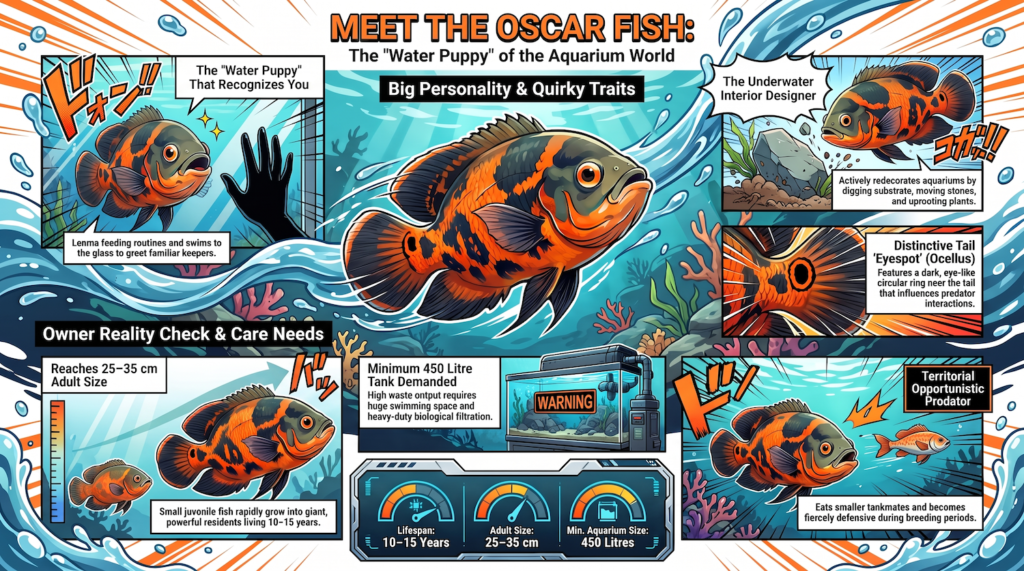








Intelligent, bold and bursting with personality, the Oscar Fish is a spectacular freshwater cichlid famous for recognising its owners and behaving almost like an underwater puppy.seasons.
🧠 QUICK SNAPSHOT
Trait | Oscar Fish |
|---|---|
Scientific Name | Astronotus ocellatus |
Other Names | Oscar Cichlid, Tiger Oscar, Velvet Cichlid, Marble Cichlid |
Pet Type | Freshwater Aquarium Fish |
Natural Origin | Amazon and Orinoco river basins, South America |
Typical Lifespan | Around 10–15 years |
Adult Size | Approximately 25–35 cm |
Adult Weight | Often 500 g–1 kg or more |
Colours | Black, orange, red, white, albino and patterned varieties |
Diet | Omnivore with strong carnivorous tendencies |
Activity | Primarily diurnal |
Temperament | Intelligent, bold, territorial and interactive |
Noise Level | Silent |
Social Needs | Can live alone or with carefully selected companions |
Water Temperature | Approximately 24–28°C |
Water pH | Approximately 6.0–7.5 |
Tank Size | Around 280–350 litres minimum for one adult; larger preferred |
Beginner Friendly? | Generally not recommended |
Famous Feature | Owner recognition and remarkable interactive behaviour |
📚 OVERVIEW
The Oscar Fish is a large, intelligent freshwater cichlid native to tropical South America. Its scientific name, Astronotus ocellatus, refers to the distinctive eye-like markings often found near its tail.
Oscars are famous for their bold personalities and unusual interactions with their owners. Many learn to recognise familiar people, approach the aquarium when someone enters the room and eagerly anticipate feeding time.
Unlike small community aquarium fish, Oscars grow rapidly and develop into powerful, territorial adults. They may rearrange decorations, dig in substrate and investigate almost anything placed inside their aquarium.
Their care requires a very large aquarium, powerful filtration, excellent water quality, a varied diet and carefully selected tankmates. Their intelligence and engaging behaviour make them particularly rewarding for experienced aquarists.
✅ PROS & CONS
👍 Pros
Remarkably intelligent and interactive
Often recognise familiar caregivers
Beautiful colours and patterns
Fascinating individual personalities
Can learn feeding routines
Impressive size and appearance
Long potential lifespan
Entertaining natural behaviours
👎 Cons
Require very large aquariums
Produce substantial amounts of waste
Need powerful filtration
May eat smaller tankmates
Can become territorial or aggressive
Frequently rearrange aquarium decorations
Expensive to house and maintain
Not suitable for most beginners
Are Oscar Fish Good Pets?
Yes. Oscar Fish can make extraordinary aquarium pets for experienced fishkeepers.
Their intelligence, interactive behaviour and distinctive personalities make them especially rewarding.
However, their large size and demanding aquarium requirements mean they’re not suitable for every household.
Are Oscar Fish Good for Beginners?
Generally, no.
Oscars grow quickly, require large aquariums and produce substantial amounts of waste.
Beginners should gain experience with aquarium maintenance, water chemistry and filtration before keeping these demanding cichlids.
How Long Do Oscar Fish Live?
Oscar Fish commonly live around 10–15 years in captivity.
Some individuals may live longer with excellent care.
Their lifespan depends on genetics, nutrition, aquarium conditions and disease prevention.
How Big Do Oscar Fish Get?
Adult Oscars commonly reach approximately 25–35 cm in length.
Some individuals may grow larger under excellent conditions.
Their impressive adult size makes careful aquarium planning essential.
How Fast Do Oscar Fish Grow?
Young Oscars can grow remarkably quickly.
Under suitable conditions, juveniles may gain approximately 2–3 cm per month during periods of rapid growth.
Growth rates vary with genetics, diet, temperature and water quality.
What Are the Different Types of Oscar Fish?
Popular aquarium varieties include:
Tiger Oscar — dark body with bright orange markings
Red Oscar — extensive red or orange colouring
Albino Oscar — pale body with red or orange patterns
Lutino Oscar — light colouring with reduced dark pigmentation
Wild-Type Oscar — natural dark and olive patterns
Longfin Oscar — selectively bred with elongated fins
White Oscar — pale-bodied ornamental variety
Most are colour or fin varieties of the same species.
Are Oscar Fish Intelligent?
Yes.
Oscars are widely recognised for their learning abilities and complex behaviour.
They can associate familiar people with feeding and respond to regular routines.
Their intelligence is one reason they’re sometimes described as underwater puppies.
Do Oscar Fish Recognise Their Owners?
Many Oscars appear to distinguish familiar caregivers from unfamiliar people.
They often approach the glass when someone associated with feeding enters the room.
This behaviour reflects learning and recognition of familiar cues, although it shouldn’t be interpreted as human-like affection.
Do Oscar Fish Like Being Petted?
Some Oscars may approach a person’s hand, but petting isn’t recommended.
Handling can damage their protective mucus coating and introduce harmful substances.
It’s safer to interact through feeding routines and observation.
Are Oscar Fish Aggressive?
Oscars can be territorial and aggressive, particularly as they mature.
Their behaviour varies between individuals.
Adequate space and carefully selected companions help reduce conflict, but compatibility is never guaranteed.
Can Oscar Fish Live Alone?
Yes.
A single Oscar can live successfully in a properly equipped aquarium.
They don’t require another Oscar for companionship, and solitary housing can prevent aggression and territorial disputes.
Can Two Oscar Fish Live Together?
Sometimes.
Two compatible Oscars may coexist in a sufficiently large aquarium.
However, they can become aggressive towards one another, particularly when establishing territories or breeding.
A backup housing arrangement may be necessary.
What Size Tank Does an Oscar Fish Need?
A single adult Oscar generally needs an aquarium of at least 280–350 litres, with larger tanks strongly preferred.
An aquarium around 450 litres or more provides additional swimming space and water stability.
Tank length, width and filtration capacity are just as important as total volume.
Do Oscar Fish Need Strong Filtration?
Yes.
Oscars are large, messy fish that produce substantial waste.
Powerful biological and mechanical filtration helps maintain healthy aquarium conditions.
Regular water changes remain essential even with excellent filtration.
How Often Should You Change Oscar Tank Water?
Many Oscar aquariums benefit from weekly water changes of approximately 25–50%.
The appropriate schedule depends on tank size, stocking, feeding and measured water quality.
Ammonia and nitrite should remain at zero, with nitrate controlled through effective maintenance.
What Water Temperature Do Oscar Fish Need?
Oscars generally thrive at approximately 24–28°C.
A reliable aquarium heater helps maintain stable conditions.
Sudden temperature fluctuations can cause stress and contribute to illness.
What pH Do Oscar Fish Prefer?
Oscars generally do well in slightly acidic to neutral water.
A pH of approximately 6.0–7.5 is commonly suitable.
Stable water chemistry is more important than repeatedly adjusting pH.
What Do Oscar Fish Eat?
Oscars are omnivores with strong carnivorous feeding tendencies.
A balanced diet should include high-quality large-cichlid pellets, supplemented with appropriate insects, crustaceans and other suitable foods.
Live feeder fish are generally discouraged because they can introduce parasites and disease.
How Often Should You Feed Oscar Fish?
Healthy adult Oscars are commonly fed once daily or on an appropriate alternate-day schedule.
Young, growing Oscars usually require more frequent meals.
Avoid overfeeding because excess food can quickly deteriorate water quality.
Can Oscar Fish Live With Other Fish?
Sometimes, but tankmates must be selected carefully.
Large, robust fish with compatible environmental requirements may coexist with Oscars in sufficiently spacious aquariums.
Small fish are likely to be eaten, while aggressive species may cause serious injuries.
Can Oscar Fish Live With Angelfish?
Generally, this isn’t recommended.
Adult Oscars are much larger and more powerful than Angelfish.
They may intimidate, injure or potentially eat smaller Angelfish.
Can Oscar Fish Live With Goldfish?
No.
Goldfish generally have different temperature requirements and produce considerable waste.
Smaller Goldfish may also be eaten by Oscars.
These species aren’t suitable long-term tankmates.
Why Does My Oscar Fish Dig in the Gravel?
Digging is normal Oscar behaviour.
They may move substrate while exploring, establishing territory or preparing a breeding area.
Providing safe substrate and securely positioned decorations helps prevent accidents.
Why Is My Oscar Fish Lying on Its Side?
Oscars sometimes rest in unusual positions, particularly when relaxed.
However, persistent sideways swimming or lying down accompanied by poor appetite, abnormal breathing or loss of balance may indicate illness.
Water quality should be checked immediately if unusual behaviour develops.
Why Is My Oscar Fish Not Eating?
Food refusal can result from stress, poor water conditions, illness or changes in routine.
Oscars may also temporarily refuse unfamiliar foods.
Persistent appetite loss, especially with other symptoms, requires investigation.
What Is Hole-in-the-Head Disease in Oscar Fish?
Hole-in-the-head disease is a condition associated with lesions around the head and sensory pores.
It may involve multiple factors, including poor water quality, nutritional deficiencies and certain protozoan infections.
Prompt veterinary assessment and improvements in husbandry are important.
How Can You Tell Male and Female Oscar Fish Apart?
Male and female Oscars look very similar.
Body shape, colour and fin appearance are generally unreliable indicators.
Sex is most reliably identified through examination of reproductive structures during breeding or specialised testing.
How Do Oscar Fish Breed?
Oscars form breeding pairs and typically lay eggs on cleaned, flat surfaces.
Both parents may guard the eggs and protect the developing fry.
Breeding pairs can become especially territorial and aggressive towards other fish.
What Makes the Oscar Fish Unique?
Imagine a fish that recognises the person who feeds it, watches movement outside its aquarium and occasionally rearranges its entire underwater home.
That’s the extraordinary Oscar Fish.
These remarkable South American cichlids are famous for their intelligence and unusually interactive personalities.
Unlike many aquarium fish that simply swim around their tanks, Oscars often appear genuinely interested in the world beyond the glass.
They can learn feeding routines, recognise familiar environmental cues and approach when their caregivers enter the room.
Some even develop distinctive habits that make them seem almost dog-like.
But their intelligence isn’t their only extraordinary feature.
Oscars are powerful predators with specialised jaws that allow them to capture and manipulate a wide variety of foods.
They also possess distinctive eye-like markings near their tails.
These markings, known as ocelli, may help confuse predators by creating the appearance of an eye in an unexpected location.
Their breeding behaviour is equally fascinating.
Oscar pairs can carefully clean a flat surface before laying eggs, then guard their offspring with remarkable dedication.
And despite their impressive size, Oscars are surprisingly sensitive to poor water conditions.
Their health depends on clean water, appropriate nutrition and sufficient space to display natural behaviours.
Perhaps most entertaining is their tendency to become underwater interior decorators.
Oscars frequently dig, move gravel and rearrange lightweight decorations, sometimes completely changing the appearance of their aquariums.
The Oscar Fish is far more than a colourful aquarium resident — it’s an intelligent, powerful and endlessly entertaining underwater personality that can become the centrepiece of an entire home.