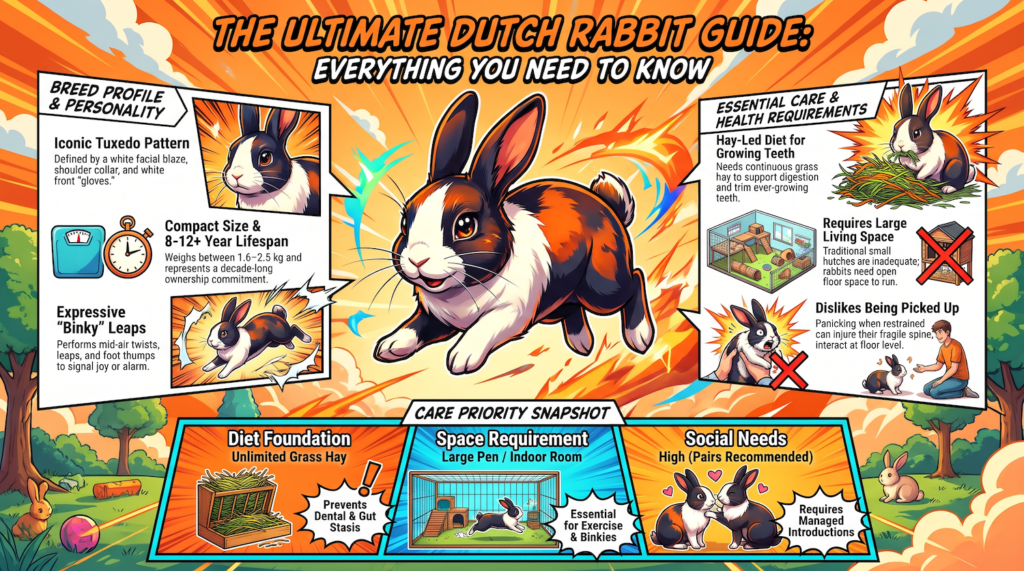
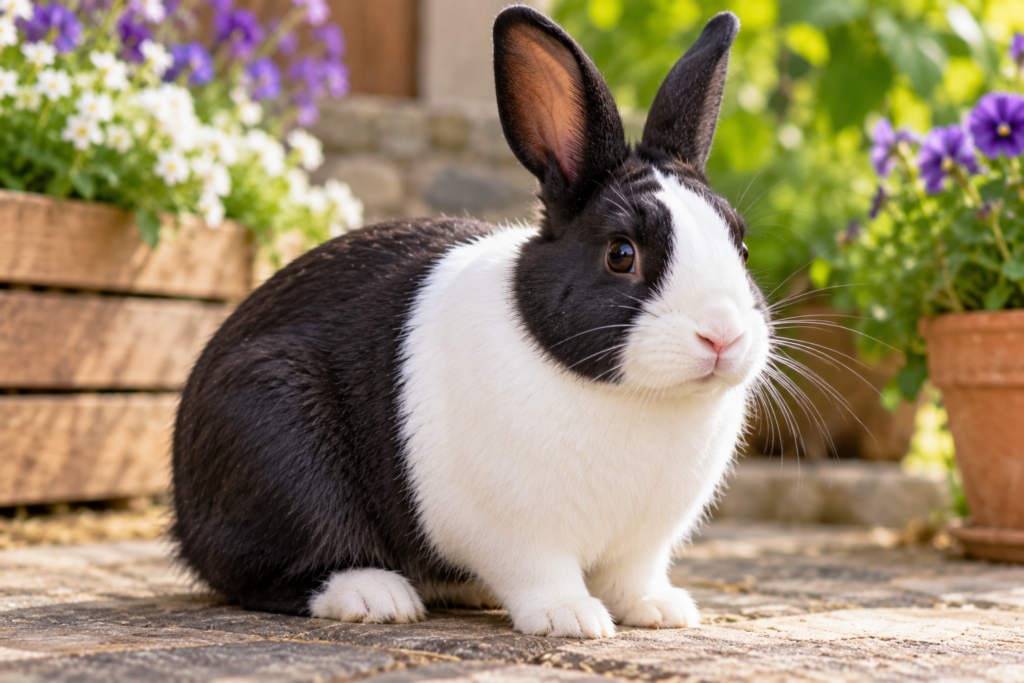







Charming, intelligent and instantly recognisable by its beautiful two-tone markings, the Dutch Rabbit is a friendly, playful companion famous for its gentle personality and distinctive appearance.
🧠 QUICK SNAPSHOT
Trait | Dutch Rabbit |
|---|---|
Scientific Name | Oryctolagus cuniculus domesticus |
Other Names | Dutch Bunny, Hollander Rabbit |
Pet Type | Domestic Rabbit / Small Mammal |
Natural Origin | Developed in England from European rabbit stock |
Typical Lifespan | Approximately 8–12 years |
Adult Size | Approximately 30–40 cm |
Adult Weight | Approximately 1.6–2.5 kg |
Coat Type | Short, smooth and dense |
Coat Colours | Black, blue, chocolate, grey, tortoise and other recognised colours with white markings |
Diet | Herbivore |
Activity | Primarily crepuscular |
Temperament | Friendly, curious, intelligent and playful |
Noise Level | Very quiet |
Social Needs | High; compatible rabbit companionship recommended |
Grooming | Low to moderate |
Housing | Spacious indoor or secure outdoor accommodation |
Exercise Needs | High; daily running and exploration |
Litter Training | Usually responds well to patient training |
Beginner Friendly? | Yes, with appropriate preparation |
Famous Feature | Distinctive white facial blaze, collar and front body markings |
📚 OVERVIEW
The Dutch Rabbit is one of the most recognisable domestic rabbit breeds, celebrated for its striking two-tone coat pattern and compact, well-proportioned body. Despite its name, the modern Dutch Rabbit was developed in England during the nineteenth century from rabbits associated with the Netherlands and Belgium.
Its distinctive markings include a white facial blaze, white chest and shoulders, and coloured hindquarters separated by a relatively sharp dividing line. The breed’s short, glossy coat requires less grooming than long-haired varieties.
Dutch Rabbits are often described as friendly, intelligent and curious. Many enjoy exploring their surroundings, interacting with familiar caregivers and learning simple behaviours through positive reinforcement.
Their care requires spacious housing, unlimited grass hay, compatible rabbit companionship, daily exercise and regular veterinary attention. Although their manageable size makes them appealing pets, they need the same commitment to welfare and enrichment as larger rabbit breeds.
✅ PROS & CONS
👍 Pros
Beautiful, distinctive coat markings
Generally friendly and sociable
Intelligent and responsive to training
Relatively easy coat maintenance
Compact, manageable size
Can learn to use a litter tray
Playful and entertaining personalities
Suitable for dedicated first-time rabbit owners
👎 Cons
Need considerable daily exercise
Require compatible rabbit companionship
May chew furniture and electrical cables
Often dislike being picked up
Vulnerable to digestive and dental problems
Require secure, spacious accommodation
Can become stressed by rough handling
Need long-term care and veterinary expenses
Are Dutch Rabbits Good Pets?
Yes. Dutch Rabbits can make excellent pets for individuals and families prepared to meet their needs.
They’re often friendly, curious and enjoyable to interact with.
However, they require appropriate companionship, spacious housing and daily opportunities to exercise.
Are Dutch Rabbits Good for Beginners?
Yes.
Dutch Rabbits are often recommended for first-time rabbit owners because of their manageable size, short coats and generally sociable personalities.
However, beginners must understand rabbit nutrition, handling, housing and veterinary requirements before bringing one home.
How Long Do Dutch Rabbits Live?
Dutch Rabbits typically live around 8–12 years.
Some individuals may live longer with excellent care.
Their lifespan depends on genetics, nutrition, housing, preventive healthcare and overall wellbeing.
How Big Do Dutch Rabbits Get?
Adult Dutch Rabbits generally measure approximately 30–40 cm in length.
They typically weigh around 1.6–2.5 kg.
Their compact, rounded bodies give them a distinctive and appealing appearance.
What Colours Do Dutch Rabbits Come In?
Dutch Rabbits are recognised in several colours, including black, blue, chocolate, grey and tortoise.
Some breed standards also recognise additional colour varieties.
Regardless of colour, their distinctive white-and-coloured coat pattern remains the breed’s defining characteristic.
Why Do Dutch Rabbits Have Such Distinctive Markings?
Their characteristic markings result from inherited coat-colour patterns refined through selective breeding.
The traditional Dutch pattern includes a white facial blaze, white shoulders and a sharply defined division between the white front body and coloured hindquarters.
Breeders have worked for generations to produce balanced, symmetrical markings.
Are Dutch Rabbits Friendly?
Many Dutch Rabbits have friendly, curious personalities.
They often become comfortable around familiar caregivers and enjoy investigating their surroundings.
However, temperament varies between individuals, and gentle socialisation is important.
Are Dutch Rabbits Affectionate?
Yes.
Some Dutch Rabbits show affection by approaching their caregivers, nudging for attention or resting nearby.
Others prefer exploring independently.
Their social behaviour is often subtle and best understood through body language.
Do Dutch Rabbits Bond With Their Owners?
Yes.
Dutch Rabbits can develop strong relationships with familiar people.
They may recognise voices, approach during feeding routines and seek gentle interaction.
Building trust requires patience, consistency and positive experiences.
Do Dutch Rabbits Like Being Held?
Most rabbits prefer keeping their feet on the ground.
Some Dutch Rabbits tolerate gentle handling, but many find being lifted stressful.
Always support the chest and hindquarters when lifting is necessary, and never pick a rabbit up by its ears.
Are Dutch Rabbits Good With Children?
Dutch Rabbits can be suitable family pets when children are taught to interact gently.
However, rabbits are delicate animals that can become frightened by loud noises or rough handling.
Adult supervision is essential, particularly with younger children.
Are Dutch Rabbits Intelligent?
Yes.
Dutch Rabbits can learn routines, recognise familiar people and respond to reward-based training.
Many can learn litter habits and simple behaviours.
Puzzle feeders, tunnels and foraging activities help provide mental stimulation.
Can Dutch Rabbits Be Litter Trained?
Yes.
Many Dutch Rabbits learn to use a litter tray with consistent training.
Providing a spacious tray containing suitable litter and nearby hay encourages natural toileting behaviour.
Desexing can also improve litter habits.
Do Dutch Rabbits Need Companions?
Yes.
Rabbits are highly social animals and generally benefit from living with a compatible rabbit companion.
A carefully bonded, desexed pair is often ideal.
Human interaction cannot fully replace normal rabbit-to-rabbit social behaviour.
Can Two Dutch Rabbits Live Together?
Yes.
Compatible Dutch Rabbits can live together successfully.
However, introductions should be gradual and supervised.
Desexing and providing adequate space help reduce territorial disputes and unwanted breeding.
Are Dutch Rabbits Aggressive?
Dutch Rabbits are generally considered gentle, but any rabbit can display defensive or territorial behaviour.
Aggression may occur when a rabbit feels frightened, threatened or uncomfortable.
Appropriate handling, sufficient space and desexing can help reduce behavioural problems.
What Size Enclosure Does a Dutch Rabbit Need?
Dutch Rabbits need spacious accommodation that allows running, hopping, stretching and standing upright.
A permanent living area of approximately 3 × 2 metres with adequate height is a useful welfare target for a compatible pair, with larger accommodation preferred.
Small hutches alone are unsuitable for their everyday needs.
Can Dutch Rabbits Live Indoors?
Yes.
Dutch Rabbits can make excellent indoor companions when provided with sufficient space.
Indoor housing offers protection from predators and extreme weather.
Electrical cables, toxic plants and other household hazards must be secured.
Can Dutch Rabbits Live Outside?
Yes, in suitable climates with carefully designed accommodation.
Outdoor housing must provide secure protection from predators, extreme temperatures, rain and strong winds.
Rabbits also require shaded areas, hiding places and sufficient space for exercise.
How Much Exercise Do Dutch Rabbits Need?
Dutch Rabbits need several hours of activity and exploration every day.
Ideally, they should have continuous access to a spacious, secure living area.
Running, jumping, digging and exploring are important for their physical and mental wellbeing.
What Do Dutch Rabbits Eat?
Dutch Rabbits are herbivores.
Their diet should consist primarily of unlimited good-quality grass hay, supplemented with suitable leafy greens and measured portions of rabbit pellets.
Fresh drinking water must always be available.
Can Dutch Rabbits Eat Carrots?
Yes, but only occasionally.
Carrots contain relatively high levels of sugar and should be treated as a small snack.
Hay and suitable leafy greens are much more important for daily nutrition.
Do Dutch Rabbits Shed?
Yes.
Dutch Rabbits shed throughout the year, with more noticeable coat changes during seasonal moults.
Their short coats are generally easy to maintain.
Regular brushing helps remove loose fur and reduces the amount swallowed during grooming.
How Often Should You Groom a Dutch Rabbit?
Most Dutch Rabbits benefit from brushing approximately once or twice weekly.
More frequent grooming may be necessary during heavy shedding.
Regular nail checks and inspections of the coat, skin and hindquarters are also important.
What Health Problems Are Common in Dutch Rabbits?
Potential concerns include dental disease, gastrointestinal stasis, obesity, respiratory infections and flystrike.
Like other rabbits, Dutch Rabbits can become seriously ill if they stop eating or producing droppings.
Prompt veterinary assessment is essential whenever unusual symptoms appear.
Should Dutch Rabbits Be Desexed?
Desexing is generally recommended for pet Dutch Rabbits unless there’s a specific veterinary reason not to proceed.
It prevents unwanted litters, can reduce hormone-related behaviours and significantly lowers the risk of uterine disease in females.
Consult a rabbit-experienced veterinarian about the appropriate age and procedure.
Are Dutch Rabbits Legal to Keep as Pets?
Dutch Rabbits are legal pets in many countries.
However, local regulations may restrict rabbit ownership or require particular housing and welfare standards.
In Australia, domestic rabbits are generally permitted in most states, but Queensland prohibits pet rabbits without specific authorisation.
What Makes the Dutch Rabbit Unique?
Imagine a rabbit that looks as though someone carefully painted half its body white and the other half a beautiful contrasting colour.
That’s the extraordinary Dutch Rabbit.
These charming animals possess one of the most recognisable coat patterns in the entire rabbit world.
Their distinctive markings aren’t random.
Generations of selective breeding have produced the classic Dutch pattern, featuring a white facial blaze, white shoulders and a sharply defined coloured section covering the hindquarters.
In exhibition breeding, the symmetry and placement of these markings are particularly important.
But perhaps the most surprising fact about the Dutch Rabbit is its name.
Despite being called Dutch, the modern breed was largely developed in England during the nineteenth century.
Its ancestry is associated with European rabbits imported from the Netherlands and Belgium, including animals known historically as Brabançon rabbits.
Another fascinating feature is its compact body shape.
Dutch Rabbits have relatively short, well-balanced bodies that give them a distinctive rounded appearance.
Their intelligence is equally impressive.
Like other domestic rabbits, they can learn routines, recognise familiar people and respond to positive reinforcement.
Some even learn to navigate simple obstacle courses or approach when called.
Dutch Rabbits also communicate through subtle body language.
A relaxed rabbit may stretch out comfortably, while an excited rabbit may leap into the air and twist its body in a joyful movement known as a binky.
And despite their neat, almost formal appearance, these rabbits can be surprisingly mischievous.
They enjoy investigating new objects, exploring tunnels and occasionally rearranging their surroundings.
Perhaps most importantly, their appealing size and appearance shouldn’t distract from their complex social and behavioural needs.
The Dutch Rabbit isn’t simply one of the prettiest rabbit breeds — it’s an intelligent, playful and fascinating companion with a distinctive history and one of the most recognisable coat patterns in the animal world.