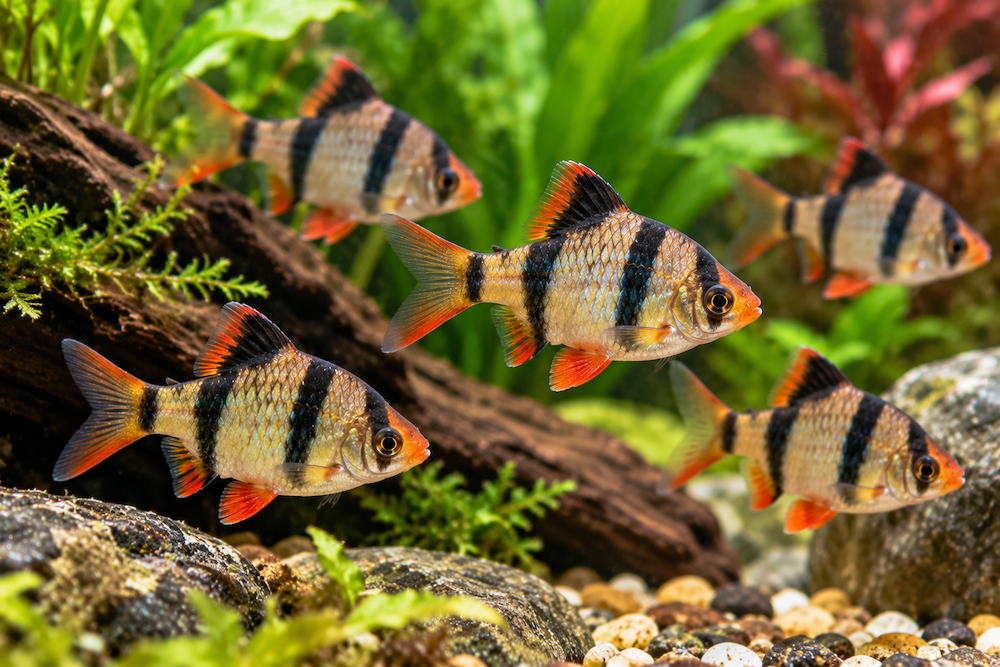







Colourful, energetic and endlessly entertaining, Barb Fish are lively freshwater aquarium favourites famous for their dazzling colours, playful schooling behaviour and constant movement.
🧠 QUICK SNAPSHOT
Trait | Barb Fish |
|---|---|
Scientific Classification | Various genera, including Puntigrus, Pethia and Barbodes |
Other Names | Barbs, Tiger Barbs, Cherry Barbs, Rosy Barbs, Gold Barbs |
Pet Type | Freshwater Aquarium Fish |
Natural Origin | Primarily Asia, with related barb groups in Africa |
Typical Lifespan | Approximately 4–8 years, depending on species |
Adult Size | Approximately 4–15 cm for many popular aquarium species |
Adult Weight | Varies by species; generally lightweight |
Colours | Red, orange, yellow, gold, green, silver, black and striped |
Diet | Primarily omnivorous |
Activity | Diurnal |
Temperament | Active, social and sometimes boisterous |
Noise Level | Silent |
Social Needs | High; most aquarium Barbs thrive in groups |
Water Temperature | Commonly 22–27°C, depending on species |
Water pH | Commonly 6.0–7.5, depending on species |
Tank Size | Approximately 75–120 litres for many smaller species; larger for active or bigger Barbs |
Breeding | Egg-scattering |
Grooming | No grooming required |
Exercise Needs | High; active swimming space essential |
Beginner Friendly? | Yes, depending on species |
Famous Feature | Colourful schooling behaviour and energetic personalities |
📚 OVERVIEW
The Barb Fish is a popular name for numerous freshwater fish belonging to the carp family, Cyprinidae. These colourful, energetic fish are particularly associated with rivers, streams and lakes throughout Asia, although related barb groups also occur in Africa.
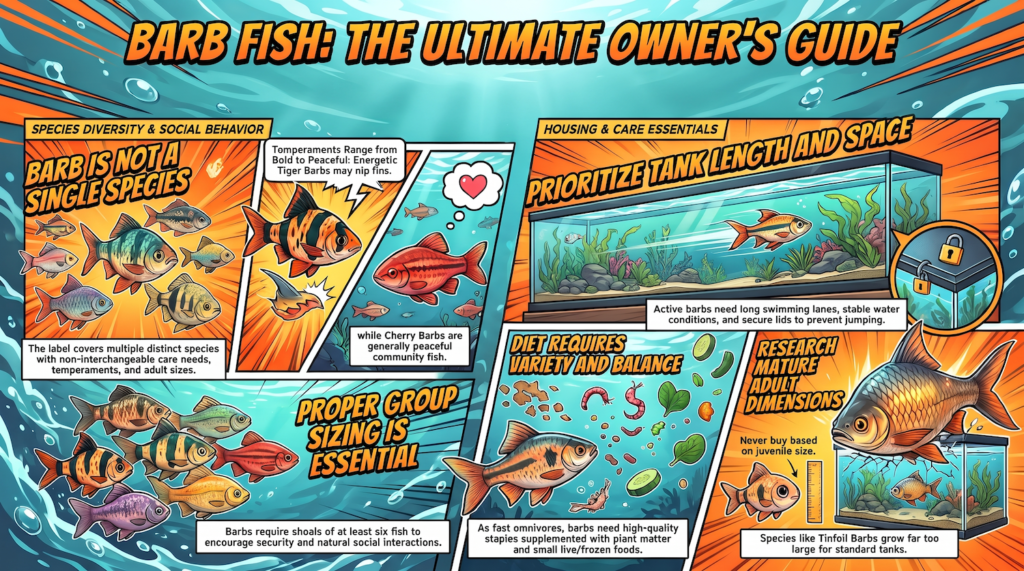
Popular aquarium varieties include Tiger Barbs, Cherry Barbs, Rosy Barbs, Gold Barbs and Odessa Barbs. Each species has distinctive colours, adult sizes and behavioural characteristics, making species selection particularly important.
Barbs are famous for their active swimming, social interactions and lively feeding behaviour. Many thrive in groups, where they establish social hierarchies and display fascinating schooling or shoaling behaviour.
Their care requires adequate swimming space, compatible companions, stable water quality, a balanced diet and carefully selected tankmates. Although many species are hardy and suitable for beginners, some are notorious for fin-nipping and can cause problems in peaceful community aquariums.
✅ PROS & CONS
👍 Pros
Beautiful colours and patterns
Extremely active and entertaining
Many species suitable for beginners
Fascinating group swimming behaviour
Generally straightforward feeding requirements
Wide variety of species available
Often hardy and adaptable
Excellent additions to suitable community aquariums
👎 Cons
Some species nip other fish’s fins
Require groups of compatible companions
Need plenty of swimming space
Can be boisterous during feeding
Some species become territorial
May stress slow-moving tankmates
Water requirements vary between species
Certain varieties grow larger than expected
Are Barb Fish Good Pets?
Yes. Barb Fish can make excellent aquarium pets for people who enjoy colourful, active freshwater fish.
Their energetic swimming and social behaviour make them particularly entertaining.
However, their suitability depends on the species and the aquarium’s existing inhabitants.
Are Barb Fish Good for Beginners?
Many Barb species are suitable for beginners.
Cherry Barbs, Gold Barbs and some other commonly kept varieties are generally hardy when provided with appropriate conditions.
However, beginners should research temperament and group requirements before purchasing.
How Long Do Barb Fish Live?
Many popular aquarium Barbs live approximately 4–8 years.
Some species may live longer with excellent care.
Lifespan depends on species, genetics, nutrition and aquarium conditions.
How Big Do Barb Fish Get?
Adult size varies considerably between species.
Cherry Barbs typically reach around 5 cm, while Tiger Barbs commonly grow to approximately 6–7 cm.
Larger varieties, including some Tinfoil Barbs, can exceed 30 cm and require substantially bigger aquariums.
What Are the Different Types of Barb Fish?
Popular aquarium varieties include:
Tiger Barb — bold black stripes and energetic behaviour
Cherry Barb — beautiful red colouring and relatively peaceful temperament
Rosy Barb — attractive pinkish-red colours and active swimming
Gold Barb — bright golden colouring and hardy nature
Odessa Barb — striking red markings in mature males
Denison Barb — streamlined body with distinctive red and black stripes
Tinfoil Barb — large, silver-bodied schooling fish
Each species has different adult sizes, environmental requirements and temperaments.
Are Barb Fish Aggressive?
Some Barb species can be aggressive or boisterous.
Tiger Barbs are particularly known for fin-nipping, especially when kept in insufficient numbers.
Other species, such as Cherry Barbs, are generally more peaceful.
Do Barb Fish Nip Fins?
Some do.
Tiger Barbs and certain other active species may nip the fins of slower-moving fish.
Keeping appropriate group sizes, providing adequate space and avoiding vulnerable tankmates can reduce this behaviour.
How Many Barb Fish Should Be Kept Together?
Most commonly kept Barbs should live in groups of at least six individuals, with larger groups often preferred.
Tiger Barbs frequently benefit from groups of eight to ten or more.
Appropriate group sizes encourage natural behaviour and may reduce aggression towards other fish.
Can Barb Fish Live Alone?
Most social Barb species shouldn’t be kept alone.
Solitary individuals may become stressed, withdrawn or unusually aggressive.
Keeping compatible groups helps support natural social behaviour.
Can Different Barb Species Live Together?
Yes, some species can coexist successfully.
However, compatibility depends on temperament, adult size, water requirements and swimming activity.
Peaceful Barbs may struggle when housed with particularly boisterous species.
Can Barb Fish Live With Guppies?
It depends on the Barb species.
Peaceful varieties may coexist with Guppies in suitable aquariums.
However, Tiger Barbs and other fin-nipping species can damage the long fins of male Guppies.
Can Barb Fish Live With Bettas?
Generally, fin-nipping Barbs aren’t suitable companions for Bettas.
A Betta’s long fins and relatively slow swimming can make it vulnerable to harassment.
Even peaceful Barb species require careful consideration before being housed with Bettas.
Can Barb Fish Live With Angelfish?
Some peaceful Barb species may coexist with Angelfish.
However, Tiger Barbs and other fin-nipping varieties are generally unsuitable.
Aquarium size, temperament and adult fish size must all be considered.
Are Barb Fish Schooling Fish?
Many Barbs are social fish that swim in groups.
Some form coordinated schools, while others spend more time in loose shoals.
Their group behaviour is one of their most entertaining characteristics.
Are Barb Fish Intelligent?
Barbs can learn feeding routines and respond to familiar environmental cues.
They also display social recognition, competition and group coordination.
Although their intelligence differs from that of mammals, their behaviour can be surprisingly complex.
What Size Tank Do Barb Fish Need?
Tank requirements depend on species and group size.
Many smaller Barbs benefit from aquariums around 75–120 litres or larger, with sufficient horizontal swimming space.
Highly active or large species require considerably bigger tanks.
What Water Temperature Do Barb Fish Need?
Many popular tropical Barbs thrive around 22–27°C.
However, some species prefer cooler or warmer conditions.
Rosy Barbs, for example, can tolerate cooler water than many tropical aquarium species.
What pH Do Barb Fish Prefer?
Many commonly kept Barbs do well in slightly acidic to neutral water, approximately pH 6.0–7.5.
However, requirements vary between species.
Stable water chemistry is generally more important than repeatedly adjusting pH.
Do Barb Fish Need Strong Filtration?
Yes.
Reliable filtration helps maintain healthy aquarium conditions.
Many Barb species also appreciate moderate water movement, although strong currents aren’t appropriate for every variety.
Regular water changes remain essential.
What Do Barb Fish Eat?
Most popular aquarium Barbs are omnivores.
They generally accept high-quality tropical flakes or micro-pellets, supplemented with suitable frozen, live or vegetable-based foods.
A varied diet supports healthy growth and colouring.
Can Barb Fish Eat Vegetables?
Yes.
Many omnivorous Barb species benefit from small amounts of suitable vegetable matter.
Spirulina-based foods and appropriately prepared vegetables can provide dietary variety.
However, their primary diet should remain nutritionally balanced.
Do Barb Fish Need Plants?
Live plants aren’t essential for every species, but they provide valuable enrichment.
Plants offer shelter, visual barriers and natural-looking surroundings.
A combination of planted areas and open swimming space is often ideal.
Why Are My Barb Fish Chasing Each Other?
Chasing can be normal social behaviour.
Barbs may chase one another while establishing hierarchies, competing for food or displaying courtship behaviour.
However, persistent harassment, injuries or exhausted fish may indicate inadequate space or incompatible stocking.
Why Are My Barb Fish Losing Colour?
Colour changes can occur because of stress, poor water quality, illness or social status.
Some Barbs also display more intense colours during courtship or breeding.
Sudden colour loss accompanied by unusual behaviour should prompt an aquarium health check.
How Do Barb Fish Breed?
Most commonly kept Barbs are egg-scattering fish.
During breeding, females release eggs that males fertilise externally.
Many species provide no parental care and may eat their own eggs.
What Health Problems Are Common in Barb Fish?
Potential concerns include white spot disease, bacterial infections, parasites, fin damage and stress-related illness.
Poor water quality and incompatible tankmates can contribute to health problems.
Stable aquarium conditions, appropriate nutrition and careful observation are important for prevention.
Are Barb Fish Legal to Keep as Pets?
Many Barb species are legal aquarium pets in numerous countries.
However, certain species may be restricted because of environmental or biosecurity concerns.
In Australia, importation and possession regulations vary by species, so local requirements should always be checked.
Never release aquarium fish into natural waterways.
What Makes the Barb Fish Unique?
Imagine an aquarium filled with flashes of brilliant red, shimmering gold and striking black stripes, all moving together in an energetic underwater display.
That’s the fascinating world of Barb Fish.
These remarkable freshwater fish belong to the carp family, one of the most successful and diverse groups of freshwater fish on Earth.
Their popularity comes from a combination of beautiful colouring, constant movement and surprisingly complex social behaviour.
Perhaps the most famous is the Tiger Barb.
With its bold black stripes, orange fins and energetic personality, this little fish has become one of the world’s most recognisable aquarium species.
But Barb Fish are far more diverse than many people realise.
The Cherry Barb displays beautiful red colouring, particularly in mature males during courtship.
The Odessa Barb can develop a spectacular red stripe running along its body.
And the Denison Barb, sometimes called the Red Line Torpedo Barb, combines a streamlined shape with dramatic red, black and yellow markings.
Their social behaviour is equally fascinating.
Many Barbs establish hierarchies within groups, engaging in chasing, displaying and other interactions that help organise their social relationships.
When maintained in appropriate numbers, these behaviours can create a constantly changing underwater spectacle.
Their breeding strategies are also interesting.
Unlike Cichlids, which often guard their offspring, many Barbs scatter their eggs among plants or other surfaces and provide little or no parental care.
Another surprising characteristic is their adaptability.
Different Barb species inhabit everything from relatively calm waterways to flowing streams and rivers.
Their body shapes, swimming abilities and feeding behaviours reflect these varied environments.
And despite their relatively small size, some species are remarkably energetic swimmers.
Watching a healthy group of Barbs explore a spacious aquarium can be like observing a miniature underwater community.
Barb Fish aren’t simply colourful aquarium decorations — they’re energetic, social and fascinating freshwater fish that bring movement, personality and spectacular natural behaviour to the aquarium world.