






Gentle, beautifully patterned and surprisingly easygoing, the Rosy Boa is a fascinating small constrictor famous for its distinctive stripes, calm temperament and remarkable adaptations to life in dry, rocky environments.
🧠 QUICK SNAPSHOT
Trait | Rosy Boa |
|---|---|
Scientific Name | Lichanura trivirgata (taxonomy varies among populations) |
Other Names | Coastal Rosy Boa, Desert Rosy Boa, Three-Lined Boa |
Pet Type | Reptile / Non-Venomous Snake |
Natural Origin | Southwestern United States and northwestern Mexico |
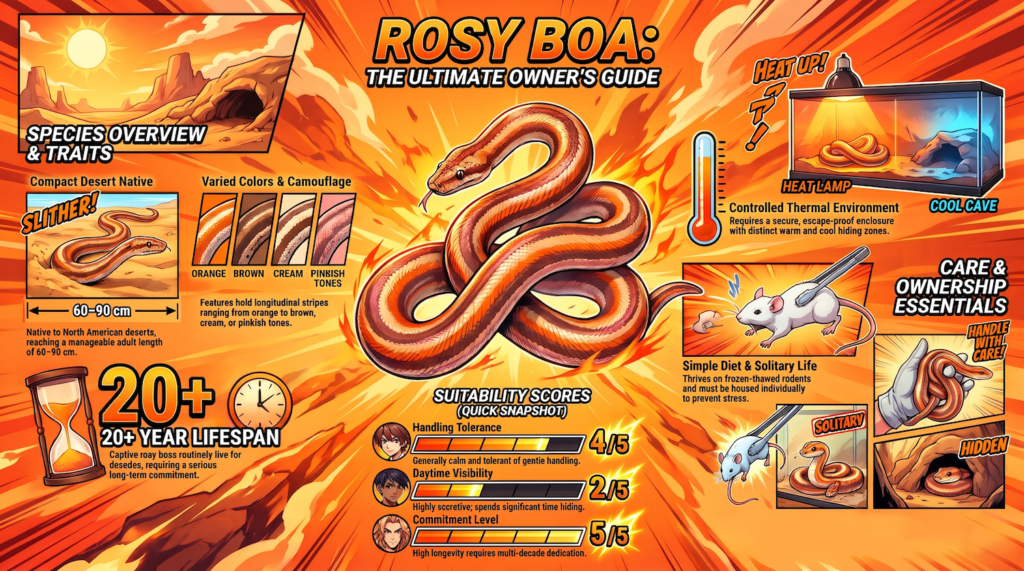
Typical Lifespan | Approximately 20–30 years in captivity |
Adult Size | Approximately 60–110 cm |
Adult Weight | Commonly around 150–500 g |
Colours | Cream, tan, brown, orange, pink, grey and reddish stripes |
Skin Type | Smooth, glossy scales |
Diet | Carnivore |
Activity | Primarily crepuscular and nocturnal, varying seasonally |
Temperament | Generally calm, secretive and slow-moving |
Noise Level | Silent |
Social Needs | Solitary |
Housing | Secure, well-ventilated terrestrial reptile enclosure |
Temperature | Warm side approximately 29–32°C; cooler retreat around 22–26°C |
Humidity | Generally low to moderate, with access to a humid hide when needed |
Grooming | No grooming required |
Exercise Needs | Moderate; benefits from exploration and climbing opportunities |
Beginner Friendly? | Yes, where legally permitted |
Famous Feature | Three distinctive longitudinal stripes and a naturally calm disposition |
📚 OVERVIEW
The Rosy Boa is a small, non-venomous constrictor native to the arid and semi-arid landscapes of southwestern North America. Found in parts of California, Arizona and northwestern Mexico, it inhabits rocky hillsides, desert scrublands and other environments offering secure shelter.
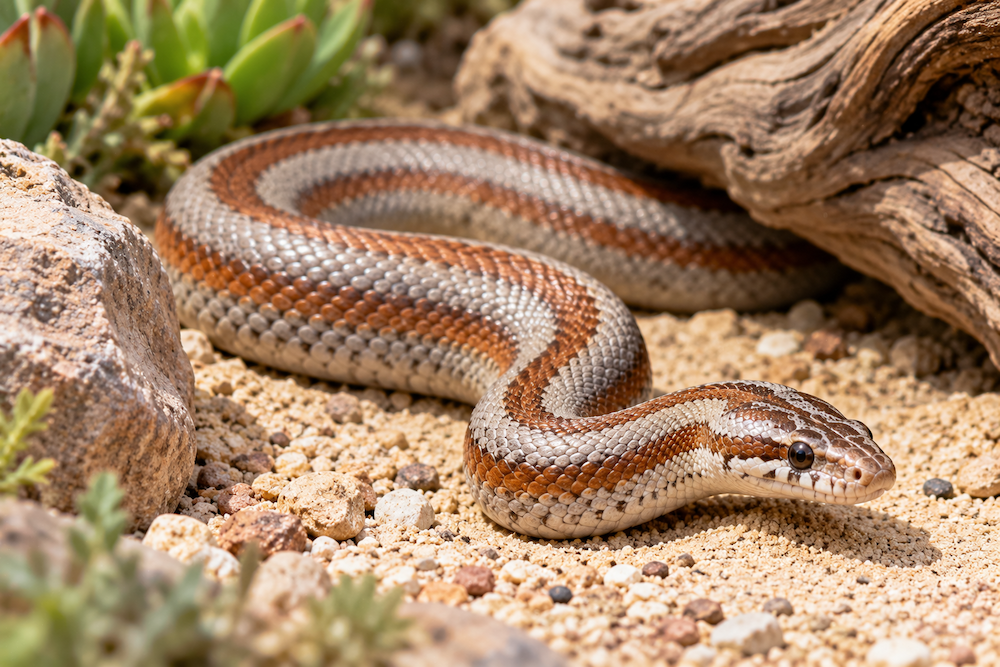
Rosy Boas are best known for their beautiful longitudinal stripes, which often run along the entire length of their bodies. Their colours vary considerably between geographical populations, ranging from soft cream and chocolate brown to striking orange, pink and reddish tones.
Unlike many fast-moving snakes, Rosy Boas are generally deliberate, secretive animals. They spend considerable time sheltering beneath rocks or within crevices, emerging to explore and hunt when environmental conditions are favourable.
Their care requires secure housing, an appropriate thermal gradient, suitable humidity, correctly sized prey and access to fresh water. Although often recommended for beginner reptile keepers, Rosy Boas are long-lived animals requiring specialised care and responsible ownership.
✅ PROS & CONS
👍 Pros
Generally calm and manageable temperament
Beautiful natural stripes and colour variations
Relatively small adult size
Usually straightforward feeding requirements
Quiet and unobtrusive
Often suitable for beginner reptile keepers
Fascinating desert adaptations
Long potential lifespan
👎 Cons
Ownership is restricted or prohibited in some regions
Require specialised heating and enclosure conditions
Can live for several decades
Skilled at escaping through small openings
Must be fed appropriately sized animal prey
Generally prefer solitary housing
May become stressed by excessive handling
Require access to reptile-experienced veterinary care
Are Rosy Boas Good Pets?
Yes. Rosy Boas can make excellent reptile pets for suitable owners in locations where they’re legal to keep.
Their manageable size, attractive appearance and generally calm temperament make them appealing to snake enthusiasts.
However, they require specialised housing, appropriate nutrition and a long-term commitment.
Are Rosy Boas Good for Beginners?
Yes.
Rosy Boas are often considered among the more approachable snakes for beginner reptile keepers.
Their relatively small size and generally calm disposition make them easier to manage than many larger constrictors.
However, beginners must understand heating, feeding, enclosure security and reptile health before obtaining one.
How Long Do Rosy Boas Live?
Rosy Boas commonly live approximately 20–30 years in captivity.
Some individuals may survive longer with excellent care.
Their longevity makes them a substantial commitment compared with many other small pets.
How Big Do Rosy Boas Get?
Most adult Rosy Boas measure approximately 60–110 cm in length.
Some populations remain relatively small, while others may grow slightly longer.
Females are often larger and heavier than males.
How Much Do Rosy Boas Weigh?
Adult Rosy Boas commonly weigh around 150–500 grams, although individuals may fall outside this range.
Weight depends on sex, age, geographical population and body condition.
A healthy Rosy Boa should have a well-rounded body without excessive fat deposits.
Are Rosy Boas Venomous?
No.
Rosy Boas are non-venomous snakes.
They subdue prey through constriction rather than venom.
Although they’re generally calm, they can still bite when frightened or confused by feeding cues.
Do Rosy Boas Bite?
Yes, although many Rosy Boas rarely bite when handled appropriately.
Defensive bites may occur if an animal feels threatened.
Some individuals also display enthusiastic feeding responses and may mistake fingers for food.
Gentle handling and good feeding practices help reduce these risks.
Are Rosy Boas Friendly?
Rosy Boas are often described as docile.
Many become accustomed to calm, predictable handling.
However, snakes don’t express affection in the same way as domestic mammals, and their tolerance for interaction varies individually.
Do Rosy Boas Like Being Handled?
Many Rosy Boas tolerate occasional gentle handling.
Their relatively slow movements can make them manageable for experienced, careful handlers.
However, handling should remain brief and stress-free, with the snake’s body fully supported.
Avoid handling during shedding or shortly after feeding.
Are Rosy Boas Aggressive?
Rosy Boas are generally not considered aggressive.
Most prefer retreating or remaining hidden when disturbed.
However, individual temperament varies, and any snake may respond defensively when frightened or restrained.
Are Rosy Boas Intelligent?
Rosy Boas can learn familiar environmental patterns and respond to feeding routines.
They use scent, touch and environmental information to navigate their surroundings.
Although reptile cognition differs from mammalian intelligence, snakes demonstrate meaningful learning and behavioural flexibility.
Are Rosy Boas Nocturnal?
Rosy Boas are often active during twilight and nighttime hours.
However, their activity varies with temperature, season and geographical location.
During cooler conditions, they may emerge during daylight to take advantage of suitable temperatures.
Do Rosy Boas Need Companions?
No.
Rosy Boas are naturally solitary animals.
They don’t require another snake for social companionship.
Individual housing is generally recommended to reduce stress, feeding competition and other management problems.
Can Two Rosy Boas Live Together?
Routine cohabitation isn’t recommended.
Although Rosy Boas may occasionally encounter one another in the wild, this doesn’t mean they benefit from permanent shared housing.
Separate enclosures allow better control of feeding, health monitoring and environmental conditions.
What Size Enclosure Does a Rosy Boa Need?
An adult Rosy Boa needs a secure enclosure large enough to stretch out, explore and move between different temperature zones.
A terrestrial enclosure around 90 × 45 × 45 cm may suit some smaller adults, while larger individuals benefit from additional floor space.
Ideally, the enclosure’s length should be at least equal to the snake’s total body length.
What Temperature Do Rosy Boas Need?
Rosy Boas require a thermal gradient that allows them to regulate their body temperature.
A warm area around 29–32°C and a cooler retreat around 22–26°C are commonly suitable starting points.
Heating equipment should be controlled by a thermostat, with temperatures checked using reliable thermometers.
Do Rosy Boas Need UVB Lighting?
Rosy Boas can survive without strong UVB lighting when their other husbandry needs are properly met.
However, appropriately provided low-level UVB may offer physiological benefits.
A regular day-night lighting cycle is also important.
Any UVB equipment should be selected and positioned according to reptile husbandry guidance.
What Humidity Do Rosy Boas Need?
Rosy Boas generally prefer relatively dry conditions.
Excessively damp environments may contribute to skin and respiratory problems.
However, they should have constant access to fresh water and a suitably humid hide when needed, particularly during shedding.
What Substrate Is Best for Rosy Boas?
Suitable substrates include reptile-safe aspen bedding, paper-based materials and carefully formulated arid reptile substrates.
The substrate should remain clean, dry and free from harmful dust or contaminants.
Avoid unsuitable loose materials that may cause injury or create hygiene problems.
Do Rosy Boas Need Hiding Places?
Yes.
Rosy Boas naturally shelter beneath rocks and within narrow crevices.
Providing secure hides on both the warm and cool sides of the enclosure helps reduce stress.
Additional cover, branches and appropriately secured rocks provide valuable environmental enrichment.
What Do Rosy Boas Eat?
Rosy Boas are carnivores.
In the wild, they primarily consume small mammals and may occasionally take other suitable vertebrate prey.
Captive Rosy Boas are commonly fed appropriately sized, commercially sourced frozen-thawed mice.
Prey size and feeding frequency should reflect the snake’s age and body condition.
How Often Should Rosy Boas Be Fed?
Young Rosy Boas generally require more frequent feeding than adults.
Adults may be fed approximately every 10–21 days, depending on prey size, metabolism and body condition.
Overfeeding should be avoided because captive snakes can become overweight.
Why Is My Rosy Boa Refusing Food?
Rosy Boas may temporarily refuse food because of shedding, seasonal changes, stress or unsuitable enclosure conditions.
Some individuals naturally reduce their feeding activity during cooler periods.
However, prolonged refusal accompanied by weight loss or unusual behaviour requires veterinary assessment.
How Often Do Rosy Boas Shed?
Shedding frequency depends on age, growth and individual condition.
Young Rosy Boas generally shed more frequently than adults.
A healthy shed should come away completely, including the transparent scales covering the eyes.
Retained skin may indicate environmental or health problems.
What Health Problems Are Common in Rosy Boas?
Potential concerns include respiratory infections, mites, retained shed, burns, obesity and digestive problems.
Poor temperature control, inappropriate humidity and inadequate hygiene can contribute to illness.
Regular observation and access to a reptile-experienced veterinarian are essential.
Are Rosy Boas Legal to Keep as Pets?
Rosy Boa ownership laws vary between countries and jurisdictions.
Some regions permit captive-bred animals, while others restrict their importation, sale or possession.
In Australia, Rosy Boas are not generally available for ordinary private pet ownership because of strict exotic reptile importation and possession controls.
Prospective owners should verify current regulations before considering acquisition.
What Makes the Rosy Boa Unique?
Imagine a beautifully striped snake moving slowly through a rocky desert landscape, slipping into narrow crevices and emerging after sunset to search for prey.
That’s the remarkable Rosy Boa.
These fascinating little constrictors possess several unusual characteristics that distinguish them from many other snakes.
Perhaps their most recognisable feature is their beautiful striped appearance.
Most Rosy Boas display three longitudinal stripes running along their bodies, creating a distinctive pattern that varies considerably between geographical populations.
Some have rich chocolate-brown stripes against creamy backgrounds.
Others display spectacular orange, reddish or pinkish tones.
Their common name is associated with the rosy colouring visible in some individuals, particularly along their undersides.
But their adaptations go far beyond appearance.
Rosy Boas inhabit dry, rocky landscapes where shelter and water can be difficult to find.
Their compact bodies and smooth scales help them move through narrow spaces beneath rocks and within crevices.
Unlike many highly active snakes, Rosy Boas often conserve energy by remaining concealed during unfavourable conditions.
They emerge when temperatures are suitable, using their keen chemical senses to locate prey.
Another fascinating characteristic is their hunting technique.
Rosy Boas are non-venomous constrictors, using their muscular bodies to restrain small mammals before swallowing them whole.
They also possess specialised jaw structures that allow them to consume prey wider than their heads.
Their reproductive biology is equally interesting.
Unlike many snakes that lay eggs, Rosy Boas give birth to live young.
Females typically produce relatively small litters, with newborn snakes already capable of independent survival.
And despite their association with hot desert environments, Rosy Boas don’t simply seek constant warmth.
They carefully regulate their body temperatures by moving between warm and cool locations.
Perhaps most surprising is their longevity.
A snake measuring less than a metre may live for two or three decades under appropriate captive conditions.
The Rosy Boa isn’t simply a beautiful little snake — it’s a remarkable desert survivor with extraordinary camouflage, specialised hunting abilities and one of the most appealing temperaments among small constrictors.