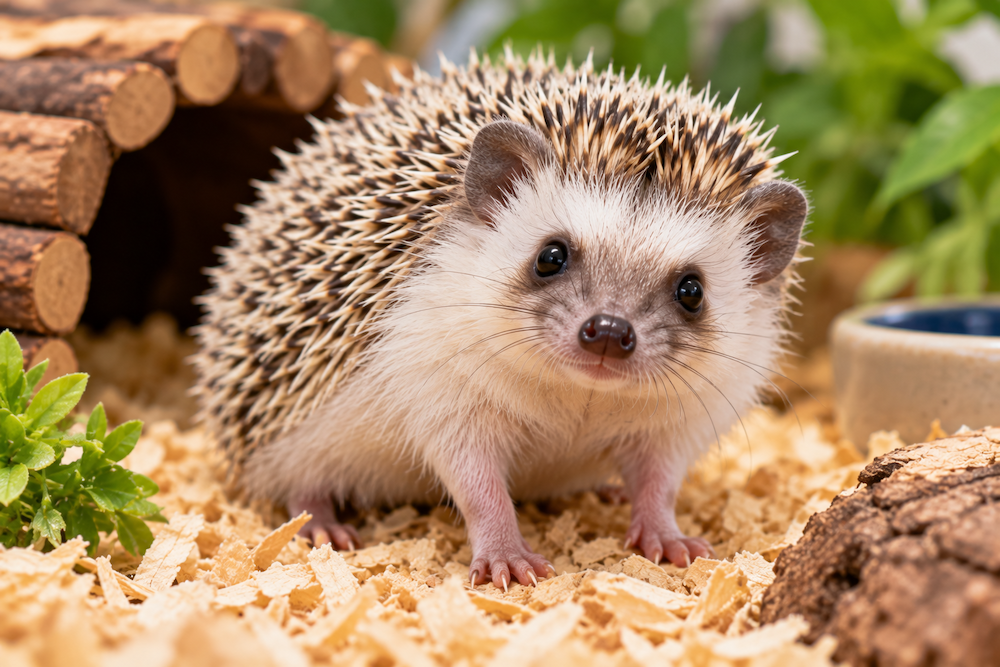







Tiny, spiky and irresistibly curious, the African Pygmy Hedgehog is an unusual exotic pet with fascinating behaviours
🧠 QUICK SNAPSHOT
| Trait | African Pygmy Hedgehog |
|---|---|
| Scientific Background | Domestic hedgehogs commonly associated with Atelerix albiventris and related African hedgehog ancestry |
| Pet Type | Small mammal / Exotic pet |
| Origin | African ancestry; captive-bred pet populations |
| Typical Lifespan | Around 3–6 years |
| Adult Size | Roughly 15–25 cm |
| Typical Weight | Approximately 250–600 g |
| Diet | Primarily insectivorous/omnivorous |
| Activity | Nocturnal |
| Temperament | Solitary, curious and sometimes shy |
| Housing | Secure enclosure with substantial floor space |
| Temperature | Requires consistently warm conditions |
| Social Needs | Generally housed alone |
| Handling | Can become accustomed to gentle handling |
| Beginner Friendly? | Moderate — specialised care required |
📚 OVERVIEW
The African Pygmy Hedgehog is one of the most distinctive small pets in the world.
Instead of fur covering its back, it carries thousands of modified hairs forming protective spines. When frightened, powerful muscles allow it to curl tightly into a prickly ball, hiding its vulnerable face and underside.
Yet underneath all that defensive equipment is a small, inquisitive mammal with an extraordinary nose and a strong desire to explore.
Pet African Pygmy Hedgehogs are commonly associated with the four-toed hedgehog (Atelerix albiventris), although the ancestry of captive populations can be more complicated than the simple “breed” name suggests.
They’re generally solitary animals and are usually kept individually rather than in pairs. They’re also nocturnal, which means that while their owner is getting ready for bed, the hedgehog may just be preparing for several hours of serious activity.
A suitable exercise wheel is therefore an important part of the enclosure.
Perhaps the most unusual hedgehog behaviour is self-anointing. When encountering an interesting new smell or taste, a hedgehog may produce frothy saliva, contort its body and spread the foam across its spines.
It looks alarming the first time you see it.
For a hedgehog, however, it’s normal behaviour.
African Pygmy Hedgehogs aren’t effortless pets. They require appropriate warmth, specialised nutrition, exercise, careful handling and access to a veterinarian experienced with exotic mammals.
They’re also illegal or restricted as pets in some locations.
For the right owner, however, this little nocturnal animal offers an extraordinary glimpse into a very different kind of companion pet.
✅ PROS & CONS
Pros
- Fascinating and unusual appearance
- Generally quiet
- Usually housed individually
- Doesn’t require outdoor walks
- Can become accustomed to gentle handling
- Interesting natural behaviours
- Relatively small
- Doesn’t need a companion hedgehog
- Can be entertaining to watch exploring
- Suitable for owners who enjoy nocturnal animals
- Huge personality packed inside a very small, very spiky body
Cons
- Primarily nocturnal
- Requires consistently appropriate temperatures
- Can become stressed or unwell if kept too cold
- Needs substantial exercise despite its small size
- Requires specialised nutrition
- Exotic veterinary care may be difficult to find
- May initially curl up, hiss or resist handling
- Shorter lifespan than many traditional pets
- Health problems can be significant
- Not legal to own everywhere
- Doesn’t generally provide the same social interaction as a rat, ferret, dog or cat
- Exercise wheels can become spectacularly messy overnight
Are African Pygmy Hedgehogs Good Pets?
They can be excellent pets for the right person.
African Pygmy Hedgehogs are fascinating, relatively quiet and don’t require same-species companionship.
However, they’re specialised exotic pets, and owners need to understand their temperature, dietary, exercise and veterinary requirements.
Are African Pygmy Hedgehogs Good Pets for Beginners?
They’re possible for committed beginners, but they’re not among the easiest small pets.
Maintaining the correct environment and finding appropriate veterinary care requires more preparation than keeping many traditional companion animals.
A prospective owner should have the enclosure completely prepared before bringing the hedgehog home.
Are African Pygmy Hedgehogs Good With Children?
They may suit responsible older children when an adult remains responsible for their care.
Their spines can make handling intimidating, and frightened hedgehogs may curl tightly into a ball.
They’re also nocturnal, meaning their natural activity period doesn’t necessarily match a young child’s schedule.
How Long Do African Pygmy Hedgehogs Live?
African Pygmy Hedgehogs commonly live around 3–6 years, although individual lifespan varies.
Genetics, nutrition, body weight, environment and veterinary care can all influence longevity.
How Big Do African Pygmy Hedgehogs Get?
Adults are commonly around 15–25 cm long and may weigh approximately 250–600 grams.
Individual size varies considerably.
They’re compact animals, but their small body size shouldn’t be confused with needing only a tiny enclosure.
Are African Pygmy Hedgehogs Nocturnal?
Yes. African Pygmy Hedgehogs are primarily nocturnal.
They commonly spend much of the daylight period sleeping and become active during the evening and overnight.
Trying to force a hedgehog into a daytime human schedule can interfere with its natural behaviour.
Do African Pygmy Hedgehogs Sleep All Day?
They commonly sleep through much of the day.
A secure, dark sleeping area should therefore be available inside the enclosure.
As evening approaches, the hedgehog may wake to eat, explore and exercise.
What Size Enclosure Does an African Pygmy Hedgehog Need?
Hedgehogs need substantially more floor space than their tiny size might suggest.
A large enclosure with plenty of uninterrupted horizontal space allows natural exploration and provides room for a suitable exercise wheel, sleeping hide, food and water.
More usable space is generally preferable to a tiny cage.
Do African Pygmy Hedgehogs Need a Heat Lamp?
African Pygmy Hedgehogs need a consistently warm environment, but the safest heating method depends on the enclosure and climate.
Any heat source should be thermostatically controlled and arranged so the animal can’t burn itself.
Heating equipment should be chosen based on reliable temperature measurements rather than guesswork.
What Temperature Does an African Pygmy Hedgehog Need?
Pet African Pygmy Hedgehogs generally require temperatures in approximately the low-to-mid 20s°C, often around 23–27°C.
Sudden or prolonged chilling can cause serious problems.
A reliable thermostat and thermometer are therefore important parts of the setup.
Do African Pygmy Hedgehogs Hibernate?
African Pygmy Hedgehogs shouldn’t be encouraged to hibernate in captivity.
If conditions become too cold, a pet hedgehog may attempt to enter a torpor-like state, which can be dangerous.
Unusual coldness, lethargy or unresponsiveness should be taken seriously.
Do African Pygmy Hedgehogs Need an Exercise Wheel?
Yes. A suitable solid-surface exercise wheel is one of the most important pieces of enrichment for a pet hedgehog.
Hedgehogs can travel surprisingly large distances during their active period.
Wire or mesh running surfaces should be avoided because feet and legs can become injured.
How Far Can a Hedgehog Run at Night?
Hedgehogs can be remarkably active overnight and may cover substantial distances while exploring.
Captive hedgehogs can consequently spend long periods running on their wheels.
Their impressive activity level is one reason adequate exercise opportunities are essential despite their small size.
What Do African Pygmy Hedgehogs Eat?
African Pygmy Hedgehogs require a balanced diet containing appropriate animal-based protein, with insects often used as part of dietary variety and enrichment.
Their exact nutritional needs shouldn’t be reduced to simply feeding unlimited insects.
A veterinarian or knowledgeable exotic-animal professional can help establish an appropriate diet.
Can African Pygmy Hedgehogs Eat Insects?
Yes. Insects can form a useful part of a hedgehog’s diet and provide natural foraging enrichment.
Appropriate feeder insects may include options such as crickets and certain larvae.
Very fatty insects should generally be treated as occasional foods rather than becoming the entire diet.
Do African Pygmy Hedgehogs Drink Water?
Yes.
Fresh, clean water should always be available.
A stable shallow bowl is often straightforward, although whatever system is used should be checked regularly to ensure the hedgehog can access water reliably.
Are African Pygmy Hedgehogs Affectionate?
Some become comfortable and relaxed with their owners, but they’re not typically affectionate in the same way as dogs or highly social pet rats.
A well-socialised hedgehog may willingly explore its owner’s hands or lap and remain relaxed during handling.
Individual personalities vary considerably.
Do African Pygmy Hedgehogs Like Being Held?
Some learn to tolerate or enjoy gentle handling, while others remain more independent.
Young hedgehogs that receive calm, regular and positive handling may become increasingly confident around people.
Handling should occur on the hedgehog’s terms rather than forcing it to uncurl.
Do Hedgehog Spines Hurt?
They can feel surprisingly sharp, particularly when the hedgehog is frightened and raises its spines.
When relaxed, the spines lie flatter and handling usually becomes considerably easier.
Unlike porcupine quills, hedgehog spines aren’t designed to detach and embed themselves in an attacker.
Can African Pygmy Hedgehogs Shoot Their Spines?
No.
Hedgehogs cannot shoot their spines.
When threatened, they raise the spines and can curl into a tight ball, creating a formidable protective barrier.
The idea of projectile spines belongs firmly in the world of animal myths.
Why Do Hedgehogs Curl Into a Ball?
Curling into a ball is an important defence mechanism.
Specialised muscles allow the hedgehog to pull its head, legs and vulnerable underside inward while presenting a surface covered almost entirely with spines.
It’s remarkably effective protection for such a small mammal.
Why Does My Hedgehog Hiss?
Hissing, clicking or puffing can indicate that a hedgehog feels frightened, defensive or disturbed.
A newly acquired hedgehog may initially respond this way during handling.
Patience and consistent gentle interaction can help some individuals become more relaxed.
What Is Hedgehog Self-Anointing?
Self-anointing is one of the strangest normal hedgehog behaviours.
After encountering an interesting smell or taste, a hedgehog may lick or chew the object, produce frothy saliva and spread that saliva over its spines.
Scientists have proposed several explanations for the behaviour, but its precise function isn’t completely settled.
Why Is My Hedgehog Foaming at the Mouth?
If the hedgehog has just encountered an interesting new smell or taste and begins twisting around to spread frothy saliva onto its spines, it’s probably self-anointing.
This can look alarming to first-time owners but is normal hedgehog behaviour.
Foaming accompanied by signs of illness should, of course, be treated differently.
Do African Pygmy Hedgehogs Smell?
The animals themselves aren’t generally extremely smelly when healthy and appropriately housed.
Their enclosure can develop significant odour if waste isn’t removed regularly.
Because hedgehogs may toilet while running, the exercise wheel often requires particularly frequent cleaning.
Can You Toilet Train an African Pygmy Hedgehog?
Some hedgehogs develop preferred toilet areas, and owners may be able to encourage this behaviour.
However, toilet training isn’t always reliable.
Many hedgehogs have the charming habit of simultaneously running and going to the toilet on their exercise wheel.
Do African Pygmy Hedgehogs Need Baths?
Routine full bathing generally isn’t necessary unless the hedgehog becomes dirty.
Their feet may occasionally need cleaning, particularly after enthusiastic nighttime wheel use.
Excessive bathing can dry the skin, so it shouldn’t become an unnecessary daily routine.
Can African Pygmy Hedgehogs Live Together?
They’re generally best housed individually.
Unlike rats and some other small mammals, hedgehogs don’t require same-species companionship to thrive.
Housing adults together can lead to stress, fighting or unintended breeding.
Can African Pygmy Hedgehogs Live With Other Pets?
Direct interaction with dogs, cats or other pets isn’t necessary and can create risks.
Even a friendly larger animal can accidentally injure a hedgehog.
The safest approach is usually to give the hedgehog its own secure environment.
Do African Pygmy Hedgehogs Bite?
They can, but biting isn’t usually their primary defence.
A frightened hedgehog is more likely to raise its spines and curl up.
Biting can occur if the animal is stressed, mishandled or attracted to food smells on someone’s fingers.
Are African Pygmy Hedgehogs Smart?
Hedgehogs can learn routines, familiar smells and associations, although they aren’t generally considered as trainable as rats or ferrets.
Their intelligence is often most obvious in exploration and foraging behaviour.
Providing changing enrichment gives them opportunities to investigate and problem-solve.
What Health Problems Are Common in African Pygmy Hedgehogs?
Potential health concerns include dental disease, obesity, skin problems, mites, tumours and neurological disease, among others.
One particularly well-known condition is Wobbly Hedgehog Syndrome.
Regular veterinary checks and prompt investigation of behavioural or physical changes are important.
What Is Wobbly Hedgehog Syndrome?
Wobbly Hedgehog Syndrome is a serious progressive neurological condition reported in African Pygmy Hedgehogs.
Affected animals can develop increasing weakness, instability and difficulty moving.
There is currently no simple cure, and veterinary assessment is essential because other illnesses can produce similar symptoms.
Why Is My African Pygmy Hedgehog Losing Spines?
Young hedgehogs naturally go through periods known as quilling, during which juvenile spines are replaced as they grow.
However, excessive spine loss can also be associated with mites, skin disease, nutritional problems or other conditions.
Unexplained or extensive spine loss warrants veterinary assessment.
What Colours Do African Pygmy Hedgehogs Come In?
Captive breeding has produced African Pygmy Hedgehogs in numerous colour variations.
These include differences in spine colour, facial markings and overall pigmentation, ranging from darker animals through lighter cinnamon-like shades and very pale forms.
They’re colour varieties rather than separate hedgehog species.
Is an African Pygmy Hedgehog the Same as a European Hedgehog?
No.
African Pygmy Hedgehogs kept as pets are different from the wild European hedgehogs commonly seen in parts of Europe.
European hedgehogs are larger wild animals and shouldn’t simply be captured and converted into household pets.
Where Do African Pygmy Hedgehogs Come From?
The domestic African Pygmy Hedgehog has ancestry in African hedgehog species, particularly the four-toed hedgehog.
Its wild relatives inhabit parts of central, eastern and western Africa.
Modern pet populations have been selectively bred in captivity.
Are African Pygmy Hedgehogs Legal to Own?
That depends entirely on location.
Hedgehog ownership is illegal or restricted in some countries, states and regions because of wildlife, biosecurity or exotic-animal regulations.
Prospective owners should check current local laws before obtaining one.
Is an African Pygmy Hedgehog a Good First Pet?
It can be for someone who specifically wants a hedgehog and has researched its needs.
But there are easier first pets.
African Pygmy Hedgehogs require temperature control, appropriate nutrition, substantial nighttime exercise and access to exotic veterinary care.
And if you want a pet that eagerly waits all day for you to come home and play, remember one important detail:
Your hedgehog may be asleep.
What Makes the African Pygmy Hedgehog Unique?
The African Pygmy Hedgehog has developed an extraordinary solution to being a small animal in a dangerous world.
When trouble appears, it can effectively turn itself into a ball of spikes.
That’s impressive enough.
Then you discover the rest.
It can spend much of the day sleeping before waking at night and running extraordinary distances on its wheel.
It may encounter an interesting smell, create a mouthful of foam, twist itself into a position that appears anatomically impossible and spread the froth across its own spines.
That’s self-anointing.
Nobody warned the first-time hedgehog owner about that.
And despite carrying several thousand sharp defensive spines, a well-socialised hedgehog can learn that the enormous human approaching its enclosure isn’t a predator and calmly begin exploring their hands.
It’s not quite a hamster.
It’s certainly not a tiny porcupine.
And it’s definitely not a conventional cuddly pet.
It’s a nocturnal, insect-hunting, self-anointing little ball of spikes — which is precisely why people find it so fascinating.
Discover why hedgehogs self-anoint, how their remarkable spines work, why they run so much at night and what it’s really like to care for one of these unusual little mammals.
Watch our African Pygmy Hedgehog video and discover what makes this tiny exotic pet so extraordinary.