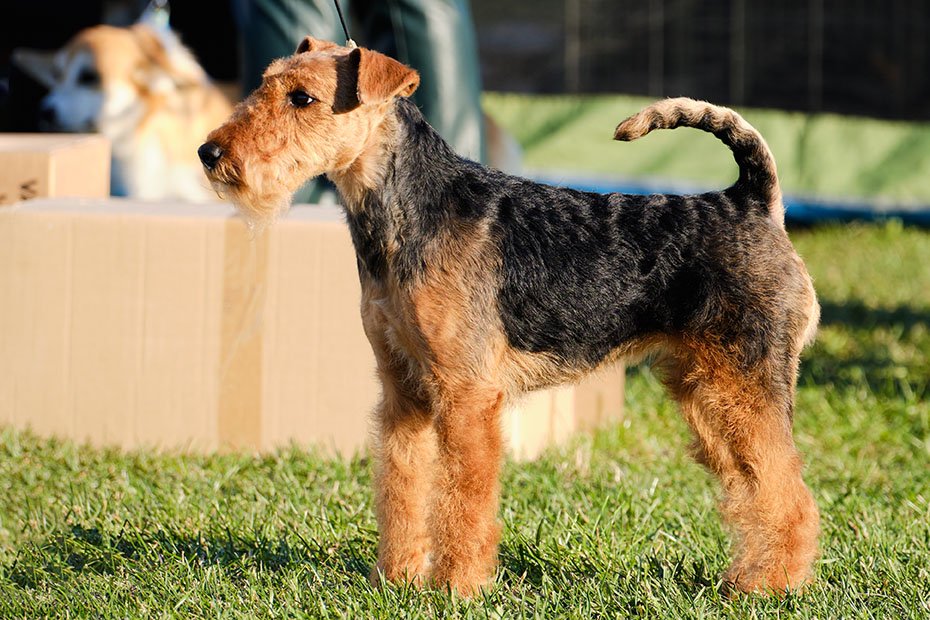







Confident, intelligent, and full of character — the “King of Terriers” with energy to match.
🧠 QUICK SNAPSHOT
- Temperament: Confident, intelligent, outgoing
- Energy Level: High
- Size: Medium to large
- Good With Families: Yes
- Trainability: Moderate to high
- Grooming: Moderate
- Best For: Active families and engaged owners
📚 OVERVIEW
The Airedale Terrier is the largest of the terrier breeds, known for its strong personality and versatility. Originally bred for hunting and working roles, they are energetic, alert, and highly capable.
They are loyal companions that thrive when given structure, activity, and attention.
✅ PROS & CONS
Pros
- Intelligent and versatile
- Loyal and protective
- Energetic and playful
- Strong, athletic build
Cons
- High exercise requirements
- Can be stubborn
- Needs consistent training
- Requires mental stimulation
Is an Airedale Terrier a Good Family Dog?
Yes, an Airedale Terrier can be an excellent family dog, particularly for active households prepared to provide consistent training and plenty of involvement.
Airedales are typically confident, playful and strongly attached to their families. Many retain an almost puppy-like sense of humour well into adulthood.
They can be very good with respectful children, although their size and exuberance mean supervision is sensible around younger kids.
This isn’t usually a quiet dog content to watch family life from the corner. Airedales like to participate.
For families wanting an intelligent, energetic dog with a lot of personality, the Airedale can be an outstanding companion.
How Much Exercise Does an Airedale Terrier Need?
An adult Airedale Terrier generally needs around one to two hours of physical activity each day, along with regular mental stimulation.
Walking, hiking, retrieving, scent work, obedience and dog sports can all help channel the breed’s considerable energy.
A secure area where the dog can run and play is particularly useful.
Mental exercise matters because Airedales are intelligent problem-solvers. A physically tired dog can still become bored if its brain has nothing interesting to do.
Exercise should be appropriate for age, especially while puppies are developing.
The Airedale isn’t the most hyperactive dog in existence, but it was built for considerably more than a ten-minute walk followed by an entire day on the sofa.
Is an Airedale Terrier Easy to Train?
Airedales are highly intelligent and capable of learning quickly, but their independent terrier personality can make training challenging for inexperienced owners.
They often understand new commands rapidly.
The more interesting question is whether they agree that repeating the same exercise for the twentieth time serves any useful purpose.
Positive reinforcement, variety and short, engaging sessions usually work best.
Harsh training can create conflict without producing genuine cooperation.
Recall training is particularly important because Airedales can have a strong prey drive.
The breed’s intelligence is one of its greatest qualities.
It’s also why an Airedale can occasionally look at a perfectly reasonable command and appear to think:
“I’ve considered your proposal.”
Does an Airedale Terrier Shed?
Yes, but Airedales are generally considered relatively low-shedding dogs.
They have a dense, wiry double coat consisting of a harsh outer layer and softer undercoat.
Regular brushing helps prevent tangles and removes loose hair.
The coat also needs periodic trimming or clipping.
Traditional show-coat maintenance involves hand stripping, where dead outer hairs are removed manually to preserve the coat’s characteristic texture and colour.
Pet Airedales are often professionally clipped instead, which is easier but can gradually soften the coat.
Airedales aren’t guaranteed to be hypoallergenic. People with dog allergies can still react to proteins found in dander and saliva.
Low shedding doesn’t mean no grooming.
What Health Problems Are Common in Airedale Terriers?
Airedales are generally robust dogs, but several health conditions occur within the breed.
Hip dysplasia is an important concern and can contribute to pain and arthritis.
Eye disorders can occur, making appropriate ophthalmic screening valuable in breeding dogs.
Hypothyroidism is also reported within the breed.
As a deep-chested dog, the Airedale may be at risk of gastric dilatation-volvulus (GDV or bloat), a potentially fatal emergency in which the stomach expands and can twist.
Skin problems and allergies can occur in some individuals.
Responsible breeders should screen breeding dogs for relevant inherited conditions and provide prospective owners with documented results.
How Long Do Airedale Terriers Live?
Airedale Terriers generally live around 11–14 years, although individual lifespan varies.
Good nutrition, appropriate exercise, maintaining a healthy weight, dental care and routine veterinary attention can all contribute to healthy ageing.
Because Airedales tend to remain enthusiastic and playful, owners sometimes forget that an older dog may need adjustments to exercise intensity.
Mental stimulation remains valuable throughout life.
One of the joys of the breed is that even a senior Airedale can retain enough terrier personality to convince you that growing old and growing sensible are entirely separate processes.
How Big Does an Airedale Terrier Get?
The Airedale is the largest of the terrier breeds, which explains its famous nickname: “King of Terriers.”
Adult males commonly stand around 58–61 cm at the shoulder, with females generally slightly smaller.
Weight often falls around 18–30 kg, although build and breed lines vary.
The breed should appear athletic and powerful rather than excessively heavy.
Its long legs and substantial body make the Airedale considerably larger than terriers such as the Jack Russell, Scottish Terrier or West Highland White Terrier.
If your mental picture of a terrier is a small dog you can tuck under one arm, the Airedale is here to correct that assumption rather decisively.
Are Airedale Terriers Aggressive?
A well-bred Airedale Terrier should be confident and courageous rather than indiscriminately aggressive.
Historically, Airedales performed demanding jobs requiring determination and independence, and many retain strong protective and territorial instincts.
Early socialisation is therefore important.
They should learn to remain calm around unfamiliar people, dogs, environments and everyday situations.
Some individuals can be assertive with other dogs, particularly without appropriate socialisation.
Their hunting heritage can also produce strong reactions toward smaller animals.
Owners shouldn’t deliberately encourage aggression in an attempt to create a better guard dog.
The Airedale already possesses plenty of confidence.
What it needs from its owner is judgement and control.
Are Airedale Terriers Good With Other Dogs?
Airedales can live successfully with other dogs, particularly when properly socialised and introduced.
However, they’re confident terriers and some individuals can be assertive or unwilling to back down from confrontation.
Early positive experiences with different dogs can help develop appropriate social behaviour.
Dog parks aren’t necessarily the ideal environment for every Airedale, particularly if interactions are uncontrolled.
Compatibility within a household depends on individual temperament, sex, age and previous experience.
The aim shouldn’t necessarily be to make an Airedale adore every dog it meets.
Being able to remain calm and controlled around other dogs is far more important.
Are Airedale Terriers Good With Cats?
An Airedale Terrier may live successfully with cats, particularly when raised with them from puppyhood, but the breed’s prey drive means introductions require care.
Airedales were historically used to hunt a variety of animals.
Rapid movement from a small animal can therefore trigger pursuit.
An individual that lives peacefully with its own family cat may still chase unfamiliar cats outdoors.
Other small pets such as rabbits, rodents and birds require even greater caution.
Training and early socialisation can help manage prey drive, but owners shouldn’t assume they can completely remove an instinct humans deliberately selected for generations.
Can an Airedale Terrier Live in an Apartment?
An Airedale can live in an apartment with a highly committed owner, but it isn’t generally the easiest environment for the breed.
Airedales are fairly large, active dogs requiring substantial daily exercise and mental stimulation.
A home with secure outdoor space is often more convenient.
However, simply owning a large garden isn’t enough either.
A bored Airedale left alone in a backyard can become an enthusiastic digger, chewer or escape planner.
An apartment owner providing excellent daily exercise can sometimes meet the dog’s needs better than someone with acreage who rarely interacts with their dog.
The real requirement isn’t simply square metres.
It’s activity, training and involvement.
Why Is the Airedale Called the King of Terriers?
The Airedale earned the nickname “King of Terriers” primarily because it’s the largest of the traditional terrier breeds.
But size isn’t the only reason the nickname feels appropriate.
Airedales have performed an extraordinary variety of jobs, including hunting, guarding, police work, military service and companionship.
They combine classic terrier determination with considerably greater size and versatility than most members of the terrier group.
The name Airedale comes from the Aire Valley in Yorkshire, England, where the breed was developed.
So the “King” isn’t an ancient royal title.
It’s an affectionate description of a dog that essentially took the traditional terrier concept and made everything bigger.
What Were Airedale Terriers Originally Bred to Do?
Airedales were developed during the 19th century in Yorkshire’s Aire Valley as versatile working dogs capable of hunting both on land and around waterways.
Early breeders crossed local terrier types with the Otterhound, producing dogs with terrier determination combined with stronger swimming ability and scenting skills.
They were used to hunt animals including otters and rats and later proved capable of much broader working roles.
Airedales subsequently became police dogs, guard dogs, messengers and military dogs.
Few breeds have such a varied résumé.
The elegant bearded dog seen at modern dog shows descends from animals expected to be hunters, swimmers, guards and problem-solvers rather than decorative companions.
Were Airedale Terriers Really Used in World War I?
Yes. Airedale Terriers served in military roles during World War I, where their intelligence, courage and physical resilience made them valuable working dogs.
They were used for tasks including carrying messages, locating wounded soldiers and performing sentry duties.
Stories of individual wartime Airedales became part of breed folklore, although some dramatic accounts have been embellished through repeated retelling.
What is well established is that Airedales were among the breeds used for demanding military and service work during this period.
Their combination of independence and determination made sense in situations where a dog might need to continue working despite chaos around it.
The Airedale’s famous beard may suggest a distinguished gentleman.
Historically, the dog underneath it was considerably tougher than the hairstyle implies.