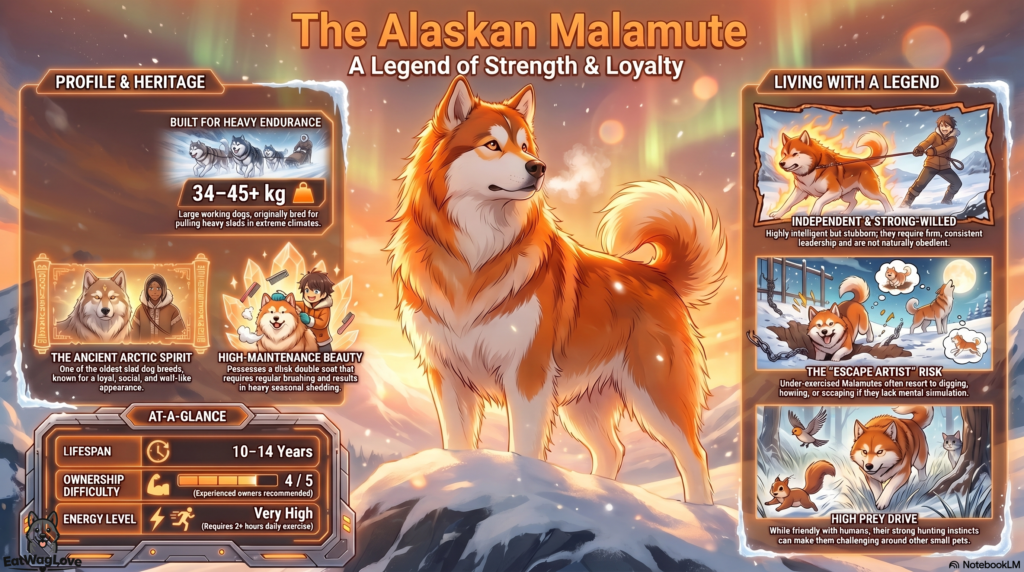
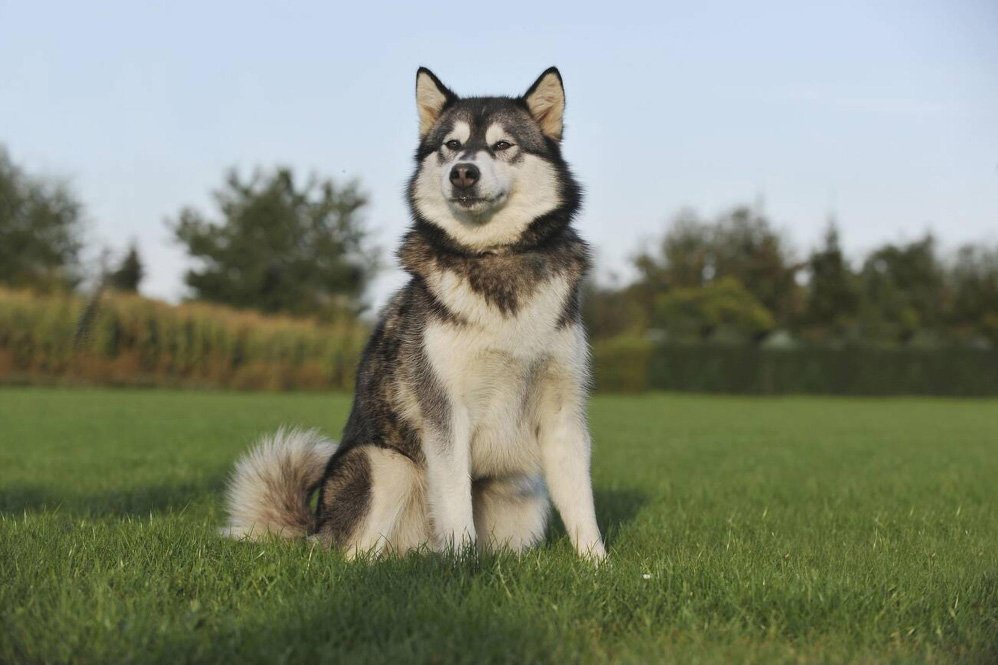







Powerful, majestic, and built for endurance — a loyal companion for experienced owners.
🧠 QUICK SNAPSHOT
- Temperament: Loyal, Independent, Strong
- Energy Level: High
- Size: Large
- Good with Families: Yes (experienced homes)
- Training Difficulty: Moderate to Hard
📚 OVERVIEW
Alaskan Malamutes are powerful working dogs originally bred to haul heavy loads across Arctic terrain. They are known for their strength, endurance, and wolf-like appearance. Despite their size, they are affectionate with their families and enjoy companionship, but they retain a strong independent nature.
✅ PROS & CONS
Pros
- Strong, loyal, and affectionate with family
- Impressive, majestic appearance
- Great for active and outdoor lifestyles
Cons
- Requires experienced handling and training
- High exercise and space requirements
- Can be stubborn and independent
Is an Alaskan Malamute a Good Family Dog?
Yes, an Alaskan Malamute can be an excellent family dog for active households that understand the needs of a large, powerful working breed.
Malamutes are typically affectionate, playful and strongly people-oriented. Despite their imposing appearance, they weren’t primarily developed as guard dogs and many are surprisingly friendly toward strangers.
They can be good with children, but their strength and enthusiasm mean supervision is important around younger kids.
The bigger challenge is meeting their exercise, training and companionship needs. A bored Malamute can become destructive, vocal or remarkably talented at escaping.
For the right family, however, they’re affectionate companions with enormous personalities to match their enormous coats.
How Much Exercise Does an Alaskan Malamute Need?
An adult Alaskan Malamute generally needs around one to two hours of exercise each day, with active individuals potentially needing more.
Walking, hiking and pulling-based activities can all provide excellent outlets for the breed’s working instincts.
Malamutes were developed for endurance rather than explosive sprinting. They historically hauled heavy loads across long distances in Arctic conditions.
Mental stimulation is also important, particularly because Malamutes are intelligent and independent problem-solvers.
Exercise needs to be carefully managed in hot weather because their exceptionally dense double coat makes overheating a serious concern.
Give a Malamute a cold morning, an interesting trail and somewhere useful to go, and you’re getting considerably closer to what this dog was built for.
Is an Alaskan Malamute Easy to Train?
Alaskan Malamutes are intelligent but independent, so they can be challenging to train despite learning quickly.
They’re not typically as handler-focused as breeds developed to follow constant human direction.
Positive reinforcement, consistency and interesting training sessions usually work best.
Early leash training is particularly important. An adult Malamute is immensely powerful, and allowing a puppy to practise pulling wherever it wants can create a substantial problem later.
Reliable recall can also be difficult because many Malamutes have a strong prey drive.
Training a Malamute isn’t about proving who’s stronger.
You won’t win that competition anyway.
The goal is convincing a very capable dog that working with you is more rewarding than implementing its own plan.
Does an Alaskan Malamute Shed?
Yes. Alaskan Malamutes are extremely heavy shedders.
Their thick double coat consists of a coarse protective outer coat and an exceptionally dense, insulating undercoat.
Malamutes typically “blow” their undercoat once or twice a year, producing extraordinary quantities of loose fur over several weeks.
Regular brushing is essential, particularly during these seasonal coat changes.
Their coat shouldn’t normally be shaved simply to keep them cool. The double coat provides insulation and protection, and shaving can interfere with normal coat function and regrowth.
Anyone considering this breed should understand that shedding isn’t a minor inconvenience.
For several weeks each year, you may genuinely wonder how one dog can produce enough spare fur to manufacture another Malamute.
What Health Problems Are Common in Alaskan Malamutes?
Alaskan Malamutes can be affected by several inherited health conditions.
Hip dysplasia is an important concern, as are certain inherited eye disorders.
The breed can also be affected by Alaskan Malamute polyneuropathy, an inherited neurological disorder that can cause weakness and abnormal movement.
Another inherited condition associated with the breed is chondrodysplasia, sometimes called dwarfism, which affects skeletal development.
Hypothyroidism can also occur.
As a large, deep-chested breed, Malamutes may be at risk of gastric dilatation-volvulus (GDV or bloat), which requires immediate veterinary attention.
Responsible breeders should conduct appropriate health and genetic screening and make the results available to prospective owners.
How Long Do Alaskan Malamutes Live?
Alaskan Malamutes typically live around 10–14 years, although lifespan varies between individuals.
Genetics, maintaining an appropriate body weight, nutrition, exercise and preventive veterinary care all influence longevity.
Keeping a Malamute lean is particularly important because excess weight places additional stress on the hips and other joints.
As they age, exercise intensity may need to decrease, but regular movement and mental stimulation remain valuable.
For such a substantial dog, a healthy Malamute can remain remarkably active well into its senior years.
Are Alaskan Malamutes Aggressive?
A well-socialised Alaskan Malamute should not be indiscriminately aggressive toward people, and many are naturally friendly and outgoing with humans.
However, aggression or intolerance toward other dogs can occur, particularly between dogs of the same sex.
Malamutes are physically powerful animals, so behavioural problems can have serious consequences.
Early socialisation, consistent training and responsible management are essential.
Owners should also distinguish aggression from prey drive. A Malamute pursuing a small animal may be displaying hunting instinct rather than territorial aggression.
This is a breed where responsible ownership means understanding both the friendly family companion and the extremely powerful working dog living inside the same furry body.
Are Alaskan Malamutes Good With Other Dogs?
Alaskan Malamutes can live successfully with other dogs, but compatibility varies considerably between individuals.
Some enjoy canine companionship, while others become less tolerant of unfamiliar dogs as they mature.
Same-sex aggression can occur within the breed.
Careful introductions, early socialisation and supervision are therefore important, particularly in multi-dog households.
Dog parks may not suit every adult Malamute.
The goal of socialisation shouldn’t necessarily be creating a dog that wants to play with every animal it encounters. Calm, manageable behaviour around other dogs is much more valuable.
Are Alaskan Malamutes Good With Cats and Small Animals?
Alaskan Malamutes can have a strong prey drive, so living with cats and smaller animals requires careful consideration.
Some Malamutes raised alongside cats live peacefully with them.
However, acceptance of the household cat doesn’t necessarily mean the dog will behave similarly toward an unfamiliar cat running outdoors.
Animals such as rabbits, guinea pigs, chickens and other small pets can be particularly vulnerable.
Training and socialisation can help manage behaviour, but owners shouldn’t assume they can completely remove a deeply rooted predatory instinct.
Secure fencing and responsible supervision are extremely important.
Can an Alaskan Malamute Live in an Apartment?
An Alaskan Malamute can technically live in an apartment, but it isn’t generally an ideal breed for small-space living.
Malamutes are large, active dogs requiring substantial daily exercise.
They can also be vocal and may howl, which can create difficulties with neighbours.
Perhaps most importantly, apartment living doesn’t reduce their need for physical activity, training and mental stimulation.
An owner committed to several substantial outings every day may successfully keep one without a large garden.
However, access to securely fenced outdoor space makes life considerably easier.
A Malamute doesn’t necessarily need an enormous house.
It does need an owner prepared to provide an enormous amount of dog ownership.
Do Alaskan Malamutes Bark or Howl a Lot?
Alaskan Malamutes are often more likely to howl, “woo” and vocalise than to bark continuously.
Many produce an impressive collection of sounds when excited, frustrated or attempting to communicate with their owners.
Some almost appear to hold conversations.
Individual vocalisation varies, but prospective owners shouldn’t expect a completely silent breed.
Howling can become particularly noticeable when a Malamute is bored, lonely or responding to sounds such as sirens.
Their vocal personality can be entertaining in the right environment and considerably less amusing to someone living on the other side of an apartment wall.
Can Alaskan Malamutes Live in Hot Weather?
Alaskan Malamutes can live in warmer climates, but owners must take substantial precautions against overheating.
The breed developed in an Arctic environment and carries an exceptionally dense double coat.
Exercise should generally occur during the coolest parts of the day in hot weather.
Malamutes need constant access to shade, fresh water and a cool indoor environment. Strenuous exercise during high temperatures should be avoided.
Hot pavement is another concern.
Their coat shouldn’t automatically be shaved for summer, as the double coat also provides protection and insulation.
For a Malamute, a scorching summer afternoon isn’t an invitation for a long run.
It’s much closer to a very good reason to find the air conditioning.
What Is the Difference Between an Alaskan Malamute and a Siberian Husky?
Alaskan Malamutes and Siberian Huskies are different breeds developed for different types of Arctic work.
The Malamute is generally larger, heavier and more powerfully built.
It was traditionally developed to haul heavy loads over substantial distances, prioritising strength and endurance.
The Siberian Husky is typically lighter and faster and became associated with pulling lighter loads at greater speed.
Both have thick double coats, high exercise needs and strong northern-breed characteristics.
Their temperaments also overlap, but they’re not simply different-sized versions of the same dog.
A useful simplification is:
Huskies were built more like distance runners; Malamutes were built more like freight haulers.
Where Does the Alaskan Malamute Come From?
The Alaskan Malamute is an ancient Arctic sled-dog breed associated with the Mahlemut people of northwestern Alaska.
The breed’s name derives from the Mahlemut, an Iñupiat people whose dogs were essential for survival in an extremely demanding environment.
These dogs helped transport heavy loads, assisted with hunting and lived closely alongside human communities.
Strength, endurance, resilience and the ability to work in severe cold were essential qualities.
Unlike racing sled dogs developed primarily for speed, Malamutes were valued particularly for their ability to move substantial loads over difficult terrain.
Their history wasn’t recreational.
These dogs were part of a transportation system that could be fundamental to human survival in the Arctic.
Were Alaskan Malamutes Used During Polar Expeditions?
Yes. Alaskan Malamutes and Malamute-type sled dogs were used during Arctic and Antarctic exploration, where their strength and endurance made them valuable for hauling supplies.
Sled dogs played critical roles during the era of polar exploration because mechanical transportation was limited or unreliable in extreme conditions.
Malamutes were particularly suited to moving heavy loads rather than racing at maximum speed.
They were also used for military transport and search-and-rescue-related work during periods of the 20th century.
Today’s Malamute may spend considerably more time negotiating for a place on the sofa, but behind that lifestyle is a dog whose ancestors were capable of working in some of the harshest environments on Earth.