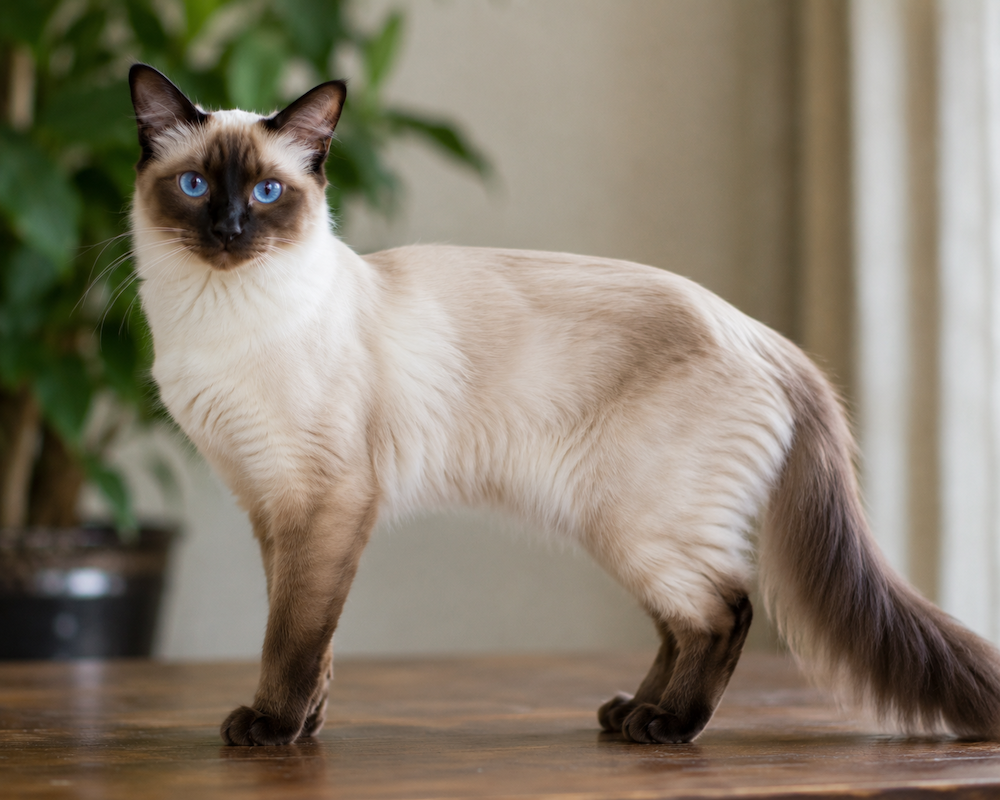







Elegant, affectionate, and wonderfully talkative — the Balinese combines the striking colourpoints and brilliant blue eyes of the Siamese with a flowing silky coat and an intelligent personality that wants to be involved in almost everything you do.
🧠 QUICK SNAPSHOT
- Energy Level: High
- Size: Medium
- Good With Families: Excellent
- Indoor Living: Excellent with sufficient enrichment
- Trainability: Very High
- Grooming: Moderate
- Best For: Interactive families, multi-pet homes, people wanting an affectionate and intelligent cat
- Typical Lifespan: Around 12–18 years
📚 OVERVIEW
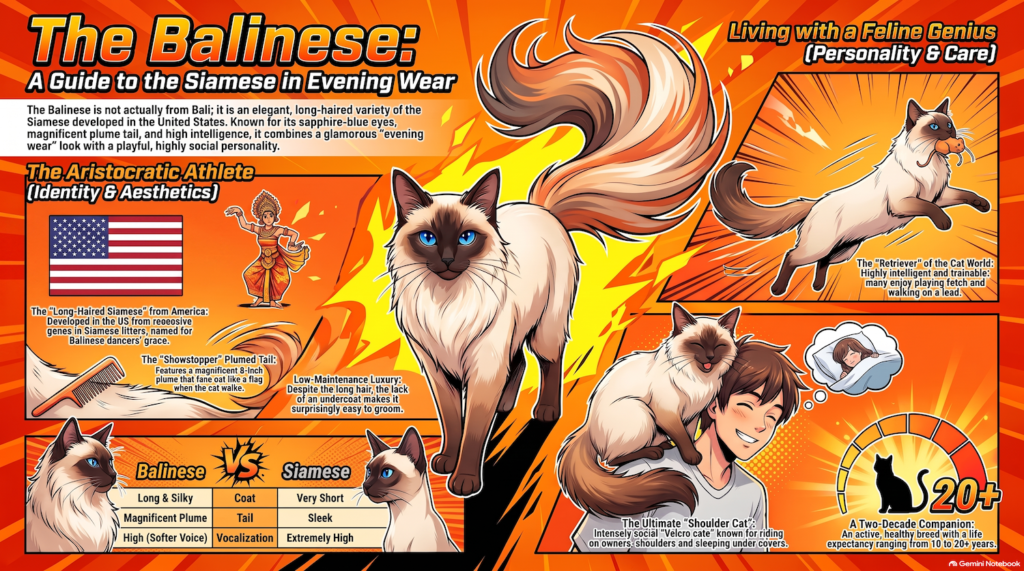
The Balinese is essentially the long-haired relative of the Siamese, sharing its elegant body, wedge-shaped head, striking blue eyes, colourpoint pattern, intelligence, and famously people-oriented personality. Its defining difference is a beautiful semi-long, silky coat and impressive plumed tail.
Despite the exotic name, the breed did not originate on the Indonesian island of Bali. Long-haired kittens occasionally appeared naturally in Siamese litters, and during the 20th century breeders in the United States began deliberately developing them as a distinct variety.
The name “Balinese” was chosen because the cats’ graceful movements reminded early breeders of Balinese dancers.
Personality is a major part of the breed’s appeal. Balinese cats tend to be affectionate, inquisitive, athletic, and highly communicative. Many follow their owners from room to room, participate in household activities, and make their opinions known through a surprisingly varied vocabulary.
This is not generally an aloof cat. A Balinese wants companionship, stimulation, and interaction — and will often make sure its humans understand that.
✅ PROS & CONS
Pros
- Exceptionally affectionate and people-oriented
- Highly intelligent and trainable
- Excellent family companion
- Usually sociable with other pets
- Playful and entertaining
- Silky coat is easier to maintain than it appears
Cons
- Can be very vocal
- Doesn’t enjoy prolonged isolation
- Needs plenty of daily interaction
- Requires regular mental stimulation
- Coat needs routine brushing
- May be too demanding for someone wanting an independent cat
Is a Balinese a Good Family Cat?
Yes, the Balinese is generally an excellent family cat, particularly for households wanting an affectionate companion that genuinely participates in family life. These cats tend to form strong bonds with their humans and often prefer being wherever the household activity is happening.
Balinese cats can be wonderful with respectful children because they are playful, intelligent, and usually enthusiastic about interactive games. Children should still learn appropriate handling and recognise when the cat wants some space.
The breed often does very well with other cats, particularly equally sociable companions. Many Balinese also adapt successfully to living with cat-friendly dogs when introductions are handled gradually.
Their social nature does mean they may struggle in households where everyone is routinely absent for long periods. Another compatible pet can provide companionship, but it doesn’t completely replace human interaction.
For families wanting a beautiful cat that behaves more like an active household participant than a distant observer, the Balinese can be an outstanding choice.
Can a Balinese Live Indoors or in an Apartment?
Yes, a Balinese can thrive indoors and in an apartment, provided its environment offers plenty of opportunities for climbing, playing, exploring, and interacting with people.
These athletic cats make excellent use of vertical space, so a tall cat tree, shelves, window perches, scratching towers, and other safe climbing areas can transform even a relatively small apartment into an interesting feline environment.
Interactive toys, tunnels, puzzle feeders, and rotating playthings help prevent boredom. Daily play with the owner remains essential.
One consideration for apartment dwellers is the breed’s voice. Like its Siamese relatives, the Balinese can be highly communicative. Some individuals hold lengthy “conversations” with their owners and aren’t shy about announcing when they want something.
Secure indoor living protects cats from many outdoor hazards, while a secure cat enclosure or carefully introduced harness walking can provide additional stimulation.
For a Balinese, the quality of its environment matters considerably more than the size of the property.
How Much Exercise and Play Does a Balinese Need?
The Balinese is a high-energy, athletic cat that needs daily interactive play and mental stimulation. Several 10–15 minute play sessions distributed throughout the day provide a useful starting point, although kittens and young adults may enthusiastically request considerably more.
Fishing-wand toys, feather toys, balls, tunnels, climbing towers, and chasing games allow the Balinese to express natural stalking, pouncing, and hunting behaviours.
Many Balinese also enjoy retrieving toys, learning tricks, and exploring puzzle feeders. Their intelligence means simply leaving the same collection of toys on the floor indefinitely may not provide sufficient stimulation.
Climbing opportunities are especially important. These cats are agile jumpers and often prefer observing household life from an elevated position.
Combining energetic play with clicker training, food puzzles, and exploration provides both physical and mental exercise.
A properly stimulated Balinese is still likely to be active and inquisitive — but is much less likely to decide that your curtains, cupboards, or carefully arranged possessions should become today’s entertainment.
Is a Balinese Easy to Train?
Yes, the Balinese is one of the more trainable cat breeds. Its intelligence, curiosity, and strong interest in interacting with humans make positive-reinforcement training particularly effective.
Using treats, toys, praise, or a clicker, many Balinese cats can learn behaviours such as coming when called, sitting, giving a paw, retrieving toys, entering a carrier voluntarily, and walking on a harness.
Training also has practical benefits. Teaching a cat to tolerate nail trimming, brushing, dental checks, carrier travel, and gentle handling can dramatically reduce stress when these activities become necessary.
Sessions should be short and enjoyable. Cats respond much better when participation feels rewarding rather than forced, and punishment should never be used as a training strategy.
The Balinese’s intelligence also means owners should expect the cat to learn things they didn’t intentionally teach. Opening doors, discovering where treats are stored, and recognising household routines can all become part of living with this observant breed.
Does a Balinese Shed?
Yes, the Balinese does shed, but its coat is often considerably easier to maintain than people expect from such an elegant long-haired cat.
Unlike heavily coated breeds, the Balinese typically has a fine, silky coat without a dense, woolly undercoat. This means it is generally less prone to severe matting and requires less grooming than breeds with thick double coats.
Brushing approximately once or twice each week is usually sufficient to remove loose hairs and prevent tangles, with more frequent grooming useful during heavier shedding periods.
Particular attention can be given to the tail and areas where friction may encourage tangling.
Routine nail trimming, dental care, and ear checks should accompany coat maintenance.
The Balinese is sometimes promoted as a hypoallergenic cat, but this description should be treated cautiously. No cat breed can be guaranteed not to trigger allergies because major feline allergens are produced in saliva and skin glands, not simply in the fur.
What Health Problems Are Common in a Balinese?
The Balinese is generally a long-lived breed, with many cats reaching approximately 12–18 years, but it shares genetic ancestry with the Siamese and can therefore be susceptible to some of the same inherited health concerns.
Progressive retinal atrophy (PRA) is an important example. This inherited eye disease can progressively damage vision, and genetic testing can identify relevant mutations in breeding cats.
Amyloidosis, involving abnormal protein deposits within organs, has also been reported within Siamese-related populations. Certain heart problems, including hypertrophic cardiomyopathy (HCM), may occur, while dental disease remains an important concern for cats generally.
Responsible breeders should understand the health history of their breeding lines, perform appropriate testing, and be willing to discuss results openly with prospective owners.
Routine veterinary examinations, dental care, good nutrition, weight management, and early investigation of changes in appetite, thirst, weight, breathing, toileting, or behaviour help give a Balinese the best opportunity for a long and healthy life.
⭐ Is the Balinese Really From Bali?
No — despite its wonderfully exotic name, the Balinese wasn’t developed in Bali.
The breed’s story is actually connected to the Siamese.
Occasionally, long-haired kittens appeared in litters of otherwise short-haired Siamese cats. While these kittens were initially regarded as an unusual variation, breeders in the United States eventually began developing the long-haired cats deliberately during the 20th century.
They needed a name.
The cats’ slender bodies, flowing coats, plumed tails, and exceptionally graceful movement reminded breeders of the elegance of traditional Balinese dancers, inspiring the name Balinese.
So the name describes the impression the cat created rather than its geographic origin.
Genetically and historically, the Balinese belongs firmly within the Siamese family — albeit wearing a considerably longer and more glamorous coat.
⭐ Why Does a Balinese Have Dark Ears, Face, Legs and Tail?
The Balinese inherits its beautiful colourpoint pattern from its Siamese ancestry, and the science behind it is fascinating.
The pigmentation involved is temperature-sensitive.
Pigment production works more effectively in cooler areas of the cat’s body. That means the relatively cool extremities — the face, ears, paws, legs, and tail — develop darker colouring, while the warmer central body remains considerably lighter.
Balinese kittens are therefore born very pale or almost completely white because conditions inside their mother’s womb are uniformly warm.
Their points gradually darken after birth as different parts of the body experience different temperatures.
Age, genetics, and environmental temperature can influence how dark an individual cat eventually becomes.
So those beautiful contrasting points aren’t simply decorative markings.
They are a visible example of genetics interacting with body temperature — making the Balinese’s appearance almost as fascinating as its personality.