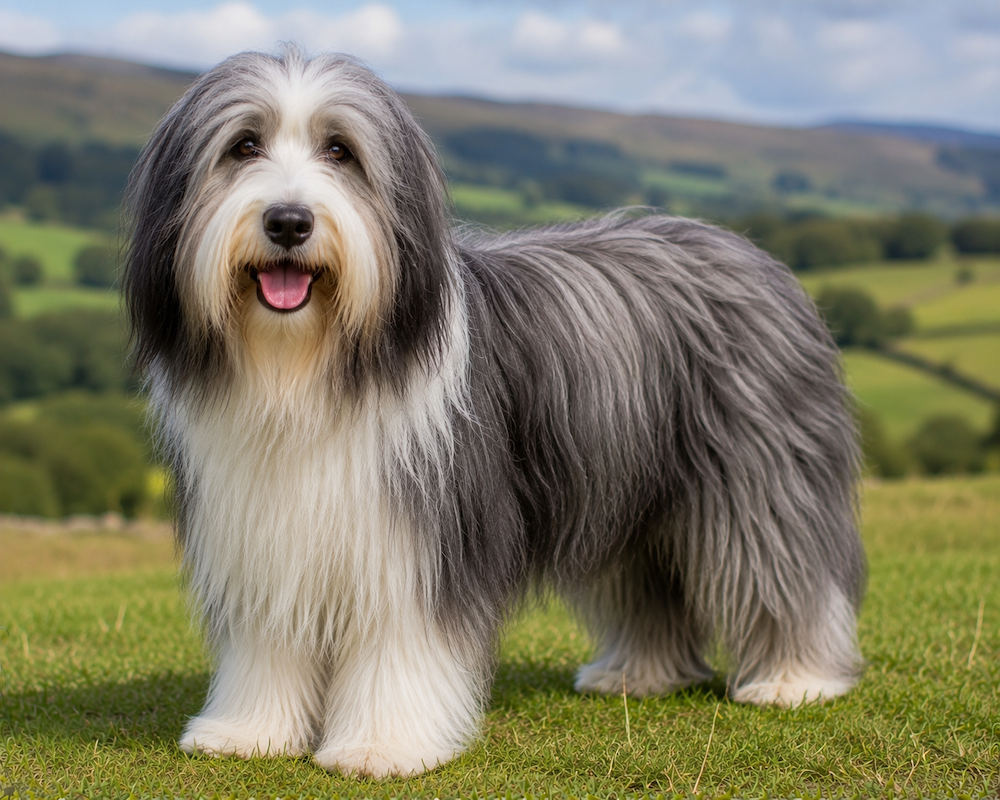







Cheerful, intelligent, and endlessly energetic — a shaggy Scottish herding dog that brings enthusiasm and affection to every adventure.
🧠 QUICK SNAPSHOT
- Temperament: Friendly, intelligent, lively
- Energy Level: High
- Size: Medium to large
- Good With Families: Yes
- Trainability: High
- Grooming: High
- Best For: Active families, outdoor lifestyles, dog sports
📚 OVERVIEW
The Bearded Collie is a historic Scottish herding breed, originally developed to move sheep and cattle across the rugged Highlands. Instantly recognisable by its long, flowing coat and expressive face, the “Beardie” is famous for its cheerful personality, athletic ability, and boundless enthusiasm.
Affectionate and outgoing, Bearded Collies thrive on companionship and enjoy being involved in every aspect of family life. Their intelligence and energy make them excellent partners for active owners who can provide plenty of exercise, training, and mental stimulation.
✅ PROS & CONS
Pros
- Friendly and affectionate with family
- Highly intelligent and trainable
- Excellent companion for active lifestyles
- Great with children and other pets
Cons
- Requires extensive grooming
- Needs significant daily exercise
- Can become bored if under-stimulated
- Coat requires regular brushing to prevent matting
Is a Bearded Collie a Good Family Dog?
Yes, the Bearded Collie is generally an excellent family dog for an active household.
Often called a Beardie, the breed is typically affectionate, playful and enthusiastic about being involved in family life. Many retain a puppy-like personality well into adulthood.
They can be very good with children, although their energy and herding instincts may result in chasing or attempting to control running youngsters.
Early training and socialisation are important.
For families wanting a cheerful dog that participates enthusiastically in almost everything, the Beardie can be wonderful — but expect considerably more bounce than its shaggy appearance might suggest.
How Much Exercise Does a Bearded Collie Need?
An adult Bearded Collie generally needs around 60–90 minutes of exercise each day, with energetic individuals often enjoying considerably more.
Beardies were developed as working herding dogs and have plenty of stamina.
Long walks, hiking, retrieving, agility, herding activities and interactive games can all provide useful outlets.
Mental stimulation is equally important. Training, scent games and puzzle activities help keep their intelligent minds occupied.
They’re not usually suited to a lifestyle built around occasional short walks.
Under all that hair is a genuine working dog waiting for something interesting to happen.
Is a Bearded Collie Easy to Train?
Bearded Collies are intelligent and highly capable of learning, although they can have an independent and occasionally mischievous streak.
Positive reinforcement and varied, enjoyable training usually produce the best results.
Harsh or repetitive training can cause a sensitive Beardie to disengage.
Early recall training is particularly valuable, as is teaching calm behaviour rather than constantly encouraging high-energy activities.
Many Beardies excel in agility, obedience and herding sports.
They learn quickly — including behaviours their owners never intended to teach.
A Beardie may not merely notice a loophole in the household rules.
It may remember it permanently.
Does a Bearded Collie Shed?
Yes, Bearded Collies do shed, despite sometimes being mistakenly described as non-shedding dogs.
Their long double coat can release a substantial amount of hair, particularly during coat changes.
Because loose hair often becomes trapped within the coat, regular thorough brushing is essential to prevent tangles and mats.
Most Beardies need grooming several times each week, and neglected coats can become extremely difficult to manage.
They’re not considered reliably hypoallergenic.
The magnificent Beardie coat is one of the breed’s greatest attractions.
It’s also a long-term grooming commitment attached to a dog.
What Health Problems Are Common in Bearded Collies?
Bearded Collies are generally robust dogs, but several health conditions can occur within the breed.
Hip dysplasia is an important concern, making appropriate screening of breeding dogs valuable.
Inherited eye disorders can also occur.
Beardies have additionally been reported with autoimmune and endocrine disorders, including conditions affecting the thyroid and adrenal glands.
Responsible breeders should use recommended health screening and be transparent about conditions occurring within their breeding lines.
Routine veterinary care and maintaining a healthy body weight remain important throughout the dog’s life.
How Long Do Bearded Collies Live?
Bearded Collies typically live around 12–14 years, although some live longer.
Genetics, nutrition, body condition, exercise and preventive veterinary care all influence lifespan.
Their naturally active lifestyle can help maintain good physical condition, provided exercise remains appropriate as they age.
Many Beardies retain their playful personality surprisingly late in life.
Owners sometimes describe them as dogs that grow older without entirely agreeing to grow up.
How Big Does a Bearded Collie Get?
The Bearded Collie is a medium-sized dog hidden beneath a considerable amount of hair.
Adults generally stand approximately 51–56 cm at the shoulder, with males typically slightly taller than females.
Weight commonly falls somewhere around 18–27 kg, although individual dogs vary.
Their long coats can make Beardies appear much larger and heavier than they actually are.
A soaking-wet Bearded Collie can therefore reveal a surprising fact:
there is considerably less dog underneath all that fluff than expected.
Can a Bearded Collie Live in an Apartment?
A Bearded Collie can live in an apartment, but it isn’t usually the easiest environment for the breed.
Beardies are energetic working dogs that need substantial daily exercise and mental stimulation.
They can also be enthusiastic barkers, particularly when bored or excited.
An active owner providing long walks, training and outdoor adventures may successfully keep one in a smaller home.
A large backyard isn’t essential, but activity is.
For most Beardies, the lifestyle matters considerably more than the postcode.
Do Bearded Collies Bark a Lot?
Bearded Collies can be fairly vocal dogs.
Their herding background made barking useful for communicating and controlling livestock, and modern Beardies may bark when excited, playing, alerting or seeking attention.
Boredom can make vocal behaviour considerably worse.
Early training can teach when barking is appropriate and when it’s time to settle.
Sufficient exercise and mental stimulation also help.
A Beardie can make an effective watchdog — although it may occasionally report events that nobody else considers particularly newsworthy.
Are Bearded Collies Good With Other Dogs?
Bearded Collies are generally sociable and good with other dogs, particularly when properly socialised.
Many enjoy canine companionship and can live successfully in multi-dog households.
Their energetic play style can sometimes overwhelm quieter dogs, so compatible personalities are important.
Herding behaviour may also appear during play, with some Beardies attempting to chase or control the movement of other dogs.
Early socialisation helps puppies develop appropriate canine manners.
Are Bearded Collies Good With Cats?
Many Bearded Collies can live successfully with cats, particularly when raised alongside them.
However, their herding instincts can lead to chasing or attempts to control a cat’s movement.
A running cat can be especially tempting.
Training should discourage persistent chasing, and cats should have safe areas where they can escape unwanted canine attention.
Their instinct is generally more about controlling movement than hunting prey, but individual behaviour varies.
Can a Bearded Collie Be Left Alone?
Bearded Collies generally prefer plenty of human companionship and may not cope well with routinely spending long periods alone.
They were developed to work alongside people and tend to become strongly involved in family life.
Bored or lonely Beardies may bark, chew or invent other forms of entertainment.
Puppies should gradually learn to spend reasonable periods independently.
Exercise and enrichment before absences can also help.
This is generally a better breed for people wanting a dog actively involved in their lives than for households where the dog will regularly spend the entire day alone.
Why Do Bearded Collies Bounce So Much?
Bearded Collies are famous for an enthusiastic behaviour often nicknamed the “Beardie Bounce.”
When excited, some Beardies spring upward on their legs, sometimes repeatedly, creating the impression of a shaggy dog on invisible springs.
The behaviour fits their naturally exuberant personality and may also have practical roots in working over rough vegetation, where jumping helped dogs see livestock and navigate difficult terrain.
Not every Beardie performs dramatic bouncing, but the expression has become closely associated with the breed.
Few dogs can transform ordinary excitement into quite such an impressive vertical event.
Why Do Bearded Collies Have Such Long Hair?
The Bearded Collie’s long double coat developed to provide protection while working in Britain’s difficult weather and terrain.
A softer insulating undercoat helps protect against cold, while the longer outer coat offers additional protection from rain, wind and vegetation.
The facial hair creates the characteristic “beard” that gives the breed its name.
This practical working coat eventually became one of the Beardie’s most recognisable features.
However, a coat that functioned outdoors around livestock still requires substantial maintenance when living inside a modern home.
Mud, leaves and twigs have an extraordinary ability to return from walks attached to a Beardie.
Do Bearded Collies Change Colour as They Grow?
Yes, many Bearded Collies undergo a dramatic colour change as they mature.
Beardie puppies may be born black, brown, blue or fawn, often with white markings.
A genetic fading process can cause the coat to become considerably lighter during adolescence and early adulthood.
A dark puppy can therefore develop into a much paler adult before the final mature colour becomes apparent.
Some coats darken again to a degree later.
It’s one of the breed’s most fascinating visual characteristics — the puppy you bring home may appear to change its wardrobe completely while growing up.
What Were Bearded Collies Originally Bred to Do?
Bearded Collies were developed as herding and droving dogs, helping move sheep and cattle across challenging terrain.
They needed stamina, intelligence and the confidence to work independently when livestock were spread across hills and rough countryside.
Beardies could help gather animals and move them over considerable distances.
Their famous enthusiasm and athleticism make much more sense when viewed through this working history.
The modern Beardie may be beautifully groomed for the show ring, but beneath that coat remains a tough livestock-working dog.
Is a Bearded Collie the Same as an Old English Sheepdog?
No. The Bearded Collie and Old English Sheepdog are separate breeds, despite their shaggy coats and herding backgrounds.
The Bearded Collie is generally lighter, more athletic and less heavily built.
Old English Sheepdogs are larger and more substantial, with a different coat texture and distinctive body shape.
Both breeds developed in Britain for livestock work, which helps explain some superficial similarities.
Their histories and breed standards, however, are distinct.
Remove all that hair and the differences become considerably easier to see.
Where Does the Bearded Collie Come From?
The Bearded Collie comes from Scotland and the wider British working-dog tradition, where shaggy herding dogs were used for centuries to manage sheep and cattle.
A frequently repeated story claims that Polish Lowland Sheepdogs brought to Scotland during the 16th century contributed to the breed’s ancestry. The story is plausible and widely repeated, but the precise early development of the Beardie isn’t thoroughly documented.
The modern breed owes much to G. Olive Willison, who began breeding Bearded Collies in Britain during the 1940s after acquiring a dog named Jeannie.
Her breeding programme played an important role in establishing today’s population.
So while the Beardie’s working ancestry stretches back much further, the modern pedigree breed was substantially shaped during the 20th century.