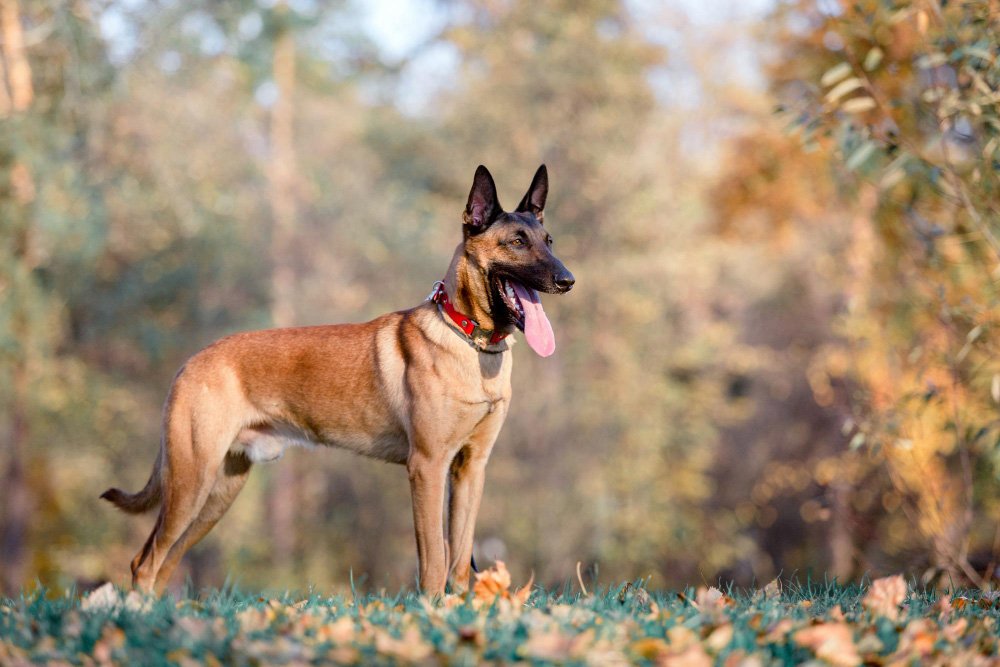







Intense, intelligent, and built for performance — a powerful working companion that thrives on purpose and activity.
🧠 QUICK SNAPSHOT
- Temperament: Driven, alert, loyal
- Energy Level: Extremely high
- Size: Medium to large
- Good With Families: Yes (experienced homes)
- Trainability: Very high
- Grooming: Low
- Best For: Active, experienced owners
📚 OVERVIEW
The Belgian Malinois is a highly capable and driven breed often used in police and military roles. Known for their intelligence and work ethic, they require structure, training, and daily mental and physical challenges.
They form strong bonds with their handlers but are not suited to casual or low-energy homes.
✅ PROS & CONS
Pros
- Extremely intelligent and trainable
- Loyal and protective
- Excellent working ability
- Low grooming needs
Cons
- Extremely high energy requirements
- Needs constant stimulation
- Not suitable for inexperienced owners
- Can become destructive if bored
Is a Belgian Malinois a Good Family Dog?
A Belgian Malinois can be a devoted family dog, but it is not an ideal breed for most households.
Malinois form extremely strong bonds with their handlers and are intelligent, loyal and naturally watchful. However, they were developed as serious working dogs and typically have enormous physical and mental demands.
They can live successfully with children when properly trained and socialised, but their speed, intensity and herding instincts can make them overwhelming around young children.
For an experienced, active owner prepared to provide daily training and purposeful activity, the Malinois can be extraordinary.
For someone wanting an easygoing family pet, there are usually much easier choices.
How Much Exercise Does a Belgian Malinois Need?
An adult Belgian Malinois generally needs at least 90 minutes to two hours of meaningful physical activity each day, and many working-line dogs require considerably more.
Exercise alone isn’t enough.
Malinois need mental challenges through obedience, tracking, scent work, agility, retrieving, protection sports or other structured activities.
Simply throwing a ball repeatedly can create an extremely fit dog without satisfying its need to think.
The goal should be a balance of physical exercise, training, enrichment and learning how to settle.
With this breed, tiring the brain can be every bit as important as tiring the legs.
Is a Belgian Malinois Easy to Train?
Belgian Malinois are exceptionally trainable, but that doesn’t necessarily make them easy dogs to own.
They learn extremely quickly and can develop remarkable precision when working with an experienced handler.
That same intelligence means they also learn unwanted behaviours rapidly.
Timing, consistency and clear communication are particularly important.
Malinois can be sensitive to movement and highly responsive to their environment, so early socialisation should develop confidence and neutrality rather than simply exposing the puppy to as much excitement as possible.
Few breeds demonstrate the difference between “easy to train” and “easy to live with” quite as clearly.
Does a Belgian Malinois Shed?
Yes, Belgian Malinois shed throughout the year and usually shed heavily during seasonal coat changes.
They have a short, weather-resistant double coat consisting of a dense undercoat and harder outer hairs.
Weekly brushing is generally sufficient during normal periods, with more frequent grooming when the undercoat is being shed.
Their coat doesn’t require trimming or elaborate professional grooming.
Malinois aren’t considered hypoallergenic.
The coat may look wonderfully low maintenance, but during shedding season the vacuum cleaner will still become an important member of the household.
What Health Problems Are Common in Belgian Malinois?
Belgian Malinois are generally athletic dogs, but several inherited health problems can occur.
Hip and elbow dysplasia are important concerns, particularly in a breed expected to perform demanding physical work.
Inherited eye disorders can also occur, and epilepsy is reported within Belgian Shepherd populations.
Responsible breeders should use appropriate hip, elbow and eye screening and carefully consider temperament as well as physical health.
Working ability should never be used as a substitute for proper health testing.
Malinois involved in high-impact sports or working roles also benefit from careful conditioning to reduce avoidable injuries.
How Long Do Belgian Malinois Live?
Belgian Malinois typically live around 12–14 years, with some individuals living longer.
Their athletic build helps them remain active well into adulthood.
Genetics, body condition, nutrition, exercise and preventive veterinary care all influence longevity.
Working and sporting dogs also need appropriate conditioning and recovery because repeated high-impact activity can place significant stress on joints and soft tissues.
Many Malinois retain an extraordinary desire to work even as they age.
Sometimes the challenge is convincing the senior dog that retirement has actually begun.
Can a Belgian Malinois Live in an Apartment?
A Belgian Malinois can physically live in an apartment, but apartment living is challenging for most examples of the breed.
The primary issue isn’t floor space — it’s the dog’s enormous requirement for structured activity and mental stimulation.
An experienced handler who spends substantial time training, exercising and working the dog may succeed without a large property.
Conversely, leaving a Malinois in a huge backyard won’t automatically satisfy it.
A bored Malinois with plenty of space is still a bored Malinois.
For this breed, a job is generally more valuable than a large garden.
Are Belgian Malinois Aggressive?
Belgian Malinois should not be indiscriminately aggressive, but they can be intense, protective and highly responsive to perceived threats.
These characteristics are deliberately valued in certain police and military working lines.
Good breeding and training should produce a dog capable of remaining controlled and responsive rather than reacting unnecessarily.
Poor socialisation, unsuitable breeding or inexperienced handling can create serious problems because Malinois are extremely fast and powerful dogs.
Their reputation shouldn’t be reduced to aggression.
What distinguishes the breed is more accurately its drive, intensity, speed, confidence and extraordinary willingness to work.
Are Belgian Malinois Good Guard Dogs?
Yes, Belgian Malinois can be exceptional working and protection dogs, which is one reason they’re widely used by police and military organisations.
They’re highly alert, athletic, intelligent and responsive to training.
However, an ordinary pet Malinois doesn’t need to be deliberately encouraged to become suspicious or aggressive.
For most owners, excellent obedience, neutrality around strangers and reliable control are much more valuable.
Professional protection work requires experienced trainers and carefully selected dogs.
A well-trained Malinois doesn’t need to react to everything.
Its greatest strength is being able to switch from intensity to control when the handler asks.
Are Belgian Malinois Good With Other Dogs?
Belgian Malinois can live successfully with other dogs, particularly when properly socialised from an early age.
However, individual temperament varies considerably.
Some Malinois are highly social, while others can be intense, competitive or selective around unfamiliar dogs.
Their fast, physical style of play can also overwhelm quieter breeds.
Owners should focus on teaching calm behaviour and neutrality rather than assuming the dog needs to greet or play with every dog it encounters.
Are Belgian Malinois Good With Cats?
Belgian Malinois can sometimes live successfully with cats, particularly when raised alongside them.
However, their strong prey drive and sensitivity to movement can make chasing a significant concern.
A running cat may trigger pursuit even in a dog that isn’t intentionally aggressive.
Early training and careful management are therefore essential.
Cats should have secure areas where they can escape unwanted attention.
Small animals such as rabbits and rodents require even greater caution.
Can a Belgian Malinois Be Left Alone?
Belgian Malinois generally don’t thrive when routinely left alone for long periods without sufficient activity.
They’re intensely handler-oriented working dogs and often want to participate in whatever their owner is doing.
A bored Malinois may become destructive, vocal or develop repetitive behaviours.
Puppies should still learn independence and how to settle alone for reasonable periods.
Creating a dog that believes it must be constantly entertained isn’t desirable either.
The goal is a Malinois that can work intensely when required but can also switch off and relax when nothing is happening.
Why Do Belgian Malinois Bite So Much?
Belgian Malinois puppies can be extremely mouthy, and working Malinois are famous for using their mouths during trained apprehension and protection work.
Part of this behaviour reflects genetics.
Malinois have been selectively bred for generations for characteristics including prey drive, gripping behaviour, confidence and rapid responses to movement.
Puppies still need to learn appropriate bite inhibition and household manners.
Owners shouldn’t deliberately encourage uncontrolled biting simply because it’s associated with the breed.
The internet nickname “Maligator” exists for a reason — but responsible ownership is about developing control over those instincts rather than celebrating chaos.
Why Are Belgian Malinois Used by Police and the Military?
Belgian Malinois are widely used by police, military and security organisations because they combine intelligence, athleticism, scenting ability and strong working drive.
They can be trained for tasks including tracking, detection, searching, patrol work and apprehension.
Their relatively light, athletic build allows them to move rapidly and negotiate obstacles while still possessing considerable strength.
Malinois can also develop extremely strong working relationships with their handlers.
Not every Malinois has the temperament required for operational work, however.
Police and military dogs are carefully selected and extensively trained — owning the same breed doesn’t automatically mean owning a canine soldier.
How High Can a Belgian Malinois Jump?
Belgian Malinois are exceptionally athletic jumpers, capable of clearing impressive obstacles when properly conditioned and trained.
Exact claims about maximum jumping height vary enormously and often involve specialised working or sporting dogs, so there isn’t one meaningful universal number for the breed.
Their combination of powerful hindquarters, relatively light body weight, speed and coordination gives them exceptional agility.
Some can scale fences that would contain many other breeds.
Secure fencing is therefore important, but owners shouldn’t encourage extreme jumping in immature dogs whose joints are still developing.
What Is the Difference Between a Belgian Malinois and a German Shepherd?
Belgian Malinois and German Shepherds are different breeds, although both are highly capable European working dogs frequently used by police and military organisations.
The Malinois is generally lighter, leaner and more squarely built, with a short fawn-to-mahogany coat and characteristic black mask.
German Shepherds are typically heavier and have a more elongated outline.
Both can be intelligent, protective and highly trainable, but working-line Malinois are particularly famous for their intensity, speed and drive.
Neither breed should be selected purely because someone wants a dog that “looks tough.”
Is a Belgian Malinois the Same as a Belgian Shepherd?
The Belgian Malinois is one of the Belgian Shepherd varieties, although kennel organisations classify them differently.
The four traditional Belgian Shepherd varieties are the Malinois, Groenendael, Tervuren and Laekenois.
They are distinguished primarily by coat type and colour.
The Malinois has the short coat most commonly associated with modern police and military work.
Some kennel organisations treat the varieties under one Belgian Shepherd breed, while others recognise them separately.
So “Belgian Shepherd” can refer to the broader family, while Malinois identifies the short-coated variety.
Where Does the Name Malinois Come From?
The name Malinois comes from the Belgian city of Mechelen, known in French as Malines.
The dogs associated with that region became known as Malinois as Belgian Shepherd varieties were being formally classified during the late 19th century.
Other Belgian Shepherd varieties similarly acquired names connected with Belgian places or historic associations.
The name therefore doesn’t describe the dog’s job or temperament.
It’s essentially a geographical label that became attached to one of the world’s most famous modern working dogs.
What Were Belgian Malinois Originally Bred to Do?
Belgian Malinois were originally developed primarily as livestock herding and farm dogs, not police or military dogs.
They needed intelligence, endurance, agility and the ability to respond rapidly while controlling livestock.
Those working characteristics later proved useful far beyond the farm.
As organised police, military and protection-dog programmes developed, the Malinois demonstrated exceptional aptitude for demanding service roles.
Modern working lines have further emphasised many of those characteristics.
The police dog seen scaling a wall today therefore has its foundations in a Belgian dog originally bred to manage livestock.
Where Does the Belgian Malinois Come From?
The Belgian Malinois comes from Belgium, where several regional types of shepherd dog were working during the 19th century.
Efforts to classify and standardise Belgian shepherd dogs accelerated during the 1890s, with Professor Adolphe Reul playing an important role in studying and organising the country’s native shepherd types.
The short-haired dogs associated with the region around Mechelen became known as Malinois.
Although the breed is now internationally famous for police and military service, that reputation represents only the latest chapter of its history.
At heart, the Belgian Malinois remains what its structure and temperament reveal: an exceptionally athletic Belgian working shepherd built to think, move and work all day.