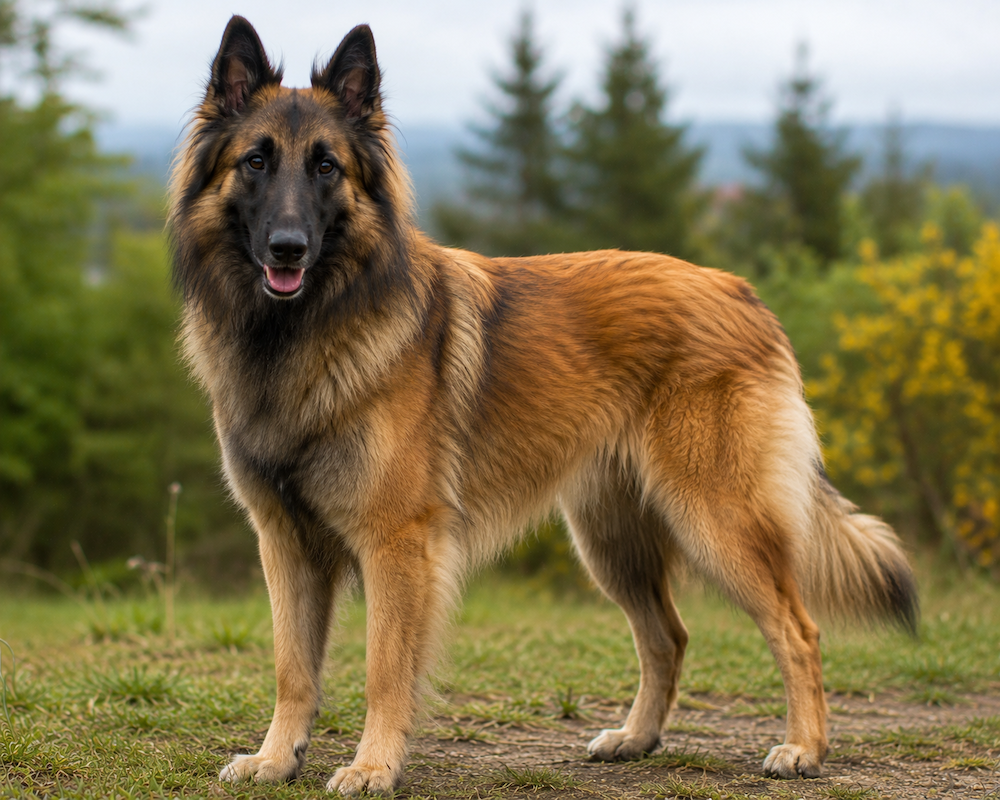







Elegant, intelligent, and fiercely loyal — a remarkable working dog that thrives on purpose, activity, and family.
🧠 QUICK SNAPSHOT
- Temperament: Intelligent, loyal, alert
- Energy Level: Very high
- Size: Large
- Good With Families: Yes
- Trainability: Very high
- Grooming: Moderate to high
- Best For: Active families, experienced owners, working homes
📚 OVERVIEW
The Belgian Tervuren is one of the four Belgian Shepherd varieties and is admired for its intelligence, elegance, and exceptional work ethic. Originally bred for herding livestock, the breed now excels in police work, search and rescue, agility, obedience, and many other canine sports.
Deeply devoted to its family, the Belgian Tervuren thrives when given a purpose. This is not a breed that enjoys sitting idle—it needs both physical exercise and mental challenges to remain happy and well-balanced.
✅ PROS & CONS
Pros
- Exceptionally intelligent and trainable
- Loyal and deeply devoted to family
- Outstanding working and sporting dog
- Excellent natural watchdog
Cons
- Extremely high exercise requirements
- Needs constant mental stimulation
- Can become anxious or destructive if bored
- Best suited to experienced owners
Is a Belgian Tervuren a Good Family Dog?
Yes, a Belgian Tervuren can be an excellent family dog for an active and experienced household.
Tervurens form very strong bonds with their families and are typically intelligent, affectionate and highly attentive to their owners. They often want to participate in virtually everything the household is doing.
They can be good with respectful children, although their energy and herding instincts may lead to chasing or attempting to control running youngsters.
Early socialisation is particularly important because Tervurens can be naturally reserved and watchful around strangers.
This isn’t usually a background companion. A Tervuren tends to become deeply involved in the daily operations of the household.
How Much Exercise Does a Belgian Tervuren Need?
An adult Belgian Tervuren generally needs around 90 minutes to two hours of exercise each day, combined with substantial mental stimulation.
These are athletic working shepherds with considerable stamina.
Hiking, running, agility, obedience, tracking, herding, scent work and retrieving can all provide excellent outlets.
Mental exercise is just as important. Tervurens learn extremely quickly and can become frustrated or develop unwanted behaviours when bored.
A large backyard by itself won’t satisfy them.
The Tervuren needs activities, interaction and opportunities to use its brain.
Is a Belgian Tervuren Easy to Train?
Belgian Tervurens are exceptionally intelligent and highly trainable, although their sensitivity and intensity can make them challenging for inexperienced owners.
They tend to learn new behaviours remarkably quickly.
Positive reinforcement, clear communication and varied training generally produce the best results.
Harsh training can be counterproductive because many Tervurens are highly responsive to their handlers.
They also need to learn how to relax. Constantly increasing excitement and physical activity can create a dog that struggles to switch off.
With a Tervuren, you’re not usually trying to convince the dog to learn.
You’re trying to make sure it learns exactly what you intended.
Does a Belgian Tervuren Shed?
Yes, Belgian Tervurens shed considerably, particularly during seasonal coat changes.
They have a long double coat consisting of a protective outer coat and dense undercoat.
Regular brushing several times each week helps remove loose hair and prevent tangles.
During major seasonal shedding periods, more frequent or even daily brushing can be useful.
The coat doesn’t normally require clipping.
Tervurens aren’t considered hypoallergenic.
The flowing coat is spectacular, but during shedding season owners may discover a second Tervuren gradually forming inside the vacuum cleaner.
What Health Problems Are Common in Belgian Tervurens?
Belgian Tervurens are generally athletic dogs, but several inherited health conditions can occur.
Hip and elbow dysplasia are important concerns.
Inherited eye disorders can also affect the breed, and epilepsy is a recognised concern within Belgian Shepherd populations.
Certain thyroid and other health conditions may also occur in some lines.
Responsible breeders should use appropriate orthopaedic and eye screening and understand the health history of their breeding dogs.
Temperament should also be considered carefully because stable nerves are particularly important in such a sensitive and intelligent working breed.
How Long Do Belgian Tervurens Live?
Belgian Tervurens typically live around 12–14 years, although some live longer.
Genetics, nutrition, exercise, body condition and preventive veterinary care all influence longevity.
Maintaining a lean, athletic body condition helps protect joints and supports mobility.
Mental stimulation remains valuable throughout the dog’s life.
Many Tervurens retain considerable enthusiasm for training into their senior years.
The body may eventually become slower, but the brain often continues reporting for duty.
Can a Belgian Tervuren Live in an Apartment?
A Belgian Tervuren can live in an apartment with an exceptionally committed owner, but it isn’t generally the easiest environment for the breed.
Tervurens require substantial exercise, training and mental stimulation every day.
They’re also naturally alert and may react to noises, people or dogs moving through communal spaces if they haven’t been taught calm behaviour.
A garden can be convenient, but having one doesn’t replace meaningful exercise.
The real requirement isn’t simply space.
It’s a lifestyle capable of keeping an intelligent working shepherd fulfilled.
Are Belgian Tervurens Aggressive?
A well-bred Belgian Tervuren should not be indiscriminately aggressive.
However, Tervurens can be naturally watchful, protective and reserved around unfamiliar people.
Those characteristics have historical value in a livestock-working and guardian breed.
Early, thoughtful socialisation is particularly important so the dog develops confidence without becoming excessively suspicious.
Poor breeding, inadequate socialisation or inappropriate protection training can create significant behavioural problems.
The ideal Tervuren should be alert and confident while remaining responsive and controllable.
Are Belgian Tervurens Good Guard Dogs?
Yes, Belgian Tervurens can be excellent natural watchdogs and guardians.
They’re highly observant, intelligent and strongly bonded to their families.
Many quickly notice unusual activity around the home and will alert their owners.
Their size, appearance and confidence can also provide an effective deterrent.
Most family Tervurens don’t require specialised protection training.
Good obedience and stable social behaviour are much more valuable than encouraging unnecessary suspicion.
Are Belgian Tervurens Good With Other Dogs?
Belgian Tervurens can live successfully with other dogs, particularly when properly socialised from puppyhood.
Many enjoy canine companionship.
However, their intense, fast-moving play style can sometimes overwhelm quieter dogs.
Some individuals can also become selective or assertive around unfamiliar dogs.
Early socialisation should focus on calm behaviour and good canine communication rather than requiring the Tervuren to play with every dog it encounters.
Are Belgian Tervurens Good With Cats?
Belgian Tervurens can live successfully with cats, particularly when raised alongside them.
However, their herding instincts and strong response to movement can encourage chasing.
A rapidly moving cat may trigger pursuit even when the dog isn’t behaving aggressively.
Early training should discourage persistent chasing, and cats should have safe areas where they can avoid unwanted attention.
Individual prey drive varies considerably.
Can a Belgian Tervuren Be Left Alone?
A Belgian Tervuren can learn to spend reasonable periods alone, but the breed generally prefers substantial interaction with its family.
Tervurens were developed to work closely with people and often form intense relationships with their owners.
Long periods of isolation combined with inadequate exercise can lead to barking, destructive behaviour or anxiety.
Puppies should gradually learn independence.
It’s equally important to teach them how to relax without constant entertainment.
A well-balanced Tervuren should be able to work enthusiastically and then switch off when the working day is finished.
Do Belgian Tervurens Bark a Lot?
Belgian Tervurens can be fairly vocal, particularly when alerting to activity around their home.
Their herding and guarding ancestry made vocal communication useful.
Modern Tervurens may bark at visitors, unfamiliar noises, passing dogs or anything else they consider noteworthy.
Boredom can increase barking substantially.
Early training can teach appropriate alert behaviour and a reliable cue to stop.
Without guidance, a Tervuren may appoint itself head of neighbourhood surveillance.
What Is the Difference Between a Belgian Tervuren and a Belgian Malinois?
The Belgian Tervuren and Belgian Malinois belong to the same Belgian Shepherd family, with coat type being the most obvious difference.
The Tervuren has a long coat, typically fawn to mahogany or grey with black overlay and a dark mask.
The Malinois has a much shorter coat.
Both are athletic, intelligent working shepherds capable of performing demanding jobs.
Modern working-line Malinois are particularly prominent in police and military service, while Tervurens excel in herding, obedience, tracking, agility, search work and other dog sports.
The Tervuren isn’t simply a fluffy Malinois, although the family resemblance can be striking.
What Is the Difference Between a Belgian Tervuren and a Belgian Sheepdog?
The Belgian Tervuren and the long-haired black Belgian Sheepdog, commonly called the Groenendael, are extremely closely related.
Both have long double coats and similar body structure.
The most obvious distinction is colour.
The Groenendael is predominantly black, while the Tervuren is typically fawn, mahogany or grey with black overlay and a black mask.
Under kennel systems that recognise one Belgian Shepherd breed, they’re considered different varieties rather than separate breeds.
Other registries classify them separately.
Is the Belgian Tervuren One of Four Belgian Shepherd Varieties?
Yes. Traditionally, the Belgian Shepherd occurs in four varieties:
Tervuren — long-haired, generally fawn/mahogany or grey with black overlay
Groenendael — long-haired black
Malinois — short-haired
Laekenois — rough-haired
Different kennel organisations classify these dogs differently.
Some recognise one Belgian Shepherd breed with four varieties, while others recognise separate breeds.
Their shared ancestry explains why their overall structure and many temperament characteristics can be remarkably similar despite dramatically different coats.
Why Does a Belgian Tervuren Have a Black Overlay?
The Belgian Tervuren’s characteristic coat often has black-tipped hairs over a fawn, mahogany or grey base, creating the dark overlay known as charbonnage.
This produces the rich shaded appearance associated with the breed.
A dark facial mask is another important characteristic.
The intensity of the black overlay can vary considerably between individual dogs.
Combined with the long coat, mane and expressive face, the colouring gives the Tervuren one of the most dramatic appearances among European shepherd breeds.
Where Does the Name Tervuren Come From?
The name Tervuren comes from the Belgian village of Tervuren, east of Brussels.
The variety became associated with dogs bred in that area during the development and standardisation of Belgian Shepherds in the late 19th century.
One figure commonly associated with early Tervuren development is M. F. Corbeel, who bred long-haired shepherd dogs of the type that contributed to the variety.
As with Malinois and Groenendael, the name reflects a Belgian geographical association rather than describing the dog’s job.
What Were Belgian Tervurens Originally Bred to Do?
Belgian Tervurens were originally developed as herding and general-purpose farm dogs.
They needed stamina, intelligence and responsiveness to manage livestock while remaining alert to potential threats.
These abilities later proved useful in many other working roles.
Belgian Shepherds have been employed for military service, police work, tracking, search work and protection as well as competitive dog sports.
Today’s elegant Tervuren therefore has thoroughly practical foundations.
That flowing coat surrounds a serious livestock-working dog.
Were Belgian Tervurens Used as Working and Service Dogs?
Yes. Belgian Shepherds, including dogs of the Tervuren type, have a long history of working beyond traditional livestock herding.
Their intelligence, trainability, scenting ability and athleticism made Belgian Shepherds useful for messenger work, military duties, tracking and other service roles.
Modern Tervurens continue to participate successfully in search and rescue, obedience, tracking, agility, herding and protection sports.
Their versatility is one of the breed family’s defining characteristics.
Where Does the Belgian Tervuren Come From?
The Belgian Tervuren comes from Belgium and developed from the country’s traditional working shepherd dogs.
During the late 19th century, Belgian dog enthusiasts began systematically classifying these shepherds according to physical characteristics, particularly coat type and colour.
Veterinary professor Adolphe Reul played an important role in studying and organising Belgium’s native shepherd population during this period.
The long-haired dogs associated with Tervuren became one of the recognised varieties alongside the Groenendael, Malinois and Laekenois.
Today, the Tervuren may be admired for its spectacular coat, but its appearance shouldn’t obscure its heritage:
it remains an intelligent, athletic Belgian working shepherd underneath all that elegance.