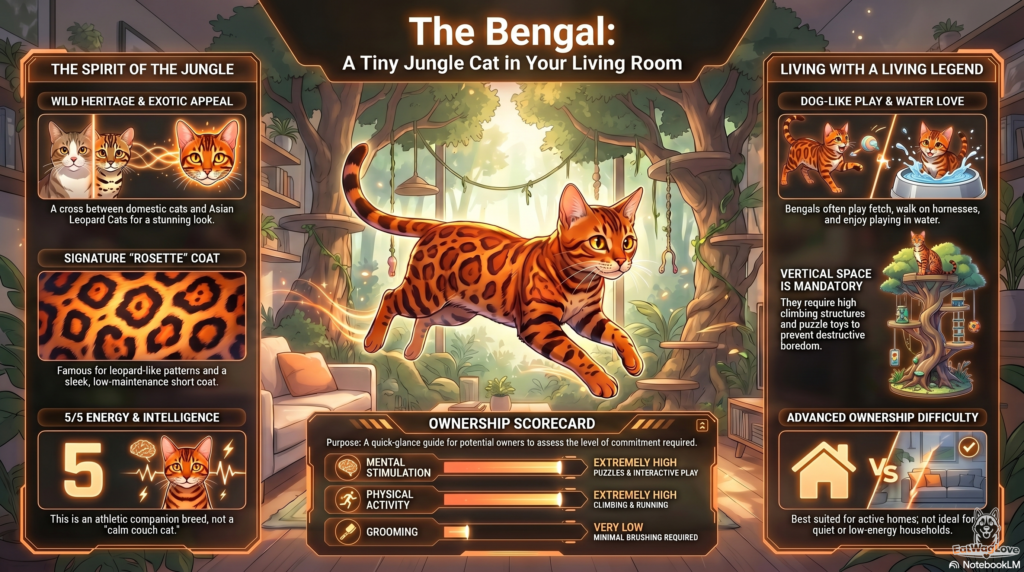
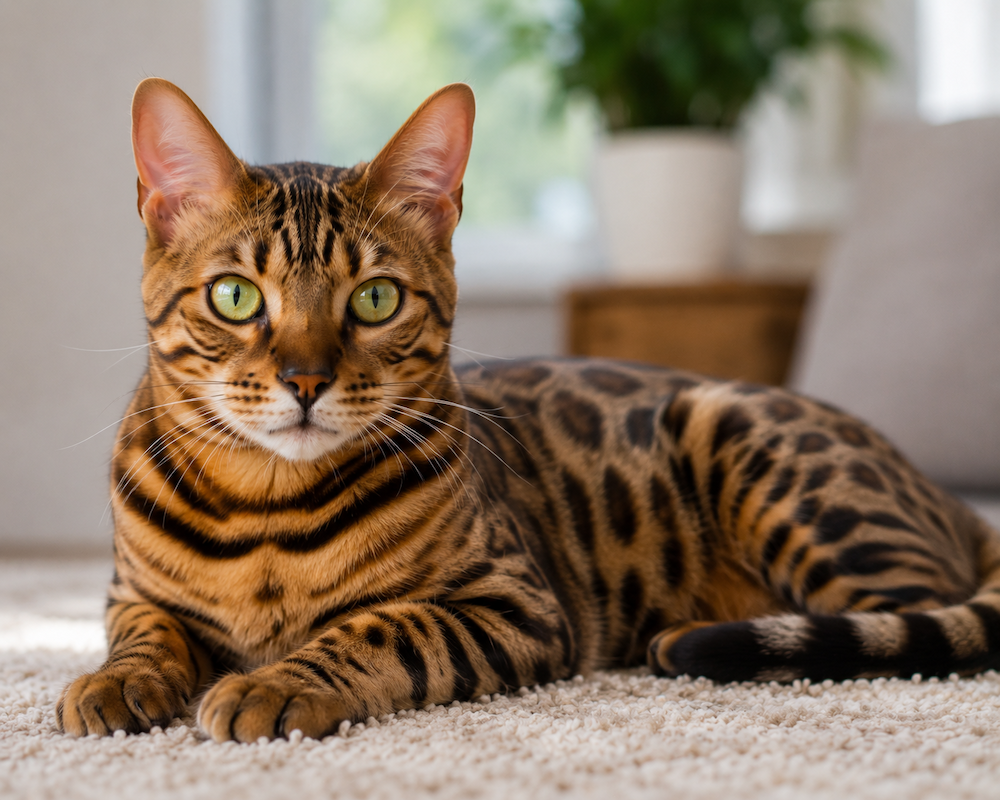







Wild-looking, energetic, and incredibly intelligent — a striking cat built for action and adventure.
🧠 QUICK SNAPSHOT
- Temperament: Energetic, intelligent, curious
- Energy Level: Very high
- Size: Medium to large
- Good With Families: Yes
- Trainability: High
- Grooming: Low
- Best For: Active households, interactive owners
📚 OVERVIEW
The Bengal is a stunning cat breed known for its wild-looking spotted coat and athletic build. Despite its exotic appearance, the Bengal is a highly social and intelligent companion that loves interaction and activity.
They are playful, curious cats that thrive in stimulating environments with plenty of climbing, exploration, and engagement.
✅ PROS & CONS
Pros
- Beautiful, exotic appearance
- Extremely intelligent and playful
- Highly interactive and social
- Low grooming requirements
Cons
- Very high energy levels
- Needs constant stimulation
- Can become destructive if bored
- Not ideal for low-interaction homes
Is a Bengal a Good Family Cat?
Yes, a Bengal can be an excellent family cat for an active household, but it is considerably more demanding than the average cat.
Bengals are intelligent, curious and highly interactive. Many form strong bonds with their owners and want to participate in almost everything happening around the home.
They can be good with respectful children, particularly those who enjoy playing and interacting with an energetic cat.
However, Bengals generally need considerably more stimulation than a typical laid-back companion cat.
If you want a cat that quietly decorates the sofa, there are easier choices. A Bengal often prefers being involved in whatever you’re doing — whether invited or not.
Can a Bengal Live Indoors or in an Apartment?
Yes, Bengals can live very successfully indoors, including in apartments, provided their environment offers sufficient enrichment.
Indoor living can also protect them from traffic, disease, fights and wildlife-related risks.
The challenge is keeping such an intelligent and athletic cat occupied.
Tall cat trees, climbing shelves, scratching posts, puzzle feeders, interactive toys and regular play sessions are extremely valuable.
Secure outdoor cat enclosures or carefully managed harness walks can provide additional stimulation.
With Bengals, usable vertical territory can be just as important as floor space.
How Much Exercise and Play Does a Bengal Need?
Bengals need considerable daily exercise and interactive play.
Several energetic play sessions throughout the day are usually more effective than simply leaving toys on the floor.
Activities that imitate hunting — stalking, chasing, climbing and pouncing — are particularly valuable.
Many Bengals also enjoy retrieving toys, learning tricks, puzzle feeders and exploring climbing structures.
Without enough stimulation, an intelligent Bengal may invent its own activities.
Unfortunately, the cat’s definition of enrichment may include opening cupboards, dismantling household objects and investigating places you believed were inaccessible.
Is a Bengal Easy to Train?
Yes, Bengals are generally exceptionally intelligent and highly trainable cats.
Many can learn to sit, come when called, retrieve toys, walk on a harness or perform tricks using clicker training and positive reinforcement.
Their intelligence also means they quickly learn how household systems work.
Some Bengals figure out doors, drawers, cupboards and even taps.
Training is particularly valuable because it provides mental stimulation as well as strengthening communication between cat and owner.
Living with a Bengal can occasionally feel less like owning a cat and more like sharing the house with a small furry engineer.
Does a Bengal Shed?
Yes, Bengals do shed, although their short coat is generally relatively easy to maintain.
Many have a sleek, close-lying coat that requires little more than occasional brushing.
Shedding levels vary between individual cats.
Bengals aren’t reliably hypoallergenic, despite claims sometimes made about the breed. People allergic to cats can still react to proteins found in saliva, skin secretions and dander.
Their coat may be easy to maintain, but it’s far more remarkable for its extraordinary pattern than its grooming requirements.
What Health Problems Are Common in Bengal Cats?
Bengals can be affected by several inherited health conditions.
Hypertrophic cardiomyopathy (HCM) is an important concern and responsible breeding programmes should include appropriate cardiac screening.
Progressive retinal atrophy (PRA-b) can cause progressive vision loss, while pyruvate kinase deficiency (PK-def) can cause haemolytic anaemia. DNA tests are available for these inherited conditions.
Patellar luxation and other health problems can also occur.
Responsible breeders should provide evidence of appropriate health testing rather than relying simply on the appearance or pedigree of their cats.
How Long Do Bengal Cats Live?
Bengal cats commonly live around 12–16 years, with some living longer.
Genetics, nutrition, body condition, veterinary care and lifestyle all influence longevity.
Indoor cats are protected from many external hazards, while regular exercise helps maintain healthy body condition.
Routine dental care and veterinary examinations are also important.
Because Bengals often remain energetic and playful well into adulthood, owners may discover that middle age does surprisingly little to reduce their enthusiasm for trouble.
Are Bengal Cats Aggressive?
Bengals are not inherently aggressive, but they can be more intense, energetic and demanding than many companion cat breeds.
Insufficient socialisation, boredom, frustration or inappropriate play can contribute to unwanted biting, scratching or rough behaviour.
Early handling and positive experiences are particularly important.
Owners should provide appropriate outlets for stalking, chasing and pouncing rather than encouraging attacks on hands and feet.
A Bengal needs stimulation and boundaries, not punishment.
Their wild appearance can make them look intimidating, but temperament depends heavily on genetics, generation, socialisation and individual personality.
Are Bengal Cats Affectionate?
Yes, many Bengals are extremely affectionate and strongly attached to their owners, although they aren’t always traditional lap cats.
A Bengal may prefer following its person around the house, supervising activities, sleeping nearby or repeatedly demanding interactive play.
Some love being held and cuddled, while others prefer affection on their own terms.
Their style of companionship is often highly interactive.
A Bengal may not spend the entire evening sitting quietly on your lap.
It may instead spend the evening helping you with absolutely everything.
Are Bengal Cats Good With Other Cats and Dogs?
Bengals can live very successfully with other cats and cat-friendly dogs, particularly when properly introduced.
Their energetic personality can make them especially compatible with confident animals that enjoy interactive play.
However, quieter or elderly pets may find an extremely active Bengal overwhelming.
Gradual introductions are important.
Small pets such as birds, rodents and reptiles require secure separation because Bengals can have strong hunting instincts.
Do Bengal Cats Like Water?
Many Bengals have a reputation for being unusually interested in water.
Some play with dripping taps, investigate showers, splash in water bowls or attempt to join their owners near baths and sinks.
However, this isn’t universal.
Individual Bengals vary considerably, and no cat should be forced into water simply because of its breed.
Their fascination with moving water can produce entertaining behaviour — although discovering your Bengal has learned how to operate a tap may make the novelty slightly less entertaining.
Are Bengal Cats Vocal?
Bengals can be very vocal and communicative cats.
Many use a surprisingly broad collection of meows, chirps, trills and other sounds to communicate with their owners.
They may vocalise when they want food, attention, play or access to somewhere interesting.
Individual cats vary, but prospective owners shouldn’t automatically expect a quiet breed.
Some Bengals seem less interested in merely living with humans than maintaining an ongoing conversation with them.
Why Do Bengal Cats Look Like Leopards?
Bengals were deliberately developed to create a domestic cat with the spotted or marbled appearance of a small wild feline.
Their coat can display striking rosettes, spots or flowing marbled patterns.
Rosettes are particularly distinctive because they contain more than one colour or shade, producing markings reminiscent of those seen on leopards and jaguars.
However, the Bengal isn’t a miniature leopard.
Its wild-looking coat reflects both selective breeding and genuine historical wild-cat ancestry.
What Is a Rosetted Bengal?
A rosetted Bengal has spots containing two or more colours or shades, rather than simple solid spots.
Different rosette patterns are sometimes described using terms such as arrowhead, paw-print, doughnut and clouded.
Rosettes contribute heavily to the dramatic leopard-like appearance for which Bengals are famous.
Not every Bengal has prominent rosettes.
Some have simpler spotted patterns, while others have marbled coats.
The extraordinary variation means two Bengals can look remarkably different while still belonging to the same breed.
What Is a Marbled Bengal?
A marbled Bengal has a coat featuring flowing horizontal swirls and contrasting bands rather than the more familiar leopard-like spots.
The pattern can create dramatic shapes across the body.
Marbling shouldn’t simply resemble the circular “bullseye” pattern commonly associated with classic tabby cats.
Selective breeding has produced highly complex Bengal marble patterns with considerable contrast and movement.
Although spotted Bengals may be more instantly recognisable, a beautifully patterned marbled Bengal can be equally spectacular.
What Is Bengal Glitter?
Some Bengals have a coat characteristic commonly called “glitter,” which causes individual hairs to reflect light and give the coat a sparkling appearance.
This isn’t actual glitter or a separate colour.
It’s an optical effect produced by the structure of the hair shaft.
Under sunlight or strong lighting, the coat can appear as though it has been dusted with gold or pearl.
Not every Bengal has glitter, and it isn’t necessary for a cat to be a Bengal.
It’s simply one of the breed’s more unusual and visually striking coat characteristics.
Are Bengal Cats Actually Part Wild Cat?
Yes. The Bengal breed has genuine historical ancestry from the Asian leopard cat (Prionailurus bengalensis), a small wild feline native to parts of Asia.
Early Bengal breeding programmes crossed Asian leopard cats with domestic cats and then bred descendants through subsequent domestic generations.
Modern pedigree Bengals are generally many generations removed from their wild ancestors and are bred as domestic companion cats.
This distinguishes the Bengal from domestic breeds that merely resemble wild cats.
However, the amount of wild ancestry and the legal treatment of Bengals can vary depending on generation and jurisdiction.
What Does F1, F2 and F3 Mean in Bengal Cats?
In Bengal terminology, F1, F2 and F3 describe early generations descending from an Asian leopard cat ancestor.
An F1 Bengal has an Asian leopard cat as one parent.
Subsequent generations are progressively further removed from the wild ancestor.
Later-generation Bengals are the cats most commonly bred and kept as domestic companions.
Terminology can become confusing because breeders and registries may use additional generation labels and breeding classifications.
The important distinction is that an early-generation hybrid can be behaviourally and legally very different from the later-generation Bengal most people recognise as a household pet.
Can You Own a Bengal Cat Everywhere?
No. Bengal ownership laws vary between countries, states and other jurisdictions, particularly for cats close to their Asian leopard cat ancestry.
Some places restrict or prohibit early-generation Bengal hybrids while allowing later-generation domestic Bengals.
Australia is a good example: importation and ownership rules have historically distinguished later-generation Bengals from cats with more recent wild ancestry.
Because regulations can change, prospective owners should check current local and national rules before purchasing or importing a Bengal.
This is particularly important if the cat’s generation isn’t clearly documented.
Where Did the Bengal Cat Come From?
The modern Bengal was developed primarily in the United States during the second half of the 20th century.
Breeder Jean Mill played a major role in establishing the breed, using descendants of crosses between domestic cats and Asian leopard cats.
During the 1970s and 1980s, breeding efforts increasingly focused on creating cats combining an exotic spotted appearance with a temperament suitable for domestic life.
The International Cat Association later became particularly important in the Bengal’s formal recognition and development.
The result is one of the most visually distinctive modern cat breeds: a domestic companion deliberately developed to retain the extraordinary appearance of its distant wild ancestors.