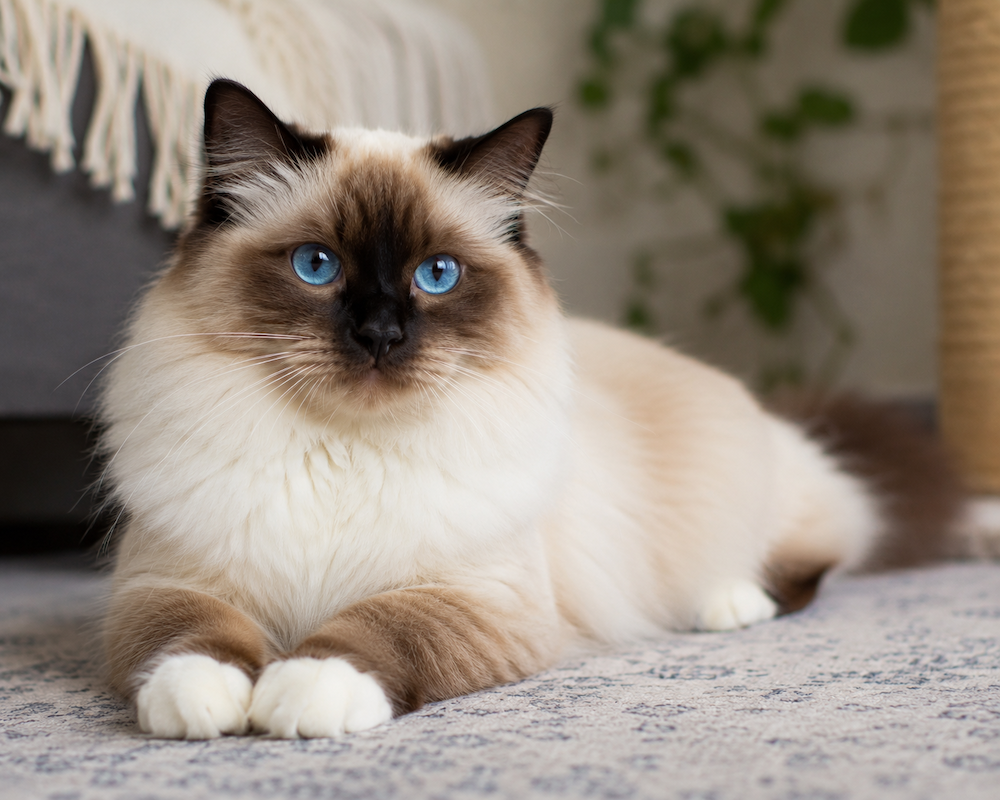







Gentle, affectionate, and famous for its brilliant blue eyes and white-gloved paws — the Birman is a beautiful companion cat that combines an elegant appearance with an exceptionally loving personality.
🧠 QUICK SNAPSHOT
- Temperament: Gentle, affectionate, sociable
- Energy Level: Moderate
- Size: Medium to Large
- Good With Families: Excellent
- Indoor Living: Excellent
- Trainability: High
- Grooming: Moderate
- Best For: Families, couples, retirees, multi-pet households, indoor homes
- Typical Lifespan: Around 12–16 years
📚 OVERVIEW
The Birman, sometimes called the Sacred Cat of Burma, is an elegant colourpoint breed instantly recognisable by its deep blue eyes, silky semi-long coat, darker face and extremities, and distinctive white “gloves” on all four paws.
Its precise early history is surrounded by mystery. Romantic legends connect Birmans with temple cats in Burma, now Myanmar, but the documented development of the modern breed is associated primarily with Europe during the early 20th century. Rather than presenting the temple story as established history, it is better understood as part of the fascinating folklore surrounding the breed.
Whatever its origins, the modern Birman has become treasured primarily for its temperament. These cats tend to be affectionate without being relentlessly demanding, playful without being hyperactive, and sociable without necessarily being as vocal as some other colourpoint breeds.
Birmans generally want to be where their people are. They may follow owners between rooms, investigate whatever the family is doing, and then settle nearby for a nap. This balance between interaction and calm companionship helps explain why the Birman has become such a popular family cat.
✅ PROS & CONS
Pros
- Exceptionally affectionate and gentle
- Usually excellent with children
- Often gets along well with other pets
- Beautiful but relatively manageable semi-long coat
- Well suited to indoor living
- Playful without being excessively energetic
Cons
- Doesn’t enjoy being routinely left alone for long periods
- Requires regular brushing
- Can shed noticeably
- Needs interactive play and enrichment
- Responsible health screening is important
- Its sociable personality may not suit owners wanting a very independent cat
Is a Birman a Good Family Cat?
Yes, the Birman is generally an excellent family cat and is particularly well known for its gentle, affectionate, and sociable temperament. Rather than attaching itself exclusively to one person, a well-socialised Birman will often develop relationships with several members of the household.
Birmans usually interact well with respectful children because they tend to be patient and enjoy attention. Children should still be taught to recognise when a cat wants space and never be allowed to pull its coat, tail, or paws.
The breed can also be an excellent choice for multi-pet households. Many Birmans live happily alongside other cats and cat-friendly dogs when introductions are handled gradually.
What they generally don’t enjoy is prolonged isolation. A Birman often wants to participate in family life and may follow people around simply to remain involved.
For households wanting an affectionate cat that provides plenty of companionship without being overwhelmingly demanding, the Birman is one of the strongest candidates.
Can a Birman Live Indoors or in an Apartment?
Yes, the Birman is very well suited to indoor and apartment living, provided its environment offers sufficient play, climbing opportunities, scratching areas, and human interaction.
Unlike highly energetic breeds that may constantly demand room to run, Birmans usually have moderate activity levels. A large house and garden are therefore unnecessary. What matters more is creating an interesting vertical environment with cat trees, shelves, window perches, scratching posts, toys, and comfortable resting places.
Indoor living can also protect cats from traffic, infectious disease, fights, predators, poisoning, and other outdoor hazards. Owners who want to provide controlled outdoor experiences can consider a secure cat enclosure or appropriately introduced harness walks.
Apartment dwellers should still provide daily interactive play rather than assuming an indoor cat will exercise itself.
A Birman’s adaptable nature, moderate energy level, and strong interest in human companionship make it particularly suitable for people seeking an affectionate indoor companion.
How Much Exercise and Play Does a Birman Need?
A Birman needs daily interactive play and mental stimulation, but it is not generally considered an extremely high-energy cat. Several play sessions of around 10–15 minutes spread throughout the day can provide a good foundation, although younger cats may want considerably more.
Fishing-wand toys, balls, toy mice, tunnels, climbing towers, puzzle feeders, and games involving stalking and chasing all encourage natural feline behaviours.
Birmans are intelligent cats, so mental exercise should not be overlooked. Food puzzles, treat hunts, clicker training, and rotating toys can help prevent boredom.
Their moderate activity level can sometimes make weight gain easy to miss, particularly once they reach middle age. Owners should monitor body condition and adjust food portions and activity accordingly.
The ideal Birman lifestyle combines bursts of energetic play with plenty of opportunities to relax near its favourite people — one moment chasing a feather toy and the next happily occupying the best seat in the house.
Does a Birman Shed?
Yes, the Birman does shed, although its beautiful semi-long coat is often easier to maintain than its appearance suggests. The coat is silky and generally has relatively little undercoat compared with some other long-haired cats, which can reduce the tendency to develop severe mats.
Brushing approximately two or three times each week helps remove loose hair, prevents tangles, and reduces the amount swallowed during self-grooming. More frequent grooming may be useful during periods of heavier seasonal shedding.
Particular attention should be paid around the legs, belly, and behind the ears, where tangles can develop.
Routine grooming also provides an opportunity to check the skin, ears, teeth, claws, and general body condition.
Despite sometimes being suggested as suitable for allergy sufferers, the Birman is not a hypoallergenic cat. Cat allergies are usually triggered by proteins found in saliva and skin secretions rather than simply the amount of visible hair a breed sheds.
What Health Problems Are Common in a Birman?
The Birman is generally a healthy breed, but prospective owners should be aware that inherited and acquired health problems can still occur. Hypertrophic cardiomyopathy (HCM), a condition in which the heart muscle becomes abnormally thickened, is an important feline health concern and should be discussed with breeders and veterinarians.
Kidney disease and urinary problems can also occur in cats, while dental disease and obesity are common issues across the wider feline population. Some inherited conditions have been documented within Birman populations, reinforcing the importance of careful breeding rather than assuming pedigree cats are automatically healthy.
Responsible breeders should be transparent about health problems within their lines and undertake appropriate screening where established tests are available.
Regular veterinary examinations, dental care, parasite prevention where appropriate, maintaining a healthy body weight, good nutrition, and monitoring changes in drinking, eating, toileting, behaviour, or activity can help identify problems early.
With responsible breeding and good lifelong care, many Birmans enjoy 12–16 years or more with their families.
⭐ Why Do Birmans Have White Paws?
The Birman’s perfectly contrasting paws are one of the breed’s defining characteristics.
A classic Birman has a colourpoint pattern similar in principle to several other breeds: the cooler parts of the body — including the face, ears, legs, and tail — develop darker pigmentation while the warmer torso remains lighter.
But the Birman adds something unusual: white spotting modifies the colour on the feet, creating the famous white gloves.
On the front paws, breeders look for neat white gloves. On the rear feet, the white markings traditionally extend farther up the back of the legs into shapes known as laces.
These markings are determined genetically, not created through grooming, and producing beautifully symmetrical gloves is far less predictable than photographs of show-winning Birmans might suggest.
Add those white paws to vivid blue eyes, a silky coat, and dark colourpoints and you get one of the most immediately recognisable appearances in the cat world.
⭐ Is the “Sacred Cat of Burma” Story True?
The Birman has one of the most enchanting origin stories of any cat breed.
According to the famous legend, white cats lived alongside priests in temples in Burma. After one cat remained beside a dying priest, a miraculous transformation supposedly gave the animal golden fur, sapphire-blue eyes, darker extremities, and pure white paws symbolising the priest’s purity.
It’s a wonderful story.
It is not, however, firmly documented historical fact.
The reliably recorded development of the modern Birman is associated with Europe in the early 20th century, and parts of its earliest pedigree history remain uncertain.
That distinction actually makes the Birman’s story more interesting rather than less. The breed carries both a genuine modern breeding history and a much older romantic legend that became inseparable from its identity.
So the safest answer is: the Birman really is commonly known as the Sacred Cat of Burma, but the temple-cat origin should be enjoyed as legend rather than presented as proven history.