





Brilliant, energetic, and incredibly loyal — an intelligent companion that thrives on activity, learning, and family life.
🧠 QUICK SNAPSHOT
- Temperament: Intelligent, loyal, energetic
- Energy Level: High
- Size: Medium
- Good With Families: Yes
- Trainability: Very high
- Grooming: Moderate to high
- Best For: Active families, experienced owners, training enthusiasts
📚 OVERVIEW
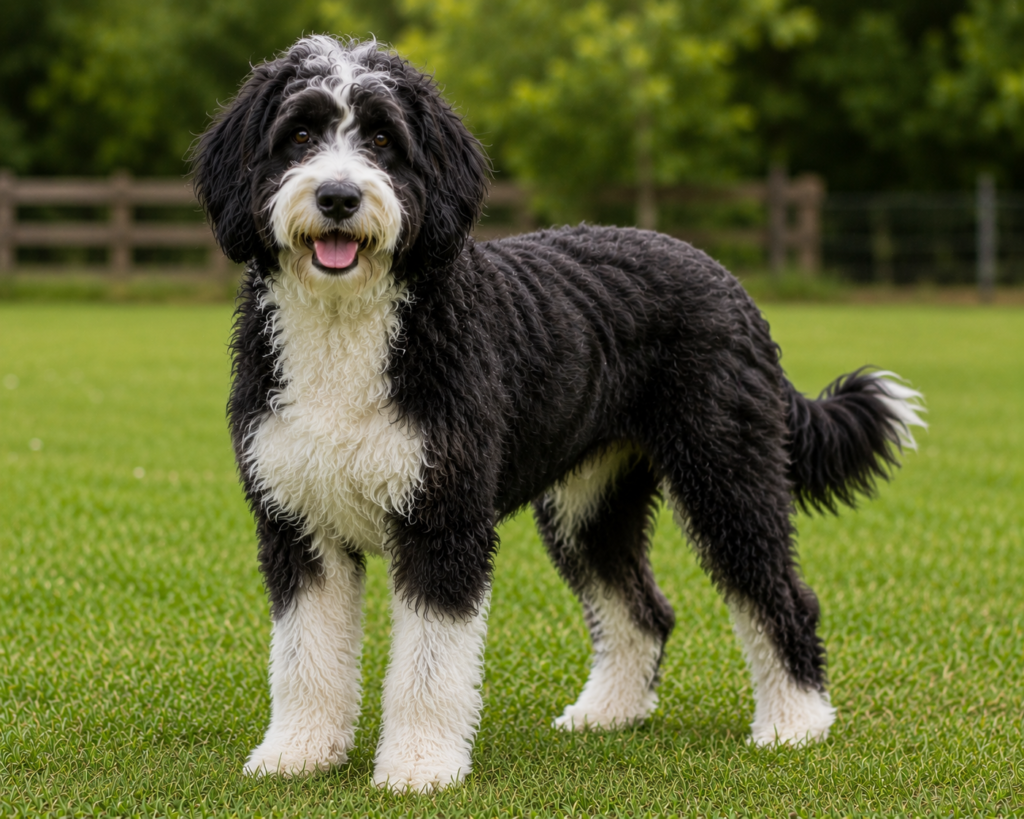
The Bordoodle is a cross between a Border Collie and a Poodle, combining two of the most intelligent dog breeds in the world. Known for their sharp minds, affectionate nature, and eagerness to learn, Bordoodles excel in active households where they can stay mentally and physically engaged.
They form strong bonds with their family and are happiest when they have a purpose, whether that’s training, dog sports, outdoor adventures, or simply being involved in everyday life.
✅ PROS & CONS
Pros
- Extremely intelligent and trainable
- Loyal and affectionate with family
- Often low shedding depending on coat type
- Excellent companion for active lifestyles
Cons
- Requires significant mental stimulation
- High exercise needs
- Can become destructive if bored
- Needs regular grooming and coat maintenance
Is a Bordoodle a Good Family Dog?
Yes, a Bordoodle can be an excellent family dog, particularly for active households wanting an intelligent, affectionate and highly interactive companion.
The Bordoodle is a cross between a Border Collie and a Poodle, usually a Standard or Miniature Poodle. Both parent breeds are exceptionally intelligent, so Bordoodles are often quick learners that become closely involved in family life.
They can be very good with respectful children, although some may inherit the Border Collie’s tendency to herd running youngsters.
Individual temperament can vary considerably because the Bordoodle isn’t a standardised breed.
How Much Exercise Does a Bordoodle Need?
Most adult Bordoodles need around 60–90 minutes of exercise each day, although particularly energetic dogs may need considerably more.
Walking, hiking, retrieving, swimming and dog sports can all provide useful physical activity.
Mental exercise is equally important.
Puzzle toys, scent games, obedience and trick training can help satisfy a dog descended from two breeds famous for their intelligence.
Simply trying to physically exhaust a Bordoodle can produce an extremely fit dog that is still looking for something to think about.
Is a Bordoodle Easy to Train?
Bordoodles are generally extremely intelligent and highly trainable.
Border Collies are renowned working dogs, while Poodles were developed as intelligent water retrievers and have excelled in numerous training disciplines.
Positive reinforcement and varied training sessions usually produce excellent results.
However, clever dogs also notice inconsistencies very quickly.
A bored Bordoodle may invent its own entertainment, and that entertainment may involve doors, cupboards or household objects you didn’t realise could become puzzles.
Does a Bordoodle Shed?
A Bordoodle’s shedding can range from very low to moderate or even substantial, depending on the coat inherited.
Dogs with strongly Poodle-like curly coats may shed relatively little.
Those inheriting more of the Border Collie’s double coat can shed noticeably, particularly during seasonal coat changes.
Some Bordoodles develop a wavy coat somewhere between the two.
Because coat genetics vary, no breeder can guarantee exactly how much every puppy will shed simply because one parent is a Poodle.
Is a Bordoodle Hypoallergenic?
No Bordoodle can be guaranteed to be hypoallergenic.
Some curly-coated individuals shed relatively little and may be better tolerated by certain people with allergies.
However, dog allergens are produced in saliva, dander and other secretions, not simply in shed hair.
A Bordoodle inheriting more Border Collie coat characteristics may also shed considerably more than expected.
Anyone with significant allergies should spend time around similar adult dogs before choosing this cross.
How Often Does a Bordoodle Need Grooming?
Most Bordoodles require brushing several times each week, while curly or particularly dense coats may need daily attention.
Professional grooming may be required approximately every six to eight weeks for dogs with continuously growing Poodle-type coats.
Wavy coats can be particularly deceptive because mats can form close to the skin while the surface still looks tidy.
Dogs with more Border Collie-like coats may require less clipping but can shed considerably more.
The Bordoodle can therefore inherit either parent’s coat maintenance requirements — or occasionally the complicated parts of both.
What Health Problems Are Common in Bordoodles?
Bordoodles can potentially inherit health conditions found in both Border Collies and Poodles.
Concerns can include hip dysplasia, inherited eye diseases and epilepsy.
Border Collies are associated with genetic disorders including Collie Eye Anomaly, trapped neutrophil syndrome and neuronal ceroid lipofuscinosis, while Poodle lines can carry conditions including progressive retinal atrophy and other inherited disorders.
The relevant risks also depend on whether a Standard, Miniature or Toy Poodle is involved.
Responsible breeders should health-test both parent breeds appropriately rather than assuming crossbreeding automatically eliminates genetic disease.
How Long Do Bordoodles Live?
Bordoodles commonly live around 12–15 years, although lifespan varies according to size, genetics and general health.
Dogs produced using smaller Poodles may sometimes have greater longevity than particularly large individuals.
Maintaining a healthy body weight, providing regular exercise and arranging preventive veterinary care can support a long life.
Dental health and regular grooming are also important.
Many Bordoodles remain active and mentally engaged well into their senior years.
How Big Does a Bordoodle Get?
Bordoodles vary considerably in size because different sizes of Poodle can be crossed with a Border Collie.
Many Standard Bordoodles weigh approximately 18–30 kg, although dogs can fall outside this range.
Mini Bordoodles are generally smaller.
Labels such as “Mini”, “Medium” and “Standard” aren’t universally standardised, so prospective owners should ask for the actual size of both parents.
With a crossbreed, parental size provides far more useful information than an attractive marketing label.
Can a Bordoodle Live in an Apartment?
A Bordoodle can live in an apartment, but its exercise and mental stimulation requirements are more important than its physical size.
A well-exercised Bordoodle that receives plenty of training and enrichment may settle very well indoors.
An under-stimulated one can become vocal, destructive or develop repetitive behaviours.
Dogs strongly influenced by the Border Collie may also react to movement outside windows or in communal areas.
Apartment living is possible, but a small home doesn’t create a low-energy dog.
Can a Bordoodle Be Left Alone?
Bordoodles can learn to spend reasonable periods alone, but many are strongly people-oriented and shouldn’t routinely be isolated for long days.
Both parent breeds were developed to work closely with humans.
Without sufficient exercise and mental stimulation, an intelligent Bordoodle may become bored remarkably quickly.
Gradual independence training should begin during puppyhood.
It’s also useful to teach the dog how to relax rather than providing entertainment every waking minute.
Are Bordoodles Good With Other Dogs?
Bordoodles are generally good with other dogs when properly socialised.
Many enjoy canine companionship and interactive play.
However, individuals inheriting strong Border Collie characteristics may stare, stalk or attempt to control the movement of other dogs.
Some dogs find this intense herding behaviour uncomfortable.
Early socialisation should therefore encourage relaxed, appropriate interactions rather than simply allowing constant high-energy play.
Are Bordoodles Good With Cats?
Yes, many Bordoodles can live successfully with cats, particularly when raised with them.
However, the Border Collie’s herding instinct can appear around feline housemates.
Running cats may trigger staring, stalking or chasing.
Poodles also have sporting and retrieving ancestry, so individual prey drive shouldn’t be ignored.
Training the dog to disengage and settle around cats is important, and cats should always have safe areas inaccessible to the dog.
Do Bordoodles Like Water?
Many Bordoodles enjoy swimming and playing in water, particularly if they inherit this characteristic from their Poodle parent.
Despite their modern reputation for elaborate grooming, Poodles were originally developed as water retrievers.
Border Collies can also be enthusiastic swimmers.
Individual preferences vary, so dogs should never be forced into water.
Curly and dense coats should be thoroughly dried and checked after swimming because moisture trapped near the skin can contribute to irritation and matting.
Do Bordoodles Herd People?
Some Bordoodles can display strong herding behaviour, inherited from the Border Collie.
They may stare, stalk, circle or chase running children and occasionally nip towards heels.
Movement from cyclists, joggers or other animals can also trigger this behaviour.
Owners should redirect these instincts rather than allowing repeated chasing to become established.
Dog sports, structured retrieving, training and controlled herding activities can provide safer outlets.
Not every Bordoodle will herd, but it’s an important possibility when one parent is arguably the world’s most famous sheepdog.
Are Bordoodles Smarter Than Other Dogs?
Bordoodles can be exceptionally intelligent, but claims that they’re definitively “smarter” than every other dog should be treated cautiously.
Both parent breeds are famous for trainability, problem-solving and responsiveness to human cues.
Border Collies excel at complex herding work, while Poodles have long histories as retrievers, performers and highly trainable working dogs.
A Bordoodle may therefore learn commands extraordinarily quickly.
That intelligence is an advantage only when owners provide something constructive for the dog to do with it.
What Colours Can Bordoodles Be?
Bordoodles can occur in a wide variety of colours and patterns because both parent breeds contribute considerable coat-colour diversity.
Black and white is common because of the Border Collie influence, but Bordoodles can also appear in brown, cream, red, apricot, grey, merle and various combinations.
Some coats may change colour as the dog matures because certain Poodle colour genes can cause progressive fading.
Colour should never be prioritised over health and temperament.
Particular care is needed around merle-to-merle breeding, which can substantially increase the risk of hearing and vision abnormalities in puppies.
What Is an F1, F1B or F2 Bordoodle?
These terms describe different generations of Bordoodle breeding.
An F1 Bordoodle is usually a first-generation Border Collie crossed with a Poodle.
An F1B Bordoodle generally results from breeding an F1 Bordoodle back to one of the parent breeds, commonly a Poodle.
An F2 Bordoodle usually results from breeding two F1 Bordoodles.
These labels describe ancestry, not guaranteed outcomes.
An F1B puppy isn’t automatically non-shedding, hypoallergenic or identical in temperament to its littermates.
Is a Bordoodle a Recognised Dog Breed?
The Bordoodle is generally considered a designer crossbreed rather than a standardised pedigree breed.
Major traditional kennel clubs don’t recognise it in the same way they recognise Border Collies or Poodles.
There is therefore no universally accepted breed standard determining its exact size, coat, colour or temperament.
This explains why individual Bordoodles can look remarkably different from one another.
The name reliably tells you the two breeds behind the dog — but considerably less about exactly what the adult puppy will become.
Does Crossing a Border Collie With a Poodle Make Bordoodles Healthier?
Crossbreeding can potentially increase genetic diversity, but it doesn’t automatically produce healthier dogs.
A puppy can still inherit disease-associated genes from either parent.
Health outcomes depend heavily on the genetic health of the parents, responsible selection and avoiding combinations that introduce unnecessary risk.
Good Bordoodle breeding therefore requires knowledge of both Border Collie and Poodle health, along with appropriate DNA, eye and orthopaedic screening.
“Hybrid vigour” should never be used as an excuse to skip health testing.
Is a Bordoodle the Same as a Borderdoodle?
Yes. Bordoodle and Borderdoodle generally refer to the same Border Collie–Poodle cross.
Other names occasionally appear, but Bordoodle has become one of the most commonly used.
Because the cross isn’t governed by one universal breed registry, naming conventions aren’t completely standardised.
Whatever name is used, prospective owners should focus on the actual parents, health testing, temperament and early socialisation rather than the label.
Where Did the Bordoodle Come From?
The precise origin of the Bordoodle is not well documented, and there doesn’t appear to be one universally accepted breeder or date responsible for creating the cross.
Border Collie–Poodle crosses became increasingly popular as deliberately bred Poodle crosses expanded during the late 20th and early 21st centuries.
The combination is easy to understand: both parent breeds are exceptionally intelligent and trainable, while the Poodle can potentially contribute a lower-shedding coat.
Accidental crosses almost certainly existed earlier, but the modern Bordoodle emerged as part of the much broader designer-dog movement.
Its appeal ultimately comes from trying to combine two of the canine world’s most famously clever breeds in one dog.