






Powerful, intelligent, and fiercely loyal — a versatile working dog with a calm nature and an unwavering devotion to its family.
🧠 QUICK SNAPSHOT
- Temperament: Loyal, intelligent, protective
- Energy Level: High
- Size: Large
- Good With Families: Yes
- Trainability: Very high
- Grooming: High
- Best For: Active families, experienced owners, working homes
📚 OVERVIEW
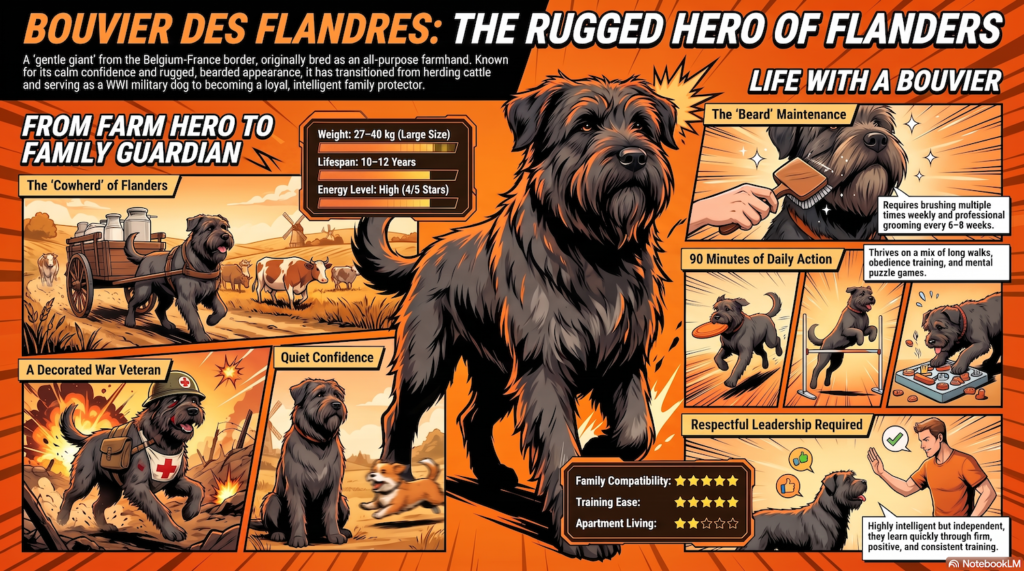
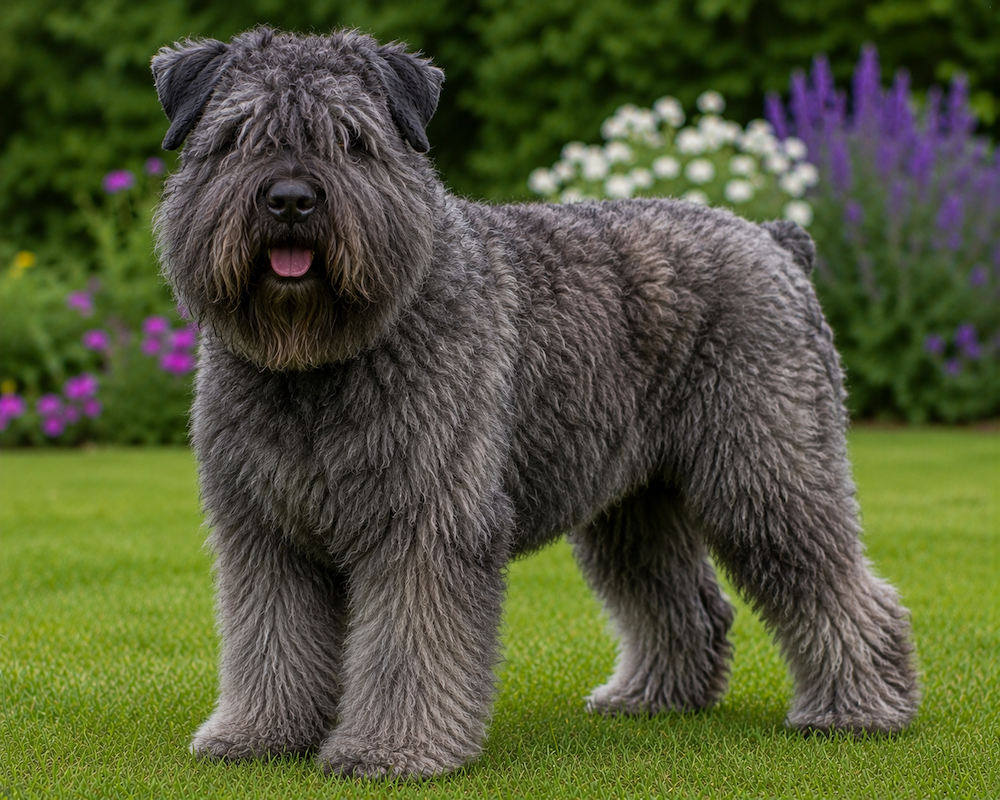
The Bouvier des Flandres is a powerful working breed that originated in Belgium, where it was developed to herd cattle, pull carts, and guard farms. Known for its rugged appearance, dense beard, and muscular build, the Bouvier is both an outstanding worker and a devoted family companion.
Despite its imposing size, the Bouvier is calm, affectionate, and dependable with those it knows. It thrives when given a purpose and enjoys being actively involved in family life.
✅ PROS & CONS
Pros
- Extremely loyal and protective
- Highly intelligent and trainable
- Calm and dependable temperament
- Excellent working and family dog
Cons
- Requires regular grooming
- Needs significant daily exercise
- Benefits from experienced handling and training
- Can be reserved with strangers
Is a Bouvier des Flandres a Good Family Dog?
Yes, a Bouvier des Flandres can be an excellent family dog for experienced owners, particularly those wanting a loyal, calm and naturally protective companion.
Bouviers tend to form strong bonds with their families and can be patient and affectionate with children they know. However, they’re large, powerful dogs, so supervision around younger children is important.
They can be reserved with strangers and possess genuine guarding instincts.
A well-bred, properly socialised Bouvier should be confident and stable rather than unnecessarily aggressive.
How Much Exercise Does a Bouvier des Flandres Need?
Most adult Bouviers need around 60–90 minutes of exercise each day, combined with regular mental stimulation.
Walking, hiking, obedience, tracking, herding and other dog sports can all suit the breed.
They’re substantial working dogs, but they aren’t usually as relentlessly energetic as breeds such as the Border Collie or Belgian Malinois.
Mental work is particularly valuable.
A Bouvier with a useful job to perform is generally much happier than one whose daily responsibility is simply deciding which section of the sofa to occupy.
Is a Bouvier des Flandres Easy to Train?
The Bouvier des Flandres is highly intelligent and trainable, but it can also be independent and strong-minded.
These dogs were developed to perform practical farm work, so they needed the ability to think for themselves.
Training should begin early and remain consistent throughout life.
Positive reinforcement combined with clear boundaries generally works well.
Because an adult Bouvier can weigh 40 kg or more, loose-lead walking and polite behaviour around people should be established long before the dog reaches full size.
Does a Bouvier des Flandres Shed?
The Bouvier des Flandres is generally a relatively low-shedding breed, but its coat requires considerable maintenance.
The harsh outer coat and dense undercoat tend to trap loose hair rather than depositing enormous quantities around the home.
Regular brushing is essential to prevent mats and remove dead coat.
Professional grooming or experienced home grooming is generally required every few weeks.
Low shedding definitely doesn’t mean low maintenance with a Bouvier.
Is a Bouvier des Flandres Hypoallergenic?
The Bouvier is sometimes described as hypoallergenic because it sheds relatively little, but no dog is completely allergen-free.
Dog allergens are produced in saliva, dander and other secretions rather than simply the coat.
Some allergy sufferers may tolerate an individual Bouvier better than a heavily shedding breed, while others may still react strongly.
Anyone with significant allergies should spend time around adult Bouviers before deciding whether the breed is suitable.
What Health Problems Are Common in Bouvier des Flandres?
Bouviers can be affected by several inherited and large-breed health conditions.
Hip and elbow dysplasia are important concerns, along with certain eye disorders and cardiac problems.
The breed can also be affected by laryngeal paralysis and other conditions within some bloodlines.
As a large, deep-chested dog, the Bouvier is also vulnerable to gastric dilatation-volvulus (GDV or bloat).
Responsible breeders should undertake appropriate orthopaedic, eye and cardiac screening and understand health issues within their breeding lines.
How Long Do Bouvier des Flandres Live?
Bouviers generally live around 10–12 years, although some live longer.
Maintaining a lean body condition is particularly important for protecting joints and mobility.
Regular exercise, appropriate nutrition and preventive veterinary care can support healthy ageing.
Because the Bouvier’s thick coat can conceal changes in body condition, owners should physically check the dog’s ribs and overall condition rather than relying purely on appearance.
How Big Does a Bouvier des Flandres Get?
The Bouvier des Flandres is a large, powerful and heavily built dog.
Adults generally stand approximately 59–70 cm at the shoulder, with males typically larger than females.
Weight often falls somewhere around 27–45 kg, although individuals vary.
Their dense coat can make them appear even more substantial than they actually are.
Despite their rugged appearance, a properly built Bouvier should remain agile and capable of sustained work rather than simply being massive.
Can a Bouvier des Flandres Live in an Apartment?
A Bouvier can live in a sufficiently spacious apartment with a very committed owner, but it isn’t usually the easiest apartment breed.
The dog’s physical size is only part of the issue.
Bouviers require daily exercise, training and mental stimulation, and their guarding instincts can make busy communal environments challenging.
A securely fenced home with more space is generally easier.
However, having a large backyard doesn’t replace interaction and exercise.
Can a Bouvier des Flandres Be Left Alone?
A mature Bouvier can learn to spend reasonable periods alone, but it shouldn’t routinely be isolated from its family.
These dogs tend to form strong attachments to their people and historically worked in close association with farmers.
Long periods of boredom can contribute to destructive or unwanted behaviour.
Puppies should gradually learn independence and how to settle quietly.
A Bouvier generally wants to be part of the household, even when its preferred contribution is simply supervising everything from the floor.
Are Bouviers Good Guard Dogs?
Yes. The Bouvier des Flandres can be an excellent natural guardian.
Historically, Bouviers protected farms, livestock and property in addition to performing other agricultural work.
They tend to be observant, confident and somewhat reserved with unfamiliar people.
Their size and imposing appearance also provide a substantial visual deterrent.
Most family Bouviers don’t need specialised protection training. Early socialisation, stability and excellent obedience are much more important.
Are Bouvier des Flandres Aggressive?
A properly bred and socialised Bouvier shouldn’t be indiscriminately aggressive.
However, the breed can be naturally protective, territorial and reserved with strangers.
These characteristics require responsible management because the Bouvier is an exceptionally powerful dog.
Early socialisation should expose puppies positively to different people, animals and environments.
The goal isn’t to eliminate the breed’s natural confidence but to produce a dog capable of distinguishing ordinary life from situations that genuinely require concern.
Are Bouviers Good With Other Dogs?
Bouviers can live successfully with other dogs, particularly when appropriately socialised from puppyhood.
Individual temperament varies, and some adults can be assertive around unfamiliar dogs.
Same-sex tension can occur in some individuals.
Their large size means owners should establish reliable control rather than depending on physical strength if disagreements occur.
Careful introductions and supervision are particularly important when adding an adult Bouvier to an existing multi-dog household.
Are Bouviers Good With Cats?
Yes, many Bouviers can live successfully with cats, particularly when raised alongside them.
Their herding background can sometimes result in attempts to follow or control a cat’s movement.
Individual prey drive also varies.
Early introductions should be supervised, and cats should have elevated or dog-free areas available.
A familiar household cat may receive a very different response from an unfamiliar animal running outdoors.
Do Bouviers Bark a Lot?
Bouviers aren’t usually considered constant barkers, but they can be serious alert dogs.
They may bark when strangers approach the home or when something unusual occurs around their territory.
A well-adjusted adult often has little reason to vocalise continuously.
Boredom, insufficient exercise and excessive territorial behaviour can increase barking.
When a Bouvier does decide something deserves an announcement, its deep voice tends to make the message fairly convincing.
Why Does a Bouvier des Flandres Have a Beard?
The Bouvier’s characteristic beard, moustache and heavy eyebrows are created by the breed’s coarse facial coat.
This rugged coat provided protection while working outdoors in the harsh weather of northern Europe.
The beard is now one of the breed’s most recognisable features.
It also possesses a remarkable ability to retain drinking water and redistribute it around the house immediately afterwards.
Bouvier owners quickly discover that the beard is both magnificent and surprisingly absorbent.
What Colours Can a Bouvier des Flandres Be?
Bouviers are commonly seen in black, grey, brindle, salt-and-pepper and fawn shades, depending on the breed standard involved.
Their harsh coat and darker colouring contribute to the breed’s rugged appearance.
A small white marking on the chest may be permitted under some standards.
Colour should always be secondary to health, temperament, structure and working soundness.
What Does Bouvier des Flandres Mean?
The French name Bouvier des Flandres essentially means “cattle dog of Flanders” or “cowherd of Flanders.”
“Bouvier” is associated with cattle driving or cattle handling, while “Flandres” refers to Flanders.
The name describes exactly what these dogs originally did.
They were practical farm dogs used to move cattle and perform numerous other agricultural jobs.
Long before they became show dogs and companions, their name was essentially their job title and home address combined.
What Were Bouviers Originally Bred to Do?
Bouviers were developed as versatile farm dogs rather than specialists performing only one task.
They drove and managed cattle, guarded livestock and farms, pulled carts and helped with general agricultural work.
Their strength, intelligence and weather-resistant coats made them particularly valuable in the demanding conditions of Flanders.
Dogs incapable of useful work had little reason to be maintained on working farms.
This practical background explains the modern Bouvier’s combination of strength, independence, trainability and protective instinct.
Did Bouviers Really Pull Carts?
Yes. Bouviers were historically used as draught dogs, pulling carts loaded with agricultural goods.
One particularly interesting job involved helping transport containers of milk and dairy products.
Dogs were useful sources of pulling power on farms where keeping additional horses could be expensive.
The Bouvier’s muscular body and substantial frame made it well suited to this work.
Its historical résumé therefore included cattle herder, guardian and four-legged farm transport.
Were Bouviers Used During the World Wars?
Yes. Bouviers served in military roles during the World Wars, particularly as messenger, ambulance and general service dogs.
Their intelligence, physical strength and ability to work in difficult conditions made them useful during wartime.
Unfortunately, the wars devastated the breed’s homeland and dramatically reduced its population.
Dedicated breeders subsequently worked to rebuild the breed from surviving dogs.
The Bouvier’s survival is particularly remarkable because Flanders itself became one of the major battlefields of the First World War.
Who Was Nic de Sottegem?
Nic de Sottegem was one of the most influential early Bouviers and is frequently mentioned in the history of the modern breed.
He was a powerful working dog that served during the First World War and later became important in breeding programmes.
His qualities helped influence the Bouvier population that survived and was rebuilt after the war.
As with many old breeds, exact historical accounts can vary, but Nic de Sottegem occupies an important place in Bouvier breed history.
Did a Bouvier des Flandres Live in the White House?
Yes. U.S. President Ronald Reagan and First Lady Nancy Reagan owned a Bouvier des Flandres named Lucky.
Lucky arrived at the White House as a puppy in the 1980s.
She quickly grew into a very large, energetic dog, and photographs of President Reagan walking — or occasionally appearing to be pulled by — Lucky became memorable images.
Lucky later spent much of her life at the Reagans’ California ranch, where there was considerably more room for a powerful Bouvier.
Where Does the Bouvier des Flandres Come From?
The Bouvier des Flandres originated in Flanders, a historical region spanning parts of modern Belgium and France.
Farmers developed rugged dogs capable of driving cattle, guarding property, pulling carts and performing whatever other work was required.
Because practical working ability mattered more than appearance, early Bouviers weren’t completely uniform.
Efforts to standardise the breed accelerated during the early 20th century, but the First World War devastated its homeland and population.
Breeders rebuilt the Bouvier after the war, preserving the tough multipurpose farm dog we recognise today.
Even its name still tells the story: the cattle dog of Flanders.