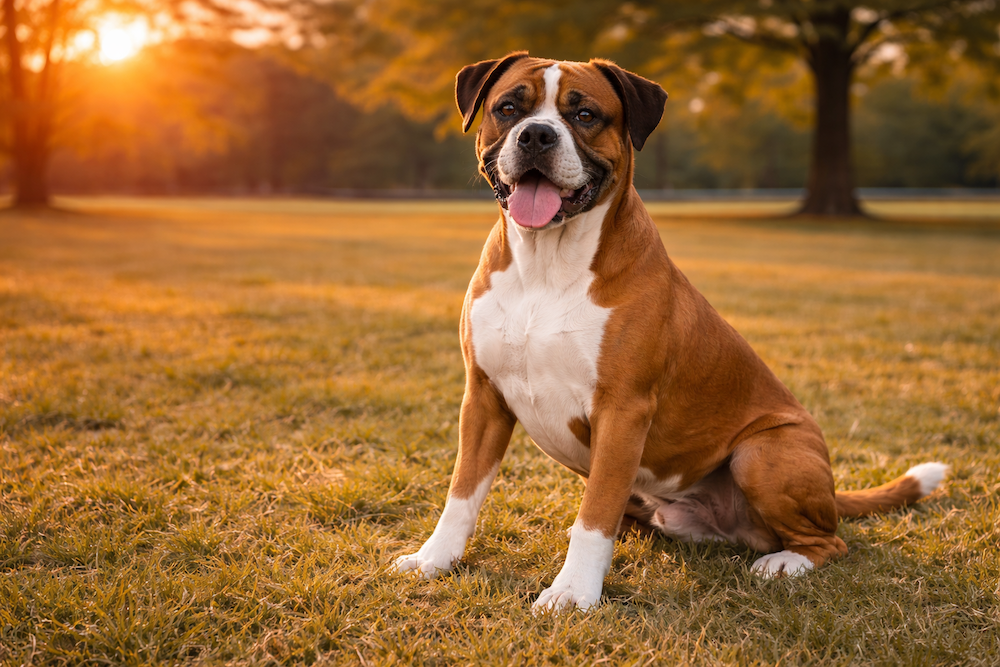







Playful, loyal, and full of energy — a fun-loving companion with a protective side.
🧠 QUICK SNAPSHOT
- Temperament: Playful, Loyal, Protective
- Energy Level: High
- Size: Medium–Large
- Good with Families: Excellent
- Training Difficulty: Moderate
📚 OVERVIEW
Boxers are strong, athletic dogs known for their playful nature and expressive faces. Originally bred as working dogs, they are energetic, intelligent, and form strong bonds with their families. Their combination of fun-loving personality and natural protectiveness makes them a popular choice for active households.
✅ PROS & CONS
Pros
- Great with children and families
- Playful and full of personality
- Loyal and protective
Cons
- High energy requires daily exercise
- Can be boisterous, especially when young
- Needs consistent training and structure
Is a Boxer a Good Family Dog?
Yes, the Boxer can be an excellent family dog, particularly for an active household.
Boxers are famously affectionate, playful and deeply attached to their families. Many are wonderful with children, although their strength and enthusiasm mean they can accidentally knock over smaller youngsters.
They’re often described as dogs that remain puppy-like well into adulthood.
A Boxer generally doesn’t want to watch family life from across the room. It prefers being directly involved in whatever everyone else is doing.
How Much Exercise Does a Boxer Need?
Most adult Boxers need around 60–90 minutes of exercise each day, combined with play and mental stimulation.
Walking, training, games and controlled running can all be excellent activities.
However, Boxers are brachycephalic, meaning their shortened muzzle can reduce their ability to cool themselves efficiently.
Exercise needs to be carefully managed in hot or humid weather.
A Boxer may be extremely enthusiastic about continuing to play even when its body is telling a rather different story.
Is a Boxer Easy to Train?
Boxers are intelligent and highly trainable, but they can also be exuberant, playful and occasionally stubborn.
Positive reinforcement works particularly well.
Training should begin early because a bouncing 8 kg puppy soon becomes a powerful adult capable of enthusiastically greeting visitors at approximately chest height.
Loose-lead walking, recall, calm greetings and impulse control are especially valuable.
Boxers also benefit enormously from learning how to relax rather than assuming every waking moment has been scheduled for entertainment.
Does a Boxer Shed?
Yes. Boxers shed moderately throughout the year, despite their very short coats.
Shedding may increase seasonally.
Weekly brushing with a soft brush or grooming mitt is generally enough to remove loose hair and keep the coat healthy.
Their grooming requirements are relatively low compared with long-coated breeds.
However, short Boxer hairs have an impressive ability to embed themselves into clothing and furniture despite appearing almost too small to cause trouble.
What Health Problems Are Common in Boxers?
Boxers have several significant inherited health concerns.
The breed has an increased risk of certain heart diseases, including arrhythmogenic right ventricular cardiomyopathy, sometimes called Boxer cardiomyopathy, and aortic/subaortic stenosis.
Boxers also have an elevated risk of several cancers, including mast cell tumours and lymphoma.
Hip problems, degenerative myelopathy and certain neurological conditions can occur as well.
Their brachycephalic head shape can contribute to breathing and heat-tolerance problems.
Responsible breeding and appropriate cardiac and genetic screening are particularly important in this breed.
How Long Do Boxers Live?
Boxers generally live around 10–12 years, although individual lifespan varies.
Cancer and heart disease are significant contributors to premature death within the breed.
Maintaining a healthy weight, providing appropriate exercise and arranging regular veterinary examinations can help identify problems earlier.
Owners should also become familiar with any breed-specific health screening recommended in their country.
A healthy senior Boxer may slow physically while remaining remarkably convinced that it’s still a puppy.
How Big Does a Boxer Get?
The Boxer is a medium-to-large, muscular dog.
Adult males typically stand around 57–63 cm at the shoulder, while females are generally around 53–59 cm.
Weight commonly falls somewhere around 25–36 kg, depending on sex and build.
A Boxer should look powerful and athletic rather than excessively heavy.
The breed was developed for demanding work, and its characteristic muscular body should still allow efficient, energetic movement.
Can a Boxer Live in an Apartment?
Yes, a Boxer can live successfully in an apartment if its exercise and stimulation requirements are properly met.
They’re active outdoors but can become surprisingly relaxed inside once exercised.
Their physical size, enthusiasm and tendency to bounce around should still be considered.
Apartment owners also need reliable access to outdoor exercise.
Air conditioning or another effective cooling option can be particularly valuable in hot climates because Boxers may struggle with excessive heat.
Can a Boxer Be Left Alone?
Boxers can learn to spend reasonable periods alone, but they’re strongly people-oriented dogs.
Many form extremely close attachments to their families.
Long periods of isolation can contribute to boredom, destructive behaviour or separation-related problems.
Independence training should begin gradually during puppyhood.
Appropriate chews, enrichment and sufficient exercise can help, but the Boxer generally isn’t an ideal choice for someone wanting a dog that spends most of every day alone.
Do Boxers Bark a Lot?
Boxers generally aren’t considered constant barkers, although they can be excellent alert dogs.
They may bark when someone approaches the home or when something unusual catches their attention.
Boredom and insufficient exercise can increase barking.
Boxers also communicate through an entertaining collection of grumbles, snorts, whines and other noises.
Some owners discover that their Boxer doesn’t bark excessively because it has developed several alternative methods of expressing an opinion.
Are Boxers Good Guard Dogs?
Yes. Boxers can be excellent natural watchdogs and family guardians.
They’re typically alert, courageous and strongly attached to their household.
Their muscular appearance alone can provide a substantial deterrent.
A stable Boxer shouldn’t be indiscriminately aggressive towards unfamiliar people.
Most family Boxers don’t need specialised protection training. Excellent socialisation and obedience are much more important for developing a trustworthy adult dog.
Are Boxers Aggressive?
A well-bred, properly socialised Boxer shouldn’t be indiscriminately aggressive.
The breed is naturally confident and can be protective, but most Boxers are playful and affectionate family companions.
Individual temperament, genetics, socialisation and training all matter.
Dog-to-dog conflict can occur, particularly between some same-sex adults.
Because Boxers are physically powerful, early socialisation and reliable owner control are particularly important.
Are Boxers Good With Other Dogs?
Many Boxers are very sociable and playful with other dogs, particularly when properly socialised.
Their play style can be physical, involving wrestling, chasing and bouncing.
This enthusiasm can overwhelm quieter dogs.
Some adult Boxers can also develop same-sex intolerance.
Careful introductions and appropriate supervision are therefore important, particularly when adding another adult dog to the household.
Are Boxers Good With Cats?
Boxers can often live successfully with cats, especially when raised alongside them.
However, individual prey drive varies, and some Boxers enjoy chasing animals that run.
Early introductions should be calm and supervised.
Cats should have elevated areas or rooms where they can retreat from the dog.
A Boxer may genuinely love the household cat while still remaining extremely interested in an unfamiliar cat sprinting across the garden.
Can Boxers Swim?
Some Boxers can swim, but many aren’t particularly strong or naturally efficient swimmers.
Their muscular bodies, deep chests and relatively short muzzles can make swimming more difficult.
Dogs should always be supervised around pools and open water.
A properly fitted canine life jacket can provide additional safety around boats or deeper water.
Never assume that an athletic dog automatically knows how to swim safely.
Can Boxers Handle Hot Weather?
Boxers can have significant difficulty in hot and humid conditions because of their shortened muzzle.
Dogs primarily regulate body temperature through panting, and brachycephalic airway anatomy can make this cooling process less efficient.
Exercise should be scheduled during cooler parts of the day, and dogs should have constant access to shade and fresh water.
Strenuous activity should stop immediately if the dog appears distressed.
Heatstroke can become life-threatening extremely quickly.
Why Does a Boxer Have Such a Short Face?
The Boxer’s shortened muzzle results from generations of selective breeding for brachycephalic head shape.
Historically, a broad, powerful jaw was considered useful in the breed’s ancestors, which were used to seize and hold large animals.
Modern breeding further established the characteristic Boxer head.
Unfortunately, extreme shortening can compromise airway function.
Responsible breeding should preserve recognisable breed characteristics while prioritising functional breathing, exercise tolerance and overall health.
Why Do Boxers Use Their Front Paws So Much?
Boxers are famous for using their front paws during play and interaction, sometimes appearing to “box.”
This behaviour is often suggested as the source of the breed’s name, but the actual origin of the word Boxer isn’t definitively established, so that explanation shouldn’t be treated as proven fact.
What isn’t disputed is that many Boxers are extremely paw-oriented.
They may bat at toys, other dogs and occasionally their owners during play.
Watching two Boxers play makes the name seem remarkably appropriate, whatever its true linguistic origin.
Why Do Boxers Do the “Kidney Bean Dance”?
The famous Boxer kidney bean dance occurs when an excited Boxer curves its body into a semicircle while enthusiastically wagging its rear end.
The movement can become so exaggerated that the dog’s head and hindquarters seem to be heading towards each other.
It’s particularly common during greetings or moments of excitement.
The behaviour isn’t a formal breed characteristic, but it’s so familiar to Boxer owners that it has become part of the breed’s culture.
Few dogs manage to communicate happiness using quite so much of their entire body at once.
Why Do Boxers Lean on Their Owners?
Many Boxers enjoy leaning their body against people they trust.
This can be a form of social contact and attention-seeking.
Boxers tend to be physically affectionate dogs, and leaning allows them to remain in direct contact with their favourite person.
It doesn’t automatically indicate dominance or problematic behaviour.
Sometimes the explanation really is as simple as: your Boxer wants to be touching you.
What Colours Can Boxers Be?
Boxers are traditionally fawn or brindle with varying amounts of white.
Fawn can range from lighter tan shades to deeper reddish colouring.
Brindle dogs have dark striping over a fawn background.
Some Boxers have extensive white markings, while others have relatively little.
So-called “black Boxers” marketed as a rare colour aren’t genetically true solid black Boxers; extremely dark reverse brindling can create an almost black appearance.
Are White Boxers Rare?
White Boxers aren’t extraordinarily rare. Approximately 20–25% of Boxer puppies have historically been estimated to be white or predominantly white, although the proportion varies between breeding populations.
White colouring itself doesn’t make a Boxer albino.
However, dogs with extensive white pigmentation have an increased risk of congenital deafness, particularly where pigment is absent around structures involved in hearing.
Many white Boxers hear perfectly normally and make excellent pets.
Their colour shouldn’t be treated as either a defect in personality or a mysterious “rare” premium colour.
Why Do Some Boxers Have Cropped Ears and Docked Tails?
Boxers naturally have floppy ears and long tails.
Historically, ear cropping and tail docking became common in some countries, partly because of the breed’s working traditions and later because these features became associated with its show-ring appearance.
Today, cosmetic cropping and docking are prohibited or heavily restricted in many countries, including Australia and much of Europe.
As a result, natural-eared and long-tailed Boxers are increasingly familiar around the world.
The dog’s characteristic Boxer personality certainly doesn’t depend on surgically changing either end of it.
What Were Boxers Originally Bred to Do?
The Boxer’s ancestors were developed for hunting and holding large game, but the modern breed became a versatile working dog.
Its most important ancestor was the German Bullenbeisser, a powerful type of dog used to seize animals such as wild boar and other large quarry.
As traditional hunting practices changed, breeders crossed and refined these dogs into the modern Boxer.
Boxers subsequently performed work including guarding, military service, police work and companionship.
What Was the Bullenbeisser?
The Bullenbeisser was an extinct German mastiff-type dog that played a major role in the development of the Boxer.
Its name roughly translates as “bull biter.”
Bullenbeissers were powerful dogs used historically in hunting large animals, where they could seize and hold quarry until hunters arrived.
As large-game hunting traditions changed during the 19th century, the old Bullenbeisser gradually disappeared as a distinct type.
Its descendants, crossed with other dogs including Bulldog-type dogs, helped produce the modern Boxer.
Were Boxers Used as Military Dogs?
Yes. Boxers have been used as military, messenger, guard and service dogs, particularly during the World Wars.
Their intelligence, strength, courage and ability to work closely with people made them suitable for a variety of tasks.
They were also used in police and security roles.
Their working history can sometimes be surprising to people who know the modern Boxer primarily as an enthusiastic family clown.
Behind the kidney-bean dancing is a breed with a serious working résumé.
Where Does the Boxer Come From?
The Boxer was developed in Germany during the late 19th century, primarily from Bullenbeisser-type dogs and Bulldog ancestry.
German breeders gradually established the athletic, square-built dog recognised today.
The Boxer Club was founded in Munich in 1895, an important milestone in formalising the breed.
Boxers subsequently spread internationally and became valued as working dogs, guardians and family companions.
The transformation is remarkable: from powerful hunting ancestors emerged a dog capable of serious work while simultaneously becoming famous for bouncing around the house like an oversized puppy.