
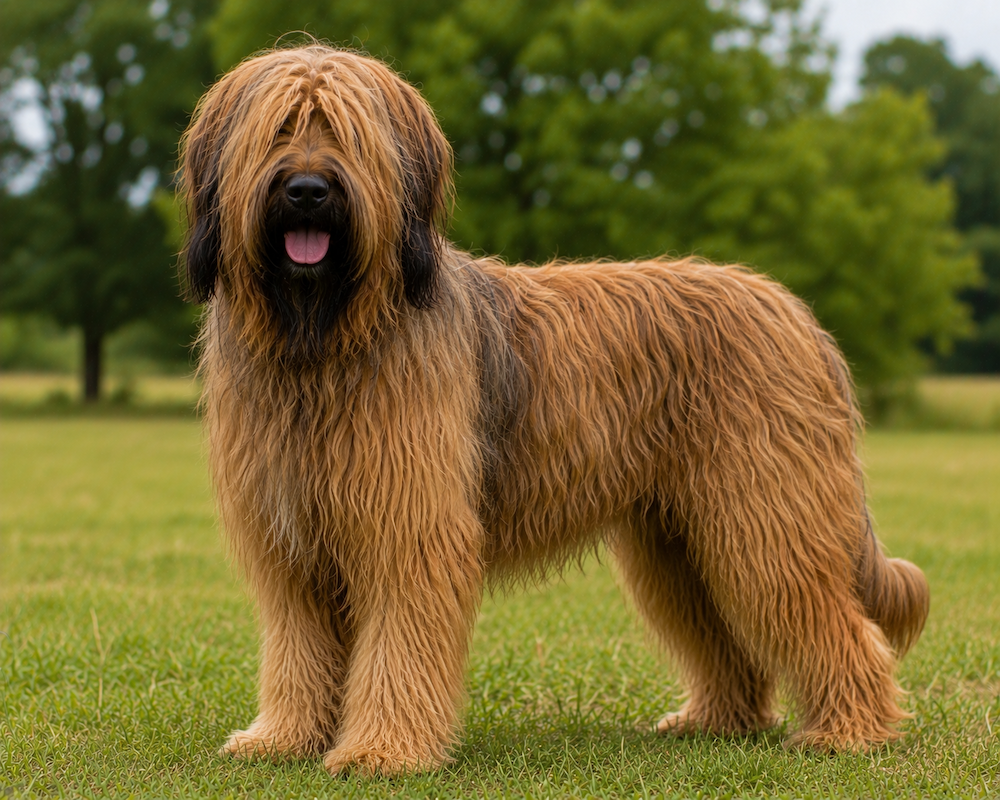







Loyal, intelligent, and magnificently shaggy — a devoted French herding dog with a protective heart and a gentle soul.
🧠 QUICK SNAPSHOT
- Temperament: Loyal, intelligent, protective
- Energy Level: High
- Size: Large
- Good With Families: Yes
- Trainability: High
- Grooming: High
- Best For: Active families, experienced owners, spacious homes
📚 OVERVIEW
The Briard is an ancient French herding breed that has spent centuries guarding and moving livestock across the French countryside. Recognisable by its long, flowing coat and distinctive beard and eyebrows, the Briard is both an impressive working dog and a deeply affectionate family companion.
Known for its intelligence, courage, and unwavering loyalty, the Briard forms exceptionally strong bonds with its family. They are naturally protective without being aggressive and thrive when given plenty of exercise, training, and meaningful interaction.
✅ PROS & CONS
Pros
- Exceptionally loyal and devoted
- Highly intelligent and trainable
- Gentle and affectionate with family
- Excellent guardian and watchdog
Cons
- Requires extensive coat maintenance
- Needs significant daily exercise
- Benefits from experienced handling
- Can be reserved with strangers without early socialisation
Is a Briard a Good Family Dog?
Yes, a Briard can be an excellent family dog for an active and experienced household.
Briards tend to form exceptionally strong bonds with their families and can be affectionate, loyal and protective. Many are very good with children they know, although their large size and herding instincts require supervision around younger children.
They can be reserved with strangers without being indiscriminately aggressive.
The Briard isn’t usually a casual companion. It tends to become deeply involved in the lives of its people.
How Much Exercise Does a Briard Need?
Most adult Briards need around 60–90 minutes of substantial exercise each day, combined with regular mental stimulation.
Walking, hiking, herding, tracking, obedience and dog sports can all suit the breed.
Briards were developed to move and guard livestock over large areas, so they’re capable of considerable endurance.
Mental activity is equally important.
A physically exercised Briard with nothing interesting to think about may still decide that the household needs a self-appointed manager.
Is a Briard Easy to Train?
Briards are highly intelligent and trainable, but they can also be independent thinkers.
A shepherd working some distance from its owner needed to assess situations and make decisions without constant instruction.
Positive reinforcement, consistency and early training generally produce the best results.
Harsh methods can damage trust in this sensitive breed.
Socialisation is particularly important because the Briard combines intelligence with natural guarding instincts.
Does a Briard Shed?
Yes, Briards do shed, although their long coat can make shedding less obvious than expected because loose hairs often remain trapped within the coat.
Regular brushing is essential.
Without proper grooming, the long outer coat and undercoat can develop substantial mats.
A thorough grooming session several times each week is generally required, with additional attention to areas behind the ears, beneath the legs and around the feet.
This is definitely not a low-maintenance coat.
Is a Briard Hypoallergenic?
No, the Briard isn’t considered truly hypoallergenic.
Although loose hair can remain trapped within its coat rather than covering the house as heavily as some breeds, Briards still produce allergens.
Dog allergies are primarily reactions to proteins found in dander, saliva and other secretions rather than simply the hair itself.
People with significant allergies should spend time around adult Briards before deciding whether the breed is suitable.
What Health Problems Are Common in Briards?
Briards can be affected by several inherited health conditions.
Hip dysplasia is an important concern, along with certain eye diseases and thyroid disorders.
One particularly significant inherited condition associated with the breed is congenital stationary night blindness, caused by variants affecting the RPE65 gene. Genetic testing can help breeders avoid producing affected puppies.
As a large, deep-chested breed, Briards are also vulnerable to gastric dilatation-volvulus (GDV or bloat).
Responsible breeders should undertake appropriate hip, eye and genetic screening.
How Long Do Briards Live?
Briards typically live around 10–12 years, although some reach their early teens.
Genetics, body condition and preventive veterinary care all influence longevity.
Maintaining a healthy weight is especially important for protecting joints.
Owners should also regularly examine the skin, ears and feet because the enormous coat can conceal problems that would be immediately obvious on a short-haired dog.
How Big Does a Briard Get?
The Briard is a large, powerful herding dog.
Adults generally stand approximately 56–69 cm at the shoulder, with males typically larger than females.
Weight commonly falls somewhere around 25–45 kg, although individual dogs vary.
The long coat can make the Briard appear considerably bulkier than it actually is.
Underneath all that hair should be an athletic working dog capable of covering substantial distances.
Can a Briard Live in an Apartment?
A Briard can live in a sufficiently spacious apartment, but it’s generally much better suited to a home that makes regular outdoor exercise easy.
Size isn’t the only issue.
Briards are active, intelligent dogs with strong guarding and herding instincts.
They need daily exercise, training and mental engagement regardless of how much space surrounds the house.
A large backyard can be useful, but leaving a Briard alone in one isn’t a substitute for actually exercising it.
Can a Briard Be Left Alone?
A mature Briard can learn to spend reasonable periods alone, but the breed tends to become strongly attached to its family.
These dogs were developed to work closely with shepherds and livestock rather than live in social isolation.
Long periods without interaction or stimulation can lead to boredom, barking or destructive behaviour.
Gradual independence training during puppyhood is valuable.
A Briard may look impressively independent outdoors while still wanting to know exactly where every family member is inside the house.
Are Briards Good Guard Dogs?
Yes. Briards can be excellent natural guardians.
Their traditional work involved not only moving livestock but also protecting flocks from predators and thieves.
They’re typically watchful, courageous and naturally suspicious of unusual activity.
Their imposing appearance provides an additional deterrent.
However, a family Briard generally doesn’t need specialised protection training. Good socialisation, stable temperament and reliable obedience are considerably more important.
Are Briards Aggressive?
A well-bred, properly socialised Briard shouldn’t be indiscriminately aggressive.
However, this is a naturally protective breed that can be reserved with unfamiliar people.
Poor socialisation can turn appropriate watchfulness into excessive suspicion.
Briard puppies should therefore experience a wide variety of people, animals, environments and situations.
The goal is a confident dog capable of recognising genuine threats without treating every unfamiliar visitor as one.
Are Briards Good With Other Dogs?
Briards can live successfully with other dogs, particularly when properly socialised.
However, individual temperament varies, and some adults can be assertive.
Their herding instincts can also lead to attempts to control the movement of other dogs.
Early socialisation and carefully managed introductions are important.
Because the Briard is large and powerful, owners should establish reliable control before the dog reaches adulthood.
Are Briards Good With Cats?
Many Briards can live successfully with cats, especially when raised alongside them.
Their herding instincts may cause them to follow, circle or attempt to control a cat’s movement.
Individual prey drive varies as well.
Careful introductions are important, and cats should always have access to safe elevated areas or dog-free spaces.
A Briard may eventually consider the household cat another member of the flock requiring supervision.
Do Briards Bark a Lot?
Briards can be quite vocal when they believe something deserves attention, although they aren’t necessarily constant barkers.
Their guarding background makes alert barking natural.
They may announce visitors, unusual noises or activity around the property.
Adequate exercise and training can help prevent excessive barking.
Owners should teach when alerting is appropriate and, equally importantly, when the job is finished.
Why Does a Briard Have Double Dewclaws?
One of the Briard’s most unusual physical characteristics is the presence of double dewclaws on each rear leg.
Breed standards traditionally require these extra toes, which should be well formed and positioned relatively close to the ground.
Similar double rear dewclaws occur in several French livestock guardian and herding breeds, including the Beauceron.
They’re often suggested to have provided additional traction or stability over difficult terrain, although precise historical functional explanations are difficult to prove.
Either way, six toes on each rear foot are part of classic Briard anatomy.
Why Does a Briard Have Hair Over Its Eyes?
The Briard’s long facial hair naturally falls around and partly over the eyes, contributing to the breed’s distinctive shaggy appearance.
A healthy Briard should still be able to see and function normally.
Some owners gently tie or arrange facial hair when necessary, particularly for activities requiring unobstructed vision.
The eyes themselves should also be checked regularly because the surrounding coat can make irritation or discharge less immediately noticeable.
Behind all that hair is a dog that is generally paying very close attention to what’s happening.
What Colours Can Briards Be?
Briards occur in several colours, most notably black, various shades of fawn and grey.
Fawn dogs may have darker shading, particularly around the muzzle and ears.
Coat colour can also change considerably as the dog matures.
Some puppies darken or lighten during development, meaning the adult coat isn’t always obvious from the puppy’s appearance.
Health, temperament and sound structure should always take priority over colour when selecting a Briard.
What Does the Name Briard Mean?
The name Briard is connected with the French name Berger de Brie, meaning roughly “Shepherd of Brie.”
Brie is a historical region of France — and yes, it’s also the region associated with the famous cheese.
However, the breed wasn’t necessarily confined exclusively to Brie, and its working ancestors existed across broader areas of France.
The English-language name Briard ultimately became the familiar shortened form.
What Were Briards Originally Bred to Do?
Briards were developed as versatile French sheepdogs, capable of both herding and guarding livestock.
They helped shepherds move flocks between grazing areas while also protecting the animals from threats.
This required intelligence, stamina, independence and courage.
Unlike dogs bred simply to follow constant commands, a Briard sometimes needed to make decisions independently while managing livestock.
Those characteristics remain clearly visible in the modern breed.
What Is the Difference Between a Briard and a Beauceron?
The Briard and Beauceron are both historic French herding breeds, but they look dramatically different.
The Briard has a long, flowing coat, while the Beauceron has a much shorter, smoother coat.
Both are large, intelligent working dogs and both traditionally have double rear dewclaws.
Historically, the names Berger de Brie and Berger de Beauce helped distinguish the two types.
A simple way to remember them is that the Briard is essentially the long-haired member of this famous pair of French shepherds.
Did Thomas Jefferson Own Briards?
Yes. Thomas Jefferson played an important role in the early history of Briard-type dogs in the United States.
While serving in France during the 1780s, Jefferson became interested in French sheepdogs and arranged for dogs to be sent to America.
He valued them for protecting and managing livestock at Monticello.
Historical terminology wasn’t always identical to modern breed registration, so descriptions of these early dogs should be interpreted in their historical context.
Nevertheless, Jefferson is one of the most famous early American figures associated with the Briard.
Did Napoleon Own Briards?
Napoleon is frequently associated with Briards in popular breed histories, but claims that particular historical figures definitively owned modern Briards should be treated cautiously.
French shepherd dogs resembling the ancestors of today’s Briard certainly existed during Napoleon’s era.
However, the breed wasn’t standardised in the modern kennel-club sense at that time.
It’s therefore safer to view such stories as part of the breed’s historical tradition rather than assume every famous attribution is supported by detailed contemporary records.
Were Briards Used During the World Wars?
Yes. Briards were used by the French military during the World Wars in roles including messenger work, sentry duty and locating wounded soldiers.
Their intelligence, courage and strong hearing made them useful working dogs under extremely difficult conditions.
The wars also had devastating effects on European dog populations, including working breeds such as the Briard.
Their military history adds another chapter to a breed that had already spent centuries performing demanding work alongside people.
Is the Briard an Ancient Dog Breed?
The Briard has very old roots as a French shepherd dog, although claims describing it as an unchanged breed stretching back many centuries should be treated carefully.
Dogs resembling long-coated French sheepdogs appear in historical descriptions and artwork well before modern kennel clubs existed.
However, today’s formally standardised Briard emerged through more recent selective breeding and breed organisation.
It’s therefore reasonable to describe the Briard as a breed with deep historical ancestry, while distinguishing those working ancestors from the precisely defined modern pedigree dog.
Where Does the Briard Come From?
The Briard comes from France, where long-coated shepherd dogs were used for centuries to manage and protect livestock.
The breed became known as the Berger de Brie, although its ancestors weren’t necessarily restricted to the Brie region alone.
During the 19th century, French dog breeding became increasingly organised, helping distinguish the long-coated Briard from other shepherd types such as the short-coated Beauceron.
The Briard subsequently served as a farm dog, livestock guardian and military working dog before becoming internationally established.
Beneath the spectacular coat remains what the breed has always fundamentally been: a serious French working shepherd with a very strong sense of responsibility.