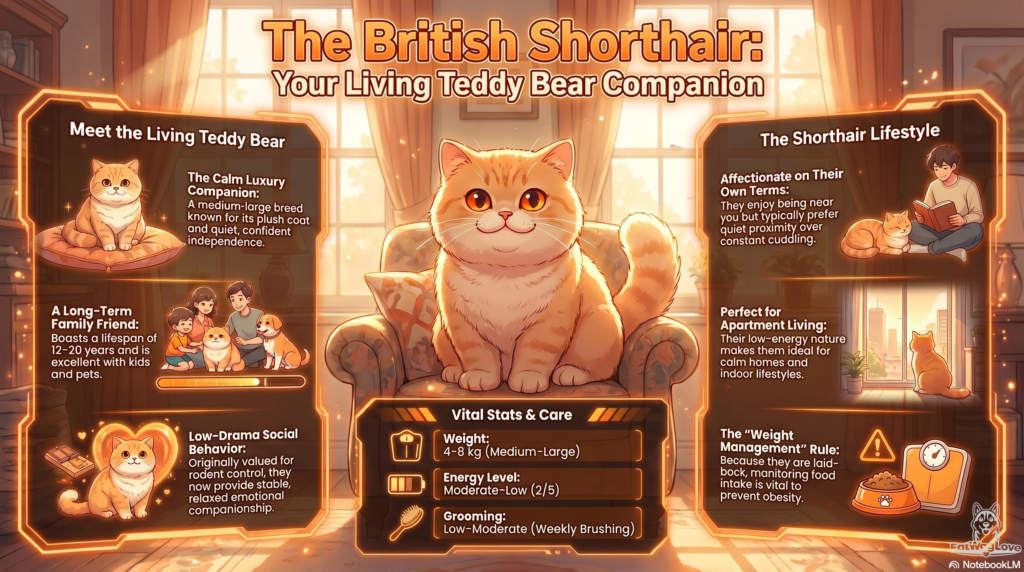
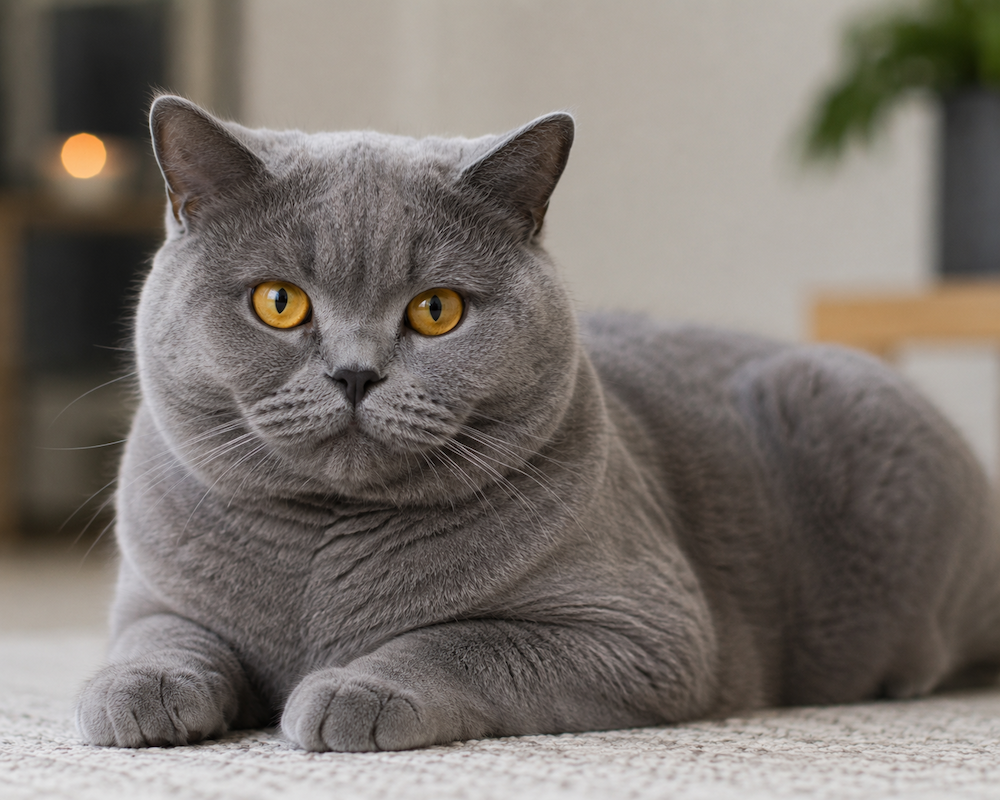





Calm, plush, and full of quiet charm — a relaxed companion with a famously teddy bear-like appearance.
🧠 QUICK SNAPSHOT
- Temperament: Calm, affectionate, independent
- Energy Level: Low to moderate
- Size: Medium to large
- Good With Families: Yes
- Trainability: Moderate
- Grooming: Low to moderate
- Best For: Families, indoor living, relaxed households
📚 OVERVIEW
The British Shorthair is one of the world’s most popular cat breeds, known for its dense plush coat, round face, and calm personality. They are affectionate without being overly demanding and enjoy being close to their family while still maintaining some independence.
Their easy-going temperament makes them excellent companions for a wide range of households.
✅ PROS & CONS
Pros
- Calm and relaxed temperament
- Great for indoor living
- Low-maintenance coat
- Friendly and adaptable personality
Cons
- Can be prone to weight gain
- Less energetic than some breeds
- May not enjoy being carried constantly
- Needs regular play to stay active
Is a British Shorthair a Good Family Cat?
Yes, the British Shorthair is generally an excellent family cat, especially for households wanting a calm, affectionate and relatively undemanding companion.
They’re usually patient, steady and tolerant of respectful children. Rather than constantly demanding attention, many British Shorthairs simply enjoy being in the same room as their family.
They’re affectionate without typically being clingy.
Their combination of independence and companionship makes them particularly well suited to households that want a cat with a quietly confident personality.
Can a British Shorthair Live Indoors or in an Apartment?
Yes, British Shorthairs are very well suited to indoor and apartment living.
They’re generally less intensely active than breeds such as Bengals or Abyssinians, although they still require daily play, scratching areas and opportunities to climb and explore.
Indoor living can work exceptionally well provided the environment is interesting.
Their calm temperament also means they don’t necessarily need an enormous home — although a sturdy cat tree is advisable because adult British Shorthairs can become surprisingly substantial cats.
How Much Exercise and Play Does a British Shorthair Need?
British Shorthairs need daily exercise and interactive play, but they’re generally moderately active rather than hyperactive.
Several short play sessions using wand toys, balls or chasing games can be enough for many adults.
Exercise becomes especially important as the cat ages because British Shorthairs can be prone to weight gain.
Food puzzles can provide useful mental and physical stimulation.
Given the choice, some adults may eventually decide that conserving energy is a perfectly legitimate recreational activity.
Is a British Shorthair Easy to Train?
Yes. British Shorthairs are intelligent cats capable of learning household routines, tricks and simple commands.
Food rewards and positive reinforcement can be particularly effective.
Many can learn their names, come when called, use scratching posts and enter carriers voluntarily.
They’re usually less relentlessly curious than some highly active breeds, so training sessions should be short and rewarding.
They’re intelligent — they simply may not always see why your latest idea deserves their participation.
Does a British Shorthair Shed?
Yes. British Shorthairs shed despite their short coats.
Their coat is exceptionally dense and plush, so they can release a surprising amount of hair, particularly during seasonal changes.
Weekly brushing is usually sufficient for much of the year, with more frequent grooming during heavier shedding periods.
Their short coat is relatively easy to maintain, but this definitely isn’t a non-shedding breed.
Is a British Shorthair Hypoallergenic?
No, the British Shorthair isn’t considered hypoallergenic.
They produce the same types of allergenic proteins found in other domestic cats.
These allergens are present in saliva and skin secretions and are distributed through the coat during grooming.
Short hair doesn’t mean fewer allergens.
Anyone with significant cat allergies should spend time around adult British Shorthairs before bringing one home.
What Health Problems Are Common in British Shorthair Cats?
British Shorthairs are generally robust cats, but several health issues deserve attention.
Hypertrophic cardiomyopathy (HCM) is one important concern. Responsible breeders may use cardiac screening to help assess breeding cats.
Polycystic kidney disease (PKD) has also occurred in British lines, partly because of historical Persian ancestry. DNA testing can identify the genetic variant responsible for the common Persian-associated form.
Obesity and dental disease are additional concerns.
Responsible breeding, weight management and regular veterinary care are important throughout life.
How Long Do British Shorthair Cats Live?
British Shorthairs commonly live around 12–18 years, and some reach their late teens or beyond.
Genetics, diet, body condition, lifestyle and preventive veterinary care all influence lifespan.
Indoor cats are also protected from many external hazards.
One of the most important things owners can control is weight. Their naturally solid appearance can make gradual obesity surprisingly easy to overlook.
A British Shorthair should be sturdy — not spherical.
How Big Does a British Shorthair Get?
The British Shorthair is a medium-to-large, powerfully built cat.
Adults commonly weigh approximately 4–8 kg, with males usually considerably larger and more muscular than females.
They have broad chests, strong legs, round heads and thick tails.
British Shorthairs also mature slowly and may not reach their full physical development until around three to five years of age.
An adult male can be an impressively substantial cat.
Are British Shorthair Cats Affectionate?
Yes, British Shorthairs are generally affectionate without being excessively demanding.
Many enjoy following their owners between rooms, sitting nearby or quietly requesting attention.
However, they aren’t always stereotypical lap cats.
Their affection is often expressed through companionship rather than constant physical contact.
A British Shorthair may spend hours beside you without ever feeling the need to sit directly on top of you.
Do British Shorthairs Like to Be Held?
Many British Shorthairs aren’t particularly enthusiastic about being carried, even when they’re extremely affectionate.
They often prefer interacting while keeping their feet on a stable surface.
Individual cats vary, and some genuinely enjoy being held.
It’s better to allow the cat to choose its preferred level of physical contact rather than forcing cuddles.
Their increasing weight as adults provides another practical reason to respect this preference.
Are British Shorthairs Good With Other Cats?
Yes, British Shorthairs are generally good with other cats when properly introduced.
Their calm, tolerant personalities can work particularly well in multi-cat households.
Compatibility still depends on the personalities involved.
Each cat should have sufficient food stations, litter trays, resting areas and hiding places to reduce competition.
Slow introductions usually produce much better results than immediately placing unfamiliar cats together.
Are British Shorthairs Good With Dogs?
British Shorthairs can often live successfully with calm, cat-friendly dogs.
Their confident temperament means many aren’t easily intimidated once they’re comfortable.
However, introductions should be gradual and supervised.
The cat should always have elevated escape routes and dog-free areas.
A respectful dog may eventually be accepted as simply another slightly strange member of the household.
Are British Shorthair Cats Vocal?
British Shorthairs are generally quiet cats.
They can meow, chirp and purr when they want something, but they aren’t usually as talkative as Siamese or Oriental breeds.
Many communicate through body language and strategically positioning themselves where they can’t possibly be ignored.
A silent British Shorthair sitting beside an empty food bowl can be remarkably expressive.
Why Is the British Shorthair So Plush?
The British Shorthair has an unusually dense coat that stands away from the body, creating its characteristic plush texture.
Unlike many short-haired cats, the coat shouldn’t lie completely flat.
Generations of selective breeding strengthened this dense, crisp coat along with the breed’s sturdy body and rounded appearance.
Running your hand over a British Shorthair can feel less like touching an ordinary short-haired cat and more like encountering extremely expensive living velvet.
What Colours Can British Shorthair Cats Be?
British Shorthairs occur in an enormous variety of colours and patterns.
These include blue, black, white, cream, red, chocolate and lilac, as well as tabby, tortoiseshell, bicolour, colourpoint, silver and golden varieties.
Accepted colours vary somewhat between cat registries.
The solid blue variety remains the most internationally recognisable, but being blue isn’t a requirement for being a British Shorthair.
Are All British Shorthair Cats Blue?
No. British Shorthairs come in many different colours and patterns.
The blue-grey variety became so famous that some people assume “British Blue” is a separate breed.
It isn’t.
A British Blue is simply a blue British Shorthair.
The breed can also be black, white, cream, red, lilac, chocolate, silver, golden and numerous patterned combinations.
Why Are British Shorthair Cats Blue?
The famous British Shorthair “blue” coat is actually a diluted form of black pigmentation.
Genetic variants affecting pigment distribution cause black pigment to appear grey or slate-blue.
Selective breeding made this colour particularly prominent in British Shorthairs.
Combined with copper or golden eyes and the breed’s extraordinarily dense coat, it produces the classic British Blue appearance that became famous around the world.
Why Does a British Shorthair Have Such a Round Face?
The British Shorthair’s large round head, full cheeks and broad muzzle are defining characteristics of the breed.
Adult males can develop particularly prominent cheeks or “jowls.”
Small rounded ears and large circular eyes exaggerate the teddy-bear appearance.
Selective breeding established this distinctive look over generations.
Responsible breeding should preserve the characteristic head without exaggerating features to the point that normal health or function is compromised.
Why Do British Shorthairs Look Like Teddy Bears?
Several characteristics combine to create the British Shorthair’s famous teddy-bear appearance.
They have round heads, broad cheeks, large round eyes, small ears, sturdy bodies and exceptionally dense plush coats.
Their calm facial expression adds to the effect.
This appearance has become one of the breed’s biggest attractions, particularly on social media.
Unlike most teddy bears, however, a British Shorthair reserves the right to decide when you’re actually allowed to cuddle it.
Is the Cheshire Cat Based on a British Shorthair?
The Cheshire Cat is frequently portrayed as resembling a British Shorthair, particularly in modern illustrations and popular culture.
However, Lewis Carroll’s Alice’s Adventures in Wonderland was published in 1865, before the British Shorthair existed as the formally standardised breed we know today.
The original illustrations by John Tenniel depict a broad-faced tabby cat rather than identifying a particular breed.
So while today’s British Shorthair certainly looks remarkably suited to the role, saying the Cheshire Cat was definitively a British Shorthair goes beyond the historical evidence.
Was Puss in Boots a British Shorthair?
The cat portrayed in the Shrek films as Puss in Boots isn’t officially defined simply by a real-world pedigree breed, but his round head, dense coat and large eyes have often been compared with British Shorthairs.
His orange tabby appearance also resembles some British Shorthair colour varieties.
The original Puss in Boots fairy-tale character predates the modern British Shorthair by centuries.
So it’s better considered a fun visual resemblance than genuine breed history.
What Is the Difference Between a British Shorthair and an American Shorthair?
British Shorthairs and American Shorthairs are distinct breeds with different development histories.
The British Shorthair is typically rounder and stockier, with a very dense plush coat, broad head and comparatively compact appearance.
The American Shorthair tends to have a more athletic working-cat build and somewhat less exaggerated roundness.
Both descend ultimately from practical domestic cats valued for controlling rodents, but they developed into separate breeds on opposite sides of the Atlantic.
What Is the Difference Between a British Shorthair and a Chartreux?
The British Shorthair and Chartreux can look similar, especially when comparing blue-grey individuals, but they’re separate breeds.
The Chartreux is a historic French breed typically characterised by a blue coat, orange-to-copper eyes and a somewhat different head and body structure.
British Shorthairs occur in many colours and patterns, not just blue.
Their breeding histories are also distinct.
A blue coat and roundish face alone aren’t enough to identify either breed accurately.
What Is the Difference Between a British Shorthair and a British Longhair?
The main difference is coat length.
British Shorthairs have short, extremely dense plush coats, while British Longhairs have semi-long coats resulting from recessive long-hair genetics historically associated with Persian ancestry.
The two share very similar body types, rounded heads and generally calm temperaments.
Depending on the cat registry, the British Longhair may be treated as a separate breed or as a closely related long-haired variety.
Is the British Shorthair One of Britain’s Oldest Cat Breeds?
The British Shorthair is commonly described as one of Britain’s oldest formally established pedigree cat breeds.
Its foundation came from Britain’s ordinary domestic short-haired cats, which had lived and worked alongside people for generations.
During the development of organised cat shows in the 19th century, enthusiasts began selectively breeding the best examples into a recognisable type.
This makes the British Shorthair’s story unusual: its ancestors weren’t exotic imports but Britain’s own everyday working cats.
Did the Romans Bring the Ancestors of British Shorthairs to Britain?
It’s often claimed that the British Shorthair descends directly from cats brought to Britain by the Romans, but the story is more complicated than that.
Domestic cats certainly spread through Europe during antiquity, and Roman trade and settlement likely contributed to their movement.
However, there isn’t a documented pedigree connecting Roman-era cats directly to today’s British Shorthair.
It’s more accurate to say that the breed developed from Britain’s long-established domestic cat population, whose ancestry ultimately reflects centuries of cat movement across Europe.
Who Was Harrison Weir and Why Is He Important to the British Shorthair?
Harrison Weir was one of the most important figures in the early development of pedigree cats in Britain.
The English artist and animal enthusiast helped organise the famous 1871 cat show at London’s Crystal Palace, generally regarded as the first major modern cat show.
Weir admired Britain’s native short-haired cats and encouraged selective breeding to preserve and improve them.
His work helped transform ordinary British domestic cats into recognised show animals and laid important foundations for what became the modern British Shorthair.
Where Does the British Shorthair Come From?
The British Shorthair was developed in Great Britain from long-established domestic short-haired cats.
These sturdy working cats were valued historically for controlling rodents in homes, farms and businesses.
During the 19th century, cat enthusiasts began selectively breeding them for consistent appearance and temperament. The emerging breed became an important feature of Britain’s early organised cat shows.
Both World Wars severely reduced breeding populations, and breeders later used carefully selected outcrosses, including Persians, while rebuilding the breed.
The result is one of the world’s most recognisable cats — a former British working mouser transformed into the extraordinarily plush, round-faced companion we know today.