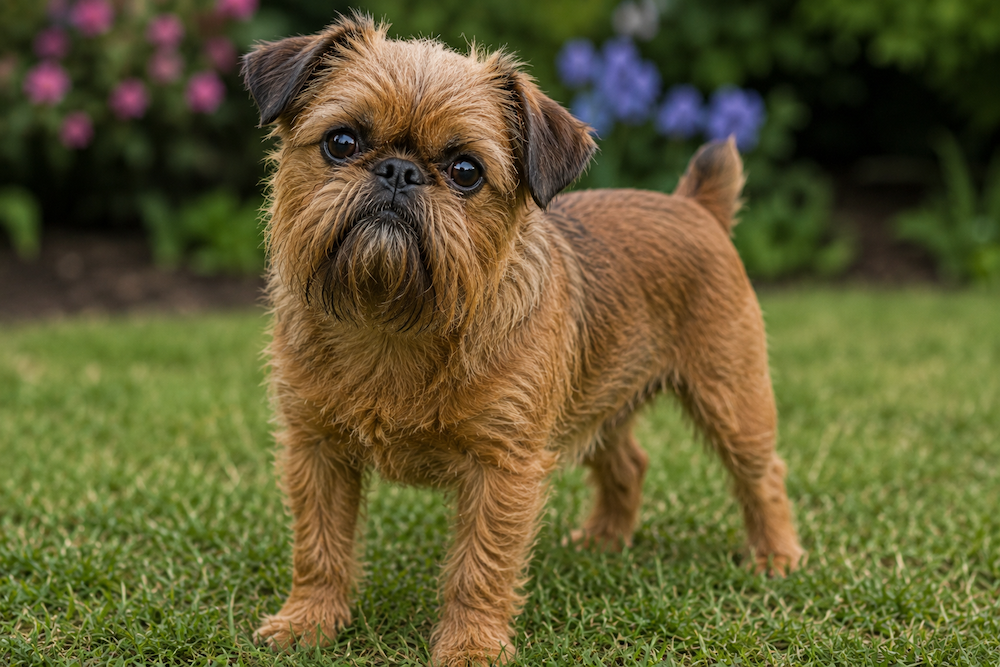





Quirky, affectionate, and full of personality — a small companion with a big, expressive character.
🧠 QUICK SNAPSHOT
- Temperament: Affectionate, alert, curious
- Energy Level: Moderate
- Size: Small
- Good With Families: Yes
- Trainability: Moderate
- Grooming: Moderate
- Best For: Companionship, indoor living
📚 OVERVIEW
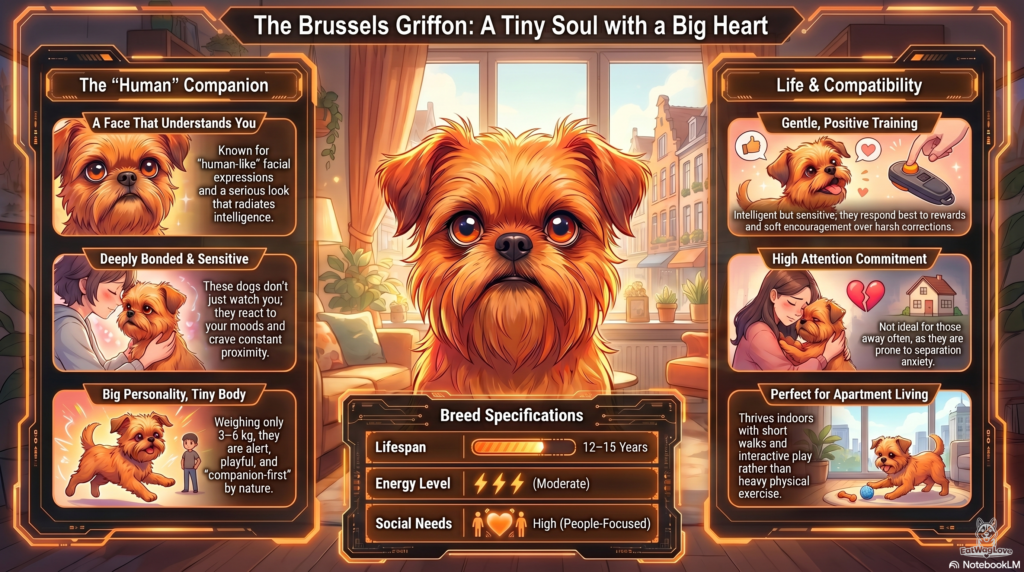
The Brussels Griffon is a small toy breed known for its distinctive, almost human-like expression and lively personality. They are highly affectionate dogs that form strong bonds with their owners and love being the centre of attention.
They are alert and curious, making them both entertaining and engaging companions.
✅ PROS & CONS
Pros
- Very affectionate and loyal
- Unique and expressive appearance
- Great for indoor living
- Strong bond with owners
Cons
- Can be sensitive
- May develop separation anxiety
- Needs attention and companionship
- Grooming required (especially rough coat)
Is a Brussels Griffon a Good Family Dog?
Yes, the Brussels Griffon can be an excellent family companion, particularly in a household that wants a small dog with an enormous personality.
Griffons are affectionate, intelligent and strongly attached to their people. They generally do best with considerate older children because their small size makes them vulnerable to rough handling.
They’re often happiest when included in everyday family activities.
This isn’t usually a dog that wants to live quietly in the background. A Brussels Griffon tends to assume that whatever you’re doing probably requires its involvement.
How Much Exercise Does a Brussels Griffon Need?
Most Brussels Griffons need around 30–60 minutes of daily activity, divided between walks and play.
They’re energetic for their size but don’t require the exercise levels of larger working breeds.
Interactive games and short training sessions provide valuable mental stimulation.
Because the breed is brachycephalic, strenuous exercise should be carefully managed in hot or humid conditions.
Their small size shouldn’t be confused with an absence of energy — many Griffons are lively little dogs.
Is a Brussels Griffon Easy to Train?
Brussels Griffons are intelligent and capable learners, although they can also be sensitive and somewhat independent.
Positive reinforcement works particularly well.
Harsh corrections can make some Griffons anxious or reluctant to participate.
House-training may require patience, as is sometimes the case with very small companion breeds.
Their intelligence means they can learn impressive tricks — but also quickly discover which behaviours make their humans provide attention.
Does a Brussels Griffon Shed?
It depends on the coat type.
Rough-coated Brussels Griffons generally shed relatively little, although their wiry coats require regular grooming and traditionally benefit from hand stripping.
Smooth-coated Griffons have short, glossy coats that do shed.
Both varieties require routine coat care, but their grooming needs are quite different.
Prospective owners should therefore consider coat type rather than assuming every Brussels Griffon has the same grooming requirements.
Is a Brussels Griffon Hypoallergenic?
No Brussels Griffon can be considered completely hypoallergenic.
Rough-coated Griffons may shed relatively little and can sometimes be better tolerated by certain allergy sufferers.
However, allergens are produced through saliva, dander and skin secretions rather than simply shed hair.
Smooth-coated Griffons generally shed more noticeably.
Anyone with significant dog allergies should spend time around the particular coat variety they’re considering.
What Health Problems Are Common in Brussels Griffons?
Brussels Griffons can be affected by several important health problems.
Their shortened skull makes brachycephalic airway problems a concern, particularly in dogs with extremely flat faces.
Their prominent eyes are vulnerable to injuries, corneal ulcers and other eye problems.
Patellar luxation, dental crowding and certain neurological conditions can also occur.
One particularly serious concern within related Griffon populations is Chiari-like malformation and syringomyelia, conditions affecting the skull, brain and spinal cord.
Responsible breeding should prioritise functional anatomy and appropriate health screening.
How Long Do Brussels Griffons Live?
Brussels Griffons commonly live around 12–15 years, with some living longer.
Their small size generally favours longevity, although inherited health problems can substantially affect individual dogs.
Maintaining a healthy body weight, providing good dental care and arranging regular veterinary examinations are particularly important.
Owners should also monitor breathing and eye health throughout the dog’s life.
How Big Does a Brussels Griffon Get?
The Brussels Griffon is a small toy breed, typically weighing around 3.5–6 kg.
Adults are usually somewhere around 18–25 cm tall, although standards focus heavily on weight and overall proportion.
Despite their tiny size, Griffons are relatively sturdy little dogs.
Their almost human facial expression and confident personality can make them seem considerably larger than they actually are.
Can a Brussels Griffon Live in an Apartment?
Yes. Brussels Griffons are excellent apartment dogs when their exercise and companionship needs are met.
Their small size makes them easy to accommodate, and they don’t require a large backyard.
Daily walks, play and mental stimulation remain important.
Owners also need to manage barking because an alert Griffon can become quite enthusiastic about announcing noises outside the home.
Apartment living is generally far easier for them than prolonged isolation.
Can a Brussels Griffon Be Left Alone?
Brussels Griffons generally don’t enjoy being left alone for long periods.
The breed was developed primarily for companionship, and many Griffons form extremely strong attachments to one or more people.
Some can develop separation-related behaviour if independence isn’t taught gradually.
They usually suit households where someone is home for a reasonable portion of the day.
This intense attachment has helped earn the breed the nickname “Velcro dog.”
Do Brussels Griffons Bark a Lot?
Brussels Griffons can be quite vocal, particularly as alert dogs.
They may bark at visitors, unfamiliar noises or activity outside windows.
Boredom and separation distress can increase barking.
Early training can teach a Griffon that one or two warning barks are sufficient.
Their tiny bodies are capable of producing a surprisingly serious opinion about what’s happening on the other side of the front door.
Are Brussels Griffons Good With Other Dogs?
Brussels Griffons are generally good with other dogs when properly socialised.
Many are confident and sociable despite their small size.
That confidence can occasionally become problematic if a Griffon challenges a much larger dog without appreciating the size difference.
Supervision around large, energetic dogs is important simply because accidental injury can occur.
Some Griffons particularly enjoy living with another small companion dog.
Are Brussels Griffons Good With Cats?
Yes, many Brussels Griffons can live very successfully with cats.
The breed’s ancestors did have a history of catching rodents, so some individuals retain chasing instincts.
However, modern Griffons are primarily companion dogs.
Dogs raised alongside cats often learn to coexist extremely well.
As always, introductions should be gradual and supervised until both animals are comfortable.
Can Brussels Griffons Handle Hot Weather?
Brussels Griffons can struggle in hot or humid weather because of their brachycephalic facial structure.
A shortened muzzle can reduce the efficiency of panting, which dogs rely on heavily for cooling.
Exercise should be limited during hot conditions and scheduled for cooler parts of the day.
Air conditioning, shade and constant access to fresh water can be particularly important.
No flat-faced dog should be left in circumstances where overheating is possible.
Why Does a Brussels Griffon Have Such a Human-Looking Face?
The Brussels Griffon’s unusual expression comes from its short muzzle, large forward-facing eyes, prominent chin and rounded head.
Together, these features can create an almost human or monkey-like expression.
Selective breeding intensified this appearance over generations.
It’s one of the breed’s greatest attractions, but extreme facial shortening can also contribute to breathing, dental and eye problems.
Health and functional anatomy should therefore matter more than producing the flattest possible face.
Why Does a Brussels Griffon Have a Beard?
The rough-coated Brussels Griffon develops distinctive facial furnishings, including a beard and moustache.
These wiry hairs contribute heavily to the breed’s characteristic expression.
The beard needs regular attention because food and water can become trapped within it.
Smooth-coated Griffons don’t have the same facial furnishings.
The difference can be dramatic enough that someone unfamiliar with the breed might initially assume they’re looking at two different types of dog.
What Is the Difference Between a Rough and Smooth Brussels Griffon?
The main difference is the coat.
Rough-coated Griffons have a dense, wiry coat with characteristic beard and facial furnishings. Their coats are traditionally hand stripped to maintain the correct texture.
Smooth-coated Griffons have short, close-fitting, glossy hair and require much less specialised grooming.
In some countries and registries, the smooth-coated red variety is associated with the name Petit Brabançon.
Temperament and basic body structure remain closely related regardless of coat.
What Colours Can Brussels Griffons Be?
Colour terminology varies between kennel organisations, but Brussels Griffon-type dogs can occur in red, black, black-and-tan and reddish mixtures with darker hairs.
In some European systems, colour and coat help determine whether the dog is registered as a Griffon Bruxellois, Griffon Belge or Petit Brabançon.
American terminology groups these closely related varieties differently.
This is one reason breed names can become confusing when comparing European and American sources.
What Is the Difference Between a Brussels Griffon, Griffon Bruxellois and Griffon Belge?
The terminology depends heavily on which country’s breed system you’re using.
In much of Europe, three closely related Belgian breeds or varieties are recognised: the Griffon Bruxellois, Griffon Belge and Petit Brabançon.
They share ancestry and basic structure but are distinguished primarily by coat and colour.
In the United States, these varieties are generally grouped under the single breed name Brussels Griffon.
So two apparently conflicting descriptions may both be correct under different kennel-club systems.
What Is a Petit Brabançon?
The Petit Brabançon is the smooth-coated member of the closely related Belgian Griffon family under many European breed classifications.
Unlike the rough-coated Griffons, it has a short, smooth coat and no prominent beard.
Its ancestry and overall structure are otherwise closely connected with the Griffon Bruxellois and Griffon Belge.
The smooth coat is believed to have entered Griffon lines partly through crosses with small smooth-coated breeds such as the Pug.
Why Is the Brussels Griffon Sometimes Called a Monkey-Faced Dog?
The Brussels Griffon has sometimes been nicknamed a “monkey-faced” dog because of its unusual facial expression.
Its large eyes, short nose, beard and prominent lower jaw create an appearance people have historically compared with small primates.
The description became strongly associated with the breed.
Today, many owners are more likely to describe the face as almost human — particularly when the dog appears to be silently judging something you’ve just done.
Were Brussels Griffons Originally Rat Catchers?
Yes. The ancestors of the modern Brussels Griffon included small rough-coated stable dogs used to control rats.
These dogs were known in Belgium as Smousje-type dogs and were kept around stables and carriage houses.
Their job was practical: hunt rodents around horses, feed and equipment.
Over time, these little working dogs were crossed with companion breeds and transformed into the distinctive toy dog we recognise today.
The elegant modern Griffon therefore has surprisingly humble working roots.
What Is the Brussels Griffon’s Connection With Horse-Drawn Carriages?
Early Griffon-type dogs became associated with Brussels coachmen and carriage stables.
They controlled rodents around the stables while also accompanying drivers.
Their small size made them convenient companions around carriages and horses.
The dogs eventually attracted attention beyond working stables, including among wealthier Belgians.
This helped transform the Griffon from a practical stable ratter into a fashionable companion dog.
Did Queen Marie Henriette Help Make the Brussels Griffon Popular?
Yes. Queen Marie Henriette of Belgium became interested in the little Griffon-type dogs during the late 19th century.
Royal attention helped increase the breed’s prestige and popularity.
Once a dog associated primarily with coachmen and stables attracted royal interest, Belgian breeders increasingly refined its appearance and promoted it as a companion and show dog.
The breed’s social journey was therefore remarkable: from catching rats in stables to attracting attention at the Belgian royal court.
What Breeds Were Used to Develop the Brussels Griffon?
The Brussels Griffon developed from small Belgian rough-coated stable dogs, with several other breeds contributing to its modern appearance.
Historical accounts commonly identify the Pug as an important influence, particularly in producing the smooth coat and shorter face.
English Toy Spaniel-type dogs are also generally considered part of the breed’s development and likely contributed to head shape and colouring.
The exact recipe wasn’t recorded as neatly as a modern breeding programme, so historical ancestry should be described with some caution.
Was the Dog in As Good as It Gets a Brussels Griffon?
Yes. The memorable dog Verdell in the 1997 film As Good as It Gets, starring Jack Nicholson and Helen Hunt, was portrayed by Brussels Griffons.
The role introduced millions of moviegoers to the breed’s extraordinary facial expressions.
Several dogs were reportedly involved in portraying Verdell during production.
The film significantly increased public recognition of a breed that many viewers had never encountered before.
Few breeds are better equipped for cinema when the script requires a dog that appears to have very definite opinions about the human actors.
Where Does the Brussels Griffon Come From?
The Brussels Griffon comes from Belgium, particularly Brussels, where its ancestors worked around stables and horse-drawn carriages.
Small rough-coated stable dogs were originally valued as ratters.
During the 19th century, selective breeding and crosses with companion breeds including the Pug and toy spaniel types gradually created the distinctive Griffon.
Royal interest helped increase its popularity, and organised breeding established the modern varieties.
It’s an extraordinary transformation: a tiny Belgian stable worker became one of the dog world’s most expressive companion breeds without ever losing its enormous personality.