






Bold, playful, and full of personality — a unique companion with a mischievous and loving nature.
🧠 QUICK SNAPSHOT
- Temperament: Playful, strong-willed, affectionate
- Energy Level: High
- Size: Medium
- Good With Families: Yes (with training)
- Trainability: Moderate
- Grooming: Low
- Best For: Active owners, experienced handlers
📚 OVERVIEW
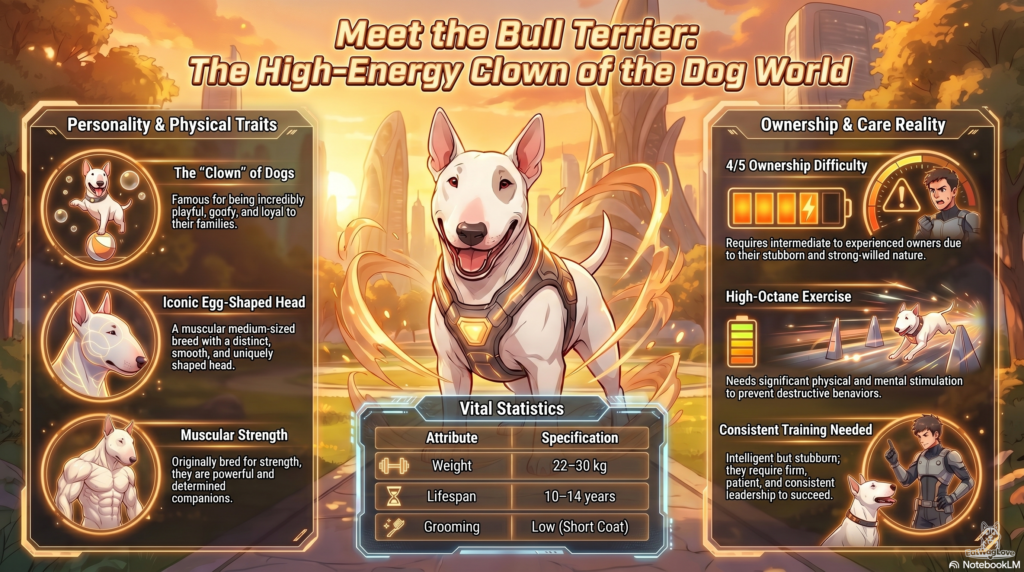
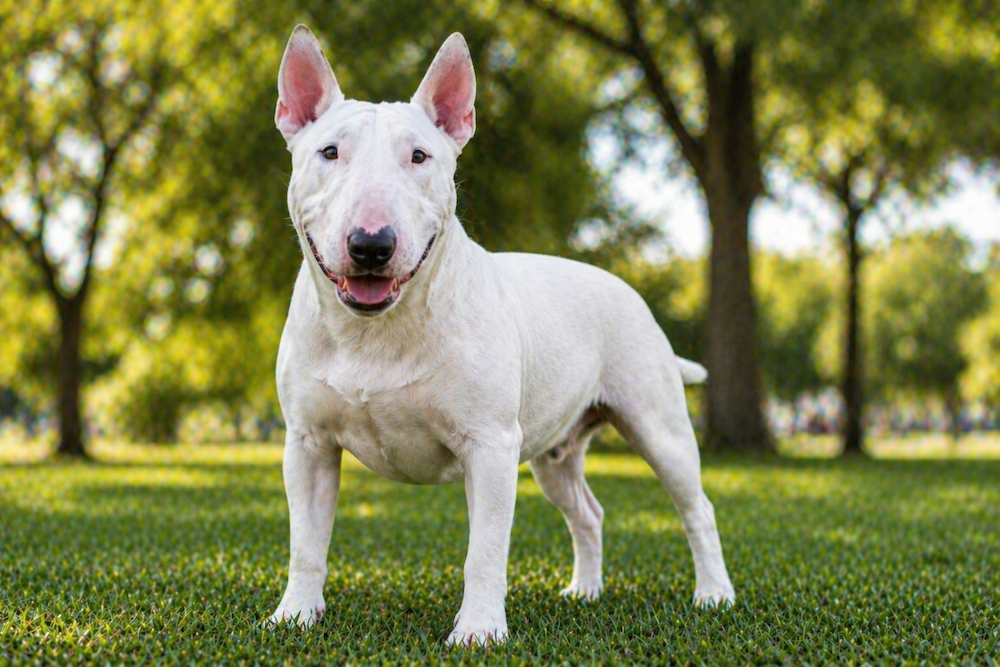
The Bull Terrier is instantly recognisable with its egg-shaped head and muscular build. Known for its playful and sometimes mischievous personality, this breed is both entertaining and loyal.
They are strong, energetic dogs that form close bonds with their owners and enjoy being part of everyday life.
✅ PROS & CONS
Pros
- Loyal and affectionate
- Fun, playful personality
- Low grooming needs
- Unique and eye-catching appearance
Cons
- Can be stubborn and strong-willed
- High energy levels
- Needs consistent training
- Requires attention and structure
Is a Bull Terrier a Good Family Dog?
Yes, a Bull Terrier can be an excellent family dog for the right household.
Bull Terriers are affectionate, playful and often extremely devoted to their people. Many are particularly entertaining companions and retain a puppy-like enthusiasm well into adulthood.
They’re powerful dogs, however, and their boisterous play can overwhelm very young children.
Early training and socialisation are essential. A well-managed Bull Terrier can be a loving family companion, but this isn’t generally a breed for someone wanting an effortless, naturally obedient dog.
How Much Exercise Does a Bull Terrier Need?
Most adult Bull Terriers need around 60–90 minutes of exercise each day, combined with play and mental stimulation.
Walks, games, training and interactive toys can all help.
They can have impressive bursts of energy but aren’t usually endurance athletes comparable with high-drive herding breeds.
Young Bull Terriers can be particularly energetic and destructive when bored.
Exercise should include opportunities to use the brain as well as the body — otherwise your Bull Terrier may develop its own entertainment programme.
Is a Bull Terrier Easy to Train?
Bull Terriers are intelligent but famously independent and sometimes stubborn.
They can learn quickly when training is interesting and rewarding, but repetitive drilling may lose their attention.
Positive reinforcement, consistency and short training sessions generally work best.
Early impulse-control training is particularly valuable because an adult Bull Terrier is extremely strong.
The challenge usually isn’t whether the dog can understand what you’re asking. It’s occasionally convincing the Bull Terrier that your suggestion is better than its own.
Does a Bull Terrier Shed?
Yes. Bull Terriers shed moderately, despite having very short coats.
Loose hair is usually most noticeable during seasonal coat changes.
Weekly brushing with a grooming mitt or soft brush is generally sufficient.
Their short coat requires relatively little maintenance compared with long-haired breeds.
However, short hairs can work their way remarkably effectively into clothing, carpets and furniture.
What Health Problems Are Common in Bull Terriers?
Bull Terriers can be affected by several important inherited health conditions.
Deafness is one of the best-known concerns, particularly in white Bull Terriers, although coloured dogs can also be affected. BAER testing can identify congenital deafness.
Kidney disease, heart disease, patellar luxation and certain skin problems can also occur.
Some Bull Terriers develop compulsive behaviours such as tail chasing.
Responsible breeding should include appropriate hearing, heart, kidney and other health screening.
How Long Do Bull Terriers Live?
Bull Terriers generally live around 11–14 years.
Genetics, body condition, exercise and preventive veterinary care all influence lifespan.
Regular veterinary examinations are particularly useful because heart and kidney problems may not initially produce obvious symptoms.
Keeping a Bull Terrier lean can also reduce unnecessary stress on joints and the cardiovascular system.
How Big Does a Bull Terrier Get?
The standard Bull Terrier is a medium-sized but extremely muscular dog.
Unlike many breeds, its standard doesn’t impose a strict height or weight limit, with overall balance and substance being more important.
Adults commonly stand around 45–55 cm and may weigh approximately 20–35 kg, although individuals vary.
They pack an extraordinary amount of strength into a relatively compact frame.
A Bull Terrier often weighs considerably more than someone expects from simply looking at its height.
Is There a Miniature Bull Terrier?
Yes. The Miniature Bull Terrier is a separate recognised breed or variety depending on the kennel organisation, developed from the same general Bull Terrier ancestry.
It has essentially the distinctive Bull Terrier appearance in a considerably smaller package.
Modern breed standards typically limit the Miniature Bull Terrier to around 35.5 cm at the shoulder.
Despite being smaller, it shouldn’t be considered an easier or quieter version.
The characteristic Bull Terrier confidence, energy and mischief remain very much intact.
Can a Bull Terrier Live in an Apartment?
A Bull Terrier can live in an apartment if provided with sufficient exercise, training and stimulation.
Their moderate size can make apartment living physically possible.
However, young Bull Terriers can be energetic, boisterous and destructive when bored.
Regular outdoor exercise is essential.
A securely fenced outdoor area is helpful but isn’t mandatory for a committed owner prepared to provide appropriate daily activity.
Can a Bull Terrier Be Left Alone?
Bull Terriers can learn to spend reasonable periods alone, but many form extremely strong bonds with their families.
Boredom can become a significant problem.
An under-stimulated Bull Terrier may chew, dig or invent other forms of entertainment that are rarely appreciated by its owner.
Gradual independence training, exercise and safe enrichment toys can help.
Long periods of daily isolation generally aren’t ideal for this people-oriented breed.
Are Bull Terriers Aggressive?
Bull Terriers shouldn’t be considered automatically aggressive, but they’re powerful dogs with terrier ancestry and require responsible socialisation and management.
Temperament varies between individuals.
Historically, their ancestry includes dogs associated with blood sports, but generations of selective breeding transformed the modern Bull Terrier primarily into a companion and show dog.
Dog-directed conflict can still occur in some individuals.
Stable breeding, early socialisation, training and responsible ownership are especially important.
Are Bull Terriers Good With Other Dogs?
Some Bull Terriers live very successfully with other dogs, while others can be selective or intolerant, particularly with unfamiliar dogs.
Same-sex conflict can occur.
Their powerful, physical play style may also be too intense for some canine companions.
Early socialisation helps, but it can’t guarantee that every adult Bull Terrier will enjoy every other dog.
Careful introductions and appropriate supervision are important.
Are Bull Terriers Good With Cats?
Bull Terriers can live with cats, particularly when raised alongside them, but individual prey drive varies.
Their terrier ancestry means some may have a strong instinct to chase smaller animals.
A familiar household cat may be treated differently from an unfamiliar cat running outdoors.
Introductions should be gradual and supervised.
Small pets such as rabbits and rodents require particularly careful management.
Do Bull Terriers Bark a Lot?
Bull Terriers generally aren’t considered extreme barkers.
They may bark to alert their owners, during excitement or when bored.
Some are surprisingly quiet around the home when their needs are properly met.
However, insufficient exercise or long periods alone can increase vocal behaviour.
Their reputation for causing household chaos is generally more connected with physical creativity than continuous barking.
Are Bull Terriers Good Guard Dogs?
Bull Terriers can make effective watchdogs, largely because they’re muscular, confident and visually intimidating.
Many are naturally alert to unfamiliar activity.
However, individual responses to strangers vary considerably.
Some Bull Terriers are far more interested in meeting visitors than guarding against them.
They generally don’t require specialised protection training; reliable obedience and excellent socialisation are much more valuable.
Why Does a Bull Terrier Have an Egg-Shaped Head?
The Bull Terrier’s famous egg-shaped head is the result of selective breeding.
Viewed from the front, the head appears oval and filled, while from the side the profile curves gently downward from the top of the skull towards the nose.
This downward-curving profile is known as a Roman nose or downface.
Early Bull Terriers didn’t have heads as extreme as modern dogs. The distinctive shape became increasingly pronounced through selective breeding during the late 19th and 20th centuries.
Why Are a Bull Terrier’s Eyes So Small and Triangular?
The Bull Terrier is famous for its small, narrow, triangular eyes.
This feature is specifically described in breed standards and contributes enormously to the dog’s distinctive expression.
Few other breeds have genuinely triangular eyes as a defining characteristic.
Combined with the egg-shaped head and upright ears, they make the Bull Terrier one of the most instantly recognisable dogs in the world.
Why Do Bull Terriers Have “Zoomies”?
Bull Terriers are famous for sudden explosions of activity often called zoomies or frantic random activity periods.
A dog may sprint around the room, race through the garden or perform abrupt turns with apparently little warning.
This isn’t unique to Bull Terriers, but their muscular bodies and enthusiastic personalities make the performance particularly memorable.
Adequate exercise helps, but even a well-exercised Bull Terrier may occasionally decide that the living room urgently requires several high-speed laps.
What Is Bull Terrier “Hucklebutting”?
“Hucklebutting” is an affectionate term Bull Terrier owners use for a distinctive form of wild, twisting, high-speed play.
The dog may tuck its rear end, spin, leap and charge around in apparently unpredictable directions.
It’s essentially an especially dramatic version of the zoomies.
The behaviour has become so closely associated with Bull Terrier culture that many owners immediately recognise the term.
Furniture and coffee tables may be less enthusiastic about the tradition.
Why Do Some Bull Terriers Chase Their Tails?
Occasional playful tail chasing can occur in many dogs, but Bull Terriers have an unusual association with compulsive tail chasing.
In affected dogs, the behaviour can become repetitive, difficult to interrupt and harmful to quality of life.
It shouldn’t simply be dismissed as funny Bull Terrier behaviour when it’s frequent or intense.
Veterinary assessment is appropriate because compulsive behaviour can involve complex genetic, neurological and environmental factors.
Are White Bull Terriers More Likely to Be Deaf?
Yes. Congenital deafness occurs more frequently in white Bull Terriers, although coloured Bull Terriers can also be affected.
The relationship involves genes controlling pigmentation and the development of structures required for normal hearing.
A dog may be deaf in one ear or both.
The BAER test can objectively determine hearing ability and is particularly valuable in breeding programmes and puppies where hearing status is uncertain.
White coat colour itself doesn’t mean a dog will be deaf.
What Colours Can Bull Terriers Be?
Bull Terriers can be white or coloured.
White dogs may have markings on the head, while coloured Bull Terriers can include brindle, red, fawn, black brindle and tricolour combinations with white.
Historically, the all-white Bull Terrier became especially famous and was once promoted as the “White Cavalier.”
Colour shouldn’t take priority over health, temperament and responsible breeding.
What Was the “White Cavalier”?
The term “White Cavalier” became associated with the white Bull Terrier during the breed’s early development.
Breeders promoted the dog as stylish, courageous and gentlemanly rather than simply as another fighting-type animal.
The nickname became strongly associated with the elegant white Bull Terriers developed during the Victorian era.
It reflected an important transformation in the breed’s identity — from its rough bull-and-terrier ancestry towards a fashionable companion and show dog.
What Were Bull Terriers Originally Bred For?
The Bull Terrier developed from bull-and-terrier dogs, which combined Bulldog-type dogs with terriers.
Earlier bull-and-terrier dogs were associated with blood sports, including dog fighting, after bull-baiting was prohibited in Britain.
During the 19th century, breeders increasingly transformed these dogs into a more distinctive companion and show breed.
Modern Bull Terriers have been selectively bred for generations away from those historical activities.
Their history explains their strength and determination but doesn’t define the temperament of every modern dog.
Who Was James Hinks and Why Is He Important to the Bull Terrier?
James Hinks was one of the most important figures in the development of the modern Bull Terrier.
Working in Birmingham, England, during the 19th century, Hinks selectively bred bull-and-terrier dogs into a more refined and recognisable type.
He became particularly associated with elegant white Bull Terriers.
His dogs differed significantly from the rougher bull-and-terrier types that preceded them.
Hinks didn’t single-handedly create every characteristic of today’s breed, but his breeding programme was pivotal in establishing the Bull Terrier as a distinct dog.
Was the Dalmatian Used to Create the Bull Terrier?
The Dalmatian is traditionally believed to have contributed to the development of the Bull Terrier, particularly during the breed’s refinement in the 19th century.
Historical accounts also mention Bulldog and various terrier ancestry.
Exactly which dogs contributed and in what proportions can’t be reconstructed with modern pedigree precision.
Dalmatian influence is commonly credited with helping produce a more athletic, elegant outline.
Later selective breeding continued changing the Bull Terrier substantially.
Who Was Lord Gladiator?
Lord Gladiator, born in 1917, is an important dog in Bull Terrier history because he is frequently credited with displaying an early example of the strongly developed downfaced head that became characteristic of the modern breed.
Earlier Bull Terriers generally had more conventional canine profiles.
Selective breeding during subsequent decades increasingly emphasised the continuous curved profile and egg-shaped head.
Comparing photographs of Victorian Bull Terriers with modern dogs makes the transformation particularly striking.
Is Bullseye From Target a Bull Terrier?
Yes. Bullseye, the dog mascot associated with Target stores in the United States, is a Bull Terrier.
The character’s distinctive eye marking reinforces the “bullseye” visual joke.
Real Bull Terriers have been used to portray the mascot in advertising.
Bullseye helped make the breed’s extraordinary head shape recognisable to millions of people who might otherwise never have encountered a Bull Terrier.
Was Spuds MacKenzie a Bull Terrier?
Yes. Spuds MacKenzie was a Bull Terrier used in a famous American Bud Light advertising campaign during the 1980s.
Despite the advertising character being portrayed as male, the dog who played Spuds was actually a female named Honey Tree Evil Eye.
The campaign became enormously famous and dramatically increased public recognition of the breed.
Between Spuds MacKenzie and Bullseye, the Bull Terrier has had a surprisingly successful second career in advertising.
Where Does the Bull Terrier Come From?
The Bull Terrier was developed in England during the 19th century from earlier bull-and-terrier dogs.
Breeders including James Hinks transformed these working and fighting-type ancestors into a more refined, distinctive dog intended increasingly for companionship and exhibition.
Early Bull Terriers looked quite different from today’s breed. Generations of selective breeding gradually produced the upright ears, triangular eyes and extraordinary egg-shaped head now associated with the dog.
Few breeds demonstrate selective breeding quite as visibly: place an early Victorian Bull Terrier beside a modern one, and the transformation is remarkable.