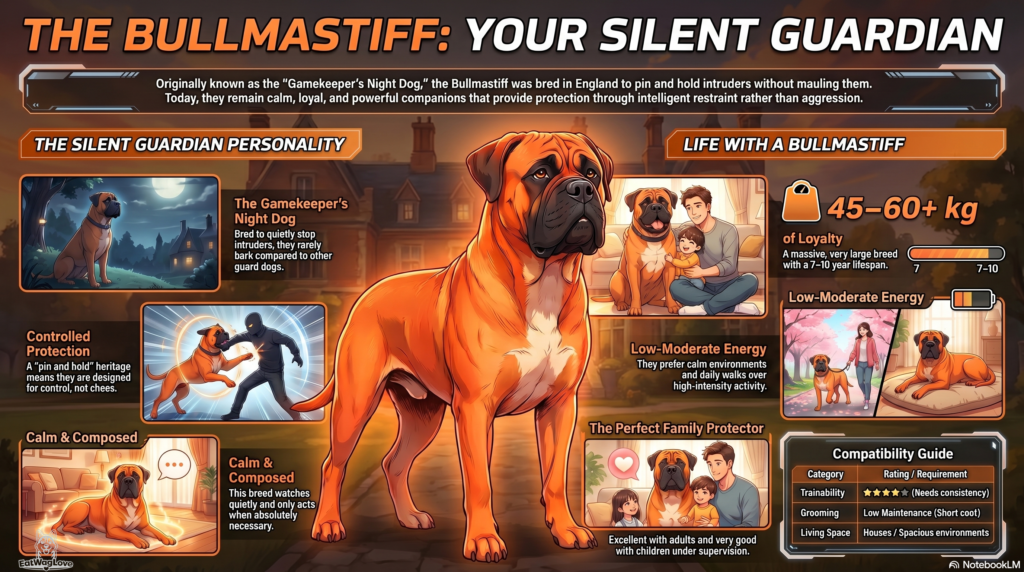
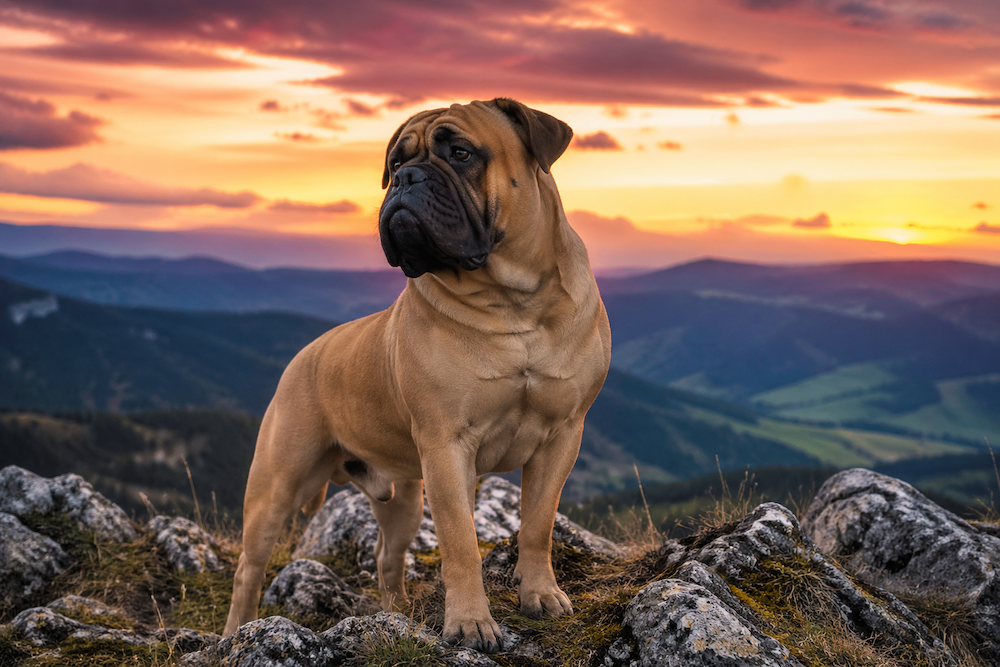







Powerful, calm, and deeply protective — a quiet guardian with a strong presence.
🧠 QUICK SNAPSHOT
- Temperament: Calm, protective, loyal
- Energy Level: Moderate
- Size: Giant
- Good With Families: Yes (with training)
- Trainability: Moderate
- Grooming: Low
- Best For: Families with space, experienced owners
📚 OVERVIEW
The Bullmastiff is a large, powerful breed originally developed to guard estates. Despite their imposing size, they are known for their calm and gentle nature with their family.
They are naturally protective and loyal, making them excellent guardians when properly trained and socialised.
✅ PROS & CONS
Pros
- Loyal and protective
- Calm and steady temperament
- Low grooming needs
- Great family guardian
Cons
- Large size requires space
- Can be stubborn
- Needs consistent training
- Prone to drooling
Is a Bullmastiff a Good Family Dog?
Yes, a well-bred and properly trained Bullmastiff can be an excellent family dog, particularly for experienced owners comfortable with a very large, powerful breed.
Bullmastiffs are typically loyal, calm and deeply attached to their families. Many are gentle and patient around respectful children.
However, their sheer size means supervision around small children is important. Even an affectionate Bullmastiff can accidentally knock someone over.
Early socialisation and consistent training are essential.
How Much Exercise Does a Bullmastiff Need?
Most adult Bullmastiffs need around 45–60 minutes of moderate exercise each day.
They aren’t endurance athletes and generally require less exercise than many working breeds.
Daily walks, gentle play and mental stimulation are usually more appropriate than prolonged running.
Growing puppies should avoid excessive high-impact exercise while their bones and joints develop.
Bullmastiffs can also struggle in hot weather, so exercise should be adjusted according to temperature and the individual dog’s breathing and fitness.
Is a Bullmastiff Easy to Train?
Bullmastiffs are intelligent and capable of learning quickly, but they can also be independent and strong-willed.
Early training is extremely important because a poorly mannered 55 kg dog is considerably harder to manage than a poorly mannered puppy.
Positive reinforcement combined with calm, consistent boundaries generally works best.
They don’t usually respond well to repetitive drilling or harsh handling.
The objective should be developing a cooperative dog rather than trying to overpower one.
Does a Bullmastiff Shed?
Yes. Bullmastiffs shed moderately, despite their short coats.
Weekly brushing with a grooming mitt or soft brush is usually sufficient to remove loose hair.
Seasonal shedding may be more noticeable.
Their coat itself is relatively easy to maintain, but owners should also check the ears, nails and skin regularly.
Some Bullmastiffs have facial wrinkles that may require monitoring for moisture and irritation.
What Health Problems Are Common in Bullmastiffs?
Bullmastiffs can be affected by several significant health problems.
Hip and elbow dysplasia are important concerns because of the breed’s size and weight.
Other potential problems include heart disease, eye disorders, hypothyroidism and certain cancers. Bullmastiffs can also be susceptible to gastric dilatation-volvulus (GDV or bloat), a life-threatening emergency.
Responsible breeders should undertake appropriate health screening and avoid breeding dogs with excessively exaggerated structure.
Maintaining a lean body condition is particularly important for joint health.
How Long Do Bullmastiffs Live?
Bullmastiffs generally live around 7–10 years.
As with many very large breeds, their average lifespan is shorter than that of smaller dogs.
Genetics, cancer risk, heart health, joint health and body condition can all influence longevity.
Keeping a Bullmastiff lean, providing appropriate exercise and arranging regular veterinary checks become especially important as the dog ages.
How Big Does a Bullmastiff Get?
The Bullmastiff is a large and exceptionally powerful dog.
Adult males typically stand around 64–69 cm at the shoulder and weigh approximately 50–59 kg. Females are generally around 61–66 cm and approximately 45–54 kg.
They’re heavily muscled without being as enormous as some Mastiffs.
The original breeding objective was a dog large enough to stop a person but athletic enough to move quickly when necessary.
Can a Bullmastiff Live in an Apartment?
Surprisingly, a mature Bullmastiff can live in a sufficiently spacious apartment if its exercise needs are consistently met.
They’re often relatively calm indoors and don’t require hours of high-intensity activity.
Their enormous physical size creates practical problems, however.
Stairs, lifts, narrow spaces and lack of access to suitable outdoor areas can make apartment living difficult.
A house with secure outdoor space is generally more convenient, although a backyard doesn’t replace daily walks and interaction.
Can a Bullmastiff Be Left Alone?
Bullmastiffs can usually learn to spend reasonable periods alone, but they’re strongly attached to their families.
Long periods of daily isolation aren’t ideal.
Boredom or separation-related distress can lead to destructive behaviour — and destruction becomes rather more impressive when performed by a 50-kilogram Mastiff.
Gradual independence training from puppyhood is worthwhile.
They generally thrive when they’re genuinely included in family life.
Are Bullmastiffs Good Guard Dogs?
Yes. The Bullmastiff was specifically developed as a guardian, and guarding ability remains one of the breed’s defining characteristics.
They’re naturally watchful, confident and physically imposing.
Many Bullmastiffs are relatively quiet and assess situations before reacting rather than barking continuously.
A stable Bullmastiff shouldn’t need aggressive protection training.
Socialisation and reliable obedience are much more important because the breed already possesses considerable size, strength and natural guarding instinct.
Are Bullmastiffs Aggressive?
Bullmastiffs shouldn’t be indiscriminately aggressive, but they’re naturally protective dogs with enormous physical power.
A stable Bullmastiff should be confident and trustworthy with its family while remaining appropriately watchful around unfamiliar people.
Poor breeding, inadequate socialisation or irresponsible management can create serious problems in such a powerful breed.
Early exposure to different people, environments and situations is therefore particularly important.
Are Bullmastiffs Good With Strangers?
Bullmastiffs are often reserved or watchful around strangers rather than immediately friendly.
This reflects their guardian heritage.
A properly socialised dog should be capable of accepting welcome visitors without unnecessary aggression.
Owners need to teach puppies how to distinguish normal everyday situations from genuine threats.
Regular positive exposure to unfamiliar people during development is particularly valuable.
Are Bullmastiffs Good With Other Dogs?
Bullmastiffs can live successfully with other dogs, but dog-to-dog compatibility varies considerably.
Some adults can be selective or intolerant, particularly towards dogs of the same sex.
Early socialisation can help but doesn’t guarantee universal sociability.
Because Bullmastiffs are extraordinarily strong, interactions with unfamiliar dogs should be managed responsibly.
A compatible canine housemate can work very well, particularly when introductions are carefully handled.
Are Bullmastiffs Good With Cats?
Bullmastiffs can live successfully with cats, particularly when raised alongside them.
Individual prey drive varies.
A familiar household cat may be accepted as part of the family, while an unfamiliar running animal outdoors can produce a different reaction.
Slow introductions and supervision are important.
Cats should also have elevated areas where they can retreat from such a large canine housemate.
Do Bullmastiffs Bark a Lot?
Bullmastiffs generally aren’t excessive barkers.
Their historical job required them to detect and confront intruders rather than simply stand somewhere making noise.
Many will bark when they believe something deserves attention but remain relatively quiet otherwise.
This can make their warning bark particularly effective.
When a normally quiet 55-kilogram Bullmastiff suddenly announces something at the front door, people tend to pay attention.
Do Bullmastiffs Drool?
Yes. Many Bullmastiffs drool, although the amount varies considerably between individuals.
Their loose lips and large jowls can allow saliva and water to escape, particularly after drinking, eating or exercising.
Some dogs are relatively tidy, while others can produce impressive strings of drool.
Anyone considering the breed should be comfortable with occasionally wiping a face — and possibly walls, furniture and trousers.
Can Bullmastiffs Handle Hot Weather?
Bullmastiffs can struggle in hot weather.
Their large, heavy bodies generate considerable heat, while their relatively short muzzles can make cooling through panting less efficient than in longer-muzzled dogs.
Exercise should be scheduled during cooler parts of the day.
Shade, fresh water and access to a cool indoor environment are essential.
Overheating in a large Mastiff-type dog can become a medical emergency surprisingly quickly.
Can Bullmastiffs Swim?
Some Bullmastiffs can swim, but they’re not naturally built to be exceptional swimmers.
Their heavy bodies, broad chests and large heads can make swimming strenuous.
Individual ability varies considerably.
Bullmastiffs should always be supervised around pools, lakes and other deep water.
A properly fitted canine life jacket is sensible when boating or spending significant time near water.
Why Does a Bullmastiff Have a Black Mask?
A dark facial mask is a characteristic feature of the Bullmastiff.
It creates the distinctive dark muzzle and facial expression associated with the breed.
The mask results from pigmentation genetics and was deliberately maintained through selective breeding.
Breed standards traditionally favour a dark muzzle, with darker shading around the eyes contributing to the characteristic appearance.
What Colours Can Bullmastiffs Be?
Bullmastiffs traditionally occur in fawn, red and brindle.
A dark muzzle or black mask is characteristic.
A small white marking on the chest may occur, although extensive white isn’t generally desired under traditional breed standards.
Brindle has particularly strong historical associations with working Bullmastiffs because the darker pattern could provide useful camouflage at night.
What Were Bullmastiffs Originally Bred to Do?
Bullmastiffs were developed in 19th-century Britain to help gamekeepers protect large estates from poachers.
Gamekeepers needed a dog powerful enough to stop a man but quieter and more agile than the enormous Mastiffs of the period.
The resulting dogs patrolled estates, detected intruders and helped gamekeepers apprehend them.
This unusual job shaped the Bullmastiff into a dog that combined strength, silence, courage and restraint.
Why Was the Bullmastiff Called the Gamekeeper’s Night Dog?
The Bullmastiff became known as the “Gamekeeper’s Night Dog” because it accompanied gamekeepers patrolling British estates after dark.
Poaching could involve dangerous confrontations, and gamekeepers needed a dog capable of locating and stopping an intruder.
The ideal dog needed to work quietly rather than announcing its approach with constant barking.
Bullmastiffs therefore became famous for silently tracking or approaching a person before using their considerable physical power to intervene.
Did Bullmastiffs Really Catch Poachers Without Attacking Them?
The traditional goal was for the Bullmastiff to pursue, knock down or hold a poacher rather than maul them.
Gamekeepers needed an intruder detained so that the person could be apprehended.
Of course, historical working situations weren’t controlled demonstrations, and it would be unrealistic to suggest that injuries never occurred.
Nevertheless, restraint was an important part of the desired working temperament.
The dog needed enormous courage and power combined with enough control to work alongside its handler.
Is the Bullmastiff a Cross Between a Mastiff and a Bulldog?
Yes. The Bullmastiff was developed primarily from the Mastiff and the old-style Bulldog.
Historical descriptions often refer to an approximate 60% Mastiff and 40% Bulldog combination as the type breeders eventually favoured.
The Mastiff contributed size, strength and guarding ability, while the Bulldog contributed determination and greater agility.
These weren’t identical to today’s Mastiffs and Bulldogs, so imagining a simple modern cross doesn’t accurately reproduce the historical Bullmastiff.
Why Was the Bullmastiff Bred Smaller Than the Mastiff?
Gamekeepers needed something more agile and manoeuvrable than the enormous Mastiff, while still possessing enough power to stop a person.
The Bulldog of the period added athleticism, determination and compact strength.
The result occupied a useful middle ground: substantially larger and more powerful than many working dogs, but more mobile than the heaviest Mastiffs.
This helps explain why the Bullmastiff remains a particularly solid dog without reaching the gigantic proportions of some Mastiff breeds.
Why Were Brindle Bullmastiffs Popular With Gamekeepers?
Brindle dogs were historically valued because their dark striped coats provided useful camouflage during night patrols.
A gamekeeper trying to approach a poacher quietly had little use for a dog that was easily visible from a distance.
Later, fawn Bullmastiffs became increasingly popular in the show ring.
This is an excellent example of how the priorities of a working dog can change once the breed moves from the field into organised exhibition.
What Is the Difference Between a Bullmastiff and an English Mastiff?
The Bullmastiff is generally smaller, lighter and more athletic than the English Mastiff.
English Mastiffs can exceed the Bullmastiff considerably in both height and weight.
The Bullmastiff was deliberately developed partly from Mastiff ancestry to create a more mobile estate guardian.
Both breeds tend to be calm, powerful and devoted, but the Bullmastiff historically needed greater speed and agility for pursuing poachers.
What Is the Difference Between a Bullmastiff and a Boerboel?
The Bullmastiff and Boerboel are both powerful guardian breeds, but they developed for different jobs in different countries.
The Bullmastiff originated in Britain as a gamekeeper’s estate guardian.
The Boerboel developed in South Africa as a versatile farm guardian and working Mastiff-type dog.
Boerboels are often more athletic and strongly territorial, while Bullmastiffs are traditionally characterised by their relatively calm, controlled guarding style.
Both require experienced, responsible ownership.
When Did the Bullmastiff Become an Official Breed?
The Bullmastiff became increasingly standardised during the late 19th and early 20th centuries as breeders moved beyond simply producing working Mastiff–Bulldog crosses.
The Kennel Club in Britain formally recognised the Bullmastiff in 1924.
Recognition required breeders to establish a consistent type capable of reproducing itself rather than continually crossing Mastiffs with Bulldogs.
By this point, the Gamekeeper’s Night Dog had become a genuine breed in its own right.
Where Does the Bullmastiff Come From?
The Bullmastiff was developed in Britain during the 19th century, primarily for gamekeepers protecting estates from poachers.
Breeders combined Mastiff-type dogs with the more athletic Bulldogs of the period to produce a guardian with an unusual combination of size, speed, courage and control.
The dogs became known as Gamekeepers’ Night Dogs and eventually developed into a consistent breed.
The modern Bullmastiff may spend far more time guarding sofas than country estates, but its history explains almost everything about it: a quiet dog, an imposing presence and an instinct to keep a very close eye on who is approaching its family.