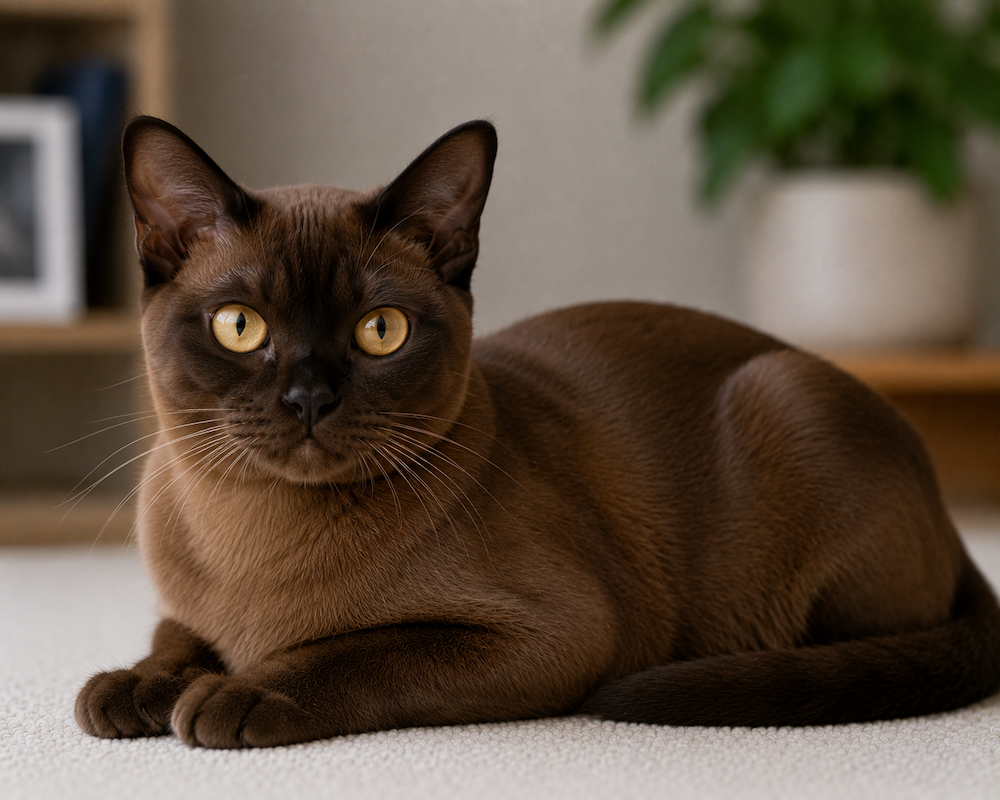







Affectionate, playful, and full of personality — a people-loving companion that thrives on attention and interaction.
🧠 QUICK SNAPSHOT
- Temperament: Affectionate, playful, social
- Energy Level: Moderate to high
- Size: Medium
- Good With Families: Yes
- Trainability: High
- Grooming: Low
- Best For: Families, indoor living, companionship
📚 OVERVIEW
The Burmese is a highly affectionate cat breed known for its sleek coat, expressive eyes, and people-oriented personality. Often described as a “dog-like” cat, the Burmese loves being involved in family activities and forms strong bonds with its owners.
They are playful throughout their lives and enjoy spending as much time as possible with their human companions.
✅ PROS & CONS
Pros
- Extremely affectionate and social
- Great with families and children
- Low grooming requirements
- Playful and interactive personality
Cons
- Dislikes being left alone for long periods
- Needs regular attention and interaction
- Can be demanding of companionship
- May become bored without stimulation
Is a Burmese a Good Family Cat?
Yes, the Burmese is generally an excellent family cat, particularly for households wanting an affectionate, interactive companion.
Burmese cats tend to form strong relationships with their people and often want to participate in whatever the family is doing. Many remain playful well into adulthood.
They’re usually good with respectful children and can thrive in busy households.
Unlike more independent breeds, the Burmese often wants to be right in the middle of family life rather than observing it from another room.
Can a Burmese Live Indoors or in an Apartment?
Yes, Burmese cats are very well suited to indoor and apartment living, provided they receive enough attention, play and enrichment.
Their relatively compact size makes them easy to accommodate.
Cat trees, scratching posts, window perches, puzzle feeders and interactive toys can make indoor life considerably more interesting.
Because Burmese cats are extremely people-oriented, companionship may actually be more important than the size of the home.
How Much Exercise and Play Does a Burmese Need?
Burmese cats are active, playful cats that benefit from several interactive play sessions each day.
Many enjoy chasing toys, climbing, retrieving objects and investigating anything their owners are doing.
They’re typically more energetic than breeds such as the British Shorthair.
Mental stimulation is equally valuable.
Puzzle feeders, clicker training and rotating toys can help keep an intelligent Burmese occupied.
Many retain an almost kitten-like enthusiasm for play throughout adulthood.
Is a Burmese Easy to Train?
Yes. Burmese cats are intelligent and highly trainable.
Many can learn to come when called, retrieve toys, perform tricks and participate in clicker training.
Their strong interest in people can make training particularly rewarding.
Food and play both work well as reinforcement.
Some Burmese can even learn to walk on a harness and lead when introduced gradually.
Their intelligence also means they can become remarkably skilled at training their owners.
Does a Burmese Cat Shed?
Yes, but Burmese cats generally shed relatively little compared with many breeds.
Their short, fine coat lies close to the body and requires minimal grooming.
Weekly brushing is usually sufficient to remove loose hair and maintain the coat’s characteristic shine.
They don’t have the enormous dense coat of breeds such as the British Shorthair.
This makes the Burmese relatively easy to groom, although they’re still not a non-shedding breed.
Is a Burmese Cat Hypoallergenic?
No, Burmese cats aren’t considered truly hypoallergenic.
They still produce allergenic proteins found in saliva, skin secretions and dander.
Their short coat and relatively modest shedding may make them easier for some people to live with, but this doesn’t guarantee a reaction-free household.
Anyone with significant cat allergies should spend time around adult Burmese cats before bringing one home.
What Health Problems Are Common in Burmese Cats?
Burmese cats can be affected by several inherited health conditions, although risks differ somewhat between breeding populations.
Potential concerns include diabetes mellitus, hypokalaemia, certain craniofacial abnormalities in some lines, and inherited neurological or muscular conditions.
Some populations have also experienced problems including gangliosidosis.
Responsible breeders use available DNA tests and other screening appropriate to their lines.
Dental health and maintaining a healthy body weight are also important throughout life.
How Long Do Burmese Cats Live?
Burmese cats commonly live around 12–18 years, and some reach their late teens or beyond.
They’re generally considered a relatively long-lived breed when healthy.
Genetics, nutrition, body condition, indoor lifestyle and preventive veterinary care all influence lifespan.
Because Burmese cats can remain playful and socially engaged well into old age, their personality may seem surprisingly youthful even when they’re technically senior cats.
How Big Does a Burmese Cat Get?
The Burmese is generally a medium-sized cat, but it can feel unexpectedly heavy when picked up.
Adults commonly weigh approximately 3–6 kg, with males usually larger than females.
They have compact, muscular bodies beneath their sleek coats.
This combination has historically inspired descriptions such as a “brick wrapped in silk” — an unusually heavy-feeling cat beneath an exceptionally smooth coat.
Are Burmese Cats Affectionate?
Yes. Burmese cats are famous for being extremely affectionate and people-oriented.
Many follow their owners around the house, sleep beside them and actively seek physical contact.
They’re often compared with dogs because of their strong social attachment and tendency to greet family members.
Someone wanting a highly independent cat may find the Burmese demanding.
Someone wanting a cat that behaves like an enthusiastic member of the household may find exactly what they’re looking for.
Do Burmese Cats Like to Sit on Your Lap?
Many Burmese cats are enthusiastic lap cats.
Warmth, physical contact and proximity to their owners are often highly valued.
Some will climb onto a lap whenever the opportunity appears, while others prefer sitting immediately beside their person.
Individual personalities naturally vary.
However, the breed’s reputation for close physical companionship is well deserved.
Can Burmese Cats Be Left Alone?
Burmese cats generally don’t enjoy spending long periods alone.
They’re one of the more socially dependent cat breeds and can become bored or lonely without sufficient interaction.
Households where everyone is absent for long working days may want to consider a compatible second cat.
Interactive toys and enrichment help, but they don’t completely replace social contact.
For many Burmese, their favourite enrichment is simply another living creature willing to pay attention to them.
Are Burmese Cats Good With Other Cats?
Yes, Burmese cats are generally very good with other cats, particularly when introductions are handled carefully.
Their social personalities can make feline companionship especially valuable.
Another playful, confident cat may provide company when humans aren’t available.
Individual compatibility still matters, and each cat should have access to its own resources.
Many Burmese thrive in multi-cat homes rather than merely tolerating them.
Are Burmese Cats Good With Dogs?
Burmese cats can often live extremely well with cat-friendly dogs.
Their confidence and sociability can make them less likely to spend their lives hiding from a respectful canine companion.
Some may even play with dogs or sleep beside them.
Introductions should still be gradual and supervised.
The cat should always have elevated areas and escape routes where it can choose to be alone.
Are Burmese Cats Vocal?
Yes. Burmese cats can be quite talkative, although their voices are often described as softer or more raspy than the powerful vocalisations associated with some Siamese cats.
They may use different sounds to request food, attention, access to a room or simply conversation.
Because they’re highly social, vocalisation can become part of their interaction with owners.
Ignoring a determined Burmese doesn’t necessarily end the conversation.
Do Burmese Cats Play Fetch?
Many Burmese cats naturally enjoy retrieving toys, and some can learn to play fetch remarkably well.
Small balls, toy mice and other lightweight objects are popular choices.
Their combination of intelligence, playfulness and strong interest in human interaction makes fetch particularly appealing.
Not every Burmese will retrieve, but the behaviour occurs often enough to contribute to the breed’s reputation as one of the more dog-like cats.
Do Burmese Cats Like Water?
Some Burmese cats are surprisingly curious about water, although this isn’t universal.
Individuals may investigate running taps, showers or water bowls.
This doesn’t mean every Burmese wants to swim.
As with most cats, preferences vary considerably.
Their curiosity simply means household activities involving water may occasionally attract an uninvited feline supervisor.
Why Are Burmese Cats So People-Oriented?
The Burmese has been selectively bred for generations as a highly social companion cat.
Breeders favoured affectionate, interactive temperaments alongside the breed’s distinctive appearance.
Modern Burmese frequently seek direct involvement with their owners rather than remaining independent.
This trait is now so characteristic that prospective owners should consider it carefully.
A Burmese isn’t simply a beautiful cat that happens to live in your home — it often expects to be an active participant in your life.
Why Do Burmese Cats Feel Heavier Than They Look?
Burmese cats have compact, muscular bodies beneath their short, sleek coats.
Because there is relatively little fluffy coat to exaggerate their apparent size, people often underestimate their weight before picking one up.
Their substantial muscle and dense body structure then come as a surprise.
This characteristic has inspired the famous description of the Burmese as a “brick wrapped in silk.”
What Colours Can Burmese Cats Be?
Burmese cats occur in several colours, but the terminology and accepted colours differ between American and British/European breed standards.
The original characteristic colour is a rich dark brown known as sable in North America and generally brown in Britain and Australia.
Other recognised colours can include blue, chocolate or champagne, lilac or platinum, and additional red, cream and tortoiseshell varieties in some registries.
This difference in terminology can make Burmese colour charts surprisingly confusing.
Why Do Burmese Kittens Sometimes Get Darker as They Grow?
Burmese coat colour can change as the cat matures.
Kittens are often lighter than adults, with pigmentation becoming richer and darker over time.
Burmese colour is influenced by a temperature-sensitive form of pigmentation related to the colourpoint gene.
However, the contrast between body and extremities is much less dramatic than in Siamese cats.
The result is the characteristic rich, relatively even Burmese coat.
Are Burmese Cats Related to Siamese Cats?
Yes. The modern Burmese has an important historical connection with the Siamese cat.
The foundation cat Wong Mau was bred with Siamese cats during the early development of the breed in the United States.
Careful breeding demonstrated that Wong Mau carried genetics different from the ordinary Siamese pattern.
This eventually helped establish the Burmese as a distinct breed.
The relationship explains some shared characteristics, including sociability, intelligence and vocal behaviour.
What Is the Difference Between a Burmese and a Siamese Cat?
Burmese and Siamese cats are related historically but have very different appearances.
Siamese cats have strong colourpoint contrast, with darker ears, face, legs and tail against a lighter body.
Burmese cats have much more evenly distributed body colour.
Modern Burmese are also typically more compact and muscular, while modern Siamese are generally longer, leaner and more angular.
Both breeds tend to be intelligent, affectionate and socially demanding.
What Is the Difference Between an American Burmese and a European Burmese?
American and European Burmese have developed into noticeably different types.
American Burmese are generally more compact and rounded, with a broad head and shorter muzzle.
European or British-developed Burmese tend to have a somewhat more moderate, wedge-shaped head and a slightly more elegant body.
Recognised colours also differ.
They share common ancestry, but decades of separate breeding have created distinct interpretations of the Burmese cat.
Who Was Wong Mau?
Wong Mau is the foundation cat behind the modern Burmese breed.
She was brought from Southeast Asia to the United States in 1930 by Dr Joseph Thompson.
Wong Mau was a small brown cat whose appearance differed from the Siamese cats familiar to American breeders.
Thompson and other researchers bred her with Siamese cats and studied the resulting kittens.
Their breeding experiments helped demonstrate that her distinctive brown colouring could be inherited consistently, laying the foundation for the Burmese breed.
Was Wong Mau Actually a Burmese Cat?
Wong Mau is regarded as the foundation of the modern Burmese, but genetically she appears to have been more complicated than a modern purebred Burmese.
Her breeding results indicated that she carried both Burmese and Siamese-type colour genetics.
Cats combining these genetic patterns later became associated with what we now call the Tonkinese pattern.
So describing Wong Mau simply as a modern pedigree Burmese isn’t entirely accurate.
She was the extraordinary foundation cat from which the modern breed was developed.
Did All Modern Burmese Cats Descend From One Cat?
The modern Western Burmese breed traces an extraordinary amount of its foundation history to Wong Mau, but saying every Burmese alive today descends exclusively from a single cat oversimplifies subsequent breeding.
Siamese cats were used during the breed’s early development, and additional breeding programmes and outcrossing influenced different populations.
Nevertheless, Wong Mau’s genetic contribution was enormously important.
Few individual cats have had such an outsized influence on the creation of a modern pedigree breed.
Does the Burmese Cat Really Come From Burma?
The breed’s foundation ancestry came from Southeast Asia, and Wong Mau was reportedly brought from Burma, now Myanmar.
Cats resembling Burmese and related Southeast Asian types existed in the region long before the modern Western pedigree was established.
However, the Burmese as a formally standardised modern breed was largely developed through organised breeding in the United States beginning in the 1930s.
So its roots are Southeast Asian, while much of its modern breed development occurred elsewhere.
Are Burmese Cats Mentioned in Ancient Thai Cat Manuscripts?
Cats resembling Burmese-type cats appear in the historic Tamra Maew, or Thai cat-book manuscripts, which describe several traditional cat types from the region.
These manuscripts are sometimes used to support claims of very ancient Burmese ancestry.
However, connecting an illustrated historical cat directly to a modern pedigree breed requires caution.
They demonstrate that similar cat types existed in Southeast Asia centuries ago, but they aren’t modern pedigree records.
The Burmese has genuinely old regional roots, while today’s formal breed is much more recent.
Where Does the Burmese Cat Come From?
The Burmese has Southeast Asian roots, but the modern breed was developed primarily in the United States during the 1930s.
Its pivotal foundation cat was Wong Mau, brought from Burma to America in 1930 and owned by Dr Joseph Thompson.
Breeding Wong Mau with Siamese cats produced kittens whose colour inheritance helped establish a distinct Burmese breeding population.
Different breeding programmes later produced the American and European Burmese types seen today.
Behind millions of modern Burmese cats therefore stands one particularly influential little brown cat — Wong Mau, whose arrival in America changed pedigree cat history.

Lorem ipsum dolor sit amet, consectetur adipiscing elit. Ut elit tellus, luctus nec ullamcorper mattis, pulvinar dapibus leo.