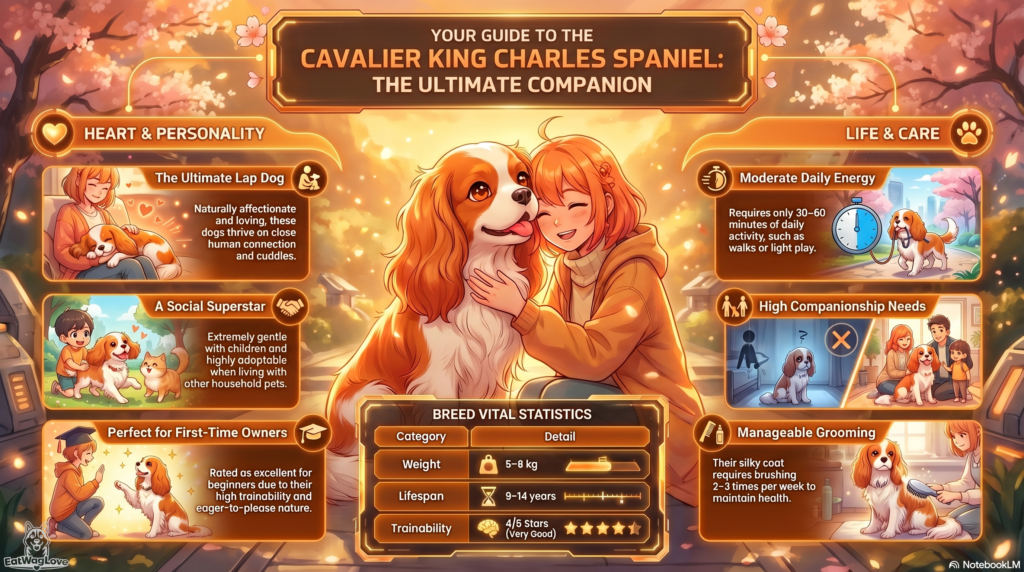
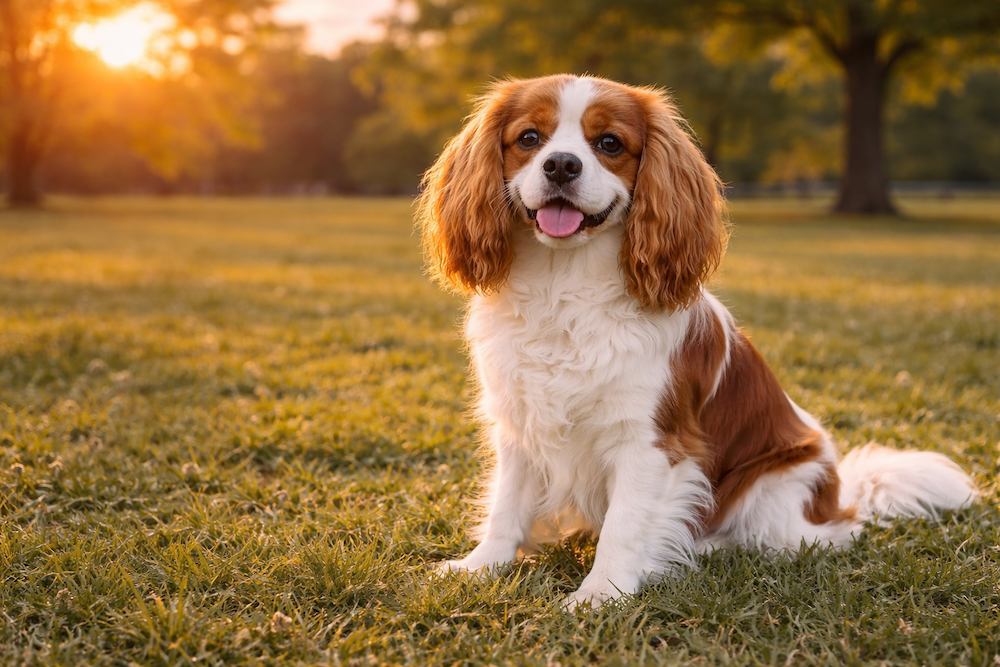







Gentle, affectionate, and loving — the perfect companion for families and lap-dog lovers.
🧠 QUICK SNAPSHOT
- Temperament: Gentle, Affectionate, Friendly
- Energy Level: Low to Moderate
- Size: Small
- Good with Families: Excellent
- Training Difficulty: Easy
📚 OVERVIEW
Cavalier King Charles Spaniels are known for their sweet nature and expressive eyes. Originally bred as companion dogs, they are loving, adaptable, and happiest when close to their owners. Their friendly temperament makes them one of the best breeds for families, seniors, and first-time dog owners.
✅ PROS & CONS
Pros
- Extremely affectionate and loving
- Great with children and families
- Easy to train and adaptable
Cons
- Can struggle being left alone
- Prone to certain health issues
- Requires regular grooming
Is a Cavalier King Charles Spaniel a Good Family Dog?
Yes, the Cavalier King Charles Spaniel is generally an excellent family dog.
Cavaliers are affectionate, gentle and highly people-oriented. Many are very good with respectful children and enjoy living with other pets.
They’re adaptable enough for both active households and quieter homes.
Their sweet temperament is one of the breed’s greatest attractions, although prospective owners should also understand the Cavalier’s significant inherited health concerns.
How Much Exercise Does a Cavalier King Charles Spaniel Need?
Most Cavaliers need around 45–60 minutes of exercise each day, together with play and mental stimulation.
Despite their lap-dog reputation, Cavaliers retain sporting spaniel ancestry and many love walks, exploring and chasing toys.
Some are surprisingly athletic.
Their exercise should always be appropriate to the individual dog’s heart health, fitness and age.
A Cavalier can happily spend an afternoon walking with its family — and then immediately volunteer for several hours on the sofa.
Is a Cavalier King Charles Spaniel Easy to Train?
Yes. Cavaliers are generally intelligent, eager to please and relatively easy to train.
They respond particularly well to positive reinforcement.
Harsh training methods are unnecessary and can be counterproductive with such a sensitive breed.
Many Cavaliers enjoy obedience, rally, scent work and even agility.
Recall training deserves attention because their spaniel instincts can occasionally become very interesting when a bird or squirrel suddenly appears.
Does a Cavalier King Charles Spaniel Shed?
Yes. Cavaliers shed moderately throughout the year.
Their silky medium-length coats require regular brushing, particularly around the ears, chest, legs and tail where tangles can develop.
Several brushing sessions each week are usually sufficient for most dogs.
They don’t normally require the elaborate clipping associated with some long-coated breeds.
Their beautiful feathering is relatively manageable, but it’s certainly capable of leaving evidence on clothing and furniture.
Is a Cavalier King Charles Spaniel Hypoallergenic?
No. Cavalier King Charles Spaniels aren’t considered hypoallergenic.
They shed hair and produce the same types of allergenic proteins found in other dogs.
People with dog allergies react primarily to proteins in saliva, skin secretions and dander rather than the length of the coat itself.
Anyone with significant allergies should spend time around adult Cavaliers before bringing one home.
What Health Problems Are Common in Cavalier King Charles Spaniels?
Unfortunately, Cavaliers have several serious inherited health concerns.
The most significant is mitral valve disease (MVD), a degenerative heart condition that occurs at unusually high frequency within the breed.
Chiari-like malformation and syringomyelia are also major concerns. Other potential problems include patellar luxation, hip dysplasia, eye disease, episodic falling syndrome and middle-ear disorders.
Responsible breeding and appropriate health screening are particularly important in this breed.
What Is Mitral Valve Disease in Cavalier King Charles Spaniels?
Mitral valve disease is a condition in which the mitral valve of the heart gradually degenerates, allowing blood to leak backwards.
Cavaliers have an unusually high predisposition to the disease, and it can occur earlier than in many other breeds.
A heart murmur is often the first sign detected by a veterinarian.
Not every murmur immediately means heart failure, and affected dogs may live for years with careful monitoring.
Because MVD is such an important Cavalier health issue, regular veterinary heart examinations are essential throughout life.
What Is Syringomyelia in Cavalier King Charles Spaniels?
Syringomyelia is a potentially painful neurological condition involving fluid-filled cavities, called syrinxes, developing within the spinal cord.
In Cavaliers it is strongly associated with Chiari-like malformation, in which the relationship between the skull and brain affects normal cerebrospinal fluid flow.
Signs can include neck or shoulder pain, sensitivity when touched, unexplained yelping and unusual scratching movements.
Diagnosis usually requires MRI.
The severity varies greatly between individual dogs.
Why Does My Cavalier Scratch the Air?
Repeated “air scratching”, particularly around the neck or shoulder without the paw actually contacting the skin, can sometimes be associated with syringomyelia.
However, scratching can have many more ordinary causes, including allergies, ear disease, parasites and skin irritation.
Air scratching shouldn’t be used to diagnose syringomyelia at home.
Persistent unusual scratching, pain, sensitivity or unexplained vocalisation warrants veterinary investigation.
How Long Do Cavalier King Charles Spaniels Live?
Cavalier King Charles Spaniels commonly live around 9–14 years, although individual longevity varies considerably.
Inherited heart and neurological disease can have a substantial effect on lifespan and quality of life.
Choosing puppies from breeders who prioritise health screening and longevity within their bloodlines is important.
Weight control, dental care and regular veterinary checks can also make a meaningful difference.
How Big Does a Cavalier King Charles Spaniel Get?
Cavaliers are small spaniels, typically standing around 30–33 cm at the shoulder.
Adults commonly weigh approximately 5.4–8.2 kg, although some pet Cavaliers grow larger.
They should be elegant and balanced rather than extremely tiny or heavily built.
There is no officially recognised “teacup Cavalier” variety.
Extremely small size should never be prioritised over health and sound structure.
Can a Cavalier King Charles Spaniel Live in an Apartment?
Yes. Cavaliers are excellent apartment dogs when provided with regular walks and companionship.
Their small size and adaptable temperament make them suitable for relatively compact homes.
They generally don’t require a large backyard.
The greater challenge can be their strong attachment to people.
An apartment is perfectly adequate for a Cavalier; spending every day alone in one may not be.
Can a Cavalier King Charles Spaniel Be Left Alone?
Cavaliers generally don’t enjoy being left alone for long periods.
They were developed as companion dogs and tend to form exceptionally close bonds with their owners.
Some can develop separation-related distress.
Gradual independence training from puppyhood is therefore valuable.
A Cavalier doesn’t necessarily need constant attention every minute, but this isn’t usually the ideal breed for someone routinely away from home for very long days.
Are Cavalier King Charles Spaniels Good With Children?
Yes. Cavaliers are generally very good with respectful children.
They’re affectionate, playful and usually gentle.
However, they’re small dogs and can be accidentally injured through rough handling.
Children should learn how to interact appropriately with dogs, and young children should always be supervised.
For many families, the Cavalier’s combination of playfulness and affection makes it a particularly appealing companion.
Are Cavalier King Charles Spaniels Good With Other Dogs?
Yes. Cavaliers are generally very sociable with other dogs.
They aren’t usually known for strong territorial or confrontational behaviour.
Many enjoy living with another dog and can thrive in multi-dog households.
Proper introductions remain important, and individual personalities vary.
Their small size should also be considered when they’re playing with much larger, boisterous dogs.
Are Cavalier King Charles Spaniels Good With Cats?
Yes. Cavaliers can often live extremely well with cats, especially when introduced appropriately.
Their spaniel ancestry can produce some chasing instinct, but many happily accept household cats as companions.
Slow introductions and providing cats with escape routes are sensible.
It’s not unusual to find a Cavalier and cat eventually sharing the same sofa — assuming the cat approves the arrangement.
Do Cavalier King Charles Spaniels Bark a Lot?
Cavaliers generally aren’t considered excessive barkers.
They may bark when someone approaches, when excited or when seeking attention.
Individual dogs vary, and boredom or separation distress can increase vocalisation.
Their history as companion dogs means most aren’t naturally intense watchdogs.
Training and adequate enrichment can usually keep barking manageable.
Do Cavalier King Charles Spaniels Like Water?
Many Cavaliers enjoy water and some are enthusiastic swimmers.
This makes sense given their spaniel ancestry.
However, not every Cavalier naturally enjoys swimming.
Dogs should be introduced gradually and supervised around pools and open water.
Heart disease or other medical conditions may also affect how much strenuous swimming is appropriate for an individual dog.
Do Cavalier King Charles Spaniels Have a Strong Prey Drive?
Cavaliers can have a surprisingly strong interest in birds and small animals.
Although they’ve been primarily companion dogs for generations, they retain ancestry from sporting spaniels.
Some will suddenly chase birds, squirrels or other moving animals despite appearing completely relaxed moments earlier.
Reliable recall training is therefore worthwhile.
Their aristocratic appearance doesn’t mean every sporting instinct disappeared.
Why Does a Cavalier King Charles Spaniel Have Such Long Ears?
The Cavalier’s long, feathered ears reflect its spaniel ancestry and have become one of the breed’s defining features.
The ears frame the face and contribute greatly to the characteristic expression.
However, long drop ears can reduce ventilation around the ear canal.
Regular inspection is important because moisture, wax and inflammation can contribute to ear problems.
The heavy feathering also needs brushing to prevent tangles.
What Colours Can Cavalier King Charles Spaniels Be?
Cavaliers traditionally occur in four recognised colour patterns:
Blenheim – chestnut markings on a white background
Tricolour – black and white with tan markings
Ruby – rich red
Black and Tan – black with tan markings
These four colours have deep historical connections with British toy spaniels.
Colour should always be secondary to health and temperament when choosing a puppy.
What Is a Blenheim Cavalier King Charles Spaniel?
A Blenheim Cavalier has rich chestnut markings on a pearly white background.
It is perhaps the breed’s most instantly recognisable colour.
The name comes from Blenheim Palace, the ancestral home of the Dukes of Marlborough.
The Marlborough family became famous for breeding red-and-white toy spaniels centuries before the modern Cavalier King Charles Spaniel was formally established.
What Is the Blenheim Spot?
A Blenheim Spot is a chestnut-coloured marking in the centre of the white area on top of the head of some Blenheim Cavaliers.
It’s considered attractive but isn’t required.
A famous legend claims that Sarah Churchill, Duchess of Marlborough, pressed her thumb against the head of a pregnant spaniel while anxiously awaiting news of the Battle of Blenheim in 1704.
When the puppies were born, they supposedly carried the thumbprint-like mark.
It’s a wonderful story — but folklore rather than documented genetics.
Why Is the Cavalier King Charles Spaniel Called a “Cavalier”?
The word Cavalier helps distinguish the breed from the King Charles Spaniel and also evokes the royalist supporters associated with King Charles I and King Charles II.
The modern Cavalier was deliberately created to resemble the longer-muzzled toy spaniels seen in paintings from the Stuart period.
When the breed became established, “Cavalier King Charles Spaniel” provided a suitably historical name.
Did King Charles II Really Love Spaniels?
Yes. King Charles II of England was famously associated with small spaniels.
Paintings and historical accounts frequently depict toy spaniels around the Stuart court.
Charles II’s fondness for them became so famous that these dogs eventually carried his name.
The spaniels of his period didn’t look exactly like today’s Cavalier, but they provided much of the inspiration for the modern breed.
Could King Charles II’s Spaniels Really Go Anywhere in the Royal Palace?
Stories claim King Charles II allowed his spaniels extraordinary freedom around the royal court, accompanying him through daily life.
The dogs became closely associated with his public image.
A frequently repeated story even claims he issued a decree allowing his spaniels into any public building.
That specific “royal decree” story is difficult to substantiate and shouldn’t be treated as established historical fact.
What is well documented is Charles II’s extraordinary fondness for his little spaniels.
Is a Cavalier King Charles Spaniel the Same as a King Charles Spaniel?
No. The Cavalier King Charles Spaniel and King Charles Spaniel are separate breeds.
The King Charles Spaniel — called the English Toy Spaniel in North America — is smaller, has a much shorter muzzle and a more domed skull.
The Cavalier is larger and was deliberately developed to recreate the longer-nosed toy spaniels shown in old paintings.
Their names and histories are closely connected, which understandably causes considerable confusion.
Why Was the Cavalier King Charles Spaniel Recreated From Old Paintings?
By the early 20th century, Britain’s toy spaniels had developed shorter noses and more domed skulls than the dogs portrayed in paintings from the era of Charles II.
An American named Roswell Eldridge wanted breeders to revive the older-looking type.
At the Crufts dog show, he offered prize money for spaniels resembling the long-nosed dogs shown in historical paintings.
That unusual challenge helped trigger the development of the modern Cavalier.
Who Was Roswell Eldridge?
Roswell Eldridge was an American who played a remarkable role in the creation of the modern Cavalier King Charles Spaniel.
Disappointed that contemporary King Charles Spaniels no longer resembled the dogs in old paintings, he offered substantial prize money at Crufts in the 1920s for breeders who could produce the older type.
The challenge encouraged British breeders to select for a flatter skull and longer muzzle.
Eldridge died before seeing the eventual success of the project, but his competition helped change canine history.
Who Was Ann’s Son?
Ann’s Son was one of the most important early dogs in Cavalier King Charles Spaniel history.
He was a Blenheim male owned by Miss Mostyn Walker and won the prize for the old-fashioned type at Crufts in 1928.
When enthusiasts drew up an early breed standard that same year, Ann’s Son was used as an important model for the desired appearance.
The breeders weren’t trying to invent a completely new-looking dog — they were attempting to recreate the toy spaniels visible in centuries-old paintings.
When Did the Cavalier King Charles Spaniel Become a Recognised Breed?
Enthusiasts formed the Cavalier King Charles Spaniel Club in Britain in 1928.
Development was interrupted by the Second World War, when maintaining breeding populations became extremely difficult.
The Kennel Club formally recognised the Cavalier King Charles Spaniel as a separate breed in 1945.
From those relatively small beginnings, the Cavalier eventually became one of the world’s most recognisable companion dogs.
Are Cavalier King Charles Spaniels an Ancient Breed?
The Cavalier has ancient toy-spaniel ancestry but is a relatively modern formally established breed.
Small spaniels resembling its ancestors appear in European paintings dating back centuries.
However, today’s Cavalier was deliberately reconstructed during the 20th century from King Charles Spaniel stock in an attempt to recreate an older appearance.
Calling the modern pedigree Cavalier itself a centuries-old unchanged breed therefore oversimplifies its fascinating history.
Where Does the Cavalier King Charles Spaniel Come From?
The modern Cavalier King Charles Spaniel was developed in Britain during the 1920s and 1930s, inspired by the toy spaniels portrayed in paintings from the Stuart period.
Its deeper ancestry stretches back through Britain’s royal toy spaniels, particularly those associated with King Charles II.
Roswell Eldridge’s Crufts competition encouraged breeders to recreate the longer-muzzled historical type, and Ann’s Son became an important early model.
The result is unusual among modern breeds: a 20th-century dog deliberately created to bring a centuries-old dog from paintings back to life.