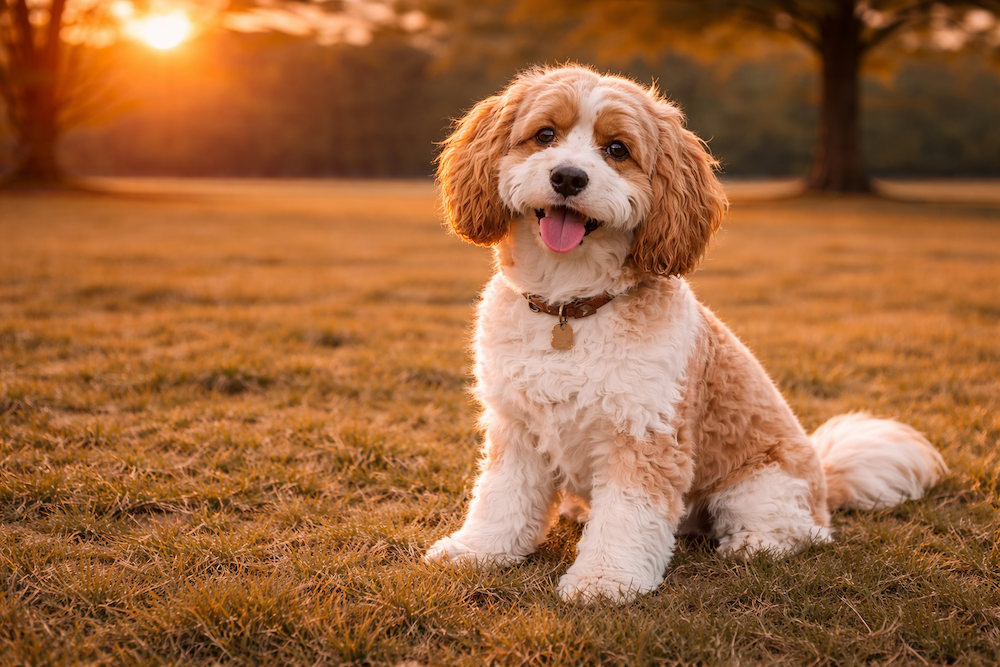





Cute, cuddly, and incredibly loving — the perfect companion for modern families.
🧠 QUICK SNAPSHOT
- Temperament: Affectionate, Friendly, Playful
- Energy Level: Moderate
- Size: Small
- Good with Families: Excellent
- Training Difficulty: Easy
📚 OVERVIEW
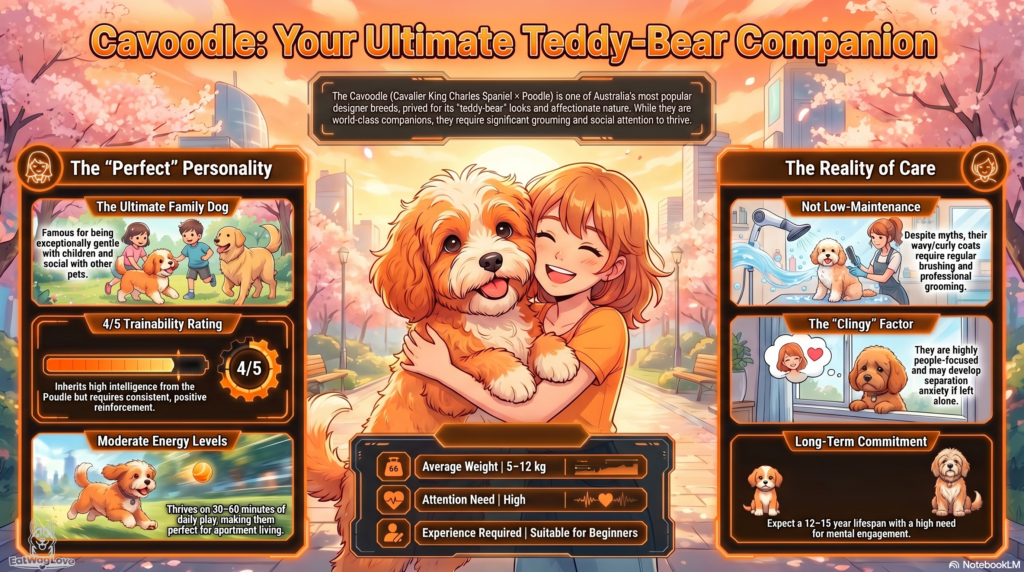
Cavoodles are a cross between the Cavalier King Charles Spaniel and a Poodle. They combine the gentle, loving nature of the Cavalier with the intelligence and low-shedding coat of the Poodle. This makes them one of the most sought-after companion breeds for families and apartment living.
✅ PROS & CONS
Pros
- Extremely affectionate and family-friendly
- Low shedding (often suitable for allergy sufferers)
- Intelligent and easy to train
Cons
- Requires regular grooming
- Can develop separation anxiety
- Needs companionship and attention
Is a Cavoodle a Good Family Dog?
Yes, the Cavoodle can be an excellent family dog, particularly for households wanting a small, affectionate and sociable companion.
A Cavoodle is a cross between a Cavalier King Charles Spaniel and a Poodle, usually a Toy or Miniature Poodle.
Both parent breeds tend to be strongly people-oriented, so Cavoodles often enjoy being involved in everyday family life.
They’re generally good with respectful children, although smaller Cavoodles can be vulnerable to accidental injury during rough play.
How Much Exercise Does a Cavoodle Need?
Most Cavoodles need around 30–60 minutes of exercise each day, together with regular play and mental stimulation.
Exercise requirements vary depending on size, age and which parent the dog most resembles.
Poodle influence can produce a surprisingly energetic and athletic little dog.
Walks, retrieving, scent games, puzzle toys and training sessions can all help keep a Cavoodle occupied.
They may look like cuddly teddy bears, but many have considerably more energy than their appearance suggests.
Is a Cavoodle Easy to Train?
Yes. Cavoodles are generally intelligent and highly trainable.
Poodles are exceptionally capable learners, while Cavaliers tend to be eager to interact with people.
Positive reinforcement using food, toys and praise usually works extremely well.
Early training should include recall, lead walking, calm greetings, independence and toilet training.
Because Cavoodles are clever, they can also become very effective at discovering exactly which behaviours persuade their owners to provide treats.
Does a Cavoodle Shed?
Cavoodles can be low-to-moderate shedders, but shedding isn’t predictable.
A dog inheriting the Poodle’s curly coat may shed relatively little.
A Cavoodle with a straighter Cavalier-style coat may shed considerably more.
Even puppies from the same litter can develop different adult coats.
Anyone purchasing a Cavoodle because they’ve been promised it “doesn’t shed” should understand that crossbreeding cannot guarantee a particular coat.
Is a Cavoodle Hypoallergenic?
No Cavoodle can be guaranteed to be hypoallergenic.
Poodles are low-shedding, but Cavaliers shed normally.
A Cavoodle can inherit coat characteristics from either parent.
More importantly, dog allergies are caused by proteins found in saliva, dander and skin secretions rather than simply hair.
Some allergy sufferers may tolerate an individual Cavoodle better than other dogs, but there is no allergy-proof Cavoodle.
How Often Does a Cavoodle Need Grooming?
Most Cavoodles require brushing several times each week, with curlier or longer coats often needing daily attention.
Professional grooming is commonly required approximately every 6–8 weeks.
Mats frequently develop behind the ears, under the legs, around the collar and anywhere the coat experiences friction.
Low shedding doesn’t mean low maintenance.
In fact, a curly Cavoodle may require considerably more coat care than many dogs that shed heavily.
What Health Problems Are Common in Cavoodles?
Cavoodles can potentially inherit health conditions from both Cavaliers and Poodles.
Cavalier ancestry makes mitral valve disease and Chiari-like malformation/syringomyelia particularly important considerations.
Other potential concerns include patellar luxation, hip problems, eye disease and dental disease. Depending on the Poodle parent, additional inherited conditions can also occur.
Responsible breeders should health-test both parents appropriately rather than relying on the assumption that crossbreeding automatically produces healthy puppies.
How Long Do Cavoodles Live?
Cavoodles commonly live around 12–15 years, and some live longer.
Smaller dogs generally enjoy relatively good longevity.
However, inherited disease can significantly affect both lifespan and quality of life.
Heart health deserves particular attention because of the Cavalier King Charles Spaniel’s predisposition to mitral valve disease.
Maintaining a healthy weight, good dental care and regular veterinary checks can help support a long life.
How Big Does a Cavoodle Get?
Cavoodle size varies considerably because the Poodle parent may be Toy or Miniature.
Adults commonly weigh somewhere around 5–12 kg, although individuals can fall outside this range.
Toy Poodle crosses are generally smaller than those involving Miniature Poodles.
There is no universal Cavoodle breed standard, so advertised labels such as “Toy Cavoodle” shouldn’t replace looking at the actual size of both parents.
What Is a Toy Cavoodle?
A Toy Cavoodle generally refers to a Cavalier King Charles Spaniel crossed with a Toy Poodle, or a later-generation Cavoodle bred towards a smaller size.
However, “Toy Cavoodle” isn’t a universally regulated breed classification.
Two breeders may use the term differently.
Because the Cavalier parent itself isn’t a toy-sized Poodle, even puppies from the same litter can mature at different sizes.
The parents provide a more useful guide than marketing terminology.
Can a Cavoodle Live in an Apartment?
Yes. Cavoodles are generally excellent apartment dogs.
Their small size and adaptable nature make them suitable for relatively compact homes.
They still require daily walks, play and mental stimulation.
Barking and separation-related behaviour can become bigger issues than physical space.
Teaching a Cavoodle to relax independently and ignore routine noises can therefore be especially valuable for apartment living.
Can a Cavoodle Be Left Alone?
Cavoodles generally don’t enjoy being left alone for very long periods.
Both parent breeds tend to form strong relationships with people, and some Cavoodles can develop separation-related distress.
Independence training should begin during puppyhood.
Owners should practise short, comfortable periods apart rather than allowing a puppy to remain beside someone every minute of the day.
A dog can be affectionate without needing to become completely dependent.
Do Cavoodles Bark a Lot?
Cavoodles can be moderately vocal, although individuals vary considerably.
They may bark at visitors, noises, other dogs, excitement or when seeking attention.
Some inherit more alert behaviour from the Poodle side.
Boredom and separation distress can also increase barking.
Early training and sufficient enrichment can usually keep vocal behaviour manageable.
Are Cavoodles Good With Other Dogs?
Yes, Cavoodles are generally sociable with other dogs when properly socialised.
Many enjoy having a canine companion.
Their small size means interactions with very large or rough-playing dogs should be supervised.
Early positive experiences with different types of dogs can help prevent fearfulness.
Individual temperament still matters more than simply being a Cavoodle.
Are Cavoodles Good With Cats?
Yes, Cavoodles can often live very successfully with cats.
Neither parent breed is typically associated with extreme prey drive, although individual dogs may still chase.
Cavaliers retain some spaniel hunting ancestry, while Poodles also originated as working hunting dogs.
Careful introductions and early training are therefore worthwhile.
Many Cavoodles eventually regard household cats as part of the family.
Are Cavoodles Good With Children?
Cavoodles are generally good with respectful children.
They’re playful, affectionate and often enthusiastic participants in family activities.
Smaller Cavoodles can be physically delicate, however.
Young children should be taught not to squeeze, drop or incorrectly pick up the dog.
Supervision is particularly important with puppies.
Do Cavoodles Like to Cuddle?
Many Cavoodles are extremely affectionate and enjoy cuddling.
The Cavalier was developed primarily as a companion and lap dog, while Poodles also form strong bonds with their families.
A Cavoodle may happily follow its owner from room to room before settling beside or on them.
That affectionate nature is one of the cross’s biggest attractions — but it’s also why independence training can be so important.
Do Cavoodles Like Water?
Many Cavoodles enjoy water, particularly those inheriting strong Poodle characteristics.
Poodles were originally developed as water retrievers, despite their modern reputation as glamorous companion dogs.
Some Cavoodles enjoy swimming, retrieving toys from water or paddling.
Others want nothing to do with it.
Dogs should always be introduced gradually and supervised around pools and open water.
Why Does My Cavoodle Have Tear Stains?
Tear staining is relatively common in Cavoodles, especially those with light-coloured facial hair.
Tears contain compounds that can create reddish-brown staining when they remain on the coat.
Excessive tearing can also result from eye irritation, facial anatomy, allergies or problems with tear drainage.
Persistent or suddenly worsening tearing should be assessed by a veterinarian rather than treated simply as a grooming problem.
Why Does a Cavoodle’s Coat Mat So Easily?
Many Cavoodles inherit a combination of soft Cavalier hair and curly or wavy Poodle coat characteristics.
Loose hairs can remain trapped within the coat rather than falling onto the floor.
Friction then causes those hairs to tangle together.
Areas behind the ears, beneath the collar, under the legs and around the chest are particularly vulnerable.
Regular brushing all the way to the skin is therefore essential.
What Colours Can Cavoodles Be?
Cavoodles occur in an enormous range of colours and patterns.
These can include red, apricot, cream, black, chocolate, white, sable, black-and-tan, parti-colour and combinations resembling Cavalier patterns such as Blenheim or tricolour.
Availability depends on the genetics of the parents.
Colour shouldn’t be prioritised over health, temperament and responsible breeding.
Some highly marketed “rare” colours may simply carry a higher price rather than offering anything beneficial to the dog.
Why Do Some Cavoodles Fade in Colour?
Some Cavoodles become considerably lighter as they mature, particularly red and apricot dogs.
Poodles can carry genes that cause coat colour to fade progressively with age.
A rich red puppy may therefore become apricot or creamier as an adult.
Other dogs retain much more of their original colour.
A puppy’s exact shade isn’t necessarily a reliable prediction of its adult appearance.
What Is an F1 Cavoodle?
An F1 Cavoodle is usually a first-generation cross between a Cavalier King Charles Spaniel and a Poodle.
This creates substantial genetic variation.
One puppy may develop a curly, low-shedding coat while a littermate has much straighter hair and sheds more noticeably.
The F1 label describes ancestry.
It doesn’t guarantee size, coat type, temperament or health.
What Is an F1B Cavoodle?
An F1B Cavoodle is usually produced by breeding an F1 Cavoodle back to one of its parent breeds, most commonly a Poodle.
This is often done in an attempt to increase the probability of a curlier, lower-shedding coat.
However, genetics remain variable.
An F1B puppy isn’t automatically non-shedding or hypoallergenic.
Prospective owners should still examine the actual parents and understand the possible outcomes.
What Is an F2 Cavoodle?
An F2 Cavoodle is generally produced by breeding two F1 Cavoodles together.
There are also multigenerational Cavoodles produced through other combinations.
Because the Cavoodle isn’t governed by a single universally accepted breed standard, generation terminology can occasionally be used differently by breeders.
A pedigree showing the actual parentage is more informative than relying solely on labels.
Is a Cavoodle a Recognised Dog Breed?
The Cavoodle is generally considered a crossbreed rather than a formally recognised pedigree breed.
Major kennel clubs don’t recognise it in the same way as the Cavalier King Charles Spaniel or Poodle.
There is therefore no universal standard governing Cavoodle size, coat, colour or appearance.
This explains why two genuine Cavoodles can look surprisingly different.
Is a Cavoodle Healthier Than a Cavalier King Charles Spaniel?
A Cavoodle can gain greater genetic diversity from crossing two different breeds, but that doesn’t automatically make every Cavoodle healthier.
Crossbreeding can reduce the risk of some recessive disorders under certain circumstances.
However, Cavoodles can still inherit serious conditions from either parent.
This is particularly important with Cavaliers because of their high prevalence of mitral valve disease and Chiari-like malformation/syringomyelia.
Health testing remains essential regardless of whether the puppy is purebred or crossbred.
What Is the Difference Between a Cavoodle and a Cavapoo?
There is essentially no inherent breed difference between a Cavoodle and a Cavapoo.
Both names usually describe a cross between a Cavalier King Charles Spaniel and a Poodle.
“Cavoodle” is particularly common in Australia, while “Cavapoo” is widely used in the United Kingdom, United States and elsewhere.
The different names don’t indicate different breeds, generations or sizes.
A Cavoodle in Melbourne and a Cavapoo in London may have exactly the same parentage.
Why Is the Cavoodle So Popular in Australia?
The Cavoodle has become one of Australia’s most popular companion crosses because it combines several traits many households actively seek.
It’s generally small, affectionate, intelligent and adaptable, and some individuals have relatively low-shedding coats.
Its teddy-bear appearance has also contributed enormously to its popularity.
However, high demand has a downside.
Popular crosses can attract irresponsible breeding, so prospective owners should pay particular attention to health testing, puppy socialisation and the welfare of the parent dogs.
Is a Cavoodle a Designer Dog?
Yes. The Cavoodle is commonly described as a designer crossbreed.
The term simply means that two established breeds are deliberately crossed in an attempt to combine particular characteristics.
It doesn’t mean every puppy receives exactly the desired traits from each parent.
Genetic inheritance is much less predictable than designing a product.
A Cavoodle can inherit almost any combination of Cavalier and Poodle characteristics.
Does Hybrid Vigour Mean Cavoodles Don’t Get Genetic Diseases?
No. Hybrid vigour doesn’t make Cavoodles immune to inherited disease.
Greater genetic diversity can provide health benefits at a population level and can reduce the likelihood of some recessive conditions when the parent breeds don’t share the same harmful variants.
But it cannot prevent a puppy inheriting a disease-associated gene present in either parent breed.
Responsible crossbreeding still requires careful health testing, pedigree knowledge and selection for sound physical and behavioural traits.
Where Does the Cavoodle Come From?
The Cavoodle is a modern Cavalier King Charles Spaniel–Poodle cross that became particularly popular in Australia during the rise of deliberately bred Poodle crosses.
Australia is frequently associated with the Cavoodle’s development and especially with the name Cavoodle, although claims that one particular breeder definitively invented the cross should be treated cautiously. Cavalier–Poodle crosses may have occurred before they were marketed under a consistent name.
Internationally, the same cross became better known as the Cavapoo.
Today, the Cavoodle is one of Australia’s most recognisable companion dogs — a cross so popular that many Australians probably don’t realise much of the rest of the world knows essentially the same dog by a different name.