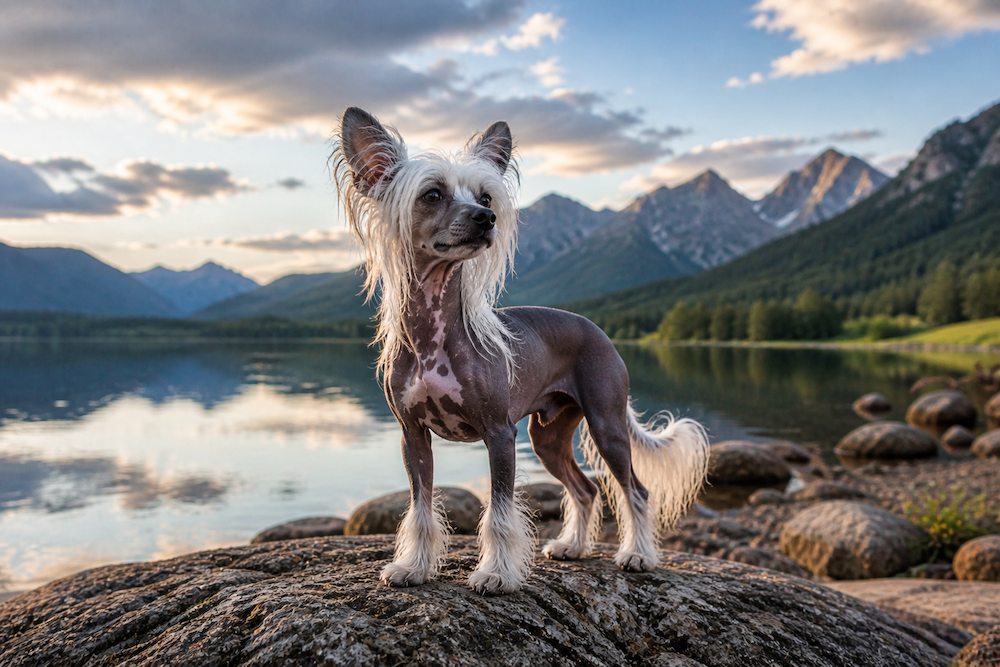







Unique, affectionate, and full of personality — a small companion that thrives on attention and closeness.
🧠 QUICK SNAPSHOT
- Temperament: Affectionate, lively, alert
- Energy Level: Low to moderate
- Size: Small
- Good With Families: Yes
- Trainability: Moderate
- Grooming: Moderate (varies by type)
- Best For: Companionship, indoor living
📚 OVERVIEW
The Chinese Crested is a distinctive toy breed that comes in two varieties — Hairless and Powderpuff. Known for their unique appearance, they are highly affectionate dogs that form strong bonds with their owners.
They love attention and are happiest when close to their family, often following their owners from room to room.
✅ PROS & CONS
Pros
- Very affectionate and loyal
- Unique and eye-catching appearance
- Great for indoor living
- Low shedding (Hairless variety)
Cons
- Sensitive to temperature (especially Hairless)
- Needs skin care or coat maintenance
- Can be clingy
- Not suited to being left alone often
Is a Chinese Crested a Good Family Dog?
Yes, the Chinese Crested can be an excellent family companion, particularly for households wanting an affectionate, people-oriented small dog.
They tend to bond very closely with their owners and often enjoy cuddling, playing and following family members around the home.
They can live happily with respectful children, although their relatively fine build means rough handling should be avoided.
Despite their unusual appearance, they’re generally much more interested in being companions than acting like tiny guard dogs.
How Much Exercise Does a Chinese Crested Need?
Most Chinese Cresteds need around 30–45 minutes of exercise each day, along with play and mental stimulation.
They’re lively and athletic but don’t require enormous amounts of physical activity.
Daily walks, indoor games, training and short bursts of energetic play are usually sufficient.
Some Cresteds are surprisingly good at climbing and jumping.
Their lack of heavy coat means Hairless dogs require protection during extreme heat, cold and strong sun.
Is a Chinese Crested Easy to Train?
Chinese Cresteds are intelligent and capable learners, particularly when training is positive and rewarding.
They can be sensitive dogs and generally respond poorly to harsh handling.
Short sessions involving treats, praise and games tend to work well.
Some individuals can be challenging to toilet train, particularly in cold or wet weather when a nearly naked dog may decide that going outdoors is an unreasonable request.
Consistency is important.
Does a Chinese Crested Shed?
It depends on the variety.
The Hairless Chinese Crested sheds very little body hair because most of its body is naturally hairless.
The Powderpuff Chinese Crested has a full, soft double coat and can shed some hair, although often less noticeably than many heavily shedding breeds.
Neither variety should be considered completely maintenance-free.
Hairless dogs require skin care, while Powderpuffs require regular coat grooming.
Is a Chinese Crested Hypoallergenic?
The Chinese Crested is sometimes promoted as hypoallergenic, particularly the Hairless variety, but no dog is completely allergy-free.
Dog allergens come from saliva, skin secretions and dander rather than simply hair.
Having less body hair may reduce the amount of loose hair carrying allergens around a home, but allergic reactions can still occur.
Anyone with significant allergies should spend time with adult Chinese Cresteds before deciding whether the breed is suitable.
What Health Problems Are Common in Chinese Cresteds?
Chinese Cresteds can be affected by several inherited health conditions.
Potential concerns include patellar luxation, progressive retinal atrophy and other eye diseases, Legg-Calvé-Perthes disease and dental abnormalities.
Hairless dogs are particularly associated with missing or abnormally shaped teeth because of the genetics linked to hairlessness.
Responsible breeders should undertake appropriate eye, patella and genetic health screening.
Skin health also requires attention in Hairless dogs.
How Long Do Chinese Cresteds Live?
Chinese Cresteds are generally long-lived dogs, commonly reaching around 13–18 years.
Some remain lively well into their senior years.
Their small size contributes to their longevity, although genetics, dental care, body condition and preventive veterinary treatment remain important.
Regular dental attention is particularly valuable because dental abnormalities and tooth loss can be more common in Hairless Cresteds.
How Big Does a Chinese Crested Get?
The Chinese Crested is a small, fine-boned dog, generally standing around 23–33 cm at the shoulder.
Adults commonly weigh approximately 3–6 kg, although breed standards generally place greater emphasis on overall proportion than a strict weight.
They’re elegant and relatively light rather than heavily built.
Despite their delicate appearance, many are surprisingly athletic.
Can a Chinese Crested Live in an Apartment?
Yes. Chinese Cresteds are excellent apartment dogs.
They’re small, adaptable and don’t require huge amounts of exercise.
Their strong attachment to people can actually make indoor family life particularly suitable.
Barking and separation-related behaviour should still be addressed through training.
Hairless Cresteds are also poorly suited to living outdoors because they have very limited protection against temperature extremes.
Can a Chinese Crested Be Left Alone?
Chinese Cresteds generally prefer not to spend long periods alone.
They’re strongly companion-oriented and can become extremely attached to their owners.
Some individuals develop separation-related distress.
Gradual independence training from puppyhood is useful.
This is a breed that frequently wants to be physically close to its favourite person, sometimes to the point of attempting to become part of whatever clothing or blanket that person happens to be using.
Do Chinese Cresteds Bark a Lot?
Chinese Cresteds can be alert and moderately vocal.
They may bark when someone approaches, when excited or when they hear unusual noises.
Some individuals become nuisance barkers if bored or anxious.
Early training can help establish appropriate behaviour.
They’re small dogs with excellent awareness of their surroundings, so expecting complete silence isn’t realistic.
Are Chinese Cresteds Good With Other Dogs?
Yes, Chinese Cresteds are generally good with other dogs when properly socialised.
Many enjoy having another canine companion.
Because they’re relatively small and lightly built, interactions with large, rough-playing dogs should be supervised.
Early positive socialisation can help prevent shyness or nervousness around unfamiliar dogs.
Are Chinese Cresteds Good With Cats?
Chinese Cresteds can usually live very successfully with cats.
They’re primarily companion dogs and aren’t generally known for extreme prey drive.
Individual personalities still vary, and some may chase cats during play.
Slow introductions and early socialisation usually provide the best results.
Their small size also means a confident household cat may be perfectly capable of establishing the rules.
Why Is a Chinese Crested Hairless?
Hairlessness in the Chinese Crested is caused by a dominant genetic variant affecting ectodermal development.
The same genetic mechanism influences both hair and teeth.
This explains why Hairless Cresteds often have missing, unusually shaped or reduced teeth.
The hairless gene is inherited in a particularly interesting way because inheriting two copies is believed to be embryonically lethal.
This has an important consequence: Hairless Chinese Cresteds cannot breed completely true for hairlessness.
Why Are Powderpuff Puppies Born to Hairless Chinese Cresteds?
Because the Hairless Chinese Crested carries one copy of the hairless variant and one copy associated with normal coat development.
When two Hairless Cresteds are bred together, some viable puppies inherit no hairless variant and are therefore born fully coated.
These are Powderpuffs.
Other viable puppies inherit one copy and are Hairless.
The theoretical embryos inheriting two copies of the hairless variant don’t survive development.
So the Powderpuff isn’t an accidental or inferior Chinese Crested — it’s genetically essential to the breed.
Is the Powderpuff Chinese Crested the Same Breed as the Hairless?
Yes. The Hairless and Powderpuff are two coat varieties of the same Chinese Crested breed.
Hairless dogs usually have hair on the head, feet and tail while most of the body remains bare.
Powderpuffs have a full coat covering the entire body.
Both varieties can occur within the same litter.
A Powderpuff isn’t a crossbreed or a “failed” Hairless dog.
Can Two Powderpuff Chinese Cresteds Produce a Hairless Puppy?
No. Two true Powderpuff Chinese Cresteds shouldn’t produce Hairless puppies.
Powderpuffs don’t carry the dominant hairless variant.
Because the gene is dominant, a dog carrying it displays the Hairless phenotype.
Therefore, at least one parent must be Hairless for Hairless puppies to be produced.
This is quite different from many coat traits that can remain hidden for generations as recessive genes.
Why Does a Hairless Chinese Crested Still Have Hair on Its Head, Feet and Tail?
The Hairless Chinese Crested isn’t usually completely hairless.
The breed characteristically retains a crest of hair on the head, feathering or “socks” on the feet and a plume on the tail.
The amount of body hair can vary between individuals.
Some Hairless Cresteds have very little additional hair, while others can be considerably hairier and may require grooming or clipping to achieve the classic appearance.
What Is a “Hairy Hairless” Chinese Crested?
A hairy Hairless is an informal term for a genetically Hairless Chinese Crested that grows more body hair than the classic show appearance suggests.
Hairlessness varies considerably.
Some genetically Hairless dogs may develop hair over substantial areas of the body.
Owners or exhibitors may remove this extra hair through grooming to create the familiar smooth-skinned appearance.
So photographs of perfectly naked show dogs don’t necessarily reveal exactly how the dog would look without grooming.
Do Hairless Chinese Cresteds Need Sunscreen?
Hairless Chinese Cresteds can be vulnerable to sunburn because much of their skin lacks protective fur.
Strong sun exposure should therefore be managed carefully.
Shade, protective clothing and suitable dog-safe sun protection may be useful when necessary.
Owners should discuss appropriate products with their veterinarian because some human sunscreens contain ingredients unsuitable for dogs.
Avoiding intense midday sun is often the simplest protection.
Do Chinese Cresteds Get Acne?
Yes. Hairless Chinese Cresteds can develop blackheads, clogged follicles and acne-like skin problems.
Their exposed skin requires appropriate care, but excessive bathing, scrubbing or moisturising can sometimes make problems worse.
Not every bump is simply cosmetic acne.
Persistent redness, pustules, itching or infection should be examined by a veterinarian.
The Hairless Crested’s skin may look human-like, but it shouldn’t automatically be treated using a human skincare routine.
Do Chinese Cresteds Get Cold Easily?
Hairless Chinese Cresteds can become cold very easily.
Without a normal insulating coat, they lose heat much more readily than fully coated dogs.
Warm bedding and appropriately fitted clothing can be useful in cool conditions.
Powderpuffs are considerably better insulated because of their full coats.
A Hairless Crested enthusiastically burrowing beneath blankets is therefore doing something extremely sensible rather than merely being spoiled.
Why Do Hairless Chinese Cresteds Have Missing Teeth?
The gene responsible for hairlessness also affects tooth development.
Hairless Cresteds commonly have missing teeth or teeth that are unusually shaped, particularly the canine and premolar teeth.
Powderpuffs generally have more conventional dentition because they don’t carry the hairless variant.
This connection between hair and teeth is a fascinating example of one gene influencing several apparently unrelated physical characteristics.
Does a Powderpuff Chinese Crested Need a Lot of Grooming?
Yes. Powderpuff Chinese Cresteds require regular and fairly intensive grooming.
Their long, soft coats can mat easily.
Brushing several times each week — and often daily for longer coats — helps prevent tangles.
Bathing and professional grooming may also be necessary.
The Powderpuff doesn’t require the specialised skin care of a Hairless Crested, but the trade-off is substantially more coat maintenance.
What Colours Can Chinese Cresteds Be?
Chinese Cresteds occur in a very wide variety of colours and colour combinations.
Hairless dogs can have skin ranging through pale, pinkish, grey, brown, black and mottled shades, combined with differently coloured furnishings.
Powderpuffs can also occur in numerous coat colours and patterns.
Skin pigmentation can become darker after sun exposure, making some Hairless dogs appear to change colour seasonally.
Are Chinese Cresteds Actually From China?
This is less certain than the breed’s name suggests.
Hairless dogs have existed in several parts of the world, and the deeper ancestry of the Chinese Crested remains debated.
One traditional theory suggests Chinese sailors kept small hairless dogs aboard ships to control vermin and traded them at ports around the world.
However, modern genetic research has complicated simple stories about the breed originating entirely in China.
The modern breed’s history involves international hairless-dog populations and later organised breeding.
Were Chinese Cresteds Really Used on Chinese Ships?
A popular breed story claims Chinese sailors kept hairless dogs aboard trading ships as ratters and companions.
The dogs were supposedly useful for controlling vermin and were traded between ports.
This story is repeated widely, but detailed historical documentation is limited.
It is therefore better treated as part of the breed’s traditional history rather than as a completely proven account.
The breed’s true development appears more complicated than one neat maritime origin story.
Is the Chinese Crested Related to the Xoloitzcuintli?
Chinese Cresteds and the Mexican Xoloitzcuintli share a fascinating biological connection because their hairlessness involves the same general FOXI3-related ectodermal dysplasia pathway found in several hairless dog populations.
However, this doesn’t mean the Chinese Crested is simply a miniature Xolo.
Their modern breed histories and appearances are distinct.
Research into hairless dogs has revealed that the genetics and historical movement of these dogs are considerably more complex than traditional breed legends suggested.
Is the Chinese Crested Related to the African Hairless Dog?
Older histories frequently suggested that Chinese Cresteds descended from large African hairless dogs, which were supposedly reduced in size by Chinese breeders.
The evidence for such a simple origin is limited.
Historical references to African hairless dogs undoubtedly exist, but tracing them directly into today’s Chinese Crested population is difficult.
Modern genetic evidence has made the breed’s ancestry more interesting — but also less tidy — than the traditional story.
Why Is It Called a Chinese “Crested” Dog?
The word “Crested” refers to the distinctive crest of hair growing on the Hairless variety’s head.
Hair is also normally present on the feet and tail.
“Chinese” reflects the breed’s traditional historical association with China, although its precise geographical ancestry remains debated.
The name therefore describes both its characteristic appearance and the historical origin once attributed to it.
What Is the Difference Between a Chinese Crested and a Xoloitzcuintli?
Both breeds can be hairless, but they’re distinct breeds with very different histories and body types.
The Xoloitzcuintli comes from Mexico and occurs in several sizes. It typically has a more substantial, primitive-looking body and can be completely or almost completely hairless.
The Chinese Crested is smaller and finer-boned, with its characteristic head crest, foot furnishings and plumed tail.
Both breeds also have coated varieties.
Have Chinese Cresteds Won the World’s Ugliest Dog Contest?
Yes. Chinese Cresteds — particularly Hairless individuals and Chinese Crested crosses — have become famously associated with the World’s Ugliest Dog Contest in California.
One of the best-known winners was Sam, a Hairless Chinese Crested who won the title several times and became an international media celebrity.
The contest is intentionally light-hearted and often celebrates unusual-looking rescue and companion dogs.
Ironically, the same unconventional appearance considered “ugly” by the competition is exactly what many Chinese Crested enthusiasts find irresistible.
Who Was Sam the Chinese Crested?
Sam was a Hairless Chinese Crested who became famous as one of the world’s most unusual-looking dogs.
He won the World’s Ugliest Dog Contest multiple times during the early 2000s.
His nearly hairless dark skin, sparse hair, unusual teeth and distinctive face made him instantly recognisable.
Sam became an international media sensation before dying in 2005 at around 14 years old.
Few dogs have demonstrated quite so effectively that being conventionally beautiful isn’t necessary for becoming famous.
Where Does the Chinese Crested Come From?
The precise ancient origin of the Chinese Crested is surprisingly uncertain.
The breed has long been associated with China and traditional stories describe small hairless dogs travelling aboard Chinese trading vessels. However, hairless dogs existed in several parts of the world, and modern genetic research makes a simple exclusively Chinese origin difficult to establish.
The modern Chinese Crested was ultimately developed through organised breeding using surviving hairless and Powderpuff dogs, particularly during the 20th century.
That uncertainty actually makes the breed more interesting: beneath one of the dog world’s strangest hairstyles is an international genetic mystery that researchers are still helping to unravel.