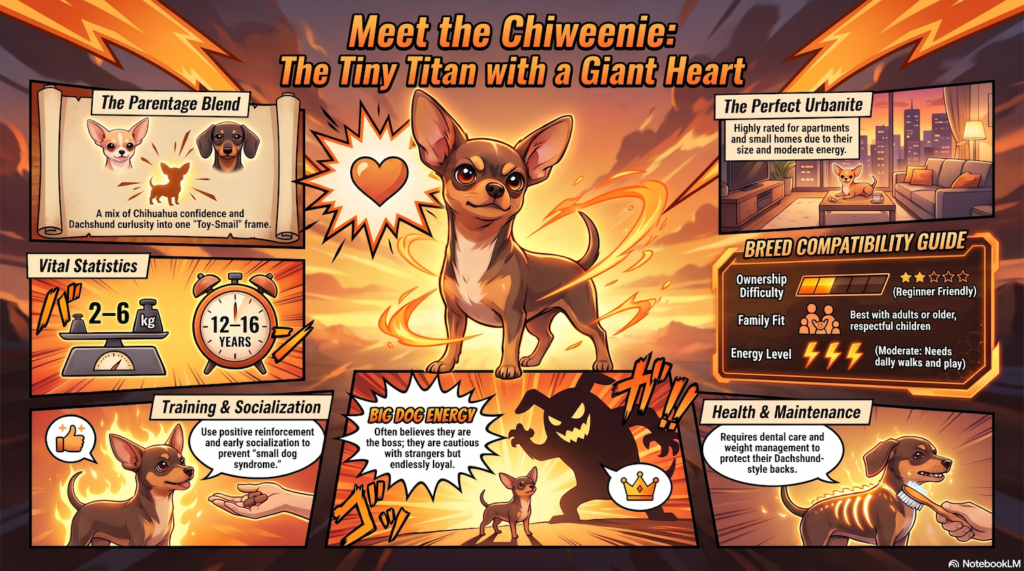
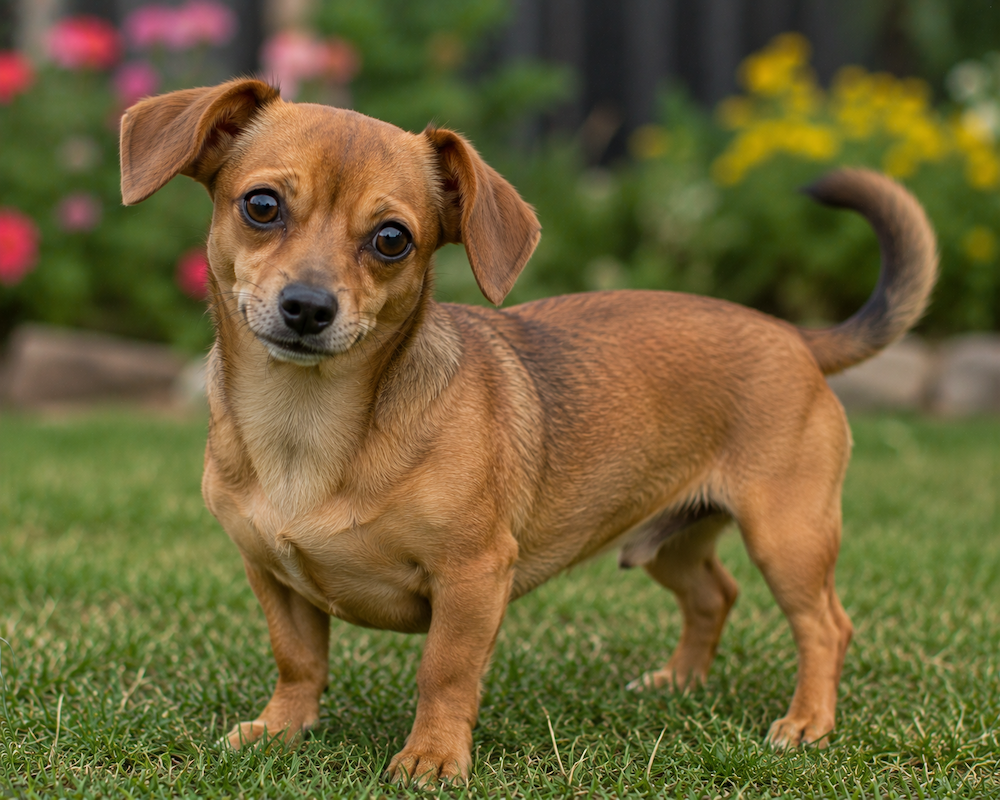







Tiny, spirited, and full of personality — a loyal companion that combines the confidence of the Chihuahua with the determination of the Dachshund.
🧠 QUICK SNAPSHOT
- Temperament: Affectionate, alert, confident
- Energy Level: Moderate
- Size: Small
- Good With Families: Yes
- Trainability: Moderate
- Grooming: Low
- Best For: Apartments, companionship, families with older children
📚 OVERVIEW
The Chiweenie is a cross between a Chihuahua and a Dachshund, creating a small dog with an enormous personality. These lively companions are known for their loyalty, playful nature, and strong attachment to their owners.
Despite their compact size, Chiweenies are confident and fearless. They enjoy being involved in family life and are equally happy curling up on the couch or exploring the neighbourhood on a walk.
✅ PROS & CONS
Pros
- Loving and devoted companion
- Compact size suits apartment living
- Low grooming requirements
- Alert and excellent little watchdog
Cons
- Can be stubborn during training
- May bark frequently at unfamiliar people or noises
- Can develop separation anxiety
- May inherit back problems from the Dachshund parent
Is a Chiweenie a Good Family Dog?
Yes, a Chiweenie can be an excellent family companion, particularly for households wanting a small, affectionate dog with plenty of personality.
A Chiweenie is a cross between a Chihuahua and Dachshund. Both parent breeds tend to form strong bonds with their owners, so Chiweenies are often extremely devoted to their families.
They can live happily with older, respectful children.
Very young children require supervision because Chiweenies can be physically vulnerable to rough handling, particularly if they inherit the Dachshund’s long-backed body shape.
How Much Exercise Does a Chiweenie Need?
Most Chiweenies need around 30–60 minutes of daily exercise, depending on their size, age and body structure.
Walks, scent games, training and indoor play are excellent options.
Dachshund influence can produce a surprisingly energetic little dog, while Chihuahua ancestry contributes plenty of alertness and enthusiasm.
Dogs with particularly long backs and short legs should avoid excessive jumping and repeated high-impact activities.
Small doesn’t necessarily mean sedentary.
Is a Chiweenie Easy to Train?
Chiweenies are intelligent but can be independent and stubborn.
Both Chihuahuas and Dachshunds are capable learners with definite personalities.
Positive reinforcement and short, interesting training sessions generally work best.
Toilet training can sometimes require patience.
Owners should also resist allowing unwanted behaviour simply because the dog is tiny. A barking, possessive or poorly socialised Chiweenie needs training just as much as a larger dog.
Does a Chiweenie Shed?
Yes. Most Chiweenies shed at least somewhat, although the amount varies considerably.
Chihuahuas occur in Smooth and Long Coat varieties, while Dachshunds can be Smooth, Longhaired or Wirehaired.
A Chiweenie’s coat can therefore range from very short and sleek to considerably longer.
Short-coated individuals are relatively easy to groom but can still leave surprising quantities of tiny hairs around the home.
Is a Chiweenie Hypoallergenic?
No. Chiweenies aren’t considered hypoallergenic.
Both parent breeds produce allergens through saliva, dander and skin secretions.
The amount of visible shedding doesn’t determine whether a dog will trigger an allergic reaction.
Anyone with significant dog allergies should spend time with the individual dog before bringing one home.
What Health Problems Are Common in Chiweenies?
Chiweenies can potentially inherit health conditions from both Chihuahuas and Dachshunds.
One particularly important concern is intervertebral disc disease (IVDD) if the dog inherits the Dachshund’s long-backed, short-legged structure.
Other potential issues include patellar luxation, dental disease, heart problems, tracheal collapse and eye conditions.
Maintaining a healthy body weight is especially important because excess weight places additional stress on the spine and joints.
Are Chiweenies Prone to Back Problems?
Some Chiweenies can be at increased risk of spinal problems, including IVDD, particularly if they inherit a strongly Dachshund-like body.
Dachshunds have chondrodystrophic genetics that contribute to both short legs and premature degeneration of the intervertebral discs.
A Chiweenie doesn’t automatically inherit the same degree of risk, but crossbreeding doesn’t guarantee protection.
Keeping the dog lean and limiting repeated high-impact jumping is sensible, especially in long-backed individuals.
How Long Do Chiweenies Live?
Chiweenies commonly live around 12–16 years, and some may live longer.
Both Chihuahuas and Dachshunds can be relatively long-lived breeds.
Individual longevity depends on genetics, body structure, weight, dental health and veterinary care.
Because small dogs often live well into their teens, choosing a Chiweenie means potentially making a very long-term commitment.
How Big Does a Chiweenie Get?
Most Chiweenies are small dogs, commonly weighing around 3–9 kg.
Size varies considerably because Chihuahuas are extremely small while Dachshunds themselves occur in different sizes.
The dog’s proportions can also vary dramatically.
Some resemble slightly elongated Chihuahuas, while others look almost like miniature Dachshunds with Chihuahua features.
There is no universal Chiweenie breed standard.
Can a Chiweenie Live in an Apartment?
Yes. Chiweenies can be excellent apartment dogs from a space perspective.
They’re small and can receive substantial exercise through walks and indoor play.
Barking can be the bigger challenge.
Both Chihuahuas and Dachshunds are naturally alert dogs, so their offspring may enthusiastically announce neighbours, footsteps, doors and anything else they consider suspicious.
Early training is especially valuable in apartments.
Can a Chiweenie Be Left Alone?
Chiweenies can learn to spend reasonable periods alone, but many become strongly attached to their owners.
Chihuahua ancestry can contribute intense one-person bonding, while Dachshunds also tend to enjoy close contact with their families.
Gradual independence training is important.
Boredom or separation distress may lead to barking, chewing or destructive behaviour.
Do Chiweenies Bark a Lot?
Chiweenies can be very vocal.
This isn’t particularly surprising considering both parent breeds are famous for being alert.
Dachshunds were bred to locate quarry and communicate with hunters, while Chihuahuas often make enthusiastic little watchdogs.
Training can reduce excessive barking, but a completely silent Chiweenie shouldn’t necessarily be expected.
They may be small enough to fit under one arm, but their alarm system frequently seems designed for a much larger building.
Are Chiweenies Good With Children?
Chiweenies can be good with respectful older children.
Their small size means rough play can easily cause injury.
Dogs inheriting a particularly long Dachshund-like spine require additional care when being picked up or handled.
Children should learn to support both the chest and hindquarters rather than allowing the dog’s back to hang unsupported.
Supervision is important with young children.
Are Chiweenies Good With Other Dogs?
Chiweenies can be very good with other dogs when properly socialised.
Many enjoy having another small dog as a companion.
Some can be surprisingly bold around much larger dogs.
That confidence shouldn’t be mistaken for physical invulnerability.
Careful supervision around unfamiliar large dogs is sensible because even playful interactions can injure a tiny Chiweenie.
Are Chiweenies Good With Cats?
Chiweenies can live successfully with cats, particularly when raised alongside them.
However, Dachshunds were hunting dogs developed to pursue animals underground, so some Chiweenies may inherit noticeable prey drive.
Chihuahua influence can also contribute chasing behaviour.
A familiar household cat may be accepted completely while unfamiliar outdoor animals trigger a very different reaction.
Do Chiweenies Like to Cuddle?
Many Chiweenies are extremely affectionate and enjoy cuddling.
Chihuahuas are famous for forming close attachments to their favourite people, while Dachshunds are often equally devoted.
A Chiweenie may spend one moment racing around the house and the next attempting to burrow beneath a blanket beside its owner.
They’re often excellent companions for people who genuinely want a dog involved in everyday life.
Why Do Chiweenies Burrow Under Blankets?
Burrowing comes naturally to both sides of the Chiweenie’s family tree.
Chihuahuas frequently seek blankets for warmth because their tiny bodies lose heat quickly.
Dachshunds were bred to enter underground dens and tunnels while hunting animals such as badgers.
Combining those tendencies can produce a dog with an almost professional interest in disappearing beneath bedding.
Always check before sitting on a suspiciously lumpy blanket.
Do Chiweenies Get Cold Easily?
Many Chiweenies feel the cold quite easily, particularly short-coated individuals.
Chihuahuas have very small bodies that lose heat quickly, while Smooth Dachshunds also have relatively little insulation.
Warm bedding and appropriately fitted coats can be useful during cold weather.
Longer-coated Chiweenies may tolerate cooler conditions somewhat better.
Do Chiweenies Like to Dig?
Many Chiweenies love digging, particularly those inheriting strong Dachshund instincts.
Dachshunds were specifically developed to pursue quarry underground.
Scratching, digging and investigating holes therefore have deep working roots.
A designated digging area can provide an acceptable outlet.
Without one, a determined Chiweenie may conclude that your garden already constitutes an excellent excavation site.
Does a Chiweenie Have a Strong Prey Drive?
Some Chiweenies can have a surprisingly strong prey drive.
Dachshunds are genuine hunting dogs despite their small size and comical proportions.
Movement from rodents, birds or other small animals may trigger pursuit.
The degree varies enormously between individuals.
Recall training and secure fencing are particularly important for dogs showing strong hunting behaviour.
Can a Chiweenie Be Trusted Off Lead?
Caution is advisable when allowing a Chiweenie off lead in unsecured areas.
Dachshund ancestry can contribute strong scent-following and hunting instincts, while both parent breeds can be independent.
A normally responsive dog may suddenly become much less interested in its owner when an exciting smell or small animal appears.
Secure areas provide the safest opportunities for unrestricted running.
What Does a Chiweenie Look Like?
There is no single Chiweenie appearance.
Some have the elongated body and short legs of a Dachshund combined with a Chihuahua-like head and large ears.
Others have more balanced proportions and look primarily like oversized Chihuahuas.
Ears can stand upright, fold down or do something somewhere between the two.
Crossbreed genetics can produce substantial variation, even among puppies in the same litter.
Can a Chiweenie Have Long Hair?
Yes. A Chiweenie can have short, medium or relatively long hair, depending on the parents.
Long Coat Chihuahuas and Longhaired Dachshunds can both contribute genes for longer coats.
Wirehaired Dachshund ancestry can produce still more variation.
Anyone wanting a specific adult coat should remember that puppy appearance isn’t always a perfect predictor of how the mature dog will look.
What Colours Can Chiweenies Be?
Chiweenies can occur in a huge variety of colours and patterns because both parent breeds have extensive colour variation.
Possible colours include black, chocolate, cream, red, fawn and combinations involving tan or white markings.
Dapple or merle-type patterning can also occur through Dachshund ancestry.
Colour should always be secondary to health and temperament.
Can a Chiweenie Be Dapple?
Yes. A Chiweenie can inherit the dapple pattern from a Dachshund parent.
Dapple is produced by the merle gene and creates irregular lighter patches within the coat.
Responsible breeding is essential because mating two merle/dapple dogs can produce double-merle puppies with a substantially increased risk of serious hearing and eye abnormalities.
An unusual coat pattern should never be prioritised over safe breeding.
What Is an F1 Chiweenie?
An F1 Chiweenie is generally a first-generation cross between a Chihuahua and a Dachshund.
Because these breeds differ significantly in body shape, size and coat, their puppies can be particularly variable.
One may strongly resemble a Dachshund while another takes after the Chihuahua.
“F1” describes ancestry — it doesn’t guarantee a particular appearance, temperament or health outcome.
Is a Chiweenie a Recognised Dog Breed?
The Chiweenie is generally considered a designer crossbreed rather than a formally recognised pedigree breed.
Major kennel clubs don’t recognise it in the same way as the Chihuahua or Dachshund.
There is therefore no universal standard defining its size, proportions, coat or temperament.
This variation is an important part of understanding the cross.
Is a Chiweenie Healthier Than a Dachshund or Chihuahua?
A Chiweenie can benefit from greater genetic diversity, but crossbreeding doesn’t automatically create a healthier dog.
Puppies can still inherit disease-associated genes and physical characteristics from either parent.
This is particularly relevant to Dachshund-related spinal disease and Chihuahua-related dental, knee, heart and airway concerns.
Responsible health testing of both parents remains important.
“Hybrid vigour” isn’t a substitute for good breeding.
Is a Chiweenie the Same as a Choxie?
Usually, yes. Chiweenie and Choxie are names sometimes used for the same Chihuahua–Dachshund cross.
Chiweenie has become the much more widely recognised term.
Other informal names occasionally appear because designer crosses aren’t governed by standardised kennel-club naming systems.
Whatever the label, prospective owners should confirm the actual parent breeds rather than relying solely on a fashionable name.
Why Is It Called a Chiweenie?
The name Chiweenie combines parts of Chihuahua and Dachshund, with the ending influenced by the common nickname “wiener dog” for the Dachshund.
It’s a deliberately playful name typical of many modern designer crosses.
The dog itself is just as unusual as the name suggests: one parent is the world’s famously tiny Mexican companion, while the other was developed in Germany to hunt badgers underground.
Where Does the Chiweenie Come From?
The Chiweenie is a modern Chihuahua–Dachshund cross, particularly associated with the designer-dog movement in the United States.
Intentional breeding became increasingly visible during the late 20th and early 21st centuries, although accidental Chihuahua–Dachshund crosses undoubtedly existed much earlier.
There is no well-documented single inventor or exact date when the first Chiweenie was created.
Its two parent breeds couldn’t have more different historical résumés — an ancient Mexican companion crossed with a German badger-hunting dog — which helps explain why such a tiny dog can combine serious cuddling ability with an equally serious desire to investigate every hole in the garden.